 Arabic Grammar
You opened an Arabic book. You recognized a few letters. Then the words blurred together and you closed it. This is exactly where most beginners get stuck — not because Arabic is impossible, but because they were never given a clear daily plan that tells them precisely what to practice and in what order.
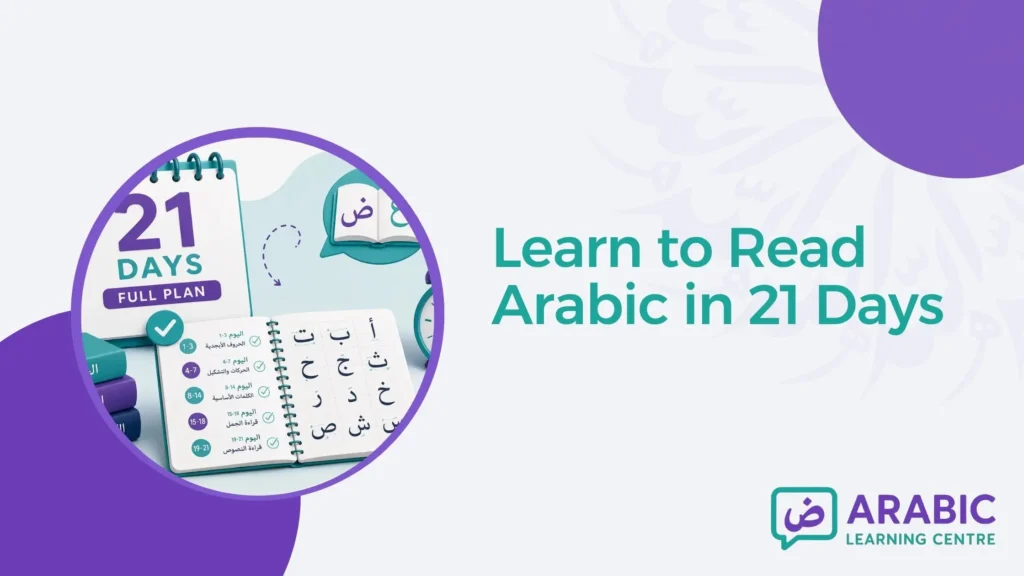
The learn to read Arabic in 21 days approach solves this. It breaks the entire reading journey into three structured weeks: one week for the alphabet, one week for connecting letters and vowels, and one final week for reading real words and short texts. Each day builds directly on the previous one. Nothing is skipped. This guide walks you through every step of that plan, with practical tools, tables, and daily targets you can follow immediately.
1- Setting a Daily Reading Goal Builds Your 21-Day Foundation
Every learner who successfully completes the learn to read Arabic in 21 days plan starts the same way: with a clear, measurable daily target. Without a target, daily study becomes unfocused and progress becomes invisible.
The 21-day journey divides naturally into three phases:
| Phase | Days | Focus | Daily Target |
| Phase 1 | Days 1–7 | Arabic alphabet and letter forms | 4 letters per day |
| Phase 2 | Days 8–14 | Letter connection, vowels, and short words | 20 new words per day |
| Phase 3 | Days 15–21 | Reading short texts and sentences | 1 short passage per day |
Setting your daily target before you open any resource is what separates learners who finish from those who abandon after Week 1. Each session should not exceed 45 minutes — consistency matters more than duration at this stage.
The three non-negotiable daily habits for every phase are:
- Review the previous day’s material for 10 minutes before starting anything new.
- Practice writing what you read, because motor memory reinforces letter recognition faster than visual review alone.
- Read aloud throughout every session, since Arabic is a phonetic language and silent study significantly slows reading acquisition.
If you are learning online with no access to a teacher, set a self-assessment checkpoint at the end of each phase. You must be able to recognize all 28 letters in isolation before moving to Phase 2, and all connected letter forms before moving to Phase 3.
At The Arabic Learning Centre, the Arabic Classes for Non-Arabic Speakers gives complete beginners exactly this kind of structured daily progression, with a certified Arabic tutor tracking your targets from Day 1.
Start your structured plan today.
2- Mastering the Arabic Alphabet in the First Seven Days
The Arabic alphabet contains 28 letters. Each letter changes shape depending on whether it appears at the beginning, middle, or end of a word — or in isolation. This is the first real challenge of the learn to read Arabic in 21 days plan, and it must be solved completely before Week 2 begins.
Distribute the 28 letters across 7 days at 4 letters per day:
| Day | Letters |
| Day 1 | أ، ب، ت، ث |
| Day 2 | ج، ح، خ، د |
| Day 3 | ذ، ر، ز، س |
| Day 4 | ش، ص، ض، ط |
| Day 5 | ظ، ع، غ، ف |
| Day 6 | ق، ك، ل، م |
| Day 7 | ن، هـ، و، ي |
For each letter learned, practice these three actions in sequence:
- Write the letter 10 times in all four positional forms: isolated, initial, medial, and final.
- Pronounce the letter’s sound aloud while writing — the combination of sound and movement builds recognition speed significantly faster than visual drilling alone.
- Find each letter inside a simple Arabic word and circle it, so that letter recognition begins in context from Day 1.
Day 7 must end with a self-test: cover all letter names and read each shape aloud without prompting. Any letter you hesitate on returns to your daily review list for Week 2.
Inside Our Classrooms
See how we make learning interactive and engaging! Watch a quick snippet of our live, conversational classes in action:
3- Connecting Arabic Letters Unlocks Every Word You Will Read
Knowing 28 letters in isolation does not mean you can read Arabic. Arabic letters connect to form words, and the way they connect changes their shape. This is the step that defeats most self-taught beginners — and it is entirely solvable with the right approach.
Six letters in Arabic never connect to the letter that follows them. These are called non-connecting letters:
| Letter | Name | Example Word | Reading |
| ا | Alif | باب | baab (door) |
| د | Dal | درس | dars (lesson) |
| ذ | Dhal | ذهب | dhahab (gold) |
| ر | Ra | رجل | rajul (man) |
| ز | Zay | زهر | zahr (flower) |
| و | Waw | ورد | ward (rose) |
Memorize these six letters as a group before attempting any connected reading. When you encounter one of them inside a word, you know the connection breaks there.
For all remaining letters, practice these connection steps:
- Take any letter from Week 1 and write it in its initial form connected to a second letter in its medial form.
- Add a third letter in its final form and read the three-letter cluster aloud.
- Use only the 28 letters you already know — never introduce unfamiliar material during connection practice.
At The Arabic Learning Centre, the Arabic Script Writing Course trains learners specifically in letter connection, positional forms, and directional flow — the exact skills this phase demands.
Read Also: Is It Compulsory to Read the Quran in Arabic?
Build accurate reading from the ground up.
4- Reading Arabic Short Vowels Before Attempting Full Words
Arabic text written for beginners includes harakat — the small symbols placed above and below letters that tell you how to pronounce each syllable. Without understanding harakat, you cannot read Arabic aloud correctly, even if you recognize every letter perfectly.
There are three core short vowels, plus two essential diacritical marks:
| Symbol | Name | Sound | Example | Reading |
| َ | Fatha | “a” as in “cat” | كَتَبَ | kataba |
| ِ | Kasra | “i” as in “sit” | كِتَاب | kitaab |
| ُ | Damma | “u” as in “put” | كُتُب | kutub |
| ْ | Sukoon | no vowel sound | مَكْتَب | maktab |
| ّ | Shadda | doubled consonant | مُدَرِّس | mudarris |
Practice reading harakat through these daily steps:
- Take each letter from Week 1 and write it three times: once with fatha, once with kasra, once with damma.
- Read each combination aloud immediately after writing it, without pausing between writing and reading.
- Progress to two-letter syllables by Day 10: write بَ then كَ and read them together as بَكَ before adding a third syllable.
The most common beginner error is reading letters without harakat and guessing the vowels from context. This habit creates inaccurate pronunciation patterns that become very difficult to correct later. Read only vowelized text during this phase.
Read Also: How to Read Arabic Without Vowels?
5- Building a 300-Word Reading Vocabulary by Day 14
By Day 8, you can read letter combinations with harakat. The next task is converting that mechanical ability into actual reading by building a functional vocabulary. Research on Arabic acquisition confirms that 300 high-frequency words cover approximately 65% of everyday Arabic text — making this the most efficient vocabulary target for the learn to read Arabic in 21 days timeline.
The most practical method for reaching 300 words in 7 days is spaced repetition. The principle is straightforward: review each word just before your brain would naturally forget it, which converts short-term exposure into long-term retention in a fraction of the time that random review requires.
The daily vocabulary target for Days 8–14:
- Learn 20 new words each day using flashcards with the Arabic word on one side and the pronunciation plus meaning on the other.
- Review all previous days’ words before adding new ones — this takes 10 minutes by Day 14 and is non-negotiable.
- Read each new word inside a short sentence, never in isolation, so that word recognition develops in context from the beginning.
Essential high-frequency words to prioritize in this phase:
| Arabic | Transliteration | Meaning |
| مرحبا | marhaban | hello |
| كتاب | kitaab | book |
| بيت | bayt | house |
| معلم | mu’allim | teacher |
| طالب | taalib | student |
| يوم | yawm | day |
| وقت | waqt | time |
| مدرسة | madrasa | school |
| ماء | maa’ | water |
| صديق | sadiq | friend |
At The Arabic Learning Centre, the Arabic Vocabulary Course delivers exactly this kind of systematic, high-frequency word acquisition through proven pedagogical frameworks designed for non-native learners.
Read Also: Learn to Read Arabic App – Top 9 Picks for Beginners
Accelerate your vocabulary from Day 8
6- Reading Short Arabic Sentences Turns Letters into Language
By Day 15, you have the alphabet, the connection rules, the harakat, and a 300-word vocabulary. The final phase of the learn to read Arabic in 21 days plan converts all of that into actual reading practice using short, complete sentences.
Short sentence reading is where reading ability consolidates. When you read a full sentence, your brain is not processing individual letters — it is grouping letter clusters into word shapes, which is the mechanism behind reading fluency in any language.
The progression for Days 15–21 follows three levels:
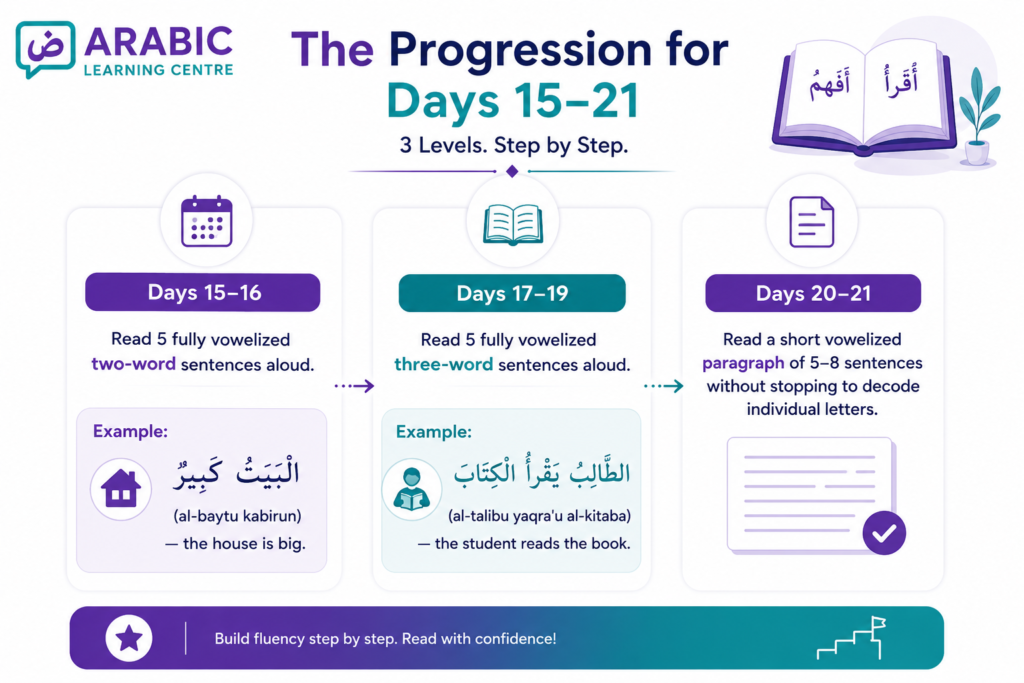
- Days 15–16: Read 5 fully vowelized two-word sentences aloud. Example: البيتُ كبيرٌ (al-baytu kabirun — the house is big).
- Days 17–19: Read 5 fully vowelized three-word sentences aloud. Example: الطالبُ يقرأُ الكتابَ (al-talibu yaqra’u al-kitaba — the student reads the book).
- Days 20–21: Read a short vowelized paragraph of 5–8 sentences without stopping to decode individual letters.
Two rules govern this phase without exception:
- Never move to the next level until you can read the current level smoothly, without pausing on individual letters.
- Record yourself reading aloud on Day 21 and compare it to your Day 15 recording — the improvement in reading speed and smoothness will be audible and will confirm your progress objectively.
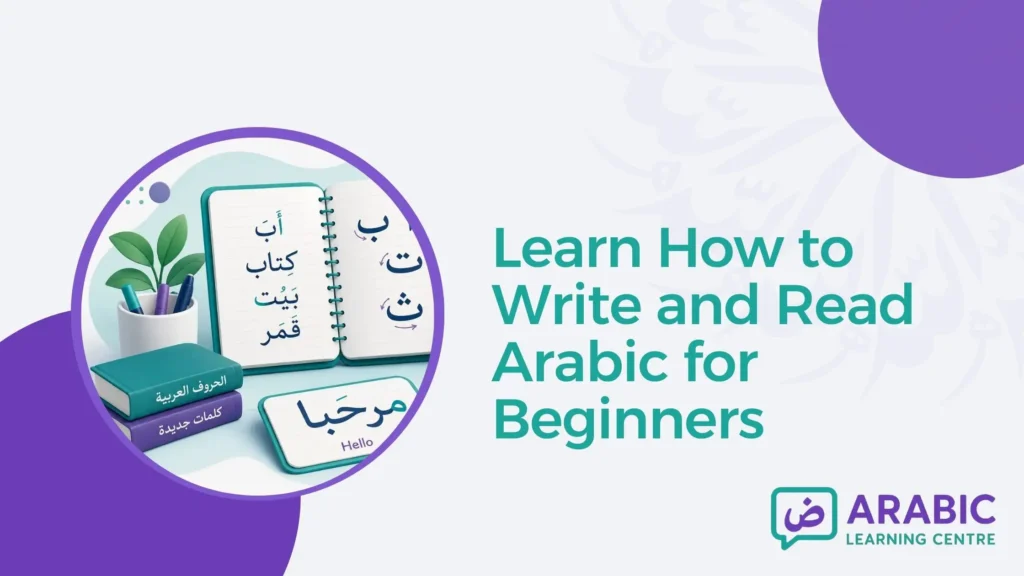
Read Also: Learn How to Write and Read Arabic for Beginners
7- Using Free Online Resources to Learn to Read Arabic in 21 Days
The ability to learn to read Arabic in 21 days online free has never been more accessible. Several structured, reliable resources can support every phase of the plan without cost.
The most effective free tools for each phase are:
- Madinah Arabic (madinaharabic.com): A fully structured beginner curriculum widely regarded as the most rigorous free Arabic reading resource available. Use it for alphabet and grammar in Phase 1.
- Anki: Free spaced repetition software with pre-made Arabic frequency decks available for download. Use it for the 300-word vocabulary phase from Day 8.
- Ahlan Simsim (Arabic Sesame Street on YouTube): Designed for children, which means slow, clearly pronounced Arabic with visual context — the most effective comprehensible input for adult beginners.
- Tanzil.net: Fully vowelized Quranic Arabic text with verse-by-verse navigation. Use it for reading practice in Phase 3 — the vowelization makes it ideal for beginners who cannot yet read unvowelized text.
A comparison of the best free resources for each phase:
| Resource | Best Phase | Primary Skill | Cost |
| Madinah Arabic | Phase 1 | Alphabet + grammar | Free |
| Anki | Phase 2 | Vocabulary retention | Free |
| Ahlan Simsim | Phase 2–3 | Listening + reading | Free |
| Tanzil.net | Phase 3 | Reading practice | Free |
To learn to read Arabic in 21 days free, combine at least two of these resources daily — one for structured input and one for reading practice or vocabulary drilling.
At The Arabic Learning Centre, the Arabic Grammar Course complements these free resources by providing live instruction in the grammatical structures that make Arabic sentences readable and comprehensible.
Read Also: How to Read Arabic Time?
Don’t Just Take Our Word For It
Take a look inside our vibrant classes and see our students and teachers in action. Click below to watch our classroom experience:
Combine free tools with live expert guidance.
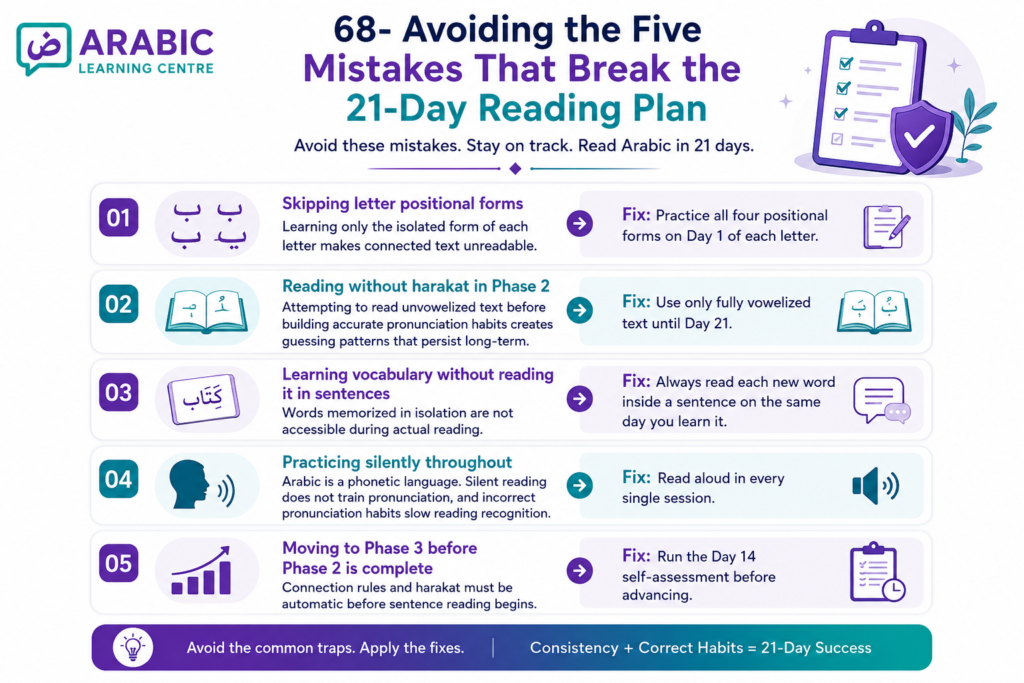
8- Avoiding the Five Mistakes That Break the 21-Day Reading Plan
Most learners who fail to learn to read Arabic in 21 days do not fail because the plan is too difficult. They fail because of five specific, avoidable mistakes that stall progress at predictable points in the timeline.
The five mistakes and their direct fixes are:
- Skipping letter positional forms: Learning only the isolated form of each letter makes connected text unreadable. Fix: practice all four positional forms on Day 1 of each letter.
- Reading without harakat in Phase 2: Attempting to read unvowelized text before building accurate pronunciation habits creates guessing patterns that persist long-term. Fix: use only fully vowelized text until Day 21.
- Learning vocabulary without reading it in sentences: Words memorized in isolation are not accessible during actual reading. Fix: always read each new word inside a sentence on the same day you learn it.
- Practicing silently throughout: Arabic is a phonetic language. Silent reading practice does not train pronunciation, and incorrect pronunciation habits slow reading recognition. Fix: read aloud in every single session.
- Moving to Phase 3 before Phase 2 is complete: Connection rules and harakat must be automatic before sentence reading begins. Fix: run the Day 14 self-assessment before advancing.
Start Reading Arabic in 21 Days at The Arabic Learning Centre
Most learners who attempt to learn to read Arabic in 21 days without guidance plateau in Week 2 — not because the plan stops working, but because self-correction without a native speaker is nearly impossible at the connection and vowelization stage.
The Arabic Learning Centre eliminates this problem with:
- Certified Arab tutors with native-level proficiency who correct your pronunciation and reading errors in real time.
- One-on-one live sessions structured specifically around your daily reading targets and individual mistakes.
- Flexible scheduling across all global time zones including EST, PST, GMT, CET, IST, GST, and MYT.
- Female Arabic teacher options for learners who prefer culturally sensitive instruction.
- Monthly progress reports and written feedback after every session.
Courses We Offer:
- Quranic Arabic Course
- Arabic Course for Islamic Studies
- Learn Arabic for New Muslims
- Learn Arabic Letters for Tajweed
- Al Azhar Arabic Course
- Madinah Arabic Course
- Online Arabic Classes for Kids
- Arabic Words Course for Kids
- Arabic Lessons for Kindergarten
- Arabic Elementary School
- Arabic Intermediate School
- Arabic High School
Book your free trial session today
Conclusion
The learn to read Arabic in 21 days plan works because it sequences correctly: alphabet before connection, connection before vowels, vowels before vocabulary, vocabulary before sentences. Every phase builds directly on the one before it. No step can be skipped without breaking the sequence.
By Day 21, you will not be fluent. You will be reading. And reading is the foundation that makes everything else — grammar, vocabulary, conversation, and Quranic study — possible. That foundation, built in 21 structured days, is worth every minute of daily practice.
FAQ
What exactly does the learn to read Arabic in 21 days plan cover?
The plan covers the 28-letter alphabet in Week 1, letter connection rules and harakat in Week 2, and short sentence reading in Week 3. Basic reading ability is the outcome, not full fluency.
Can I learn to read Arabic in 21 days online free without any paid tools?
Yes. Madinah Arabic, Anki, Ahlan Simsim on YouTube, and Tanzil.net provide everything needed for all three phases at no cost.
How many minutes per day does the 21-day plan require?
Each session should be 40 to 45 minutes. Consistency across all 21 days matters more than longer occasional sessions.
Is the learn to read Arabic in 21 days plan suitable for children?
Yes, for children aged 7 and above with adult supervision. Younger children benefit from the Arabic Lessons for Kindergarten program at The Arabic Learning Centre.
What should I do after completing the 21-day reading plan?
Move immediately to reading short vowelized paragraphs daily, expand vocabulary to 600 words, and begin structured grammar study to understand what you are now able to read.