 Learn Arabic
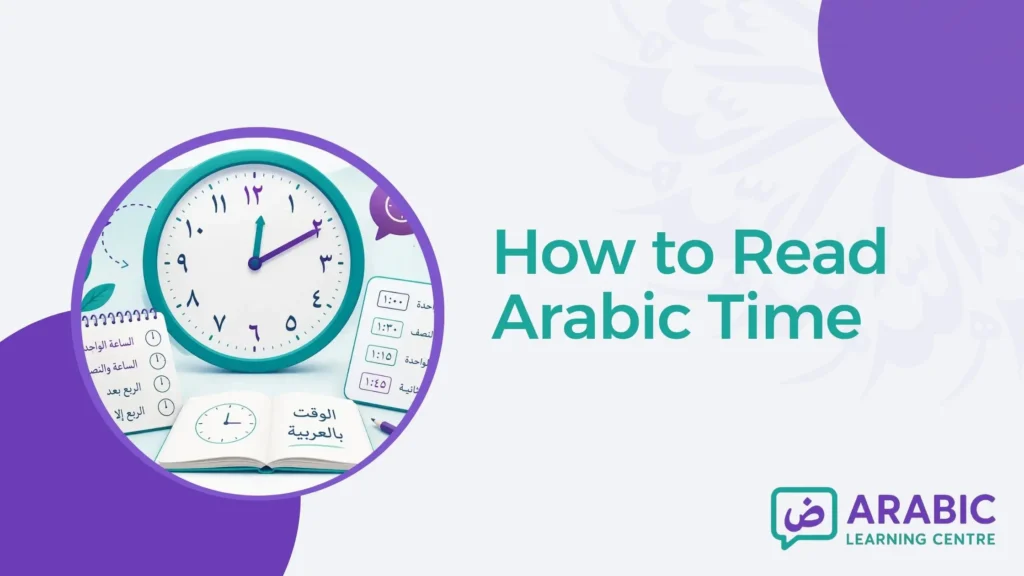
You look at an Arabic clock or phone display and see ٣:٤٥ — and hesitate. Or someone asks كم الساعة؟ and you understand the question but cannot form the answer. Reading and telling Arabic time is one of the most immediately practical language skills — it appears on schedules, transport timetables, prayer times, receipts, and phone screens every single day.
This guide gives you everything you need: the two number systems used on Arabic clocks, the grammar rule that governs all hours, the two structures for minutes, and every essential time expression.
1- Arabic Time Uses Two Visual Systems on Clocks and Displays
The first step to understanding how to read Arabic time is knowing that Arabic-speaking countries use two numeral systems on clocks, digital displays, and printed schedules:
| System | Symbols | Where Used |
| Eastern Arabic Indic | ١ ٢ ٣ ٤ ٥ ٦ ٧ ٨ ٩ ١٠ ١١ ١٢ | Gulf, Egypt, Levant, Iraq |
| Western Arabic | 1 2 3 4 5 6 7 8 9 10 11 12 | North Africa, international contexts |
How to read Arabic Indic time in English follows the same left-to-right digit order as Western numerals — even though Arabic text runs right to left. The time ٣:٤٥ reads as 3:45, not reversed. The digit on the left is always the hour, the digit on the right is always the minutes.
The Eastern Arabic Indic digit-to-Western conversion for clock reading:
| Eastern Indic | 0 | 1 | 2 | 3 | 4 | 5 | 6 | 7 | 8 | 9 |
| Western | 0 | 1 | 2 | 3 | 4 | 5 | 6 | 7 | 8 | 9 |
Two digits cause consistent confusion for Western readers: ٥ looks like a small circle — it is 5, not 0. And ٦ looks like a 7 — it is 6. Memorize these two specifically before reading any Arabic clock or timetable.
At The Arabic Learning Centre, the Arabic Classes for Non-Arabic Speakers introduces Arabic Indic numbers and time reading in structured live sessions from the very first lessons.

Start reading Arabic time displays correctly from Day 1.
2- How to Tell Arabic Time Requires Feminine Ordinal Numbers for Every Hour
The single most important grammar rule for how to tell Arabic time is this: the word ساعة (saa’ah — hour) is grammatically feminine in Arabic. This means every hour is expressed using a feminine ordinal number — not a cardinal number.
The complete clock time in Arabic for all 12 hours:
| Western Time | Arabic Script | Transliteration | English |
| 1:00 | الساعة الواحدة | as-saa’ah al-waahidah | One o’clock |
| 2:00 | الساعة الثانية | as-saa’ah ath-thaaniyah | Two o’clock |
| 3:00 | الساعة الثالثة | as-saa’ah ath-thaalithah | Three o’clock |
| 4:00 | الساعة الرابعة | as-saa’ah ar-raabi’ah | Four o’clock |
| 5:00 | الساعة الخامسة | as-saa’ah al-khaamisah | Five o’clock |
| 6:00 | الساعة السادسة | as-saa’ah as-saadisah | Six o’clock |
| 7:00 | الساعة السابعة | as-saa’ah as-saabi’ah | Seven o’clock |
| 8:00 | الساعة الثامنة | as-saa’ah ath-thaaminah | Eight o’clock |
| 9:00 | الساعة التاسعة | as-saa’ah at-taasi’ah | Nine o’clock |
| 10:00 | الساعة العاشرة | as-saa’ah al-‘aashirah | Ten o’clock |
| 11:00 | الساعة الحادية عشرة | as-saa’ah al-haadiyah ‘ashrah | Eleven o’clock |
| 12:00 | الساعة الثانية عشرة | as-saa’ah ath-thaaniyah ‘ashrah | Twelve o’clock |
12 o’clock in Arabic language has two specific expressions depending on the time of day:
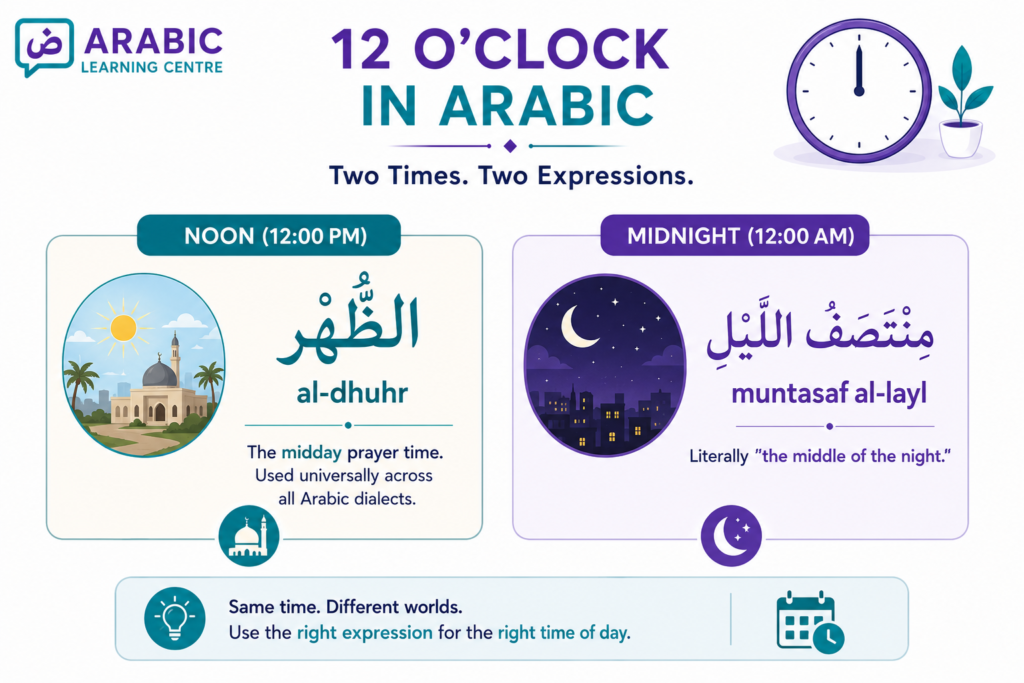
- Noon (12:00 PM): الظُّهْر (al-dhuhr) — the midday prayer time, used universally across all Arabic dialects.
- Midnight (12:00 AM): مِنْتَصَف الليل (muntasaf al-layl) — literally “the middle of the night.”
Both expressions are used in everyday speech instead of الثانية عشرة when the context is exactly noon or exactly midnight.
Inside Our Classrooms
See how we make learning interactive and engaging! Watch a quick snippet of our live, conversational classes in action:
3- Minutes Past the Hour Use و (Wa) — Minutes to the Hour Use إلا (Illa)
How to read Arabic time with minutes follows two completely different structures depending on whether the minutes are before or after the half-hour mark. This is the most important practical skill for reading clock time in Arabic in real situations.
Structure 1 — Minutes Past the Hour (1–30 minutes): use و (wa — “and”)
Formula: الساعة + [hour] + و + [minutes] + دقيقة
| Time | Arabic | Transliteration |
| 3:05 | الساعة الثالثة وخمس دقائق | as-saa’ah ath-thaalithah wa khams daqaa’iq |
| 3:15 | الساعة الثالثة والربع | as-saa’ah ath-thaalithah wa ar-rub’ |
| 3:30 | الساعة الثالثة والنصف | as-saa’ah ath-thaalithah wa an-nisf |
Three shortcut expressions every Arabic time reader must know:
- النصف (an-nisf) = the half = 30 minutes past any hour.
- الربع (ar-rub’) = the quarter = 15 minutes past any hour.
- إلا الربع (illa ar-rub’) = except the quarter = 15 minutes to the next hour.
Structure 2 — Minutes to the Hour (31–59 minutes): use إلا (illa — “except/minus”)
Formula: الساعة + [NEXT hour] + إلا + [minutes remaining]
| Time | Arabic | Transliteration |
| 3:45 | الساعة الرابعة إلا الربع | as-saa’ah ar-raabi’ah illa ar-rub’ |
| 3:50 | الساعة الرابعة إلا عشر دقائق | as-saa’ah ar-raabi’ah illa ‘ashr daqaa’iq |
| 3:55 | الساعة الرابعة إلا خمس دقائق | as-saa’ah ar-raabi’ah illa khams daqaa’iq |
The critical point for the إلا structure: you say the NEXT hour, not the current one. For 3:45, you say “four o’clock except a quarter” — not “three o’clock and forty-five.”
At The Arabic Learning Centre, the Arabic Vocabulary Course builds time vocabulary alongside all core Arabic expressions — giving learners the practical fluency needed for real daily conversations.
Read Also: Learn to Read Arabic App – Top 9 Picks for Beginners

Master Arabic time expressions with live expert instruction
4- Arabic Time of Day Divides into Five Periods, Not Two
Arabic does not simply divide the day into AM and PM the way English does. How to read Arabic Eastern time — the system used across Arab countries — uses five distinct time-of-day periods:
| Arabic | Transliteration | Period | Approximate Hours |
| صَبَاح | Sabaah | Morning | Sunrise to ~11:00 AM |
| ظُهْر | Dhuhr | Midday/Noon | ~11:00 AM to 3:00 PM |
| بَعْد الظُّهْر | Ba’d al-dhuhr | Afternoon | 3:00 PM to sunset |
| مَسَاء | Masaa’ | Evening | Sunset to ~10:00 PM |
| لَيْل | Layl | Night | ~10:00 PM to sunrise |
In practice: when telling time in Arabic, you add the time-of-day word after the hour — not before it, as in English.
- 8:00 AM = الساعة الثامنة صباحاً (as-saa’ah ath-thaaminah sabaahan)
- 3:00 PM = الساعة الثالثة بعد الظهر (as-saa’ah ath-thaalithah ba’d al-dhuhr)
- 9:00 PM = الساعة التاسعة مساءً (as-saa’ah at-taasi’ah masaa’an.
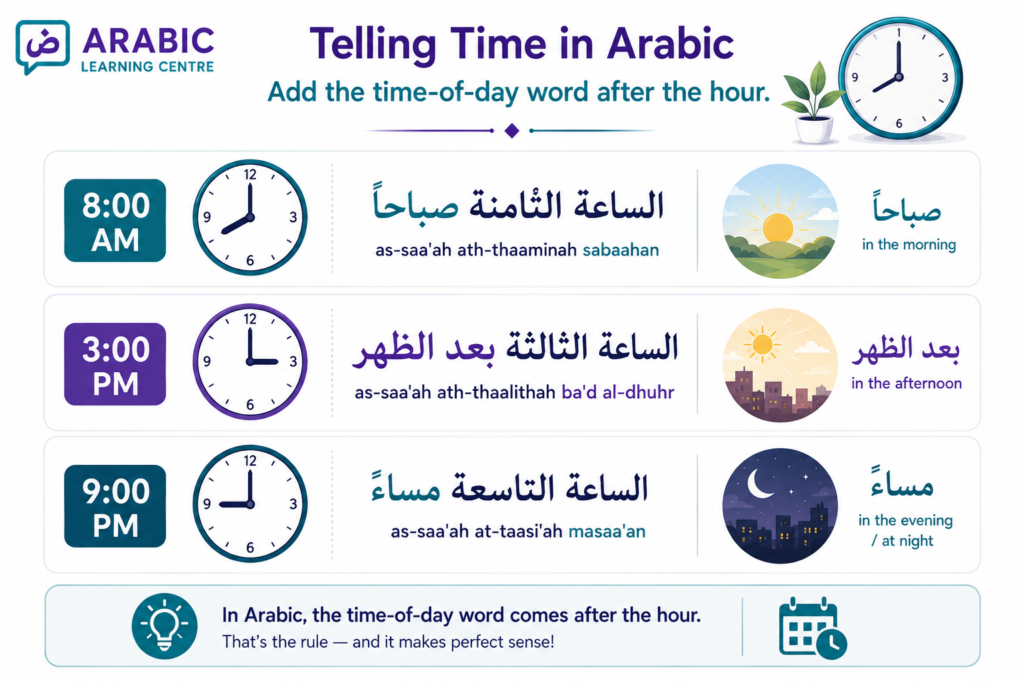
How to read Arabic Indic time in English when a display shows ٨:٠٠ص: the ص abbreviation stands for صباح (sabaah — morning), equivalent to AM. The م abbreviation stands for مساء (masaa’ — evening/PM). These single-letter indicators appear on digital displays across Arab countries exactly as AM/PM appear in English.
Don’t Just Take Our Word For It
Take a look inside our vibrant classes and see our students and teachers in action. Click below to watch our classroom experience:
Read Also: Learn to Read Arabic in 21 Days
5- Essential Arabic Time Phrases for Every Real Situation
Every beginner learning how to read Arabic time needs the practical phrases that appear in real conversations, schedules, and daily interactions:
Asking the time:
| Arabic | Transliteration | English |
| كم الساعة؟ | Kam as-saa’ah? | What time is it? |
| كم الساعة الآن؟ | Kam as-saa’ah al-aan? | What time is it now? |
| في أي ساعة؟ | Fi ayyi saa’ah? | At what time? |
Answering and describing time:
| Arabic | Transliteration | English |
| الساعة الثالثة تماماً | as-saa’ah ath-thaalithah tamaaman | Exactly three o’clock |
| حوالي الخامسة | Hawaali al-khaamisah | Around five o’clock |
| قبل الساعة السابعة | Qabl as-saa’ah as-saabi’ah | Before seven o’clock |
| بعد الساعة التاسعة | Ba’d as-saa’ah at-taasi’ah | After nine o’clock |
| الموعد الساعة العاشرة | Al-maw’id as-saa’ah al-‘aashirah | The appointment is at ten |
The complete time reading formula — how to say any time in Arabic:
الساعة + [hour in feminine ordinal] + و/إلا + [minutes] + [time of day]
Example — 7:25 PM: الساعة السابعة وخمس وعشرون دقيقة مساءً As-saa’ah as-saabi’ah wa khams wa ‘ishroon daqeeqah masaa’an.
Example — 11:45 AM: الساعة الثانية عشرة إلا الربع صباحاً As-saa’ah ath-thaaniyah ‘ashrah illa ar-rub’ sabaahan.
At The Arabic Learning Centre, the Arabic Speaking Course practices exactly these time expressions in real conversational contexts — building the fluency that passive reading cannot produce.
Read Also: Learn How to Write and Read Arabic for Beginners

Practice Arabic time in real conversations with a native tutor
Start Reading Arabic Time at The Arabic Learning Centre
Arabic time reading involves two numeral systems, a feminine grammar rule, two minute structures, five time-of-day periods, and practical daily phrases — every element of this guide can be learned independently.
What self-study cannot provide is real-time correction when the feminine ordinal number is wrong or the إلا structure is applied to the wrong hour.
The Arabic Learning Centre provides exactly that:
- Certified Arab tutors with native-level proficiency who correct grammar errors, wrong ordinal forms, and incorrect time structures in real time.
- One-on-one live sessions that practice time expressions in real conversational scenarios — not just memorization.
- Flexible scheduling across all global time zones — EST, PST, GMT, CET, IST, GST, and MYT.
- Female Arabic teacher options for learners who prefer culturally sensitive instruction.
- Monthly progress reports and written feedback after every session.
Take the next step today and join thousands of students learning Arabic the right way.
Courses We Offer:
- Online Arabic Course
- Classical arabic course
- Modern Standard Arabic Course
- Fusha Arabic Course
- Learn Saudi Arabic
- Arabic Course for Beginners
- Arabic Classes for Adults
- Arabic Classes for Ladies
- Advanced Arabic Course
- Intensive Arabic Course
Your free trial session is one step away.
Conclusion
How to read Arabic time rests on four practical skills: recognizing Eastern Arabic Indic numerals on clocks and displays, using feminine ordinal numbers for every hour, applying و (wa) for minutes past and إلا (illa) for minutes to the next hour, and knowing the five Arabic time-of-day periods that replace simple AM/PM. Master these four elements and every Arabic clock, timetable, and time-related conversation becomes fully readable.
Register at The Arabic Learning Centre today and build Arabic time fluency alongside complete Arabic vocabulary — with certified native guidance from your very first session.
FAQ
How to read Arabic time on a phone or digital display?
Look for the ص (sabaah/AM) or م (masaa’/PM) abbreviation after the digits. Read the digit sequence left to right — ٧:٣٠ is 7:30, not reversed. Convert any Eastern Indic digits using the comparison table in Section 1.
How to tell Arabic time for minutes past the half hour?
Use the إلا (illa) structure with the NEXT hour. For 3:45, say “الساعة الرابعة إلا الربع” — four o’clock except a quarter. Never say the current hour with إلا.
What is 12 o’clock in Arabic language?
Noon (12:00 PM) is الظُّهْر (al-dhuhr). Midnight (12:00 AM) is مِنْتَصَف الليل (muntasaf al-layl). Both expressions replace الثانية عشرة in everyday speech for these specific times.
How to read Arabic Indic time in English when digits are unfamiliar?
The two most commonly confused Eastern Indic digits are ٥ (which looks like 0 but is 5) and ٦ (which looks like 7 but is 6). Memorize these two first — they resolve the majority of Arabic Indic clock reading errors.
Why do Arabic hours use ordinal numbers instead of cardinal numbers?
Because ساعة (saa’ah — hour) is a feminine noun in Arabic, and time expressions use ordinal numbers (first, second, third) rather than cardinal numbers (one, two, three). This is consistent across all 12 hours without exception..
Related Articles
Learn Arabic