 Arabic Alphabet & Writing
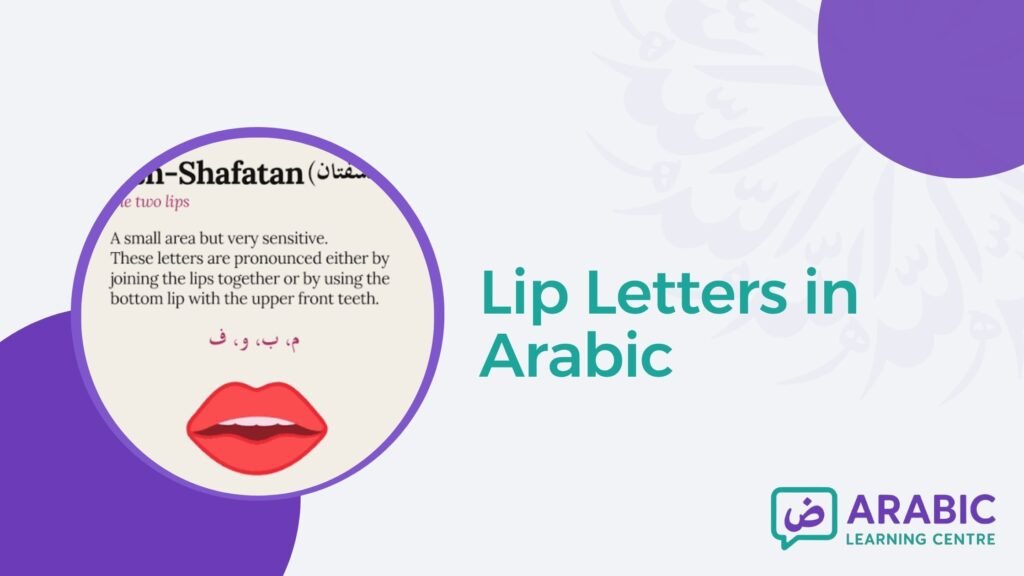
The lips letters in Arabic are Baa (ب), Meem (م), Waw (و), and Faa (ف). In Tajweed, these letters are known as Al-Huruf Ash-Shafawiyyah (الحروف الشفوية) because their articulation depends on the lips, or Ash-Shafataan (الشفتان).
Although these four letters come from the same general articulation area, they are not pronounced in exactly the same way. Baa and Meem require the two lips to meet, consonant Waw is formed by rounding the lips, and Faa is produced when the lower lip interacts with the upper front teeth.
Learning these distinctions is important for anyone studying Arabic pronunciation or Quranic recitation. Correct lip positioning helps prevent letters from becoming unclear or being confused with similar sounds.
In this guide, you will learn what the lip letters in Arabic are, where each letter originates, how to pronounce it correctly, and how its articulation works in Quranic recitation.
1. Baa (ب): Closing Both Lips
Baa (ب) is one of the four lip letters in Arabic. It is articulated by bringing the inner surfaces of both lips together, briefly stopping the airflow, and then separating the lips to release the sound.
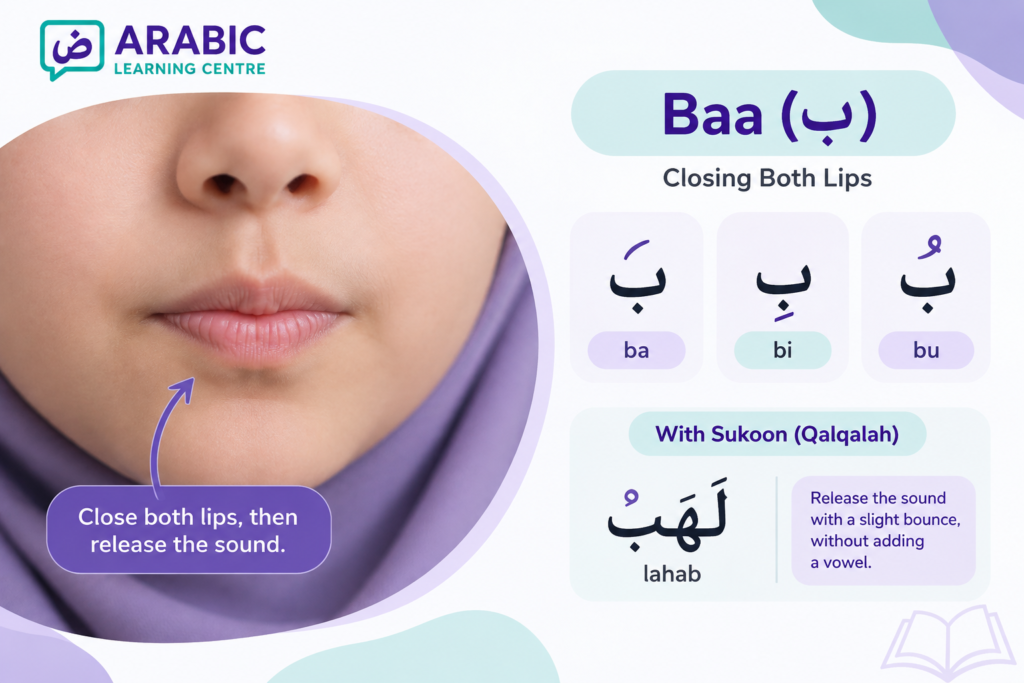
To practise the basic articulation, try:
- بَ — ba
- بِ — bi
- بُ — bu
As you pronounce Baa, notice that the lips close completely before opening again. This brief closure gives the letter its clear and strong sound.
Although Baa has a firm articulation, it is a light letter (Muraqqaq). It should therefore be pronounced without the heaviness or fullness associated with emphatic Arabic letters such as ص، ض، ط، ظ.
Baa and Qalqalah
Baa is also one of the five Qalqalah (قلقلة) letters, traditionally grouped as:
ق ط ب ج د
Qalqalah becomes noticeable when Baa carries a Sukoon (بْ). In this case, the sound is released with a slight controlled bounce rather than being completely suppressed.
For example:
لَهَبْ — lahab
When stopping on the final بْ, the Baa should remain clear through a gentle Qalqalah sound. However, the bounce should not be exaggerated until it creates an additional vowel, such as pronouncing it lahaba.
The goal is to produce a clear release without adding Fathah, Kasrah, or Dammah. Practising this balance helps learners preserve the correct articulation of Baa while applying Tajweed naturally and accurately.
2. Meem (م): Closing the Lips With Ghunnah
Meem (م) is articulated by closing the two lips.
Examples include:
مَ — ma
مِ — mi
مُ — mu
Although its lip position is similar to Baa, the two letters should not sound alike. One major difference is that Meem is inherently connected with Ghunnah (غنة), or nasal resonance.
When Meem is pronounced, its oral articulation occurs at the lips, while the Ghunnah resonates through the nasal passage (Al-Khayshoom). This is especially noticeable with a doubled Meem: إِنَّمَا
Ghunnah is also important in the rules involving Meem Sakinah (مْ).
Meem should remain light and should not become unnecessarily heavy because of neighboring emphatic letters.
For example: صُمٌّ — ṣummun
The preceding Ṣaad is heavy, but the Meem itself should not acquire the same emphatic quality.
3. Waw (و): Rounding the Lips
The consonant Waw (و) differs from Baa and Meem. Instead of closing the lips completely, the lips are rounded and brought forward slightly, leaving an opening through which the sound passes.
Examples include:
وَ — wa
وِ — wi
وُ — wu
The lips should form a rounded shape without unnecessary tension.
Examples of Waw in Arabic include:
وَاللَّهُ — wa-Allāhu — And Allah
وُجُوهٌ — wujūhun — Faces
Learning words containing the same articulation pattern is a useful way to reinforce pronunciation. Students can combine pronunciation practice with structured Arabic vocabulary lessons to encounter Arabic letters in meaningful words rather than practising isolated sounds alone.

Consonant Waw vs. Madd Waw
An important Tajweed distinction is that not every Waw has the same makhraj.
When Waw functions as a consonant, the lips are its primary articulation point. This includes Waw carrying:
- Fathah: وَ
- Dammah: وُ
- Kasrah: وِ
A Waw with Sukoon preceded by a Fathah can also function as a letter of Leen, as in: خَوْف — khawf
However, when a Sakin Waw is preceded by a Dammah and functions as a Madd letter, its elongation is associated with Al-Jawf (الجوف), the empty space of the mouth and throat.
For example: يَقُولُ — yaqūlu
The و here lengthens the preceding Dammah.
This distinction is important when studying Makharij because simply seeing the letter و does not always indicate which articulation category applies. Its function within the word matters.
4. Faa (ف): The Lower Lip and Upper Teeth
Faa (ف) is unique among the four lips letters in Arabic because it does not require bringing both lips together.
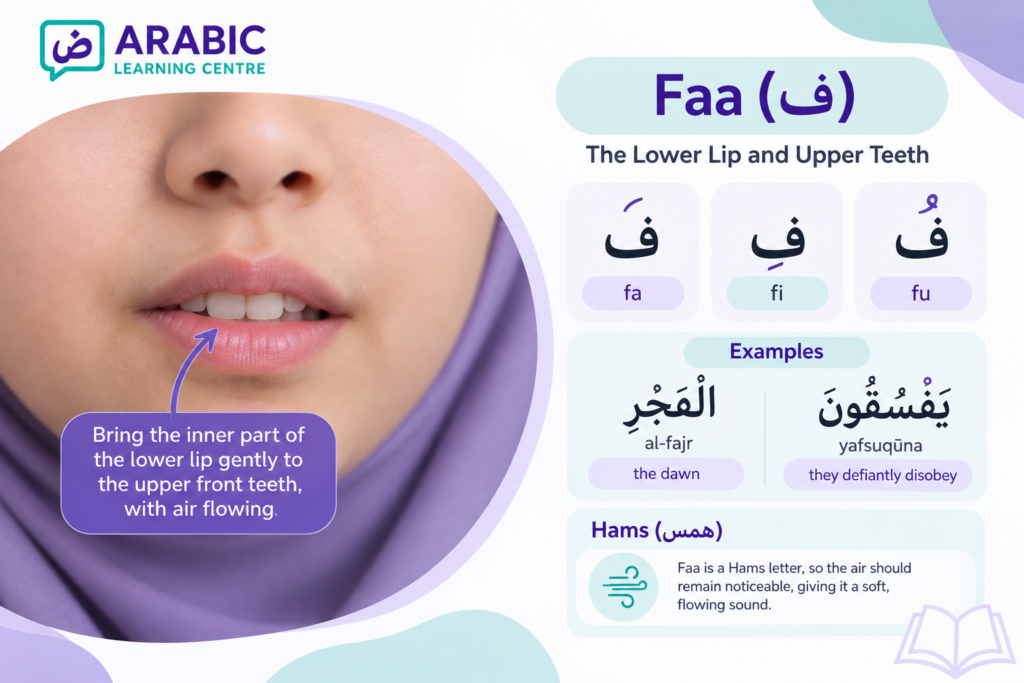
To pronounce Faa correctly, bring the inner portion of the lower lip gently toward the edges of the upper front incisors and allow air to pass through.
Try:
فَ — fa
فِ — fi
فُ — fu
You should be able to feel a continuous stream of air.
Examples include:
الْفَجْرِ — al-fajr — the dawn
يَفْسُقُونَ — yafsuqūna — they defiantly disobey
Faa and Hams
One important characteristic of Faa is Hams (همس), often described as the flowing or whispering of breath.
Faa belongs to the Hams letters gathered in the traditional phrase: فَحَثَّهُ شَخْصٌ سَكَتْ
When pronouncing Faa, the air should remain noticeable rather than being completely blocked. This characteristic helps distinguish the letter and gives it its correct Quranic sound.
Read also: Qalqalah Letters in Arabic – Types, Rules, and Quran Examples
What Is the Difference Between Baa, Meem, Waw, and Faa?
The easiest way to understand the four letters is to compare what the lips actually do.
| Letter | Lip Position | Important Feature |
| ب Baa | Both lips close firmly | Qalqalah when sakin |
| م Meem | Both lips close | Ghunnah accompanies Meem |
| و Waw | Lips round with an opening | Can be consonant, Leen, or Madd |
| ف Faa | Lower lip meets/approaches upper incisors | Hams and continuous airflow |
This shows why learning Makharij involves more than memorizing where letters originate. Students also need to understand how the articulators move and how the letter’s characteristics affect its sound.
What Are Lip Letters in Arabic?
The four lip letters in Arabic are ب، م، و، ف — Baa, Meem, Waw, and Faa. They are associated with the general makhraj called Ash-Shafataan (الشفتان), meaning “the two lips.”
Within this general articulation area, however, there are two more specific points:
- Between the two lips: Baa (ب), Meem (م), and consonant Waw (و)
- The lower lip with the upper front teeth: Faa (ف)
This distinction explains why all four letters are called lip letters even though the lips do not perform exactly the same movement for every letter.
For students learning Arabic beyond Quranic recitation, developing accurate pronunciation alongside grammar and communication can also make spoken Arabic clearer.
The Arabic course for adults at Arabic Learning Centre provides structured study for adult learners who want to build their Arabic skills progressively.

Why Are They Called Al-Huruf Ash-Shafawiyyah?
The Arabic term Shafawiyyah (شفوية) comes from shafah (شفة), meaning “lip.” Therefore, Al-Huruf Ash-Shafawiyyah can be understood as the labial or lip letters.
They receive this name because the lips play the central role in forming their sounds. The four letters can be summarized as follows:
| Lip Letter | Arabic | Main Articulation |
| Baa | ب | Both lips close together |
| Meem | م | Both lips close together |
| Waw | و | Lips round without fully closing |
| Faa | ف | Lower lip approaches/touches the upper incisors |
The visible movements involved can make these letters relatively accessible to beginners. However, correct pronunciation still requires careful attention to the exact contact, airflow, and characteristics of each sound.
Read also: Arabic Throat Letters – A Guide to Pronunciation and Articulation
Inside Our Classrooms
See how we make learning interactive and engaging! Watch a quick snippet of our live, conversational classes in action:
The Two Articulation Points of the Lip Letters in Arabic
Although Ash-Shafataan is treated as one of the main articulation areas, the lip letters Arabic learners encounter are produced through two distinct mechanisms.
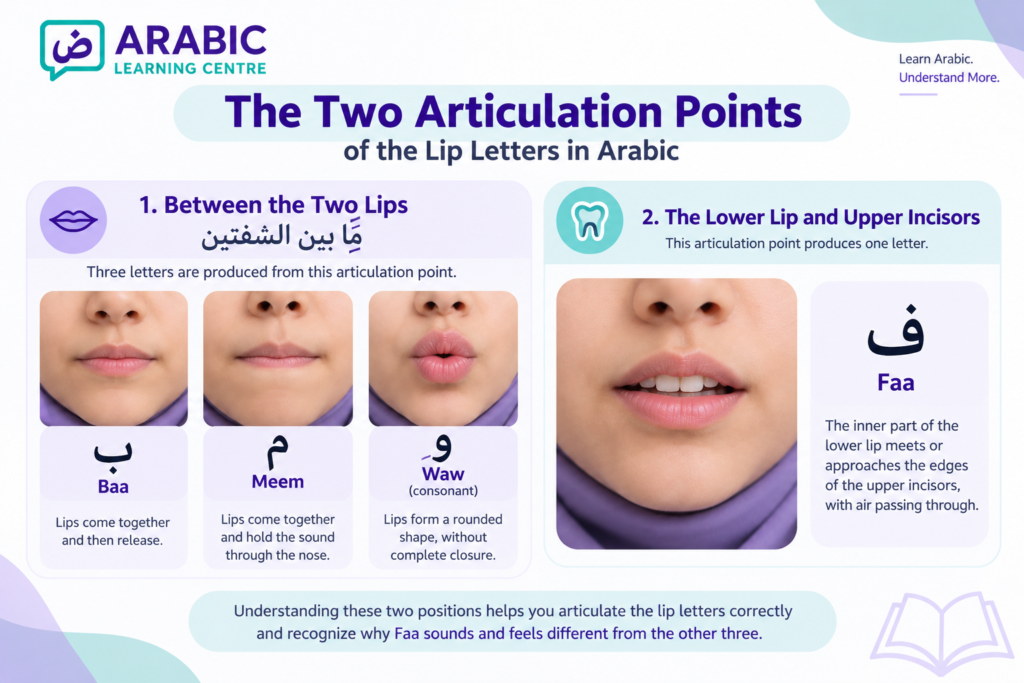
1. Between the Two Lips — ما بين الشفتين
The first articulation point is Maa Bayna Ash-Shafatayn (ما بين الشفتين), meaning “between the two lips.”
Three letters are associated with this area:
ب — Baa
م — Meem
و — consonant Waw
Baa and Meem involve bringing the lips together, while Waw requires a rounded lip shape rather than complete closure.
2. The Lower Lip and Upper Incisors
The second articulation involves the lower lip and the upper front teeth.
This produces: ف — Faa
Unlike Baa and Meem, Faa does not require both lips to close. Instead, the inner part of the lower lip meets or approaches the edges of the upper incisors while air passes through.
Understanding these two positions makes it easier to see why Faa sounds and feels different from the other three lip letters.
Common Mistakes When Pronouncing Lip Letters
Although the lip letters in Arabic may seem simple, small pronunciation mistakes can affect Quranic recitation.
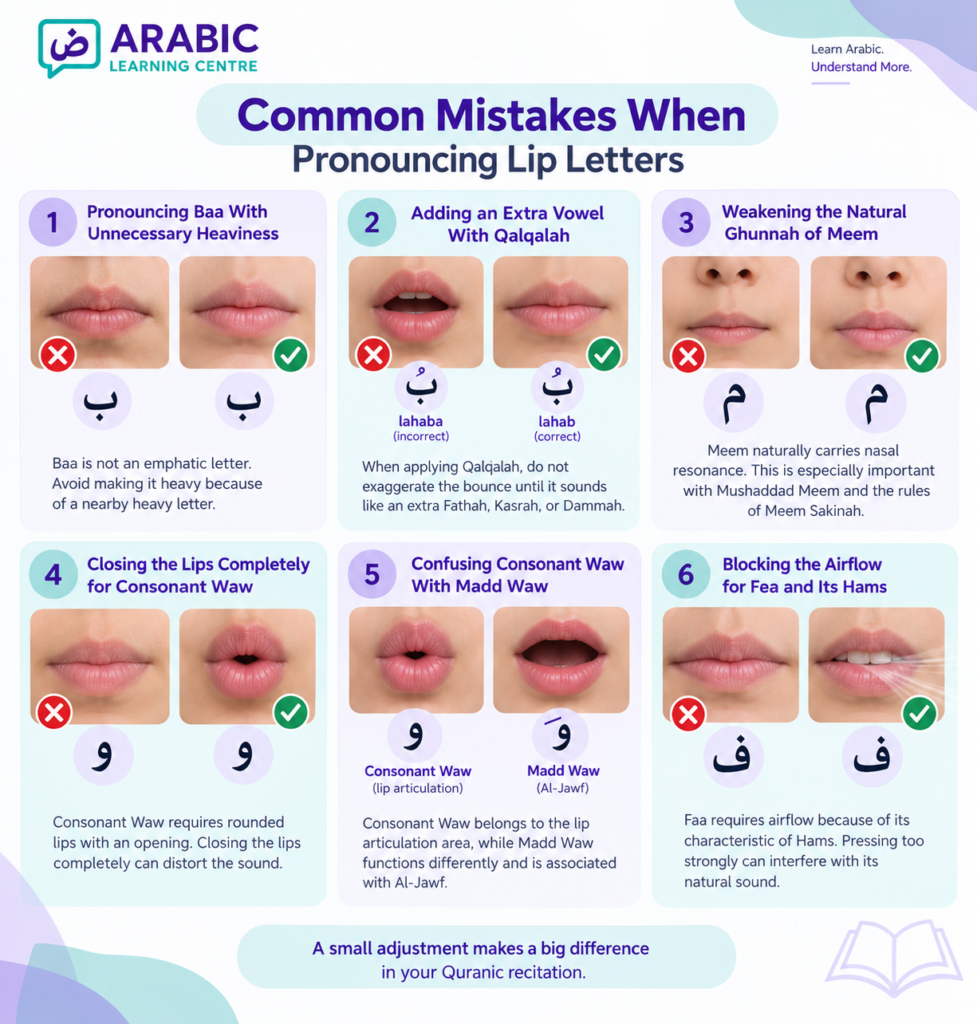
Here are the most common ones:
- Pronouncing Baa With Unnecessary Heaviness: Baa is not an emphatic letter. Avoid making it heavy because of a nearby heavy letter.
- Adding an Extra Vowel When Applying Qalqalah to Sakin Baa: When applying Qalqalah, do not exaggerate the bounce until it sounds like an extra Fathah, Kasrah, or Dammah
- Weakening the Natural Ghunnah When Pronouncing Meem: Meem naturally carries nasal resonance. This is especially important with Mushaddad Meem and the rules of Meem Sakinah.
- Closing the Lips Completely When Pronouncing Consonant Waw: Consonant Waw requires rounded lips with an opening. Closing the lips completely can distort the sound.
- Confusing the Articulation of Consonant Waw With Madd Waw: Consonant Waw belongs to the lip articulation area, while Madd Waw functions differently and is associated with Al-Jawf.
- Blocking the Airflow Required for Faa and Its Hams: Faa requires airflow because of its characteristic of Hams. Pressing too strongly can interfere with its natural sound.
Are Lip Letters Easy for Beginners?
Yes, lip letters are often among the easier Arabic articulation groups for beginners because learners can see and physically feel how the lips move while producing them.
However, correct Quranic pronunciation still requires learners to distinguish between:
- Complete and partial lip closure
- Nasal and oral resonance
- Blocked and flowing airflow
- Light and heavy pronunciation
- Consonant and Madd forms of Waw
These distinctions become more important as learners progress from recognizing individual Arabic letters to reciting complete Quranic passages with Tajweed.
Read also: Tongue Letters in Arabic – Makharij and Pronunciation Guide
Don’t Just Take Our Word For It
Take a look inside our vibrant classes and see our students and teachers in action. Click below to watch our classroom experience:
Master Arabic Pronunciation With Arabic Learning Centre
Learning the lip letters in Arabic gives you a strong foundation for clearer pronunciation, but accurate Arabic requires more than mastering a few individual sounds. Understanding how letters are formed and practising them in real words can help you read more confidently, recognize pronunciation differences, and avoid common mistakes.
At Arabic Learning Centre, you can learn Arabic with experienced teachers who provide structured, personalized guidance based on your level and learning goals. Whether you want to improve pronunciation, reading, vocabulary, or everyday communication, guided practice can help you build your Arabic skills with greater confidence.
Start your Arabic learning journey today and book your free trial lesson with Arabic Learning Centre.
Courses We Offer:
- Business Arabic Course
- Learn Arabic from Zero
- Medical Arabic Course
- Learning Arabic for Non Arabic Speakers
- Learn Arabic in Saudi Arabia
- Learn to Read Arabic Course
- Arabic Grammar Course
- Arabic Speaking Course
- Arabic Script writing course
- Arabic Vocabulary Course
- Arabic Pronunciation Course

Conclusion
The lips letters in Arabic are Baa (ب), Meem (م), consonant Waw (و), and Faa (ف). Collectively, they are known as Al-Huruf Ash-Shafawiyyah, because the lips play the central role in their articulation.
Baa and Meem are formed by bringing the two lips together, although Meem is distinguished by its Ghunnah. Consonant Waw is produced by rounding the lips while leaving an opening, while Faa is articulated using the lower lip and upper front incisors.
Their Tajweed characteristics also differ. Baa is one of the Qalqalah letters, Meem carries nasal resonance, Waw can occur as a consonant, Leen, or Madd letter depending on its context, and Faa is characterized by Hams and flowing breath.
Mastering these apparently simple differences builds a stronger foundation for Makharij and helps learners pronounce Arabic and recite the Quran with greater accuracy.
FAQs About Lip Letters in Arabic
What are the lip letters in Arabic?
The lip letters in Arabic are ب (Baa), م (Meem), و (consonant Waw), and ف (Faa). They are called Al-Huruf Ash-Shafawiyyah because the lips are central to their articulation.
How many lip letters are there in Arabic?
There are four main lip letters in the Arabic Makharij system: Baa, Meem, Waw, and Faa.
What Arabic letters come from between the two lips?
Baa (ب), Meem (م), and consonant Waw (و) are articulated from the area between the two lips. Baa and Meem require lip closure, while Waw is formed by rounding the lips.
Which Arabic letter comes from the lower lip and upper teeth?
Faa (ف) is articulated using the lower lip and the edges of the upper front teeth. Air continues to flow during its pronunciation.
Is Waw always a lip letter?
No. Consonant Waw is articulated using the lips. When Waw functions as a Madd letter—when it is sakin and preceded by a Dammah—its elongation is associated with Al-Jawf, the empty space of the mouth and throat.
What is Ash-Shafataan in Tajweed?
Ash-Shafataan (الشفتان) means “the two lips.” It is one of the main articulation areas studied in Makharij and is responsible for the lip letters Baa, Meem, consonant Waw, and Faa.
Related Articles
Arabic Alphabet & Writing