 Learn Arabic
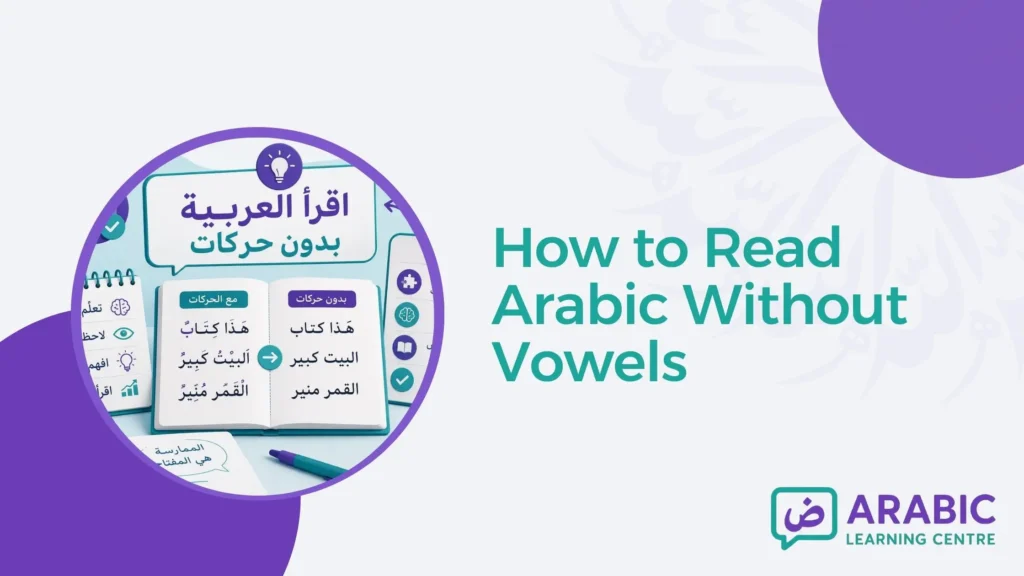
Every Arabic learner hits the same wall. The textbook Arabic they studied had harakat everywhere — the small marks that show every vowel. Real Arabic does not. Newspapers, novels, websites, and street signs appear as walls of consonants with zero vowel guidance.
The word كتب with no harakat could mean “he wrote,” “books,” “it was written,” or “he made someone write.” How do 400 million Arabic speakers read this without confusion? They use patterns, roots, grammar, and context simultaneously — and so can you, with the right sequence.
1- Master Arabic Word Patterns Before Attempting Any Unvowelized Text
Arabic word patterns — called أَوْزَان (awzaan) — are the most powerful single tool for reading without vowels. Every Arabic word fits into a finite set of templates that map specific vowels onto consonantal roots. Once you know the pattern, you predict the vowels of thousands of words automatically — without seeing any harakat.
The 10 patterns that cover the majority of everyday Arabic text:
| Pattern | Meaning | Examples |
| فَعَلَ (fa’ala) | Past tense verb | كَتَبَ (wrote), دَرَسَ (studied) |
| يَفْعَلُ (yaf’alu) | Present tense verb | يَكْتُبُ (writes), يَدْرُسُ (studies) |
| فَاعِل (faa’il) | Doer of the action | كَاتِب (writer), طَالِب (student) |
| مَفْعُول (maf’uul) | Thing acted upon | مَكْتُوب (written), مَعْلُوم (known) |
| مَفْعَل (maf’al) | Place of action | مَكْتَب (office), مَدْرَسَة (school) |
| فِعَال (fi’aal) | Common plural | جِبَال (mountains), رِجَال (men) |
| فُعُول (fu’uul) | Common plural | دُرُوس (lessons), بُيُوت (houses) |
| تَفْعِيل (taf’iil) | Verbal noun Form II | تَعْلِيم (education), تَدْرِيب (training) |
| اِفْتِعَال (ifti’aal) | Verbal noun Form VIII | اِجْتِمَاع (meeting), اِخْتِبَار (exam) |
| اِسْتِفْعَال (istif’aal) | Verbal noun Form X | اِسْتِعْمَال (usage), اِسْتِقْبَال (reception) |
Start with فَاعِل and مَفْعُول first — these two patterns eliminate the most common ambiguities in unvowelized text immediately.
Take 5 words you already know and identify which pattern each belongs to. Do this every day for 30 days. After 30 days, pattern recognition becomes subconscious — you see an unvowelized word and know its vowel structure from its consonantal shape alone, before consciously analyzing it.
An important warning: a common mistake is believing that completing a grammar course makes you ready for unvowelized text. Grammar knowledge is necessary but not sufficient. Reading is a completely different skill from analyzing grammatical rules. You must practice reading specifically — not just studying grammar — to develop unvowelized reading ability.
At The Arabic Learning Centre, the Arabic Grammar Course teaches all core word patterns through live structured instruction with a certified native tutor correcting every identification error in real time.

Build pattern recognition with expert correction from Day 1
2- Use the Three-Letter Root System to Decode Every Unknown Word
The Arabic root system is the decoder that makes unvowelized reading possible. Almost every Arabic word derives from a three-consonant root that carries a core lexical meaning. When you identify the root of any unvowelized word, you narrow it immediately to a family of related meanings — and the sentence context tells you which specific meaning applies.
Research on Arabic reading confirms that skilled readers process words as whole units, using the consonantal skeleton to identify the root and word family before vowels are even considered. This is the mechanism that allows fluent readers to process unvowelized text at near-native speed.
The root extraction method in four steps:
- Strip any prefix: ال (the), يـ (present tense), مـ (place/tool marker), تـ (feminine or Form V/VI).
- Strip any suffix: ة (feminine), ات (feminine plural), ون/ين (masculine plural), ها/هم (pronouns).
- What remains is the three-letter root.
- Identify the word family — then let context confirm the specific meaning.
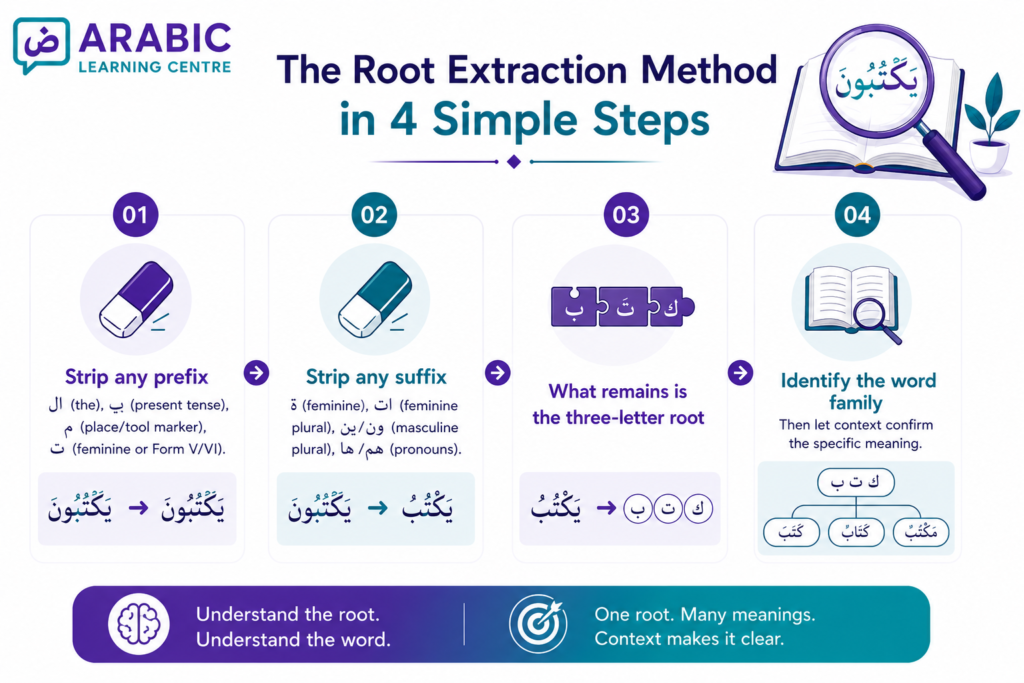
A practical example: the unvowelized word المدرسون — strip ال + م + ون → root = درس → meaning family = studying/teaching → the word means “the male teachers.” This takes under one second once the skill is practiced.
The 100 most common Arabic roots cover approximately 60% of everyday vocabulary. Prioritize these:
| Root | Core Meaning | Key Words |
| ك-ت-ب | Writing | كتاب، كاتب، مكتبة، مكتوب |
| د-ر-س | Studying | درس، مدرسة، مدرس، دراسة |
| ع-ل-م | Knowledge | علم، عالم، معلم، معلومة |
| ق-ر-أ | Reading | قرأ، قراءة، قارئ، مقروء |
| ك-ل-م | Speaking | كلام، كلمة، تكلم، مكالمة |
Keep a root journal. Every new Arabic word you learn — write its three-letter root and list three other words from the same family. After 200 roots, unvowelized text becomes significantly more readable. Use Anki to review roots at the correct memory interval — 15 daily minutes of Anki root review outperforms one hour of passive vocabulary study.
Inside Our Classrooms
See how we make learning interactive and engaging! Watch a quick snippet of our live, conversational classes in action:
3- Learn Grammatical Cases to Supply Word Endings Without Harakat
Grammar knowledge transforms guessing into reading. Arabic uses three grammatical cases that determine word endings — and therefore vowels — based purely on the word’s role in the sentence. The sentence structure itself tells you which vowels to supply, without needing to see any harakat.
The three cases every learner must internalize:
| Case | Term | Vowel | When It Applies |
| Nominative | الرَّفع | Damma (ُ) | Subject, predicate |
| Accusative | النَّصب | Fatha (َ) | Direct object, adverbs |
| Genitive | الجَّر | Kasra (ِ) | After prepositions, possessives |
In practice: any noun after في، على، إلى، من takes kasra automatically — no harakat needed. Any noun after a verb is likely the subject (damma) or object (fatha). Prepositions and conjunctions are your grammar signposts inside unvowelized text — they reveal the grammatical role of surrounding words and therefore their vowels.
Four additional grammatical cues that resolve unvowelized text:
- Verb position: in verbal sentences, the verb typically opens with fatha.
- Subject-verb agreement: a masculine singular verb carries different voweling than a feminine plural form.
- Definite vs. indefinite: the presence or absence of ال changes the grammatical case reading of the whole noun phrase.
- Preposition recognition: the 15 most common Arabic prepositions are short, high-frequency, and immediately signal the case of the word that follows.
Take 5 vowelized Arabic sentences. Identify the grammatical case of every noun. Then cover the harakat and determine the case from structure alone. Do this until case identification from sentence position becomes automatic — typically 4–6 weeks of daily practice.
At The Arabic Learning Centre, the Fusha Arabic Course builds the Modern Standard Arabic grammatical foundation that makes case identification automatic — the prerequisite for confident unvowelized reading.
Build the grammatical foundation that makes vowels predictable.
4- Build a 1500-Word Vocabulary Before Reading Unvowelized Text
How to read Arabic without vowels ultimately depends on one variable more than any other: vocabulary size. When you already know a word, you supply its vowels from memory automatically — exactly how native speakers process unvowelized text. The consonants trigger the stored word, and the stored word includes its correct pronunciation. There is no guessing involved.
This is why native Arabic speakers read unvowelized text with near-zero hesitation: every word on the page is already in their memory with its full vowel pattern. For learners, the threshold for functional unvowelized reading is 1,500–2,000 words.
Below this, too many words are unknown — and when both the vowels and the meaning are unknown simultaneously, reading breaks down into pure guessing. The vocabulary-building sequence for unvowelized reading readiness:
- Months 1–2: Learn the 500 highest-frequency Arabic words. These cover approximately 75% of everyday text. Use Anki with a pre-made Arabic frequency deck.
- Months 2–4: Expand to 1,500 words, prioritizing words from the same root families as your first 500 — each root learned multiplies your vocabulary across its entire word family.
- Month 4 onward: Learn vocabulary in context from actual texts — a word encountered inside a sentence is retained 3–4 times faster than a word learned in isolation.
Learn 10 new words daily — always inside a sentence, never in isolation. Read the sentence aloud. Write it by hand. Test recall the following morning before opening any study materials. This sequence — encounter, production, spaced recall — is what converts short-term exposure into permanent vocabulary.
5- Use Context Clues to Eliminate Vowel Ambiguity in Real Sentences
Context resolves over 90% of all vowel ambiguity in unvowelized Arabic text. The remaining 10% — cases where even native speakers occasionally pause — involves unusual proper nouns or highly technical terms that are rare in everyday reading.
Skilled Arabic readers use four contextual cues simultaneously, and research on Arabic reading confirms this is the actual mechanism native speakers use — not letter-by-letter decoding:
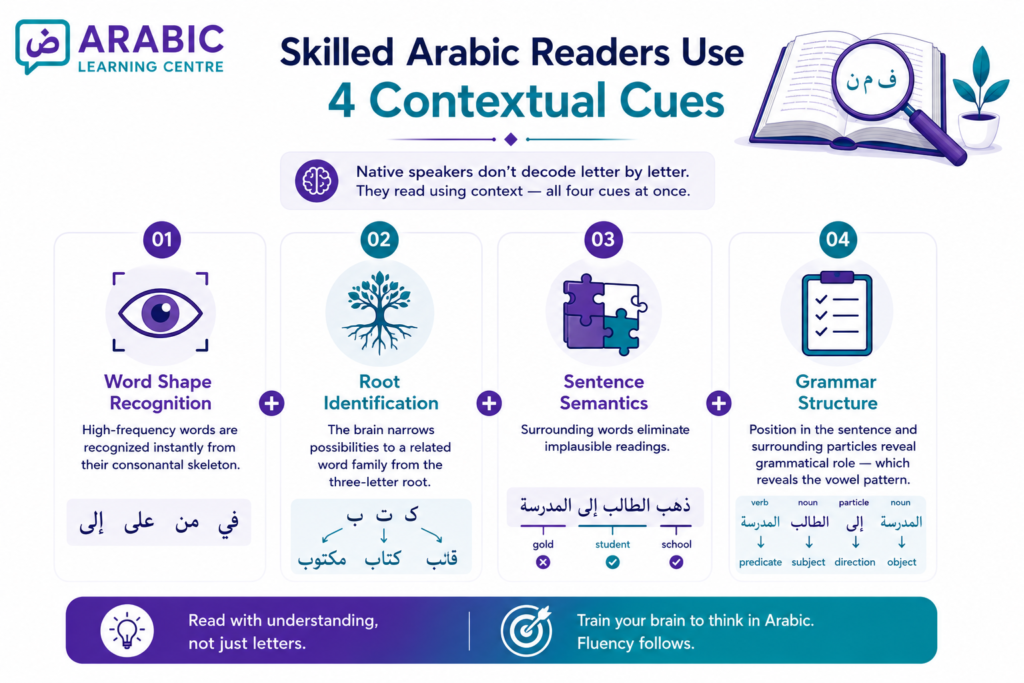
- Word shape recognition: High-frequency words are recognized instantly from their consonantal skeleton — في، من، على، إلى — the way English readers recognize “the” without analysis.
- Root identification: The brain narrows possibilities to a related word family from the three-letter root.
- Sentence semantics: Surrounding words eliminate implausible readings. The sentence ذهب الطالب إلى المدرسة is entirely unambiguous without a single haraka — ذهب cannot mean “gold” when followed by a person, and المدرسة cannot mean anything but “school” in this context.
- Grammar structure: Position in the sentence and surrounding particles reveal grammatical role — which reveals the vowel pattern.
When you encounter an ambiguous word in unvowelized text, do not stop. Read the full sentence first, then return to the ambiguous word. Context resolves it in the overwhelming majority of cases.
Only look up words that remain ambiguous after reading the entire sentence — this habit prevents the attention fragmentation that slows reading development.
An important additional strategy: read the same content in English first, then in Arabic. Your brain already knows the information — so you focus entirely on decoding the Arabic rather than simultaneously building content comprehension and language comprehension from scratch.
At The Arabic Learning Centre, the Advanced Arabic Course develops contextual reading specifically through live sessions using authentic Arabic texts — with a certified native tutor explaining every ambiguity in real time.

Read authentic Arabic texts with expert support.
6- Follow the Staged Transition from Vowelized to Unvowelized Text
The single most damaging mistake Arabic learners make is jumping directly from fully vowelized textbooks to unvowelized newspapers. This gap is too wide — it forces guessing, which builds incorrect pronunciation patterns that are very difficult to unlearn. Even native Arabic speakers learn with full tashkeel first — children read with complete harakat for years before transitioning to unvowelized text naturally.
The correct staged transition has five levels:
Level 1 — Fully vowelized (Months 1–3)
Read only fully vowelized text. The Quran with tashkeel, Madinah Arabic Book 1, and children’s books are your materials. Build vocabulary, root knowledge, and pattern recognition here before touching unvowelized text.
Level 2 — Cover the vowels (Months 3–4)
Take fully vowelized text you have already read. Cover the harakat and attempt reading without them. Uncover to check accuracy. Every error reveals a gap in pattern recognition or vocabulary — that gap is your next study target.
Level 3 — Parallel texts (Months 4–5)
Read the same passage twice — first with harakat, then without. Your brain uses the vowelized version to pre-load the correct pronunciation, then applies it to the unvowelized version. This is one of the most effective bridge techniques available.
Level 4 — Partially vowelized (Months 5–6)
Read texts where only ambiguous words carry harakat. Madinah Arabic Books 2 and 3 progressively reduce vowelization — use them in sequence as designed.
Level 5 — News Arabic (Months 7–9)
Start with BBC Arabic (simpler sentence structures) before Al Jazeera (more complex). Read the headline and first paragraph of three articles daily. Look up maximum 5 words per article. If you look up more than 5, the text is too difficult — drop back one level.
Read Also: Learn to Read Arabic App
The readiness test for each level
Can you read the current level at 80%+ accuracy without hesitation? If yes, move up. If no, stay for another two weeks before testing again.
Read Also: Is It Compulsory to Read the Quran in Arabic?
7- Build a Daily Practice Routine That Produces Measurable Weekly Progress
How to read Arabic without vowels free of a teacher is possible — but only with a structured daily routine that targets every component simultaneously.
Research on language acquisition consistently confirms that 20 minutes daily produces faster progress than two hours weekly — the brain consolidates Arabic script during sleep, and daily exposure is what triggers that consolidation.
The 25-minute daily session that covers every skill:
| Block | Activity | Purpose |
| 5 minutes | Pattern recognition drill | Write 5 unvowelized words, identify their awzaan |
| 5 minutes | Root extraction practice | Extract 3-letter roots from 5 words in a real text |
| 5 minutes | Vocabulary review in Anki | Maintain and expand word recognition speed |
| 5 minutes | Read unvowelized text aloud | Apply all skills in real context |
| 5 minutes | Write a sentence from memory | Active production reinforces receptive reading |
Four common mistakes that stall progress — and their direct fixes:
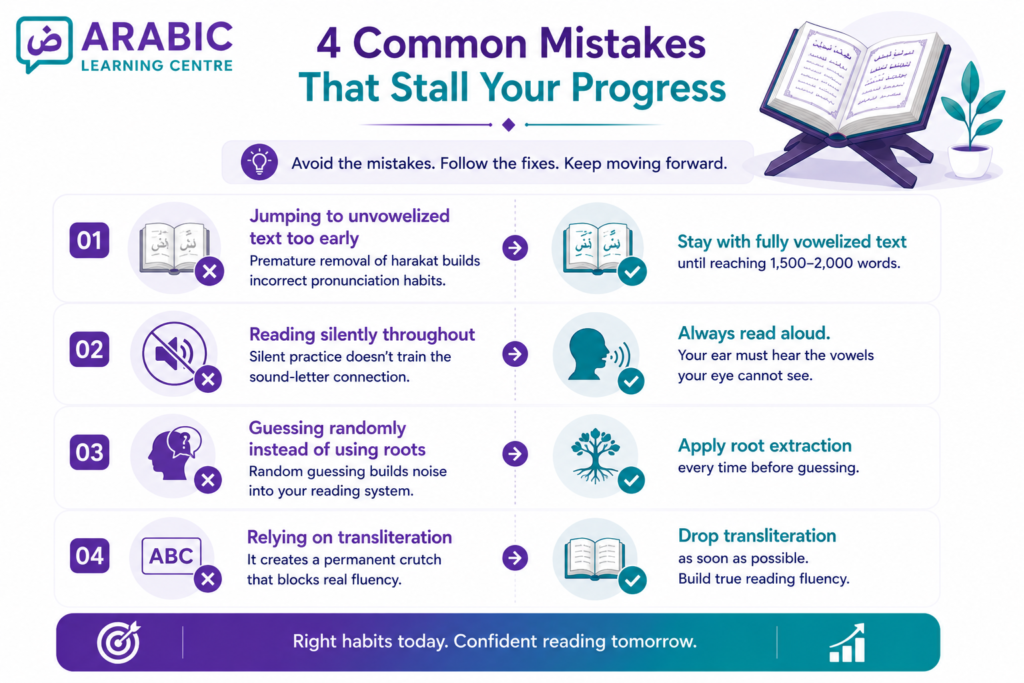
- Jumping to unvowelized text too early: Stay with fully vowelized text until reaching 1,500–2,000 words. Premature removal of harakat builds incorrect pronunciation habits that persist long-term.
- Reading silently throughout: Always read aloud. Silent practice does not train the sound-letter connection that unvowelized reading depends on — your ear must hear the vowels your eye cannot see.
- Guessing randomly instead of using roots: Random guessing builds noise into your reading system. Apply root extraction every time before guessing.
- Relying on transliteration: Drop transliteration as soon as possible. It creates a permanent crutch that prevents genuine reading fluency from developing.
Weekly progress markers that show you are on track:
- Week 1–4: Identify 8 of 10 core awzaan patterns from unvowelized words.
- Month 2: Extract the root from 80% of unvowelized words in a simple text.
- Month 3: Read a fully unvowelized children’s story with 80%+ vowel accuracy.
- Month 5: Read BBC Arabic headlines without looking up more than 3 words.
- Month 7: Read a full BBC Arabic article with fewer than 5 lookups.
Read Also: Learn to Read Arabic in 21 Days
Don’t Just Take Our Word For It
Take a look inside our vibrant classes and see our students and teachers in action. Click below to watch our classroom experience:
Start Reading Unvowelized Arabic at The Arabic Learning Centre
Every strategy in this guide is executable independently. The honest limitation of self-study at the unvowelized stage is that no resource can tell you when your vowel production is wrong — and the errors that cost the most are the ones you cannot hear yourself making. A mispronounced word that goes uncorrected for weeks becomes a habit that requires months to fix.
The Arabic Learning Centre provides what self-study cannot:
- Certified Arab tutors with native-level proficiency who identify incorrect vowel production and pattern misidentification in real time during every session.
- One-on-one live sessions structured around your specific level — from pattern recognition through to reading authentic unvowelized Arabic news and literature.
- Real-time Makharij and pronunciation correction ensuring that the vowels you supply mentally are always accurate.
- Flexible scheduling across all global time zones — EST, PST, GMT, CET, IST, GST, and MYT.
- Female Arabic teacher options for learners who prefer culturally sensitive instruction.
- Monthly progress reports and written feedback after every session.
Courses We Offer:
- Business Arabic Course
- Learn Arabic from Zero
- Medical Arabic Course
- Learning Arabic for Non Arabic Speakers
- Learn Arabic in Saudi Arabia
- Learn to Read Arabic Course
- Arabic Grammar Course
- Arabic Speaking Course
- Arabic Script writing course
- Arabic Vocabulary Course
- Arabic Pronunciation Course
Your free trial session is one step away
Conclusion
Reading Arabic without vowels is not a separate skill — it is the natural result of building the skills that vowelized reading develops. Word patterns predict vowels. Root knowledge narrows meaning. Grammar reveals word endings. Context eliminates ambiguity. Vocabulary makes every word recognizable on sight. Build these five foundations in sequence, follow the staged transition from vowelized to unvowelized text, practice 25 minutes daily, and the consonantal skeleton of Arabic text becomes fully readable.
FAQ
How long does it take to read Arabic without vowels fluently?
With 20–30 minutes of daily structured practice, most learners read simple unvowelized texts after 5–6 months and news Arabic comfortably after 7–9 months.
How to read Arabic without fatha kasra damma as a complete beginner?
You cannot yet — build a vocabulary of 1,500–2,000 words with full harakat first. Only then does the consonantal skeleton carry enough information to read accurately.
Is how to read Arabic without vowels free achievable without a teacher?
Yes, using free resources like BBC Arabic, Anki, and Madinah Arabic Books — but a teacher who corrects vowel errors in real time accelerates progress significantly and prevents incorrect habits from solidifying.
Do native Arabic speakers ever struggle with unvowelized text?
Rarely — but unusual proper nouns and technical terms cause even native speakers to pause occasionally. This is why news anchors sometimes mispronounce unfamiliar names during live broadcasts.
Why do even native Arabic speakers learn with harakat first?
Because harakat connect sounds to letters correctly from the very beginning. Arabic children read with full tashkeel for years before transitioning naturally. Skipping this stage — for learners or native speakers — produces guessing habits that undermine accuracy long-term.