 Learn Arabic
Millions of Muslims around the world are not native Arabic speakers, yet they hold the Quran daily and ask the same honest question: is Arabic obligatory, or is an English translation enough? The answer depends on whether you are asking about prayer, daily recitation, or understanding. This guide answers all three with the Islamic ruling, the scholarly evidence, and practical steps.
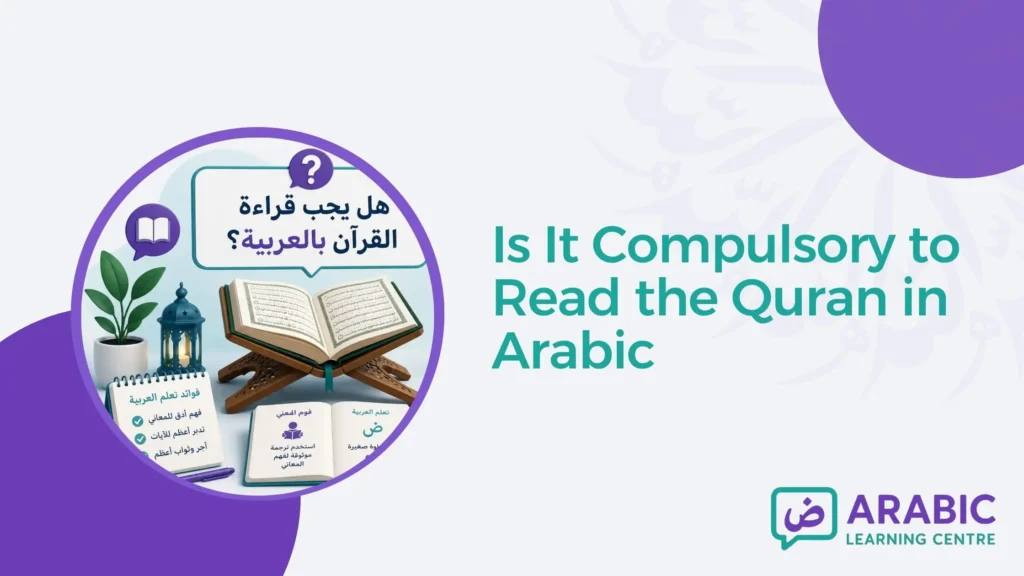
Is It Compulsory to Read Quran in Arabic?
Yes — for recitation in the obligatory prayers, reading the Quran in Arabic is compulsory without exception. Imam al-Shafi’i stated that it is obligatory for every Muslim to learn enough Arabic to fulfill their obligations in prayer, because recitation in any other language during Salah is not valid.
The Quran itself confirms this:
“نَزَلَ بِهِ الرُّوحُ الْأَمِينُ ﴿١٩٣﴾ عَلَىٰ قَلْبِكَ لِتَكُونَ مِنَ الْمُنذِرِينَ ﴿١٩٤﴾ بِلِسَانٍ عَرَبِيٍّ مُّبِينٍ ﴿١٩٥﴾”
Nazala bihi al-ruhu al-aminu ‘ala qalbika litakuna mina al-mundhirina bilisanin ‘arabiyyin mubin
“The Trustworthy Spirit has brought it down (193) Upon your heart, [O Muhammad] – that you may be of the warners – (194) In a clear Arabic language. (195).”
The ruling divides into two levels:
| Level | Arabic Term | Requirement |
| Obligatory minimum | Fard | Three short verses minimum — enough for valid prayer |
| Required beyond minimum | Wajib | Surah al-Fatiha plus one additional Surah |
Outside of prayer, Arabic recitation is strongly recommended and carries reward for every letter — but reading a translation for understanding is permissible and encouraged as a complement, never a replacement.
At The Arabic Learning Centre, the Arabic Course for Islamic Studies builds the Arabic foundation Muslims need to read and understand the Quran directly — without relying solely on translation.
Read the Quran in Arabic with understanding from Day 1
Reading the Quran in English Serves Understanding but Not Recitation
Can you read the Quran in English instead of Arabic? You can read a translation — but what you are reading is a scholar’s best effort to render Allah’s speech into human language, not the Quran itself.
Every translation involves choices and approximations that the Arabic original does not have. This is why scholars across all madhabs agree: the Quran, strictly defined, exists only in its Arabic original.
What an English translation does for a Muslim:
- Delivers the Quran’s meaning and guidance to non-Arabic speakers from Day 1.
- Builds the intellectual relationship with the Quran’s stories, rulings, and wisdom.
- Motivates Arabic learning by making the meaning of each recited verse accessible.
What an English translation does not do:
- It does not substitute for Arabic recitation in Salah — prayer performed in English is not valid.
- It does not carry the letter-by-letter reward that Arabic recitation carries.
- It does not preserve the Quran’s miraculous linguistic dimension, which is bound entirely to the Arabic.
The recommended practice: recite the Arabic first, then read the translation immediately after — building the connection between the sounds recited and their meanings simultaneously.
Inside Our Classrooms
See how we make learning interactive and engaging! Watch a quick snippet of our live, conversational classes in action:
Non-Arabic Speakers Earn a Double Reward for Reading the Quran in Arabic
One of the most important pieces of knowledge for any non-Arabic speaker struggling with recitation is that the struggle itself carries a specific, documented reward. ‘Aishah (may Allah be pleased with her) narrated that the Prophet (peace be upon him) said:
“ الْمَاهِرُ بِالْقُرْآنِ مَعَ السَّفَرَةِ الْكِرَامِ الْبَرَرَةِ وَالَّذِي يَقْرَأُ الْقُرْآنَ وَيَتَتَعْتَعُ فِيهِ وَهُوَ عَلَيْهِ شَاقٌّ لَهُ أَجْرَ”
“One who is proficient in the Qur’an is associated with the noble, upright, recording angels; and he who falters in it, and finds it difficult for him, will have two rewards.”
This Hadith removes every excuse a non-Arabic speaker might carry. The struggle is not a deficiency — it is an act of worship rewarded specifically by Allah. Do not delay Arabic recitation until your pronunciation is perfect. The imperfect recitation made with sincere effort carries its own unique, compounded reward.
At The Arabic Learning Centre, the Al Azhar Arabic Course provides the classical Arabic foundation that connects Muslim learners directly to Quranic vocabulary and grammar — taught by certified native Arab tutors.
Connect with the Quran in its original language
Learning Arabic Gives Every Muslim Direct Access to the Quran
Do you have to know Arabic to read the Quran? No — a Muslim can recite the Quran in Arabic without understanding every word, and that recitation carries full reward.
But every scholar who has addressed this question follows the ruling with the same encouragement: learning Arabic is not optional for the Muslim who wants a genuine, living relationship with the Quran.
Learning even the vocabulary of Surah al-Fatiha — recited in every unit of every prayer — transforms the experience of Salah immediately. From there, each Arabic word learned adds to a growing direct connection with the Quran’s original language.
The difference between reciting with and without Arabic knowledge:
| Without Arabic Knowledge | With Arabic Knowledge |
| Full letter-by-letter reward | Reward plus active comprehension |
| Salah valid, meaning unclear | Salah valid, meaning present |
| Dependent on translation | Direct access to Allah’s words |
Read Also: Learn to Read Arabic App
Daily Practice Takes Non-Arabic Speakers from Zero to Quran Reading
The practical question for most non-Arabic speakers is not whether to read in Arabic — it is how to begin. The path is clear and structured:
- Week 1–2: Learn all 28 Arabic letters — 5 letters per day, focusing on name, shape, and sound together.
- Week 3–4: Learn harakat — Fatha first, then Kasra and Damma — so every vowelized word becomes pronounceable.
- Month 2: Practice with the shortest Surahs — Al-Ikhlas, Al-Falaq, and An-Nas — all of which are fully vowelized in learner-edition Qurans.
- Month 2–3: Work through Surah al-Fatiha with full attention to pronunciation, learning the meaning of each word alongside the Arabic.
A daily session does not need to be long to be effective:
| Activity | Time |
| Review previous letters or words | 5 minutes |
| Practice one new Surah or verse aloud | 10 minutes |
| Read the translation of what was recited | 5 minutes |
| Write out the verses practiced by hand | 5 minutes |
| Total | 25 minutes |
Twenty-five consistent minutes daily takes a complete beginner to reading the short Surahs within 4–6 weeks.
Read Also: Learn to Read Arabic in 21 Days
Reflecting on Quran Meanings Completes What Recitation Alone Cannot
Recitation is the foundation — but the Quran calls for something more. Reflection on its meanings is itself an act of worship that draws the believer closer to Allah. The Quran addresses this directly:
“أَفَلَا يَتَدَبَّرُونَ الْقُرْآنَ أَمْ عَلَىٰ قُلُوبٍ أَقْفَالُهَا ﴿٢٤﴾”
Afala yatadabbaruna al-Qurana am ‘ala qulubin aqfaluha
“Then do they not reflect upon the Qur’an, or are there locks upon [their] hearts? (24) “
Practical steps for building reflection into daily Quran reading:
- Recite the Arabic verse aloud first, focusing entirely on accurate pronunciation.
- Read the translation immediately after, connecting the sounds recited to their meanings.
- Pause on any verse that strikes you and read a brief tafsir from a trusted scholar.
- Never quote a translation as the Quran itself — always acknowledge it as a translation.
At The Arabic Learning Centre, the Classical Arabic Course builds the advanced Arabic literacy that allows serious learners to engage with Quranic tafsir directly in Arabic — accessing the scholarly tradition without translation as an intermediary.
Read Also: How to Read Arabic Without Vowels?
Access Quranic tafsir in its original Arabic form
No Perfect Translation Exists for the Original Arabic Quran
Every Muslim who reads the Quran in translation should hold one foundational reality clearly: no translation is the Quran. It is a human being’s best effort to render Allah’s speech into another language.
Arabic carries layers of meaning that no single English word can replicate — a single root generates dozens of related words that share a semantic field, meaning a single Quranic word often carries connotations an English translation can only approximate.
This reality points toward one conclusion: the translation is a tool for understanding, and Arabic is the destination. Every Muslim who currently relies on a translation is using the available tool correctly — but that tool should point toward Arabic learning, not replace it.
Read Also: How to Read Arabic Without Vowels?
Don’t Just Take Our Word For It
Take a look inside our vibrant classes and see our students and teachers in action. Click below to watch our classroom experience:
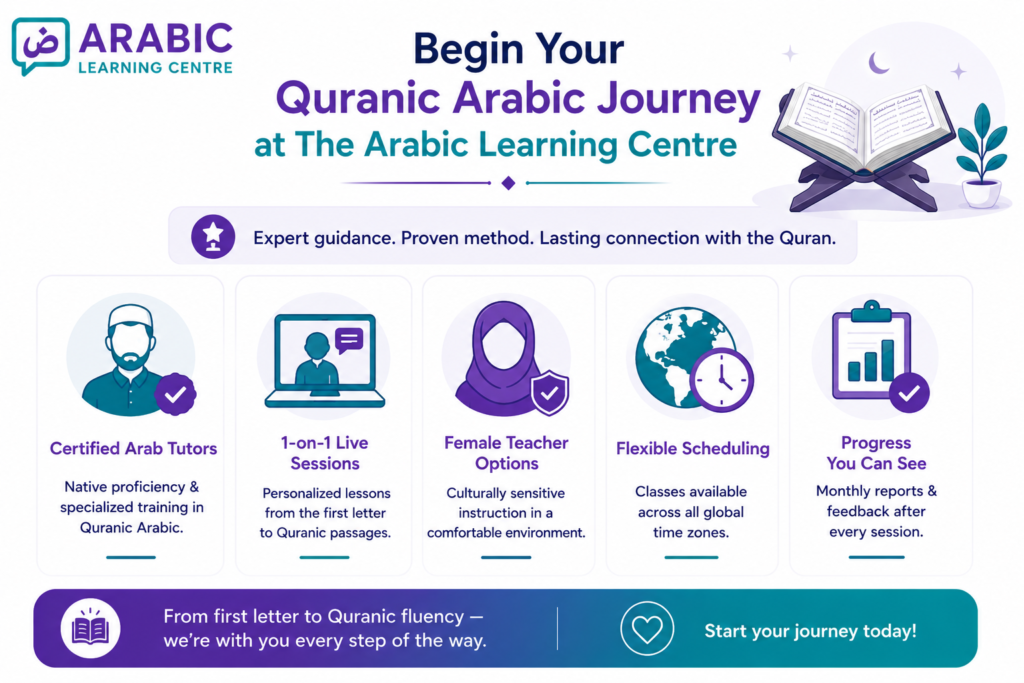
Begin Your Quranic Arabic Journey at The Arabic Learning Centre
The obligation is clear. The reward for the struggling reciter is confirmed. The path from zero Arabic to Quranic recitation is structured and achievable. What every non-Arabic speaker needs is a qualified teacher who corrects pronunciation from the first session and builds the Arabic skill that makes the Quran’s original words accessible.
The Arabic Learning Centre provides exactly that:
- Certified Arab tutors with native-level proficiency and specialized training in Quranic Arabic and Makharij correction.
- One-on-one live sessions built around each student’s current level — from the first letter through to full Quranic passages.
- Female Arabic teacher options for learners who prefer culturally sensitive instruction.
- Flexible scheduling across all global time zones — EST, PST, GMT, CET, IST, GST, and MYT.
- Monthly progress reports and written feedback after every session.
Courses We Offer:
- Quranic Arabic Course
- Arabic Course for Islamic Studies
- Learn Arabic for New Muslims
- Learn Arabic Letters for Tajweed
- Al Azhar Arabic Course
- Madinah Arabic Course
- Online Arabic Classes for Kids
- Arabic Words Course for Kids
- Arabic Lessons for Kindergarten
- Arabic Elementary School
- Arabic Intermediate School
- Arabic High School
Your free trial session is one step away
Conclusion
The ruling is clear: Arabic recitation in Salah is obligatory, and the Arabic Quran alone carries the full spiritual and linguistic reality of Allah’s speech. For non-Arabic speakers, the path is not to replace Arabic with translation — it is to use translation as a bridge toward Arabic, building Quranic literacy one letter and one verse at a time.
The double reward for the struggling reciter is Allah’s own acknowledgment that the effort is honored. Register at The Arabic Learning Centre today and take the first structured step toward reading the Quran in the language Allah chose for it.
FAQ
Is it compulsory to read Quran in Arabic during daily prayers?
Yes, without exception. Reciting in any language other than Arabic during Salah renders the prayer invalid according to scholarly consensus across all madhabs.
Can you read the Quran in English instead of Arabic for understanding?
Yes — reading a translation is encouraged for understanding. It is not a substitute for Arabic recitation and does not carry the same letter-by-letter reward.
Do you have to know Arabic to read the Quran?
No — a Muslim can recite the Quran in Arabic without full comprehension and receive the full reward. However, every scholar encourages progressive Arabic learning to deepen the Quran connection.
What reward does a non-Arabic speaker receive for struggling with Arabic recitation?
The Prophet confirmed in an authenticated Hadith that the person who recites the Quran with difficulty receives a double reward — one for the recitation and one for the effort.
Is reading the Quran in Arabic with English letters permissible?
No — scholars have stated that using non-Arabic letters to represent Quranic text distorts the language of the Quran and is not permissible as a substitute for Arabic script.
Related Articles
Learn Arabic