 Arabic Grammar

Understanding the nominative case in Arabic is an essential part of learning Arabic grammar. Known as al-raf’ (الرَّفْع), it helps learners identify important grammatical roles such as the subject, predicate, and other elements that take the nominative form. A good understanding of this case makes it easier to read, understand, and analyze Arabic sentences correctly.
The nominative case is not marked by the damma alone. Depending on the type of word and its grammatical position, Arabic can also use the waw, alif, or retained nun as signs of the nominative case. Learning when each sign is used allows students to recognize grammatical patterns and apply Arabic grammar more accurately.
In this guide, we will explore the nominative case in Arabic, including its main and secondary signs, the grammatical positions in which nouns become nominative, and how the present tense verb can be nominative. We will also provide clear examples and practical tips to help learners understand and use these rules with greater confidence.
What you’ll learn in this article:
- What the nominative case in Arabic (al-raf’) means and why it is important
- The main and secondary signs of the nominative case, including damma, waw, alif, and retained nun
- When the damma is visible or implied and why it may not appear on the final letter
- Which nouns take the nominative case and the grammatical positions they can occupy
- How the five nouns, dual nouns, sound masculine plurals, and five verbs use different nominative signs
- How kāna and inna affect the grammatical case of nouns
- When a present-tense verb is nominative and how grammatical particles can change its case
- Practical tips for recognizing and using the nominative case more accurately
What Is the Nominative Case in Arabic?
Arabic grammar (nahw) has four case-like states called i’rab: raf’ (nominative), nasb (accusative), jarr (genitive), and jazm (jussive). Raf’ and nasb apply to both nouns and verbs; jarr belongs only to nouns, and jazm only to verbs.
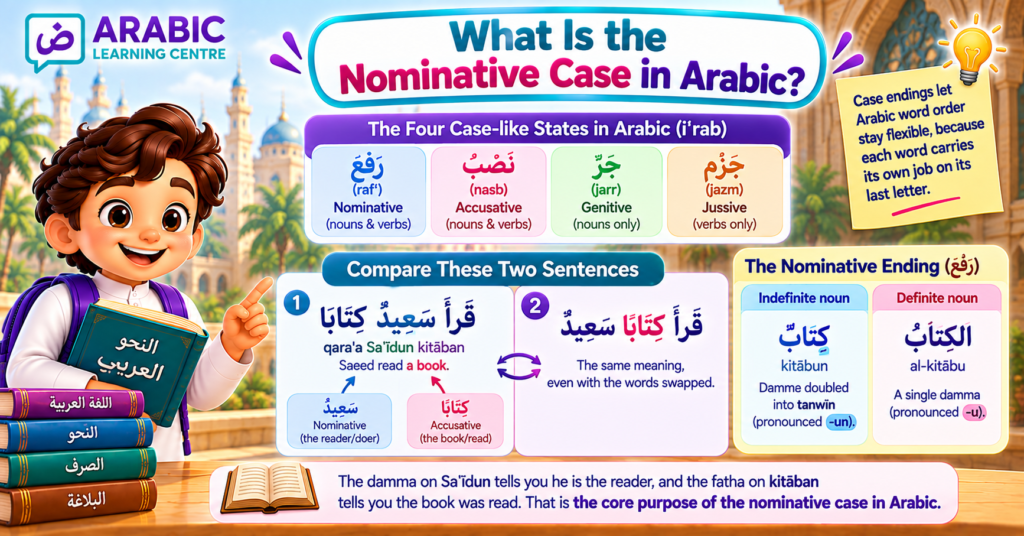
Case endings let Arabic word order stay flexible, because each word carries its own job on its last letter. Compare these two sentences:
- قَرَأَ سَعِيدٌ كِتَابًا (qara’a Sa’īdun kitāban) — Saeed read a book.
- قَرَأَ كِتَابًا سَعِيدٌ — the same meaning, even with the words swapped.
The damma on Sa’īdun tells you he is the reader, and the fatha on kitāban tells you the book was read. That is the core purpose of the nominative case in Arabic: it separates the doer from the thing done.
When a word is indefinite, the damma is doubled into tanwīn and pronounced -un (كِتَابٌ, kitābun). When it is definite, it is a single damma pronounced -u (الكِتَابُ, al-kitābu). Many traditions credit Abu al-Aswad al-Du’ali with founding Arabic grammar and these terms, though some scholars doubt the terminology was fully developed in his time.
Young learners can meet these ideas gently through vocabulary first. Our Arabic words for kids course builds the word bank that makes case endings easier to notice later.
Read also: Mansub In Arabic Grammar – A Complete Guide To The Accusative Case

The Original Sign of the Nominative Case: Damma
The damma (الضمة) is the original and most common sign of the nominative case.
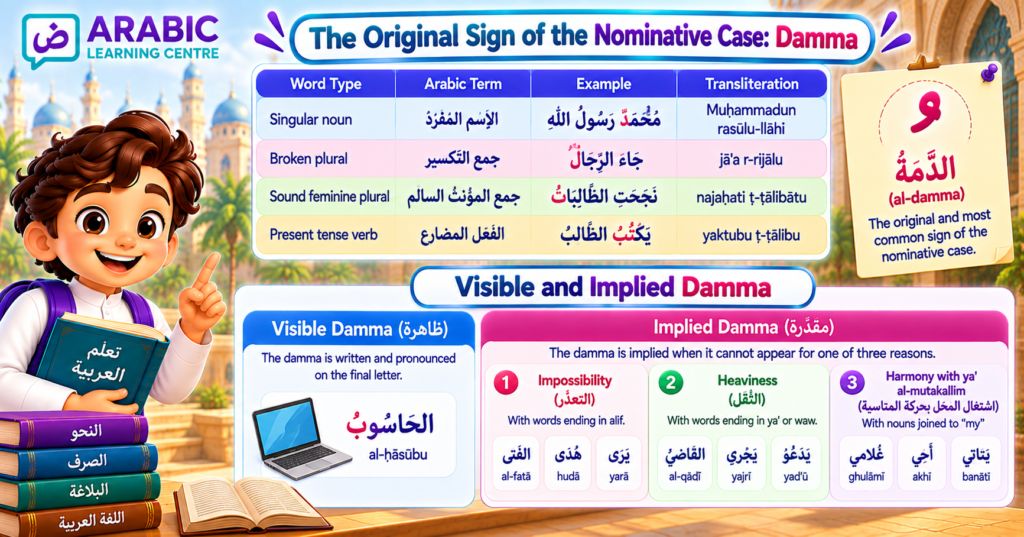
It appears with several types of words:
| Word Type | Arabic Term | Example | Transliteration |
| Singular noun | الاسم المفرد | مُحَمَّدٌ رَسُولُ اللهِ | Muḥammadun rasūlu-llāhi |
| Broken plural | جمع التكسير | جَاءَ الرِّجَالُ | jā’a r-rijālu |
| Sound feminine plural | جمع المؤنث السالم | نَجَحَتِ الطَّالِبَاتُ | najaḥati ṭ-ṭālibātu |
| Present tense verb | الفعل المضارع | يَكْتُبُ الطَّالِبُ | yaktubu ṭ-ṭālibu |
A singular noun is a noun that is neither dual nor plural and is not one of the five nouns. A broken plural changes the internal structure of the singular, such as:
كِتَاب → كُتُب
A sound feminine plural adds ـات without changing the basic structure of the singular.
Read also: 13 Arabic Punctuation Marks – A Complete Guide to Punctuation in Arabic
Visible and Implied Damma
The damma may be either visible (ظاهرة) or implied (مقدّرة). The damma is visible when it can be written and pronounced on the final letter, as in:
الحَاسُوبُ
It is implied when the word ends in a weak letter or another grammatical feature prevents the damma from appearing.
There are three main reasons:
- Impossibility (التعذّر)
With words ending in alif:- الفَتَى
- هُدَى
- يَرَى
- Heaviness (الثِّقل)
With words ending in ya’ or waw:- القَاضِي
- يَجْرِي
- يَدْعُو
- Harmony with ya’ al-mutakallim (اشتغال المحل بحركة المناسبة)
With nouns joined to “my”:- غُلَامِي
- أَخِي
- بَنَاتِي
In all three cases, the word remains nominative; the damma is simply described as implied because it cannot appear.
The Subsidiary Signs of the Nominative Case
The nominative case does not always use the damma There are three subsidiary signs that replace it in specific grammatical forms:
- Waw (الواو)
- Alif (الألف)
- Retained nun (ثبوت النون)

1. The waw (الواو)
The waw marks the nominative case in two main situations. Sound masculine plurals (جمع المذكر السالم): These add ـونَ to the singular in the nominative, and ـينَ in the other cases.
Example: المُعَلِّمُونَ نَشِيطُونَ (al-mu’allimūna nashīṭūna) — The teachers are active. Words treated the same way include عِشْرُونَ to تِسْعُونَ, أَهْلُونَ, أُولُو, and سِنُونَ.
The five nouns (الأسماء الخمسة): These are أَب, أَخ, حَم, فُو, and ذُو. Example: جَاءَ أَخُوكَ (jā’a akhūka) — Your brother came. They take the waw only when all four conditions are met:
- They are singular, not dual or plural.
- They are not in diminutive form (أُخَيّ takes a normal damma).
- They are in an iḍāfa (possessive) construction, as in أَبُو هُرَيْرَةَ.
- They are not joined to ya’ al-mutakallim (أَخِي takes an implied damma).
Two extra conditions apply: فُو must appear without its mim (فُوكَ, not فَمُكَ), and ذُو must mean “possessor of” and be followed by a regular noun, as in ذُو عِلْمٍ.
2. The alif (الألف)
The alif marks the nominative case of the dual (المثنى), which adds ـانِ to the singular. Example: كَانَ الوَلَدَانِ فِي الصَّفِّ — The two boys were in class. When a dual is the first term of an iḍāfa, its nun drops: يَدْرُسُ بَاحِثَا اللُّغَةِ — The two language researchers study.
The words اثْنَانِ and اثْنَتَانِ follow the dual pattern. So do كِلَا and كِلْتَا, but only when joined to a pronoun (كِلَاهُمَا). With a regular noun, as in كِلَا الطَّالِبَيْنِ, they take an implied damma on the alif.
3. The retained nun (ثبوت النون)
The nun marks the nominative case of the five verbs (الأفعال الخمسة). These are present tense verbs joined to the dual alif, the plural waw, or the feminine ya’:
| Pattern | Example | Meaning |
| يَفْعَلَانِ | يَكْتُبَانِ | they (two) write |
| تَفْعَلَانِ | تَكْتُبَانِ | you (two) write / they (two, f.) write |
| يَفْعَلُونَ | يَكْتُبُونَ | they write |
| تَفْعَلُونَ | تَكْتُبُونَ | you (pl.) write |
| تَفْعَلِينَ | تَكْتُبِينَ | you (f.) write |
If the nun stays, the verb is nominative. If a particle like لَنْ or لَمْ removes it, the verb has moved to the accusative or jussive.
Inside Our Classrooms
See how we make learning interactive and engaging! Watch a quick snippet of our live, conversational classes in action:
Where Nouns Take the Nominative Case
Knowing the signs is half the job; the other half is knowing when a noun must be nominative. These are the main positions, called marfū’āt al-asmā’ (مرفوعات الأسماء).

1. Al-Fā’il: The Subject
The fā’il (الفاعل) is the doer of the action in a verbal sentence and is normally nominative.
Example: جَاءَ المُعَلِّمُ — The teacher came.
2. Nā’ib al-Fā’il: The Deputy Subject
When a verb is passive, the object takes the subject’s place and becomes nominative.
Example: كُتِبَ الدَّرْسُ — The lesson was written.
3. Al-Mubtada’ and Al-Khabar
In a nominal sentence, both the mubtada’ (المبتدأ) and khabar (الخبر) are normally nominative.
Example: المُعَلِّمُونَ نَشِيطُونَ — The teachers are active.
4. Ism Kāna and Its Sisters
Kāna and its sisters (كان وأخواتها) keep their subject nominative and make the predicate accusative.
Examples of these verbs include:
- أَصْبَحَ
- صَارَ
- لَيْسَ
Example: كَانَ الجَوُّ جَمِيلًا — The weather was beautiful.
5. Khabar Inna and Its Sisters
Inna and its sisters (إنّ وأخواتها) do the reverse.
They make their subject accusative while their predicate remains nominative.
These include:
- إِنَّ
- أَنَّ
- كَأَنَّ
- لَكِنَّ
- لَيْتَ
- لَعَلَّ
Example: إِنَّ الفَرَجَ قَرِيبٌ — Relief is indeed near.
6. Al-Tawābi’: Followers
The tawābi’ (التوابع) are words that copy the grammatical case of the word they follow.
They include:
- Adjective (النعت)
- Conjoined word (العطف)
- Emphasis (التوكيد)
- Substitute/apposition (البدل)
Example: جَاءَ الطُّلَّابُ كُلُّهُمْ — The students all came.
Once your child is comfortable with basic sentence types, our elementary school Arabic course introduces the subject, mubtada’, and khabar with guided practice.

The Nominative Case in Verbs
Only one verb form can be nominative: the present tense verb (الفعل المضارع). The past tense and the imperative are fixed (مبنيّ) and never change their endings.
A present tense verb is nominative whenever no accusative particle (أَنْ, لَنْ, كَيْ) or jussive particle (لَمْ, لَا الناهية) comes before it. Grammarians call this “being free” (التجرّد) of those particles.
- يَذْهَبُ أَحْمَدُ إِلَى المَدْرَسَةِ — Ahmad goes to school. (visible damma)
- أَرَى القَمَرَ — I see the moon. (implied damma on the alif)
- الطُّلَّابُ يَدْرُسُونَ — The students are studying. (retained nun)
One exception matters. When a present tense verb is joined to the nun of emphasis (لَأَكِيدَنَّ) or the feminine plural nun (يُرْضِعْنَ), it becomes fixed and no longer takes case at all.
Tips for Mastering the Nominative Case in Arabic
Mastering the nominative case becomes easier when you focus on the grammatical role of each word and recognize the word type before identifying its ending.

The following tips can help you understand nominative forms more accurately and apply them with confidence.
1. Identify the Grammatical Role of the Word
Ask yourself: What job is this word doing in the sentence?
Is it the subject, topic, or predicate? Identifying the grammatical role first helps you determine whether the word should be nominative.
2. Determine the Type of Word
First, determine whether the word is:
- Singular
- Dual
- Plural
- One of the five nouns
Knowing the word type helps you determine which nominative sign it takes.
3. Understand How Kāna and Inna Affect Case Endings
Pay close attention to Kāna and its sisters and Inna and its sisters, as they are among the most common reasons learners identify the wrong word as nominative.
4. Improve Your Understanding by Listening to Arabic News
Arabic newsreaders often pronounce case endings clearly. Listening to formal Arabic can therefore help train your ear to recognize nominative endings naturally.
5. Practice I’rab Aloud to Strengthen Your Grammar Skills
Practice saying the complete grammatical analysis aloud, such as: مبتدأ مرفوع وعلامة رفعه الضمة الظاهرة. Older students preparing for exams can also benefit from deeper practice with full grammatical analysis. Our high school Arabic course covers i’rab, the five nouns, and kāna and inna in detail.

Don’t Just Take Our Word For It
Take a look inside our vibrant classes and see our students and teachers in action. Click below to watch our classroom experience:
Build Stronger Arabic Grammar Skills with Arabic Learning Centre
Understanding Arabic grammar takes more than memorizing rules. At Arabic Learning Centre, students learn grammar through clear explanations and guided practice that make difficult concepts easier to understand.
From basic sentence structure to advanced topics like the nominative case in Arabic, our courses help learners develop stronger reading, writing, and Arabic grammar skills through structured lessons.
Whether you are learning Arabic yourself or looking for a course for your child, Arabic Learning Centre offers programs designed to support steady progress and greater confidence.
Book your free trial lesson today and discover a better way to learn Arabic!
Courses We Offer:
- Quranic Arabic Course
- Arabic Course for Islamic Studies
- Learn Arabic for New Muslims
- Learn Arabic Letters for Tajweed
- Al Azhar Arabic Course
- Madinah Arabic Course

Conclusion
Understanding the nominative case in Arabic is an important step toward mastering Arabic grammar. By learning the difference between the damma, waw, alif, and retained nun, learners can identify nominative words more easily and understand how their grammatical roles affect sentence structure.
However, mastering the nominative case is not simply about memorizing its signs. It is equally important to understand the grammatical position of each word. Subjects, deputy subjects, mubtada’, khabar, the subject of kāna and its sisters, and the predicate of inna and its sisters all follow specific grammatical rules that determine their case.
With regular practice, reading, listening to formal Arabic, and applying i’rab to complete sentences, learners can gradually develop a stronger understanding of the nominative case in Arabic. These skills can make reading, writing, and understanding Modern Standard Arabic much easier and more accurate.
Frequently Asked Questions
1. What is the nominative case in Arabic?
The nominative case, or al-raf’ (الرَّفْع), is a grammatical state used to mark certain nouns and present-tense verbs in Arabic. Its original sign is the damma.
2. What is the main sign of the nominative case?
The damma (الضمة) is the original and most common sign of the nominative case. It can be visible or implied depending on the word.
3. What are the signs of the nominative case in Arabic?
The nominative case has one original sign, the damma, and three main subsidiary signs: waw, alif, and retained nun.
4. When does a noun take the nominative case?
A noun can be nominative when it functions as the subject, deputy subject, mubtada’, khabar, the subject of kāna and its sisters, the predicate of inna and its sisters, or a follower of another nominative word.
5. Is the present tense verb always nominative?
No. A present tense verb is normally nominative when it is not preceded by an accusative or jussive particle. Particles such as لَنْ and لَمْ can change its grammatical state.
6. What is the difference between the nominative case and the accusative case?
The nominative case is commonly associated with roles such as the subject and predicate, while the accusative case appears in different grammatical positions, such as the direct object and the predicate of kāna and its sisters. Learning the grammatical role of each word helps distinguish between the two cases.
One response to “Nominative Case In Arabic – Signs, Positions, And Examples”
Related Articles
Arabic Grammar








[…] Read also: Nominative Case In Arabic – Signs, Positions, And Examples […]