 Arabic Grammar

A single vowel can change the meaning of an entire Arabic sentence. Consider رأى زيدٌ عمرًا (Zayd saw Amr) and رأى زيدًا عمرٌو (Amr saw Zayd). Although the same verb and names appear in both sentences, their grammatical endings reveal who performs the action and who receives it. This distinction is one of the reasons understanding mansub in Arabic grammar is essential.
Mansub (مَنْصُوب), also known as the accusative case in Arabic, is not simply about adding a fatha to the end of a word. It is a grammatical system that helps explain the relationships between different parts of a sentence, from direct objects and adverbs to circumstantial expressions and present-tense verbs.
In this guide, you will learn what mansub means, how to recognise its grammatical signs, and when nouns and verbs take the accusative case.
Through clear explanations, practical examples and illustrations from the Qur’an, you will also discover how these rules can improve your understanding of Classical Arabic and everyday written Arabic.
What you’ll learn in this article:
- What mansub (مَنْصُوب) means in Arabic grammar and how it differs from nasb
- The main signs of the accusative case and when each one is used
- The different types of mansub nouns, including direct objects, adverbs, ḥāl, tamyīz, and more
- How pronouns affect the position of the subject and object in Arabic sentences
- The difference between ḥāl and tamyīz and how to identify each one
- How kāna, inna, and lā change the grammatical case of nouns
- When present-tense verbs become mansub and which particles cause nasb
- How understanding mansub can help you read and understand Arabic sentences more accurately
What Is Mansub in Arabic Grammar?
A mansub (مَنْصُوب) word is a noun or a present-tense verb that carries the sign of nasb, the accusative case. In Arabic grammar, a word becomes mansub for a grammatical reason: it is the object of a verb, it describes a state, it follows a particle such as إنَّ, or it sits in another position that demands the accusative.
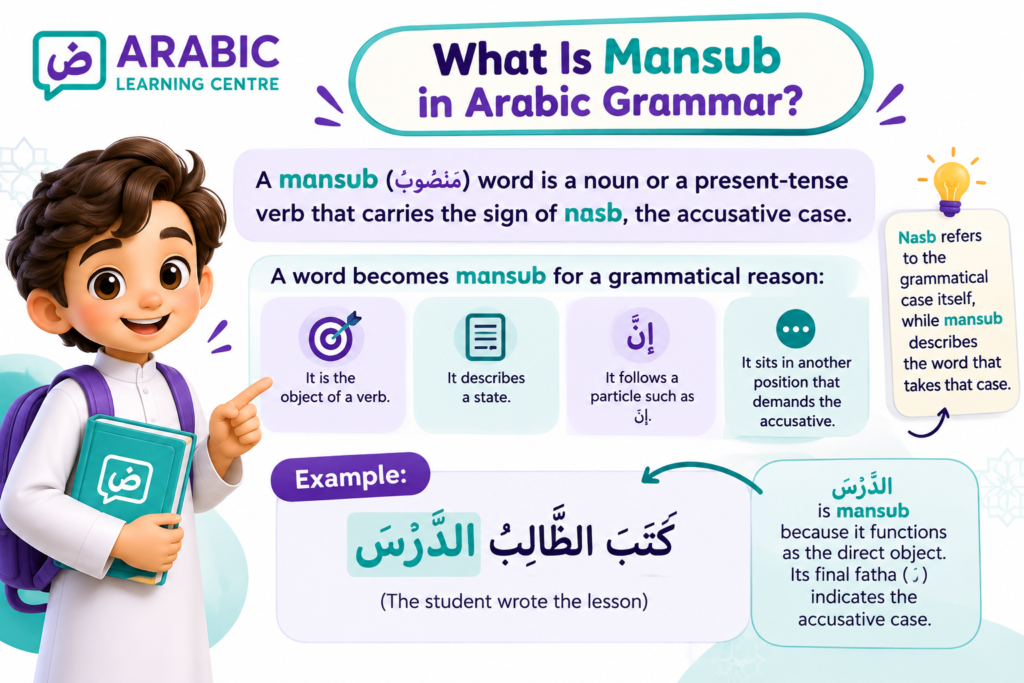
It is important to distinguish between nasb and mansub. Nasb refers to the grammatical case itself, while mansub describes the word that takes that case.
For example, in كَتَبَ الطَّالِبُ الدَّرْسَ (The student wrote the lesson), الدَّرْسَ is mansub because it functions as the direct object. Its final fatha indicates the accusative case, helping readers distinguish the person performing the action from the thing receiving it.
Understanding mansub in Arabic grammar is one of the biggest steps from reading Arabic to truly understanding it. The ending of a single word can tell you who did the action, who received it, and how it happened.
That is why the accusative case in Arabic sits at the heart of every serious grammar programme, from beginner lessons to our Classical Arabic Course.
Read also:13 Arabic Punctuation Marks – A Complete Guide to Punctuation in Arabic

The Signs of the Accusative Case in Arabic
The original sign of nasb is the fatha (ـَ), shown or implied. Four other signs can stand in for it, depending on the type of word.
| Word type | Sign of nasb | Example |
| Singular noun and broken plural | Fatha (shown or implied) | رأيتُ الطالبَ |
| The five nouns (أبٌ، أخٌ، حمٌ، فو، ذو) when in iḍāfa | Alif (ا) | احترمْ أباكَ |
| Sound feminine plural | Kasra in place of fatha | كرّمتُ الطالباتِ |
| Dual and sound masculine plural | Yā’ (ي) | قابلتُ رجلَيْنِ / المعلّمِينَ |
| The five verbs (يفعلان، تفعلون، تفعلين…) | Dropping the final nūn | لن تنالوا البرّ |
One sentence can show almost all of these at once: احترمْ أمَّك وأباك وأخوَيك وخالاتِك والأقربين. Here أمَّ takes a fatha, أبا takes an alif, أخوَي takes a yā’ (dual), خالاتِ takes a kasra, and الأقربين takes a yā’ (masculine plural).
Read also: How To Ask A Question In Arabic?
Which Arabic Nouns Are Mansub?
In his classical primer al-Ājurrūmiyya, Ibn Ājurrūm states that there are fifteen categories of accusative nouns (المنصوبات خمسة عشر), although his enumeration explicitly lists fourteen. Later commentators have discussed this discrepancy, with some identifying the objects of ẓanna and its sisters (مفعولا ظن وأخواتها) as the omitted category.
For a comprehensive learning overview, the following table presents fifteen grammatical categories, keeping adverbs of time and place separate and grouping the four accusative followers together.
| # | Arabic Term | English | Quick Example |
| 1 | المفعول به | Direct object | قرأتُ الكتابَ |
| 2 | المفعول المطلق | Absolute object | فرحتُ فرحًا |
| 3 | المفعول لأجله | Object of reason | درستُ طلبًا للنجاح |
| 4 | ظرف الزمان | Adverb of time | سافرتُ صباحًا |
| 5 | ظرف المكان | Adverb of place | جلستُ أمامَ المنزلِ |
| 6 | المفعول معه | Object of accompaniment | سرتُ والنهرَ |
| 7 | الحال | Circumstantial state | جاء زيدٌ راكبًا |
| 8 | التمييز | Specification | اشتعل الرأسُ شيبًا |
| 9 | المستثنى | Excepted noun | حضر الطلابُ إلا طالبًا |
| 10 | المنادى | Vocative (certain types) | يا طالبَ العلمِ |
| 11 | خبر كان وأخواتها | Predicate of kāna and its sisters | كان الجوُّ لطيفًا |
| 12 | اسم إنّ وأخواتها | Subject of inna and its sisters | إنّ الطالبَ مجتهدٌ |
| 13 | اسم لا النافية للجنس | Subject of generic negation lā | لا طالبَ علمٍ مهملٌ |
| 14 | التابع للمنصوب | Follower of an accusative noun | قابلتُ رجلًا خلوقًا |
| 15 | مفعولا ظن وأخواتها | Two objects of ẓanna and its sisters | ظننتُ الطالبَ مجتهدًا |
The Direct Object in Arabic (al-Maf‘ūl Bihi)
The direct object is the noun that receives the action of the doer, as in قدّم معنٌ أطروحةً (Ma‘n submitted a thesis). It is the most common mansub word you will meet.
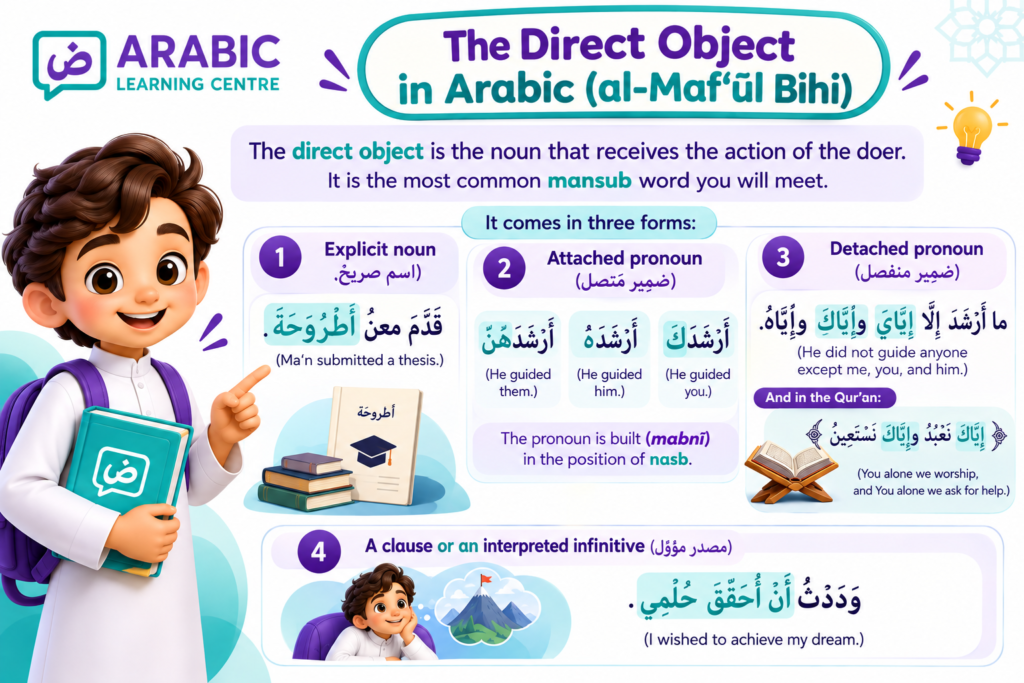
It comes in three forms:
- Explicit noun: قدّم معنٌ أطروحةً.
- Attached pronoun: أرشدَكَ، أرشدَه، أرشدَهنّ. The pronoun is built (mabnī) in the position of nasb.
- Detached pronoun: ما أرشدَ إلا إيّايَ وإيّاكَ وإيّاه, and in the Qur’an: إِيَّاكَ نَعْبُدُ وَإِيَّاكَ نَسْتَعِينُ.
The object can also be a clause or an interpreted infinitive (مصدر مؤوّل), as in وددتُ أن أحقّقَ حلمي, which means “I wished to achieve my dream.”
Don’t Just Take Our Word For It
Take a look inside our vibrant classes and see our students and teachers in action. Click below to watch our classroom experience:
How Pronouns Affect the Order of Subject and Object?
Pronouns can influence word order in Arabic, particularly when they attach directly to a verb. Two important rules help explain how the subject and object are arranged.
1. Word Order When the Subject or Object Is an Attached Pronoun
The object may appear before or after an explicit subject. However, an attached pronoun must remain connected to its verb:
- Attached object pronoun: أرشدَكَ المعلّمُ (the object pronoun is attached to the verb).
- Attached subject pronoun: أرشدْتُ الطالبَ (the subject pronoun is attached to the verb).
2. Word Order When a Verb Takes Two Object Pronouns
When a verb such as ملّك or أعطى takes two pronoun objects, the second may be attached or detached if the first is more specific (أعرف):
- Both attached: ملّكْتُكَهُ.
- Second detached: ملّكْتُكَ إيّاه.
If the first object is less specific, the second must be detached: ملّكْتُهُ إيّاكَ.
These rules matter in writing as much as in reading. Learners who want to apply them in their own sentences can practise them in our Arabic writing course.

Four More Types of Maf‘ūl: Emphasis, Reason, Time and Place, and Accompaniment
Beyond the direct object, Arabic grammar uses four other types of maf‘ūl to add meaning to an action. They explain how an action is emphasised, why it happens, when or where it takes place, and what accompanies it. Each has a distinct grammatical function and rules of usage.
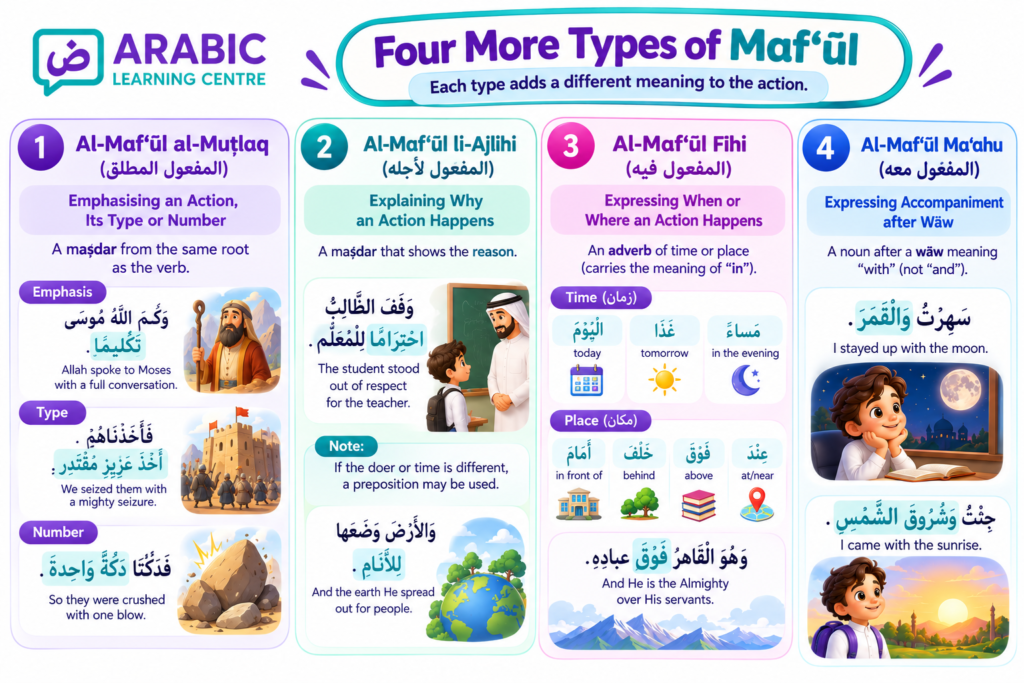
Al-Maf‘ūl al-Muṭlaq: Emphasising an Action, Its Type or Number
The absolute object is a verbal noun (maṣdar) from the same root as its verb. It does one of three jobs:
- Emphasis: وَكَلَّمَ اللَّهُ مُوسَى تَكْلِيمًا.
- Type: فَأَخَذْنَاهُمْ أَخْذَ عَزِيزٍ مُقْتَدِرٍ.
- Number: فَدُكَّتَا دَكَّةً وَاحِدَةً.
Other words can stand in for it, such as its adjective (درستُ كثيرًا), a number (درتُ الملعبَ ثلاثَ دوراتٍ), or كلّ and بعض (أخلصتُ كلَّ الإخلاص). A maṣdar can also replace its verb completely, as in صبرًا على الأذى or سقيًا لك ورعيًا.
Al-Maf‘ūl li-Ajlihi: Explaining Why an Action Happens
This is a maṣdar that explains why the action happened. For direct accusative use, it generally shares the same doer and time as the verb: وقف الطالبُ احترامًا للمعلّم. When these conditions are not met, a preposition of reason may be used instead, as in وَالْأَرْضَ وَضَعَهَا لِلْأَنَامِ.
Al-Maf‘ūl Fīhi: Expressing When or Where an Action Happens
The adverb tells you when or where the action happened, and it carries the meaning of “in” (في). Examples include اليومَ، غدًا، مساءً for time and أمامَ، خلفَ، فوقَ، عندَ for place: وَهُوَ الْقَاهِرُ فَوْقَ عِبَادِهِ.
A time word is an adverb only when it means “in.” In وَإِنَّ يَوْمًا عِنْدَ رَبِّكَ كَأَلْفِ سَنَةٍ, the word يومًا is not an adverb; it is the subject of إنّ.
Al-Maf‘ūl Ma‘ahu: Expressing Accompaniment After Wāw
This noun comes after a wāw meaning “with” (واو المعية), not “and.” It must follow a verb or something with a verb’s meaning: سهرتُ والقمرَ (I stayed up with the moon) and جئتُ وشروقَ الشمسِ.
Ḥāl vs Tamyīz: Describing a State or Removing Ambiguity
Both ḥāl and tamyīz are important accusative constructions in Arabic grammar, and learners often confuse them because both provide additional information about a sentence. However, they serve different purposes: ḥāl describes the state or manner of an action, while tamyīz clarifies an otherwise vague word or expression.
Al-Ḥāl: Describing Someone’s State During an Action
The ḥāl describes the state of a noun at the moment of the action. It answers the question “how?”: جاء زيدٌ راكبًا (Zayd came riding). It is usually indefinite and derived, and the noun it describes is usually definite.
The ḥāl can take three forms:
- A single word: فَتَبَسَّمَ ضَاحِكًا مِنْ قَوْلِهَا.
- A sentence, linked by a pronoun, a wāw, or both: وَجَاءُوا أَبَاهُمْ عِشَاءً يَبْكُونَ, or عاد الجنديّ وهو منتصرٌ.
- A semi-sentence (prepositional phrase or adverb): فَخَرَجَ عَلَى قَوْمِهِ فِي زِينَتِهِ.
At-Tamyīz: Clarifying an Ambiguous Word or Sentence
The tamyīz is an indefinite noun that removes vagueness. It clarifies what is meant by an otherwise ambiguous expression. There are two main types:
- Tamyīz of an entity: It clarifies a vague word before it, such as a number or a measure: إِنِّي رَأَيْتُ أَحَدَ عَشَرَ كَوْكَبًا, اشتريتُ رطلًا زيتًا.
- Tamyīz of a relation: It clarifies a whole vague sentence. It is often shifted from a subject (وَاشْتَعَلَ الرَّأْسُ شَيْبًا), an object (وَفَجَّرْنَا الْأَرْضَ عُيُونًا), or a subject of a nominal sentence (أَنَا أَكْثَرُ مِنْكَ مَالًا).
Key Differences Between Ḥāl and Tamyīz
Although both constructions add meaning to a sentence, their grammatical roles and forms differ. The following table summarises the main distinctions to help learners identify each one correctly.
| Point | Ḥāl | Tamyīz |
| Question it answers | How? | What? / In what respect? |
| Usual form | Derived (مشتق) | Non-derived (جامد) |
| Job | Shows the state of its owner | Removes vagueness from a word or sentence |
| Possible forms | Word, sentence, or semi-sentence | Single noun only |
| Typical meaning | State or manner | Specification or clarification |
The Excepted Noun and the Vocative in Arabic Grammar
The excepted noun (al-mustathnā) and the vocative (al-munādā) are two important constructions in Arabic grammar. The first excludes someone or something from a general statement, while the second is used to address or call someone directly. Their grammatical forms vary according to the structure of the sentence.
Al-Mustathnā: How Exception Affects the Grammatical Case
The noun after إلا is excluded from the ruling of what came before it. Its grammatical case depends on whether the sentence is complete or incomplete, and affirmative or negative:
- Complete and affirmative: The excepted noun must be mansub: حضر الطلابُ إلا طالبًا.
- Complete and negative: It may be mansub or follow the noun before it as a substitute (badal): ما جاء الطلابُ إلا طالبًا / إلا طالبٌ.
- Incomplete and negative: إلا expresses restriction, and the noun takes the grammatical case required by its position in the sentence: ما جاء إلا زيدٌ (زيدٌ is the subject).
Al-Munādā: When the Vocative Is Mansub or Built on Ḍamma
The vocative is a noun addressed using a calling particle such as يا، أيا، هيا، أ، or أي. It is grammatically in the position of nasb, although its ending varies according to its type:
- Mansub with an accusative ending: This includes the vocative in iḍāfa (يا طالبَ العلمِ), the one resembling iḍāfa (يا صاعدًا جبلًا), and the non-specific indefinite (يا غافلًا تنبّهْ).
- Built on ḍamma in the position of nasb: This includes the single proper name (يا يوسفُ أعرضْ عن هذا) and the specific indefinite (يا رجلُ أغلقِ البابَ).
How Kāna, Inna and Lā Change the Case of Nominal Sentences?
Some words enter a nominal sentence and change its case endings. Grammarians call them nawāsikh (cancellers).
- Predicate of kāna and its sisters: كان، أصبح، أمسى، أضحى، ظلّ، بات، صار، ليس، ما زال، ما دام and others keep the subject in the nominative and make the predicate mansub: كان الجوُّ لطيفًا.
- Subject of inna and its sisters: إنّ، أنّ، كأنّ، لكنّ، ليت، لعلّ make the subject mansub and keep the predicate nominative: إنّ الطالبَ مجتهدٌ.
- Subject of generic lā: لا that denies a whole class works like إنّ when its subject and predicate are indefinite and nothing separates lā from its subject: لا رجلَ في الدار.
If Arabic is not your first language, our Arabic course for non-Arabic speakers builds these grammar foundations step by step, with real texts and personal feedback.

When Does the Arabic Present-Tense Verb Become Mansub?
The only verb that can be mansub is the present tense (al-muḍāri‘). Its sign is normally a fatha (which may be estimated on a final alif); the five verbs instead lose their final nūn. The particles that cause this fall into four groups.
| Group | Particles | Example |
| Work on their own | أنْ، لنْ، كي (after a real or implied lām), إذنْ | أَلَا تُحِبُّونَ أَن يَغْفِرَ اللَّهُ لَكُمْ — لَنْ تَنَالُوا البِرَّ |
| Hidden أنْ, optional | Lām of reason (لام التعليل) | إِنَّا آمَنَّا بِرَبِّنَا لِيَغْفِرَ لَنَا خَطَايَانَا |
| Hidden أنْ, required | حتى، lām of denial (after ما كان / لم يكن) | فَاعْفُوا وَاصْفَحُوا حَتَّى يَأْتِيَ اللَّهُ بِأَمْرِهِ — وَمَا كَانَ اللَّهُ لِيُضِيعَ إِيمَانَكُمْ |
| Hidden أنْ, required | فاء السببية، واو المعية (after a negation or request), أو meaning “until” or “unless” | لَا تَجْعَلْ مَعَ اللَّهِ إِلَهًا آخَرَ فَتَقْعُدَ مَذْمُومًا — لأُحاربنَّ الكافرَ أو يُسلمَ |
Note the two examples with the five verbs: in لن تنالوا البرّ and لِكَيْ لَا تَحْزَنُوا, the sign of nasb is the dropped nūn, not a fatha.
Inside Our Classrooms
See how we make learning interactive and engaging! Watch a quick snippet of our live, conversational classes in action:
Master Arabic Grammar with Arabic Learning Centre
Understanding the rules of mansub is an important step towards mastering Arabic, but knowing grammatical rules and applying them confidently are two different skills. With the right guidance and consistent practice, learners can begin to recognise grammatical patterns naturally and understand how they shape the meaning of Arabic sentences.
At Arabic Learning Centre, we make learning Arabic clear, engaging and accessible. Our experienced teachers guide students through essential language concepts, helping them develop a deeper understanding of Arabic grammar while strengthening their reading, writing and communication skills.
Whether you are a beginner building your foundations or an advanced learner seeking a deeper understanding of Classical Arabic, our academy provides a supportive learning environment where you can progress at your own pace and turn grammatical knowledge into practical language skills.
Ready to take the next step? Book your free trial lesson with Arabic Learning Centre today!
Courses We Offer:
- Online Arabic Course
- Classical arabic course
- Modern Standard Arabic Course
- Fusha Arabic Course
- Learn Saudi Arabic

Conclusion
Understanding mansub in Arabic grammar goes beyond recognising a fatha at the end of a word. It involves identifying the grammatical role of each expression and understanding why a noun or present-tense verb takes the accusative case.
From the direct object and the different types of maf‘ūl to ḥāl, tamyīz, exception, vocative constructions and the particles that affect present-tense verbs, each rule contributes to a clearer understanding of Arabic sentence structure.
The key to mastering these concepts is consistent practice. Start by identifying mansub words in short sentences, examine the grammatical reason behind each ending, and gradually apply what you learn to longer passages. Over time, this approach will help you read Arabic texts more accurately and express yourself with greater confidence.
Frequently Asked Questions
1. What does Mansub mean in Arabic grammar?
Mansub (مَنْصُوب) refers to a noun or present-tense verb that takes the accusative case (naṣb) due to its grammatical position or an influencing particle. It helps identify the role of a word within an Arabic sentence.
2. What are the signs of Nasb in Arabic?
The primary sign of nasb is the fatha (ـَ). Depending on the word type, other signs include alif for the five nouns, yā’ for dual nouns and sound masculine plurals, kasra for sound feminine plurals, and the omission of the final nūn in the five verbs.
3. What is the difference between Mansub and Marfu‘?
Mansub indicates the accusative case, while marfu‘ (مَرْفُوع) indicates the nominative case. For example, in كَتَبَ الطَّالِبُ الدَّرْسَ, الطالبُ is marfu‘ because it is the subject performing the action, whereas الدرسَ is mansub because it is the direct object receiving the action.
4. Are all direct objects Mansub in Arabic?
Yes. The direct object (al-maf‘ūl bihi) occupies the accusative position in Arabic grammar. An explicit noun normally displays an appropriate sign of nasb, while an attached or detached object pronoun is grammatically in the position of nasb (في محل نصب), even when its ending does not change.
5. What is the difference between Ḥāl and Tamyīz?
Ḥāl describes the state or manner of someone or something during an action and usually answers “how?”. Tamyīz removes ambiguity from a word or an entire expression. For example, جاء زيدٌ راكبًا contains a ḥāl, while اشتعل الرأسُ شيبًا contains a tamyīz.
6. When does a present-tense verb become Mansub in Arabic?
A present-tense verb becomes mansub when preceded by a governing particle such as أنْ or لنْ, or when affected by an implied أنْ in certain grammatical constructions. For example, in لن أَتَأَخَّرَ, the verb أَتَأَخَّرَ is mansub with a fatha because it follows لنْ.