 Arabic Grammar
| Key Takeaways |
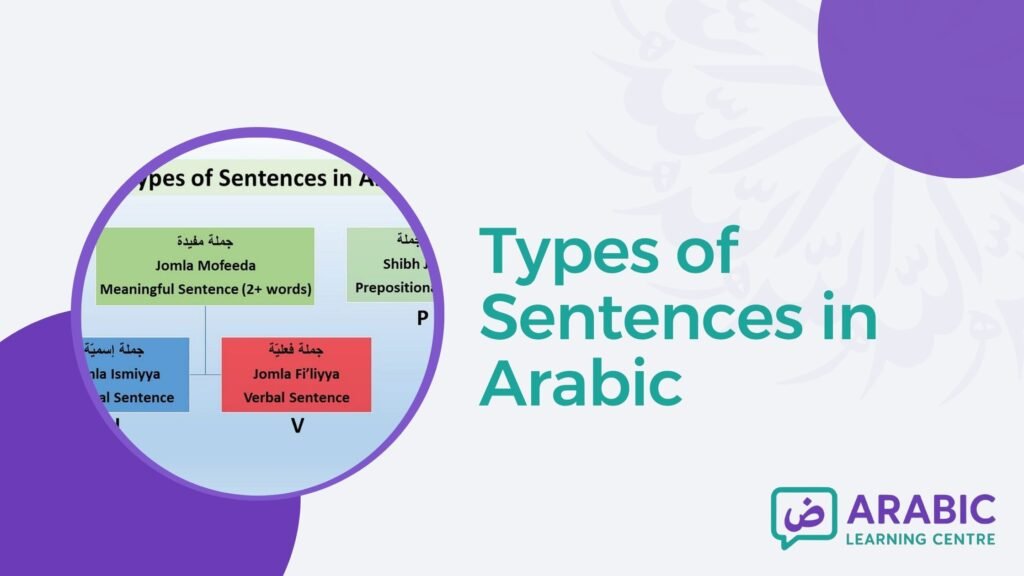
| Arabic has two foundational sentence types: the nominal sentence (الجملة الاسمية) and the verbal sentence (الجملة الفعلية), each with distinct grammatical structures. |
| A nominal sentence begins with a noun or pronoun and consists of a subject (مبتدأ) and a predicate (خبر), expressing states or facts. |
| A verbal sentence begins with a verb (فعل) followed by a subject (فاعل), making the action the primary focus of the sentence. |
| Every Arabic sentence must achieve grammatical completeness (الإسناد), meaning the subject and predicate together convey a full, intelligible meaning. |
Understanding which type of Arabic sentence you are working with is not optional — it determines case endings, word order, verb agreement, and pronoun use.
Once this distinction clicks, the rest of Arabic grammar begins to make structural sense in a way it simply cannot without it.
What Are the Types of Sentences in Arabic?
Arabic sentences fall into two main types: the nominal sentence (الجملة الاسمية, al-jumla al-ismiyya) and the verbal sentence (الجملة الفعلية, al-jumla al-fi’liyya). This is one of the earliest and most definitive classifications in classical Arabic grammar (Nahw), established by Arab grammarians over a thousand years ago and still the backbone of every serious Arabic curriculum today.
What Is the Nominal Sentence in Arabic?
The nominal sentence (الجملة الاسمية, al-jumla al-ismiyya) is an Arabic sentence that begins with a noun or pronoun. It consists of two parts: the مبتدأ (mubtada’, subject) and the خبر (khabar, predicate). Together, these two elements make a complete, self-contained statement — typically expressing a state, description, or fact rather than an action. The مبتدأ is always in the nominative case (مرفوع).
What Is the مبتدأ (Subject) in a Nominal Sentence?
The مبتدأ (mubtada’) is the topic of the sentence — the noun or pronoun that the sentence is about. In classical Nahw scholarship, it carries the nominative case marker (ضمة, damma) and is typically definite, either through the definite article ال (al-) or through being a proper noun.
Example:
الكِتَابُ جَدِيدٌ
Al-kitābu jadīdun
The book is new.
Here, الكتابُ (al-kitābu) is the مبتدأ — definite, nominative. جديدٌ (jadīdun) is the خبر — indefinite, also nominative.
What Is the خبر (Predicate) in a Nominal Sentence?
The خبر (khabar) completes the meaning by telling us something about the مبتدأ. It can take several forms, which is where many learners encounter difficulty. The خبر is also marked with the nominative case (مرفوع).
| Type of خبر | Arabic Example | Transliteration | Meaning |
| Single adjective | الطَّالِبُ مُجْتَهِدٌ | aṭ-ṭālibu mujtahidun | The student is hardworking. |
| Prepositional phrase | الكِتَابُ عَلَى الطَّاوِلَةِ | al-kitābu ʿalā aṭ-ṭāwila | The book is on the table. |
| Another nominal sentence | الرَّجُلُ أَبُوهُ طَبِيبٌ | ar-rajulu abūhu ṭabībun | The man — his father is a doctor. |
At The Arabic Learning Centre, our Arabic Grammar Course covers both sentence types in detail, with structured exercises that help learners move from recognizing sentence parts to producing them correctly in spoken and written Arabic.
Start Learning Arabic Grammar with a Free Trial

What Is the Verbal Sentence in Arabic?
The verbal sentence (الجملة الفعلية, al-jumla al-fi’liyya) is an Arabic sentence that begins with a verb (فعل, fi’l). It places action at the forefront and typically follows the order: verb → subject → object (VSO). This structure differs meaningfully from English’s subject-verb-object (SVO) default, which is one of the main reasons English speakers need targeted instruction to internalize it.
The verb in a verbal sentence agrees with its subject in gender but — crucially — not in number when the subject follows the verb. This is a rule that trips up even advanced learners.
Example:
ذَهَبَ الطَّالِبُ إِلَى المَدْرَسَةِ
Dhahaba aṭ-ṭālibu ilā al-madrasa
The student went to school.
Here, ذهبَ (dhahaba) is the verb in the past tense — masculine singular, because the subject الطالبُ is masculine. The verb comes first; the subject follows.
Shots Videos from Our Courses
How Does Verb-Subject Agreement Work in a Verbal Sentence?
When the subject comes after the verb in a verbal sentence, the verb takes the singular form regardless of whether the subject is plural.
| Sentence | Transliteration | Meaning | Note |
| ذَهَبَ الطُّلَّابُ | dhahaba aṭ-ṭullābu | The students went. | Verb is singular (not plural), subject follows |
| ذَهَبَتِ الطَّالِبَاتُ | dhahabati aṭ-ṭālibātu | The female students went. | Verb feminine singular, subject follows |
| الطُّلَّابُ ذَهَبُوا | aṭ-ṭullābu dhahabū | The students went. | Verb plural, subject precedes (nominal sentence!) |
This table illustrates one of the most important intersections between the two sentence types. When the subject moves before the verb, you have a nominal sentence — and the verb must now agree fully in number and gender.
For a deeper look at how verbs behave in these structures, see our guide on verbal sentences in Arabic.
What Is the Difference Between a Nominal and Verbal Sentence in Arabic?
The nominal sentence and the verbal sentence differ in their opening element, their grammatical focus, and the case endings they require.
The nominal sentence opens with a noun and describes a state; the verbal sentence opens with a verb and describes an action or event.
| Feature | Nominal Sentence (الجملة الاسمية) | Verbal Sentence (الجملة الفعلية) |
| Begins with | Noun or pronoun | Verb |
| Core elements | مبتدأ + خبر | فعل + فاعل (+ مفعول) |
| Primary function | States facts, descriptions | Expresses actions, events |
| Verb-subject agreement | Full agreement (gender + number) | Gender only (when subject follows) |
| Typical tense feel | Present/timeless states | Past, present, or future actions |
In our instructors’ experience at The Arabic Learning Centre, the most common error among beginners is attempting to apply English SVO word order to Arabic verbal sentences — writing the subject before the verb and then expecting the verb to remain singular. Understanding this table prevents that confusion before it becomes a habit.
Read also: Future Tense in Arabic
How Do the مبتدأ and خبر Function Together in Arabic Grammar?
The مبتدأ and خبر are the two pillars of the nominal sentence, and together they achieve what classical Arab grammarians called الإسناد (al-isnād) — the fundamental act of attribution that makes a sentence grammatically complete. Neither element alone constitutes a sentence.
The مبتدأ must be:
- In the nominative case (مرفوع)
- Typically definite (معرفة)
- A noun, pronoun, or noun phrase
The خبر must be:
- In the nominative case (مرفوع)
- Agreeing with the مبتدأ in gender and number when it is an adjective
- Capable of completing the meaning independently
Practice Exercise — Identify the مبتدأ and خبر:
- البَيْتُ كَبِيرٌ — Al-baytu kabīrun — “The house is big.”
- هِيَ طَبِيبَةٌ — Hiya ṭabībatun — “She is a doctor.”
- المَاءُ بَارِدٌ — Al-māʾu bāridun — “The water is cold.”
In each case, the first element is the مبتدأ; the second is the خبر. For related reading on how diacritical marks show these case roles, see how many harakat in Arabic and harakat in Arabic.
How Does the فاعل (Subject) Function in a Verbal Sentence?
The فاعل (fā’il, doer of the action) is the grammatical subject of a verbal sentence. Like the مبتدأ, it carries the nominative case marker (مرفوع). However, its position and its relationship to the verb follow their own specific rules, which are distinct from those of the nominal sentence.
Key rules for the فاعل:
- Always nominative (مرفوع), marked with ضمة (damma) or its equivalent
- Must follow the verb when the verbal sentence order (VSO) is maintained
- Can be a noun, pronoun (sometimes embedded in the verb ending), or a proper name
Example with embedded pronoun:
كَتَبْتُ الرِّسَالَةَ
Katabtu ar-risālata
I wrote the letter.
Here, the فاعل is the pronoun ت (tu, “I”) — attached directly to the verb. The verb itself carries the subject. This is why Arabic attached pronouns are inseparable from understanding verbal sentences at the intermediate level.
Students at The Arabic Learning Centre who study verbal sentence structure alongside our Arabic Conversation Course consistently find that mastering فاعل agreement accelerates their spoken fluency — because they stop second-guessing verb endings in real-time conversation.
Enroll in Our Arabic Speaking Course Today With a Free Trial

Read also: Adjectives in Arabic
Exercises for Practising Arabic Sentence Types
Applying both sentence types in structured exercises is the fastest route from recognition to production. The following exercises progress from identification to construction.
Exercise One — Identify the Sentence Type
Determine whether each sentence is nominal (اسمية) or verbal (فعلية):
- قَرَأَ الوَلَدُ الكِتَابَ — Qaraʾa al-waladu al-kitāba
- المَدِينَةُ جَمِيلَةٌ — Al-madīnatu jamīlatun
- تَعْمَلُ المُعَلِّمَةُ بِجِدٍّ — Taʿmalu al-muʿalliamtu bijiddin
- أَخِي مُهَنْدِسٌ — Akhī muhandisun
Answers: 1. Verbal | 2. Nominal | 3. Verbal | 4. Nominal
Exercise Two — Construct Your Own Sentences
Using the words below, build one nominal sentence and one verbal sentence:
Words: طَالِبٌ (student) | دَرَسَ (studied) | المَكْتَبَةُ (the library) | مَشْغُولٌ (busy)
- Nominal: الطَّالِبُ مَشْغُولٌ — “The student is busy.”
- Verbal: دَرَسَ الطَّالِبُ فِي المَكْتَبَةِ — “The student studied in the library.”
For connected reading on how tenses affect verbal sentences specifically, our article on tenses in Arabic provides the next layer of detail. And to understand how conjugation changes by subject, see how to conjugate verbs in Arabic.
How Do Arabic Sentence Types Connect to Broader Grammar Topics?
Both sentence types connect directly to virtually every other area of Arabic grammar. The nominal sentence is the natural home for understanding definiteness (the role of definite articles in Arabic) and for learning the إضافة (iḍāfa) construction, where two nouns link in a possessive chain.
The verbal sentence is where verb conjugation, object case marking (مفعول به, marked with فتحة), and sentence negation all come into play.
Understanding how السكون (sukoon) affects verb endings in these sentences is equally important. When a verb ends in a sukoon, its grammatical function changes — a subtlety covered in detail in our article on what is sukoon in Arabic.
If you are just beginning your Arabic grammar study, our Arabic Course for Beginners builds both sentence types from the ground up, using authentic Arabic texts and live instruction with certified Arabic teachers — ensuring you develop correct grammatical intuition from your very first lesson.
Our Students Reviews
Join Our Arabic Course for Beginners With a Free Trial
Read also: Past Continuous Tense in Arabic
Start Learning Arabic Sentence Structure with Certified Instructors at The Arabic Learning Centre
Arabic sentence types are not abstract theory — they are the practical framework behind every sentence you will ever read, write, or speak in Arabic. Mastering them early means every subsequent grammar topic builds on solid ground.
The Arabic Learning Centre offers:
- 1-on-1 personalised instruction with certified native Arabic instructors
- Flexible 24/7 scheduling to fit any time zone or lifestyle
- Structured curricula grounded in classical Nahw scholarship
- A free trial lesson to experience the teaching approach before committing
Explore our Arabic Grammar Course or begin from the very beginning with our Arabic Course for Beginners. Your first lesson is waiting — Insha’Allah, this is the start of something lasting.
Check out our top courses in Arabic and choose the course you need to start learning Arabic today:
- Arabic Course for Beginners
- Arabic Script Writing Course
- Arabic Speaking Course
- Learn Arabic Letters for Tajweed
- Learning Arabic Grammar
- Arabic Vocabulary Course
- Fusha Arabic Course
- Classical Arabic Course
- Arabic Course for Islamic Studies
- Quranic Arabic Course
- Learn Arabic for New Muslims
Start with a FREE trial class and enhance your Arabic language skills

Conclusion
Nominal and verbal sentences are the two structural pillars of Arabic syntax, established by classical Nahw scholars and confirmed by every serious Arabic grammar reference from Sibawayhi’s Al-Kitāb onward. Every Arabic sentence you encounter belongs to one of these categories — and identifying which one you are reading changes how you parse case endings, verb agreement, and pronoun attachment.
The مبتدأ-خبر relationship in the nominal sentence and the فعل-فاعل relationship in the verbal sentence are not isolated grammar rules. They are the lens through which all Arabic sentence meaning is organized and expressed.
Frequently Asked Questions About Types of Sentences in Arabic
What Are the Two Main Types of Sentences in Arabic?
The two main sentence types in Arabic grammar are the nominal sentence (الجملة الاسمية), which begins with a noun or pronoun and consists of a subject (مبتدأ) and predicate (خبر), and the verbal sentence (الجملة الفعلية), which begins with a verb followed by a subject (فاعل). These two categories cover every complete Arabic sentence in both Modern Standard Arabic and Classical Arabic.
What Is the Difference Between مبتدأ and فاعل in Arabic?
Both the مبتدأ and the فاعل are nominative-case subjects, but they belong to different sentence types. The مبتدأ is the subject of a nominal sentence, describing a state or fact alongside the خبر. The فاعل is the doer of the action in a verbal sentence. Their grammatical positions and agreement rules with other sentence elements differ significantly.
How Do Harakat (Diacritical Marks) Show Sentence Structure in Arabic?
Harakat reveal the grammatical role of each word in a sentence. The ضمة (damma) on a noun signals the nominative case — used for both the مبتدأ and the خبر in nominal sentences, and for the فاعل in verbal sentences. The فتحة (fatha) marks the accusative case used on sentence objects. Reading harakat accurately is therefore inseparable from understanding sentence structure.