 Arabic Grammar
| Key Takeaways |
| Arabic nouns follow predictable root-and-pattern (وزن wazn) systems that govern meaning, grammar, and form across thousands of words. |
| The three core Arabic noun pattern categories are: مصدر (maṣdar), اسم الفاعل (ism al-fāʿil), and اسم المفعول (ism al-mafʿūl), each serving distinct grammatical roles. |
| Mastering the فَعَلَ (faʿala) root pattern family unlocks recognition of hundreds of Arabic nouns without memorizing each word individually. |
| Arabic noun patterns change predictably with gender, definiteness, and grammatical case, following rules documented in classical Nahw scholarship. |
Arabic noun patterns are systematic templates — called أوزان (awzān, singular: وزن wazn) — that Arabic uses to generate nouns from three-letter roots. Every Arabic noun fits into one of these patterns, and recognizing the pattern tells you the noun’s grammatical function, meaning category, and how it will behave in a sentence. This is not a feature unique to Classical Arabic; it operates identically in Modern Standard Arabic (Fusha).
Once you understand this system, Arabic vocabulary stops feeling like an endless list and starts feeling like a code you can read. A learner who knows the pattern فَعَّال (faʿʿāl), for example, will immediately recognize نَجَّار (najjār, carpenter), خَبَّاز (khabbāz, baker), and حَدَّاد (ḥaddād, blacksmith) as professionals — without ever having seen those specific words before.
What Are Arabic Noun Patterns?
Arabic noun patterns (awzān) are abstract templates applied to three-consonant roots to produce nouns with predictable meanings. The root provides the semantic core — the “idea” — while the pattern determines the grammatical category. Together, they form any given Arabic noun in a systematic, rule-governed way.
This root-and-pattern morphology is the engine of the Arabic lexicon. The root ك-ت-ب (k-t-b), relating to writing, produces كِتَاب (kitāb, book), كَاتِب (kātib, writer), مَكْتَب (maktab, office/desk), and مَكْتُوب (maktūb, written/letter). The root stays constant; the pattern shifts to produce different noun types.
This is why The Arabic Learning Centre’s Arabic Grammar Course introduces noun patterns systematically from the outset — students who learn patterns alongside roots build a transferable skill, not just isolated vocabulary.
Start Learning Arabic Grammar with a Free Trial

How the Root System Connects to Noun Patterns
The Arabic root (جذر, jidhr) is typically three consonants. These consonants are mapped onto a pattern using the placeholder consonants ف-ع-ل (f-ʿ-l), where ف represents the first root letter, ع the second, and ل the third.
So, if the pattern is فَاعِل (fāʿil) and the root is ك-ت-ب, you get: كَاتِب (kātib, writer). This placeholder system is used universally in classical Arabic grammar texts and dictionaries.
Arabic Noun Patterns List
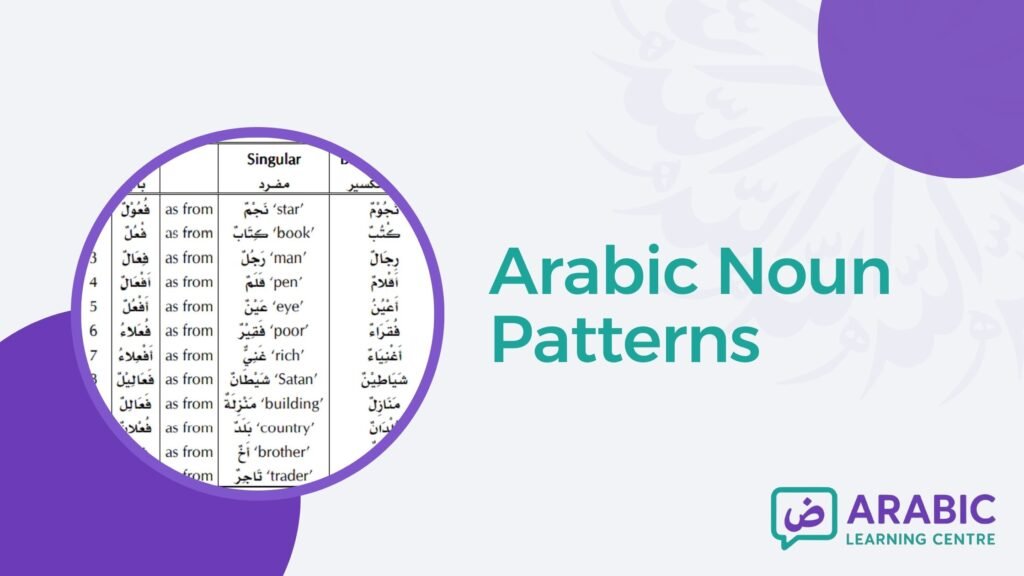
Arabic noun patterns fall into six major functional categories. Each category contains multiple specific patterns (awzān), all producing nouns that perform the same grammatical role in a sentence.
Here are the six core categories:
| Category | Arabic Name | Function | Example Pattern |
| Verbal Noun | مصدر (maṣdar) | Names the action itself | فِعَال (fiʿāl), فَعْل (faʿl) |
| Active Participle | اسم الفاعل (ism al-fāʿil) | The one performing the action | فَاعِل (fāʿil) |
| Passive Participle | اسم المفعول (ism al-mafʿūl) | The one receiving the action | مَفْعُول (mafʿūl) |
| Instrument Noun | اسم الآلة (ism al-āla) | Tool or instrument | مِفْعَل (mifʿal), مِفْعَلة (mifʿala) |
| Place/Time Noun | اسم المكان والزمان (ism al-makān) | Where or when an action occurs | مَفْعَل (mafʿal), مَفْعِل (mafʿil) |
| Intensive/Professional | صيغة المبالغة (ṣīghat al-mubālagha) | One who does something habitually or professionally | فَعَّال (faʿʿāl), فَعِيل (faʿīl) |
1. The Maṣdar: The Verbal Noun Pattern Family
The مصدر (maṣdar) is a verbal noun — it names the action or state expressed by a verb without specifying tense, subject, or object. It is arguably the most important noun category in Arabic grammar, appearing constantly in both spoken and written Fusha, and functioning similarly to gerunds or infinitives in English.
Unlike its English equivalent, the Arabic maṣdar follows specific patterns depending on the verb form (bāb).
For Form I verbs (the base triliteral form), the maṣdar pattern is not fully predictable and must be learned with each verb.
However, for Forms II through X, the maṣdar patterns are entirely regular and predictable.
Maṣdar Patterns for Form I Verbs
Form I maṣdar patterns vary. The most common ones include:
| Pattern | Arabic Example | Transliteration | Meaning |
| فَعْل (faʿl) | ضَرْب | ḍarb | striking |
| فِعْل (fiʿl) | عِلْم | ʿilm | knowledge |
| فُعُول (fuʿūl) | دُخُول | dukhūl | entering |
| فِعَال (fiʿāl) | نزال | Nizal | fight |
| فَعَلَان (faʿalān) | غَلَيَان | ghalyān | boiling |
Example in sentence:
الكِتَابَةُ مُهِمَّةٌ
Al-kitābatu muhimmatun
Writing is important.
Here الكِتَابَة (al-kitāba) is the maṣdar of كَتَبَ (kataba, to write), functioning as the sentence’s subject.
Maṣdar Patterns for Forms II–X (Fully Predictable)
| Verb Form | Maṣdar Pattern | Example | Meaning |
| Form II (فَعَّلَ) | تَفْعِيل (tafʿīl) | تَعْلِيم (taʿlīm) | teaching/education |
| Form III (فَاعَلَ) | مُفَاعَلة (mufāʿala) | مُحَادَثة (muḥādatha) | conversation |
| Form IV (أَفْعَلَ) | إِفْعَال (ifʿāl) | إِرْسَال (irsāl) | sending |
| Form V (تَفَعَّلَ) | تَفَعُّل (tafaʿʿul) | تَعَلُّم (taʿallum) | learning |
| Form X (اسْتَفْعَلَ) | اسْتِفْعَال (istifʿāl) | اسْتِفْسَار (istifṣār) | enquiry |
Students at The Arabic Learning Centre find that Form II and Form V maṣdar patterns — تَفْعِيل and تَفَعُّل — are the ones they encounter most frequently in news Arabic and Islamic texts. Learning to recognize these two alone opens up enormous reading comprehension.
If you are also studying verbal sentences in Arabic, understanding the maṣdar is essential — it frequently appears as a substitute for the verb clause in formal writing.
Shots Videos from Our Courses
2. The Ism al-Fāʿil (اسم الفاعل): The Active Participle Pattern
The اسم الفاعل (ism al-fāʿil) is the active participle — the noun or adjective describing the one who performs the action. For all Form I verbs, its pattern is invariably فَاعِل (fāʿil). For higher verb forms, it follows predictable derivation using the prefix مُـ and an i vowel on the penultimate syllable.
Form I examples:
| Root | Ism al-Fāʿil | Transliteration | Meaning |
| ك-ت-ب | كَاتِب | kātib | writer |
| د-ر-س | دَارِس | dāris | student/one who studies |
| ع-م-ل | عَامِل | ʿāmil | worker |
| ف-ه-م | فَاهِم | fāhim | one who understands |
For higher forms, the ism al-fāʿil is formed from the present tense verb by replacing the initial يَـ (ya-) prefix with مُـ (mu-) and adding a kasra (ِ) under the penultimate letter:
مُعَلِّم (muʿallim, teacher) — from Form II عَلَّمَ (ʿallama, to teach) مُتَعَلِّم (mutaʿallim, learner) — from Form V تَعَلَّمَ (taʿallama, to learn)
In our instructors’ experience, learners who understand this single derivation rule — replacing يَـ with مُـ and inserting kasra — can generate active participles for Forms II–X without memorizing any additional patterns. That one rule saves dozens of vocabulary entries.
Read also: Dual Nouns in Arabic
3. The Ism al-Mafʿūl (اسم المفعول): The Passive Participle Pattern
The اسم المفعول (ism al-mafʿūl) names the entity that receives the action — the passive participle. For Form I verbs, its pattern is مَفْعُول (mafʿūl). For higher forms, the derivation mirrors the ism al-fāʿil rule, except the penultimate vowel becomes a fatḥa followed by ـة or a ḍamma in specific contexts.
| Root | Pattern | Arabic | Transliteration | Meaning |
| ك-ت-ب | مَفْعُول | مَكْتُوب | maktūb | written / a letter |
| ف-ت-ح | مَفْعُول | مَفْتُوح | maftūḥ | open / opened |
| ع-ر-ف | مَفْعُول | مَعْرُوف | maʿrūf | known / recognised |
مَعْرُوف (maʿrūf) is a particularly important example — it appears in the Quran and classical texts with the extended meaning of “what is recognised as good” (i.e., virtue), showing how passive participles develop semantic richness beyond their literal grammatical function.
Understanding passive participles also links directly to how Arabic attached pronouns interact with these forms in possessive and object constructions.
4. Instrument Nouns and Place/Time nouns
Instrument nouns (ism al-āla) and place/time nouns (ism al-makān/al-zamān) follow their own distinct patterns and are among the most practically useful for beginner vocabulary building.
A. Instrument Noun Patterns (اسم الآلة)
These patterns produce nouns that name tools or instruments:
| Pattern | Arabic Example | Transliteration | Meaning |
| مِفْعَل (mifʿal) | مِقَصّ | miqaṣṣ | scissors |
| مِفْعَلة (mifʿala) | مِكْنَسة | miknasa | broom |
| مِفْعَال (mifʿāl) | مِفْتَاح | miftāḥ | key |
The مِـ (mi-) prefix is the signature marker of instrument nouns in Form I. Any noun beginning with مِـ and following the consonantal skeleton of a known root is very likely an instrument noun — a pattern recognition skill that significantly accelerates reading speed.
B. Place and Time Noun Patterns (اسم المكان والزمان)
| Pattern | Arabic Example | Transliteration | Meaning |
| مَفْعَل (mafʿal) | مَدْرَسة | madrasa | school (place of study) |
| مَفْعِل (mafʿil) | مَسْجِد | masjid | mosque (place of prostration) |
| مَفْعَلة (mafʿala) | مَكْتَبة | maktaba | library/bookshop |
مَدْرَسة (madrasa) comes from the root د-ر-س (d-r-s, to study). مَسْجِد comes from س-ج-د (s-j-d, to prostrate). Knowing the root instantly explains the place noun’s meaning.
5. The Intensive (Ṣīghat al-Mubālagha) Patterns with Arabic Noun Patterns Chart
The صيغة المبالغة (ṣīghat al-mubālagha) — intensive or professional noun patterns — describe someone who performs an action habitually, professionally, or with great intensity. These five classical patterns are documented in all standard Nahw references.
| Pattern | Arabic Example | Transliteration | Meaning |
| فَعَّال (faʿʿāl) | غَفَّار | ghaffār | the Oft-Forgiving |
| فَعِيل (faʿīl) | عَلِيم | ʿalīm | all-knowing |
| فَعُول (faʿūl) | صَبُور | ṣabūr | very patient |
| فَعِل (faʿil) | حَذِر | ḥadhir | cautious |
| مِفْعَال (mifʿāl) | مِعْطَاء | miʿṭāʾ | very generous |
The فَعَّال (faʿʿāl) pattern is the one learners encounter most in everyday vocabulary, particularly for traditional professions and occupations. It is also one of the Divine Names contexts: الرَّزَّاق (al-Razzāq, the All-Provider), الغَفَّار (al-Ghaffār, the Oft-Forgiving).
How Do Arabic Noun Patterns Change with Gender and Case?
Arabic noun patterns are modified by grammatical gender (masculine/feminine) and case (nominative, accusative, genitive), governed by the harakat system. Understanding this interaction is essential for reading Arabic with full diacritical marks (tashkeel).
Most Arabic nouns derived from the patterns above follow standard case endings:
| Case | Ending (Indefinite) | Ending (Definite) |
| Nominative (subject) | ـٌ (-un) | ـُ (-u) |
| Accusative (object) | ـً (-an) | ـَ (-a) |
| Genitive (possessive) | ـٍ (-in) | ـِ (-i) |
Feminine forms are typically formed by adding ـة (tāʾ marbūṭa) to the masculine pattern:
كَاتِب (kātib, male writer) → كَاتِبة (kātiba, female writer) مُعَلِّم (muʿallim, male teacher) → مُعَلِّمة (muʿallima, female teacher)
For a deeper understanding of how vowel markers interact with noun endings, our guide on harakat in Arabic provides thorough coverage of the full diacritical system.
Practice Exercises: Identifying and Building Arabic Noun Patterns
These exercises build pattern recognition — the practical skill of identifying a noun’s pattern and function on sight. Work through each exercise before checking the answer. The goal is not translation speed, but morphological awareness.
Exercise 1: Identify the Pattern
For each word below, identify the pattern (wazn) and the noun category:
- مَكْتَب (maktab)
- فَاهِم (fāhim)
- تَعْلِيم (taʿlīm)
- مَفْتُوح (maftūḥ)
- بَقَّال (baqqāl)
Answers:
- مَفْعَل — place noun (office/desk, from root ك-ت-ب)
- فَاعِل — active participle (one who understands)
- تَفْعِيل — maṣdar Form II (education/teaching)
- مَفْعُول — passive participle (opened/open)
- فَعَّال — intensive/professional (grocer)
Exercise 2: Build the Noun
Using the root د-ر-س (d-r-s, related to studying/lessons), form:
- The active participle (Form I)
- The maṣdar of Form II (دَرَّسَ, to teach formally)
- The place noun
Answers:
- دَارِس (dāris, one who studies)
- تَدْرِيس (tadrīs, formal teaching/instruction)
- مَدْرَسة (madrasa, school)
At The Arabic Learning Centre, our certified instructors in the Arabic Course for Beginners use structured pattern-drilling exercises precisely like these — combined with root analysis — to move students from recognition to production within weeks.
Our Students Reviews
Join Our Arabic Course for Beginners With a Free Trial
Read also: Verbal Noun in Arabic
Begin Mastering Arabic Noun Patterns with The Arabic Learning Centre
Arabic noun patterns are a systematic, learnable skill — not a memorization challenge. Knowing the six core pattern categories gives you a framework to decode thousands of Arabic words you have never seen before.
The Arabic Learning Centre offers:
- 1-on-1 personalized sessions with certified native Arabic instructors
- Structured Arabic Grammar Course covering Nahw rules including all awzān in depth
- Flexible scheduling 24/7 to fit any timezone or lifestyle
- Free trial lesson — start with no commitment
Explore the Arabic Grammar Course or the Arabic Course for Beginners and begin building real morphological fluency today.
Check out our top courses in Arabic and choose the course you need to start learning Arabic today:
- Arabic Course for Beginners
- Arabic Script Writing Course
- Arabic Speaking Course
- Learn Arabic Letters for Tajweed
- Learning Arabic Grammar
- Arabic Vocabulary Course
- Fusha Arabic Course
- Classical Arabic Course
- Arabic Course for Islamic Studies
- Quranic Arabic Course
- Learn Arabic for New Muslims
Start with a FREE trial class and enhance your Arabic language skills

Conclusion
Arabic noun patterns give learners a structural key to the entire Arabic lexicon. Rather than treating each word as isolated vocabulary, you learn to see the root and the pattern — and from those two elements, meaning and grammatical function become transparent.
The six pattern categories — maṣdar, ism al-fāʿil, ism al-mafʿūl, ism al-āla, ism al-makān, and ṣīghat al-mubālagha — cover the vast majority of Arabic nouns a learner will encounter in Fusha texts, the Quran, and modern Arabic media.
Consistent daily practice with roots and patterns — even fifteen minutes of focused pattern identification — produces measurable vocabulary recognition within weeks. The system rewards systematic effort in a way that rote memorization simply cannot.
Frequently Asked Questions About Arabic Noun Patterns
What are Arabic noun patterns (awzān)?
Arabic noun patterns (awzān, singular wazn) are abstract morphological templates applied to three-consonant roots to produce nouns with predictable grammatical functions and meaning categories. Every Arabic noun fits a specific pattern, and knowing the pattern tells you whether the word is a verbal noun, active participle, place noun, or another category.
What is the difference between ism al-fāʿiland ism al-mafʿūl?
The ism al-fāʿil (active participle, pattern فَاعِل) describes the one performing the action — for example, كَاتِب (kātib, writer). The ism al-mafʿūl (passive participle, pattern مَفْعُول) describes the one receiving the action — مَكْتُوب (maktūb, written/a letter). The distinction mirrors the active/passive distinction in English, but in Arabic, each has a fixed, recognizable pattern.
Is learning Arabic noun patterns necessary for beginners?
Beginners benefit enormously from an early introduction to the concept of roots and patterns, even before mastering all individual pattern types. Knowing that Arabic vocabulary is root-based — and that patterns signal grammatical function — prevents the common beginner mistake of memorizing words without understanding their morphological relationship. Our Arabic Course for Beginners introduces this framework progressively from the first lessons.
Related Articles
Arabic Grammar