 Arabic Grammar

Imagine hearing this on the evening news: a firefighter bravely saved a child’s life, and his photo is in every newspaper. In Arabic, that one short report is packed with phrases like نَشْرَةُ الأخبارِ (the news bulletin), رَجُلُ إطفاءٍ (a firefighter), and حَياةَ طِفْلٍ (a child’s life). Every one of them is built on the same structure: the genitive case in Arabic, known in Arabic grammar as الإضافة (al-iḍāfa).
If you can read those phrases and understand them, congratulations — you already sense how idafa works. This guide turns that instinct into clear rules. You will learn what the genitive case Arabic structure is, why Arabic uses it, how to spot it, and how to parse (إعراب) it like a grammarian.
What you’ll learn in this article:
- What the genitive case in Arabic means and how idafa (الإضافة) works.
- The roles of the muḍāf and muḍāf ilayh in an idafa phrase.
- How idafa expresses definiteness, specification, and possession.
- The main rules of the muḍāf, including tanween and ال.
- The difference between real and verbal idafa.
- How to parse idafa and identify the genitive noun.
- How idafa chains work and how to recognize common muḍāf words.
- The difference between Arabic idafa and the English possessive.
What Is the Genitive Case in Arabic (Idafa)?
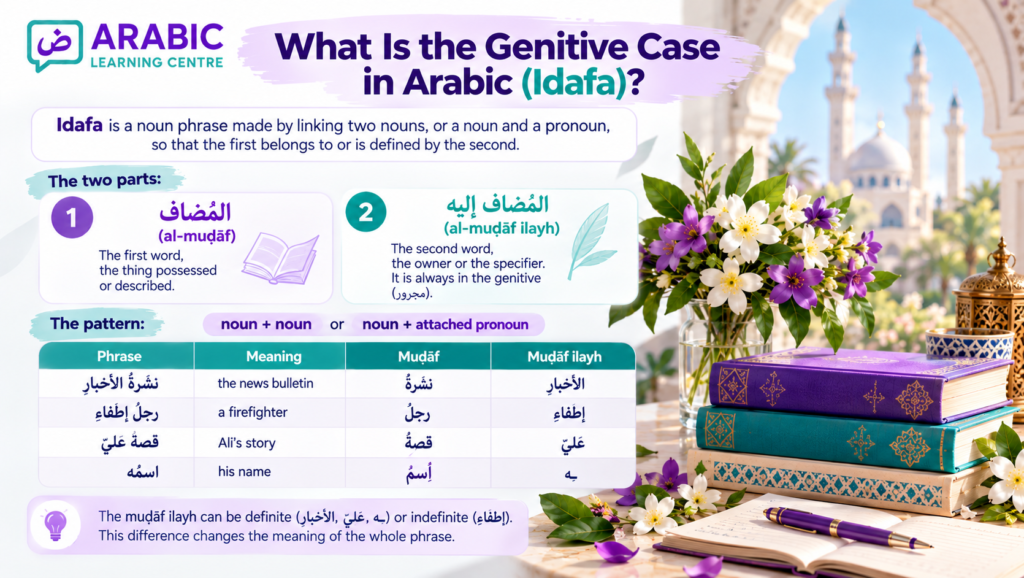
Idafa is a noun phrase made by linking two nouns, or a noun and a pronoun, so that the first belongs to or is defined by the second. Arabic grammarians call this attributing the first word to the second.
The two parts have fixed names:
- المُضاف (al-muḍāf) — the first word, the thing possessed or described.
- المُضاف إليه (al-muḍāf ilayh) — the second word, the owner or the specifier. It is always in the genitive (مجرور).
The pattern is simply noun + noun or noun + attached pronoun:
| Phrase | Meaning | Muḍāf | Muḍāf ilayh |
| نشرةُ الأخبارِ | the news bulletin | نشرةُ | الأخبارِ |
| رجلُ إطفاءٍ | a firefighter | رجلُ | إطفاءٍ |
| قصةُ عليٍّ | Ali’s story | قصةُ | عليٍّ |
| اسمُه | his name | اسمُ | ـه |
Notice that the muḍāf ilayh is sometimes definite (الأخبار, عليّ, ـه) and sometimes indefinite (إطفاء). That difference changes the meaning of the whole phrase, as the next section shows.
Read also: Nominative Case In Arabic – Signs, Positions, And Examples
Why Arabic Uses Idafa?
The genitive construction does more than show ownership. It has two classic functions, definiteness and specification, plus a third that learners use every day: possession.
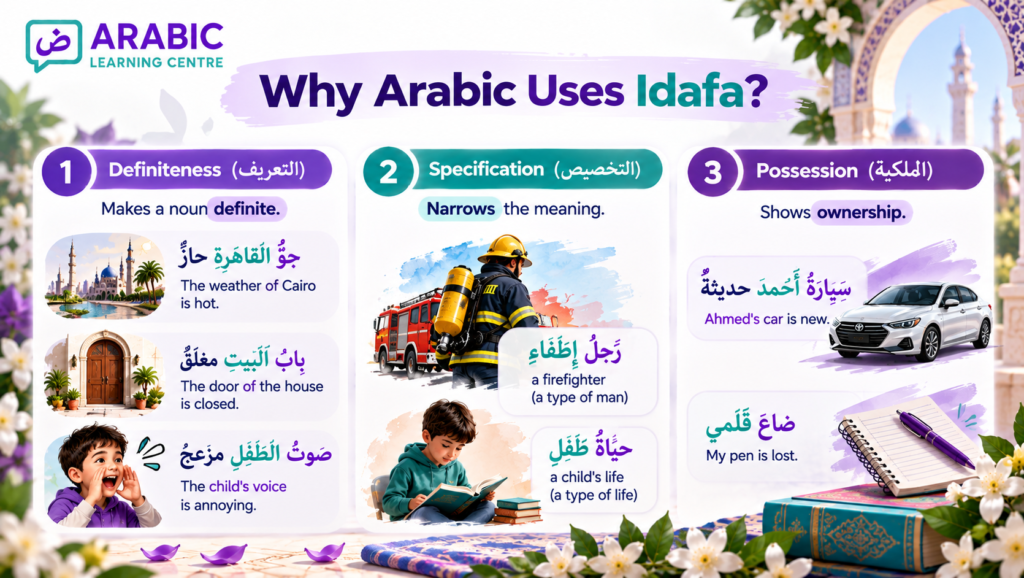
1. Definiteness (التعريف)
In Arabic, one of the six kinds of definite nouns is a noun annexed to a definite noun. The word نشرة (“a bulletin”) is indefinite on its own. In نشرةُ الأخبارِ it becomes definite, because الأخبار is definite. Listeners know exactly which bulletin is meant.
More examples:
- جوُّ القاهرةِ حارٌّ — The weather of Cairo is hot.
- بابُ البيتِ مغلقٌ — The door of the house is closed.
- صوتُ الطفلِ مزعجٌ — The child’s voice is annoying.
2. Specification (التخصيص)
When the muḍāf ilayh is indefinite, the first noun stays indefinite but becomes narrower. In رجلُ إطفاءٍ you still don’t know which man, but you know his type: not a businessman (رجلُ أعمالٍ) or a politician (رجلُ سياسةٍ), but a firefighter. Likewise, حياةُ طفلٍ tells you the kind of life, not whose.
3. Possession (الملكية)
When the muḍāf ilayh is a proper name or a pronoun, idafa gives definiteness and ownership:
- سيارةُ أحمدَ حديثةٌ — Ahmed’s car is new. Whose car? Ahmed’s.
- ضاع قلمي — My pen is lost. The pronoun ـي makes قلم definite and shows it is mine.
Read also: Mansub In Arabic Grammar – A Complete Guide To The Accusative Case
The Four Patterns of Idafa at a Glance
Putting it together, every idafa phrase follows one of four patterns. The type of the second noun decides the meaning.
| Pattern | Example | Meaning | Function |
| Indefinite + indefinite | سيارةُ إسعافٍ | an ambulance | Specification |
| Indefinite + definite (with ال) | منظرُ الغروبِ | the sunset view | Definiteness |
| Indefinite + proper name | سيارةُ هاشمٍ | Hashem’s car | Definiteness + possession |
| Indefinite + pronoun | صديقُه مشهورٌ | his friend is famous | Definiteness + possession |
If you are learning Arabic to read the Quran and daily prayers, you will meet the last two patterns constantly, in phrases like رَبُّ العالمين and دينُنا. Our Arabic course for new Muslims introduces these structures through familiar religious texts.

Core Rules of the Muḍāf
The first word of an idafa changes form in predictable ways. Linguists call this the construct state.

- The Muḍāf Never Takes Tanween: The first noun in an idafa always drops its nunation.
كتابٌ becomes كتابُ الطالبِ, and سيارةٌ becomes سيارةُ إسعافٍ. - The Muḍāf Drops the ن of the Dual and Sound Plural: Dual and sound masculine plural nouns lose their final ن when they become muḍāf.
يدانِ becomes يدا in تَبَّتْ يدا أبي لهبٍ, and مُرسِلون becomes مُرسِلو in إنّا مُرسِلو النّاقةِ. - The Muḍāf Does Not Take ال, Except for Derived Nouns: You say بابُ البيتِ, never البابُ البيتِ. The only exception is a derived noun (مشتق), such as an active participle or an adjective. You can say طويلُ القامةِ or الطويلُ القامةِ (“the tall one”). The Quran offers a clear case: وَالمُقيمي الصلاةِ, where المقيمي carries ال and also loses its ن.
- The Muḍāf Ilayh Is Always Genitive: Whatever role the muḍāf plays in the sentence, the muḍāf ilayh is always مجرور. This rule has no exceptions.
Don’t Just Take Our Word For It:
Take a look inside our vibrant classes and see our students and teachers in action. Click below to watch our classroom experience:
The Difference Between Real and Verbal Idafa in Arabic
Classical grammar divides idafa into two types. To tell them apart, replace the muḍāf with its verb and check whether the meaning stays the same.
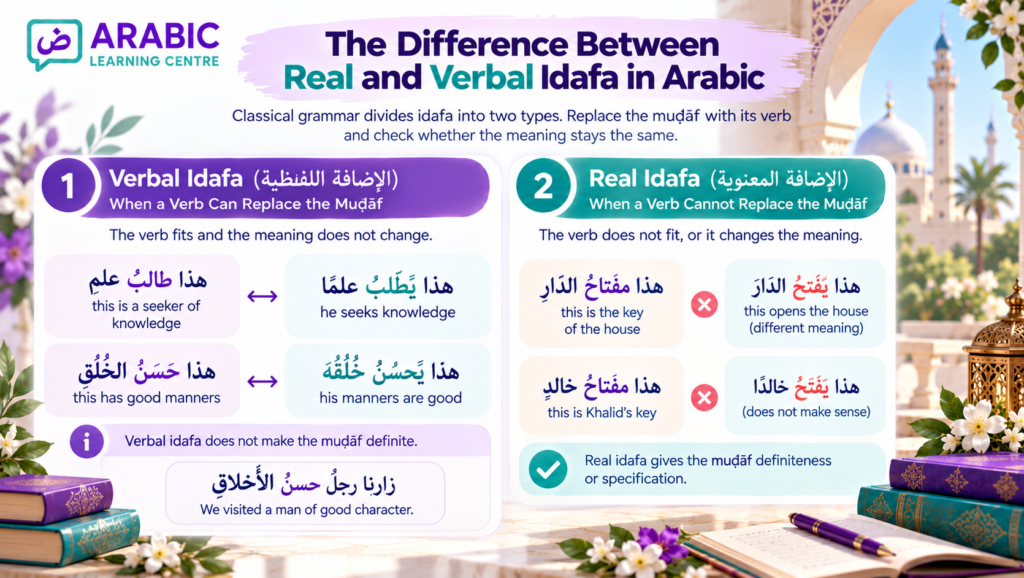
Verbal Idafa: When a Verb Can Replace the Muḍāf
Verbal idafa (الإضافة اللفظية), also called غير المحضة, passes the verb test. The verb fits and the meaning does not change:
- هذا طالبُ علمٍ → هذا يطلبُ علمًا (he seeks knowledge)
- هذا حَسَنُ الخُلُقِ → هذا يَحسُنُ خُلُقُه (his manners are good)
Verbal idafa does not make the muḍāf definite. That is why we say زارنا رجلٌ حسنُ الأخلاقِ, where حسنُ still describes the indefinite noun رجلٌ.
Real Idafa: When a Verb Cannot Replace the Muḍāf
Real idafa (الإضافة المعنوية), also called المحضة, fails the verb test. In هذا مفتاحُ الدارِ, saying هذا يفتحُ الدارَ changes the meaning. With هذا مفتاحُ خالدٍ, the verb makes no sense at all. This type is the one that gives the muḍāf definiteness or specification.
How to Parse Idafa in Arabic?
Parsing idafa is easier than it looks, because half the job is already done once you name the muḍāf and the muḍāf ilayh.
- The muḍāf takes whatever role it has in the sentence: subject, object, predicate, adjective, and so on. At the end of its parsing you add “وهو مضاف”.
- The muḍāf ilayh never changes: it is always مضاف إليه مجرور.
| Sentence | Muḍāf | Muḍāf ilayh |
| أشعةُ الشمسِ مفيدةٌ | أشعةُ: مبتدأ مرفوع بالضمة، وهو مضاف | الشمسِ: مضاف إليه مجرور بالكسرة |
| العدلُ أساسُ الحكمِ | أساسُ: خبر مرفوع بالضمة، وهو مضاف | الحكمِ: مضاف إليه مجرور بالكسرة |
| جاءَ طبيبُ الحيِّ | طبيبُ: فاعل مرفوع بالضمة، وهو مضاف | الحيِّ: مضاف إليه مجرور بالكسرة |
| قابلتُ صديقَه | صديقَ: مفعول به منصوب بالفتحة، وهو مضاف | ـه: ضمير متصل مبني في محل جر مضاف إليه |
Note the pronoun case: an attached pronoun is indeclinable (مبني), so it is “in the position of” the genitive rather than showing a kasra.
Can one word be both muḍāf and muḍāf ilayh?
Yes. In a chain of idafa, the middle word can function as muḍāf ilayh in relation to the word before it and as muḍāf in relation to the word after it.
القناعةُ أساسُ سعادةِ الإنسانِ — Contentment is the basis of human happiness.
- أساسُ: خبر مرفوع، وهو مضاف
- سعادةِ: مضاف إليه مجرور، وهو مضاف
- الإنسانِ: مضاف إليه مجرور
This type of structure is called an idafa chain. Each noun is linked to the next, and the grammatical relationship continues until the final noun in the chain.
A useful way to identify the structure is to read it in pairs:
أساسُ سعادةِ → “the basis of happiness”
سعادةِ الإنسانِ → “human happiness”
So سعادةِ belongs to both relationships at the same time.
If you want guided practice with full i‘rab drills like these, our Arabic grammar course builds this skill step by step.

Common Words That Often Function as Muḍāf
Some Arabic words commonly appear as the first part of an idafa. Recognizing them can make it easier to identify the muḍāf ilayh that follows.
Adverbs of time and place (ظروف الزمان والمكان) often function as muḍāf when followed by a noun, such as: فوق، تحت، قبل، بعد، بين.
- وضعتُ الكتابَ فوقَ الطاولةِ — I put the book on the table.
Here, فوقَ is the muḍāf, and الطاولةِ is the muḍāf ilayh.
Other common words that frequently appear in idafa include: بعض، كلّ، كلا، كلتا، دون، سوى، غير، جميع، نحو، حوالي.
- كلُّ الطلابِ هنا — All the students are here.
Here, كلُّ is the muḍāf, and الطلابِ is the muḍāf ilayh.
A useful shortcut is to look for a noun that naturally requires another noun to complete its meaning. In many cases, the following noun will be the muḍāf ilayh.
Another useful pattern appears when more than one noun is connected to the same possessor: استعرتُ كتابَ وقلمَ خالدٍ — I borrowed Khalid’s book and pen.
Here, خالدٍ is understood as relating to both كتابَ and قلمَ, even though it appears only once.
The Difference Between Arabic Idafa and the English Possessive
English speakers often expect the genitive case in Arabic to work like John’s book. The idea is similar, but the grammar works differently.
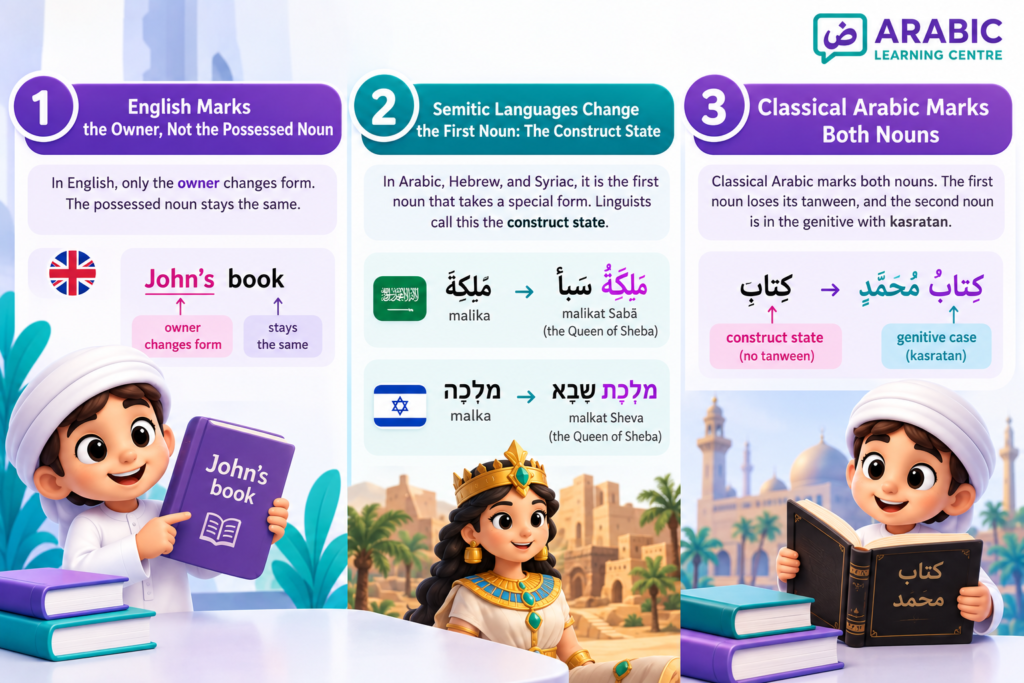
English Marks the Owner, Not the Possessed Noun
In English, only the owner changes form: John becomes John’s. The word book stays exactly the same, with no special ending or case marking.
Semitic Languages Change the First Noun: The Construct State
In Semitic languages such as Arabic, Hebrew, and Syriac, it is the first noun that takes a special form. Linguists call this form the construct state (Latin status constructus).
The word for “queen” shows this clearly. On its own it is مَلِكَة (malika). In مَلِكَةُ سبأ (the Queen of Sheba), the hidden ت is pronounced: malikat. Hebrew does the same, turning malka into malkat in malkat Sheva.
Classical Arabic Marks Both Nouns
Classical Arabic goes further than most Semitic languages because it marks both nouns. In كتابُ محمدٍ, كتابُ is in the construct state and loses its tanween, while محمدٍ is in the genitive with kasratan. That double marking is why learners must watch both ends of every idafa phrase.
The Genitive Case in Arabic iCn 10 Key Points
The genitive case in Arabic becomes much easier once you understand the basic logic of idafa. The following ten points bring together the main rules you need to recognize, parse, and use this construction correctly.
- Idafa is a noun construction that links two nouns, or a noun and an attached pronoun.
- The first element is the muḍāf, while the second is the muḍāf ilayh.
- When the muḍāf ilayh is definite, the whole idafa becomes definite.
- When the muḍāf ilayh is indefinite, the idafa usually gives the first noun specification rather than full definiteness.
- Idafa with a proper name or pronoun often expresses possession or close association.
- The muḍāf does not take tanween, and it also loses the final ن of the dual and sound masculine plural when required by the construct state.
- The muḍāf normally does not take ال. In verbal idafa involving a derived noun, however, forms with ال may occur under specific grammatical conditions.
- The muḍāf is parsed according to its grammatical role in the sentence, followed by وهو مضاف.
- The muḍāf ilayh is always genitive (مجرور), whether the genitive is marked by a visible ending or represented by an attached pronoun in the genitive position.
- Words such as فوق، تحت، قبل، بعد، كلّ، بعض، غير frequently occur as muḍāf when followed by a noun that completes their meaning.
Mastering idafa makes a major difference in Arabic reading and writing because the construction appears constantly in everyday language, formal writing, news headlines, and Quranic Arabic.
Teenagers preparing for exams can strengthen these rules in our high school Arabic course, where native teachers help students apply grammar confidently in reading and writing.

Inside Our Classrooms
See how we make learning interactive and engaging! Watch a quick snippet of our live, conversational classes in action:
Learn Arabic Grammar with Arabic Learning Centre
Reading about idafa is a great start, but real mastery comes from practice with a teacher who corrects you on the spot. At Arabic Learning Centre, qualified native Arabic tutors teach one-to-one online lessons built around your level, goals, and schedule.
Whether you are a beginner, a new Muslim wanting to understand the Quran, a high school student preparing for exams, or an adult polishing your grammar, there is a course designed for you.
Every lesson combines clear explanations, real examples, and guided exercises, so rules like the genitive case in Arabic turn into skills you use naturally.
Book your free trial lesson today and take your first step toward fluent, confident Arabic.
Courses We Offer:
- Online Arabic Course
- Classical arabic course
- Modern Standard Arabic Course
- Fusha Arabic Course
- Learn Saudi Arabic
- Arabic Course for Beginners

Conclusion
The genitive case in Arabic is one of the first structures every learner meets, and one they keep using for life. Once you know the muḍāf from the muḍāf ilayh, you can read phrases like نشرةُ الأخبارِ, سيارةُ أحمدَ, and ربُّ العالمين with confidence.
Remember the essentials: the muḍāf drops its tanween and usually its ال, while the muḍāf ilayh is always genitive. The type of the second noun tells you whether the phrase gives definiteness, specification, or possession. Practise with short sentences, parse them aloud, and idafa will soon feel natural.
Idafa is also a gateway to the rest of Arabic grammar. Once it feels natural, you will find it easier to handle adjectives that describe an idafa phrase, prepositions that put nouns in the genitive, and the long noun chains common in news, academic writing, and the Quran. Treat each new idafa you read as a small parsing exercise: name the muḍāf, find the muḍāf ilayh, and check its case ending.
Frequently Asked Questions
1. What is the genitive case in Arabic called?
In Arabic grammar it is called الجرّ (al-jarr), and the possessive construction that uses it is الإضافة (al-iḍāfa). A noun in the genitive is described as مجرور.
2. What causes a noun to be in the genitive case in Arabic?
Two main things: being the muḍāf ilayh in an idafa phrase (كتابُ الطالبِ), or following a preposition such as في, من, or على (في البيتِ).
3. How do I recognise the genitive case in Arabic?
The usual sign is a kasra (ـِ) on the last letter, or kasratan (ـٍ) if the noun is indefinite. Duals and sound masculine plurals take ـَيْنِ and ـِينَ, and the five nouns take ي, as in أبي لهبٍ.
4. Why does the first word in idafa lose its tanween?
The muḍāf is in the construct state, which is closely bound to the next word. That bond replaces the tanween, so كتابٌ becomes كتابُ محمدٍ.
5. Can the first word of an idafa have ال?
Normally no. The only exception is a derived noun in verbal idafa, such as الطويلُ القامةِ or المقيمي الصلاةِ.
6. Can an idafa have more than two words?
Yes. Arabic allows chains, such as أساسُ سعادةِ الإنسانِ. Every word except the first and last is both muḍāf and muḍāf ilayh, and only the last word can take ال.
Related Articles
Arabic Grammar