 Learn Arabic
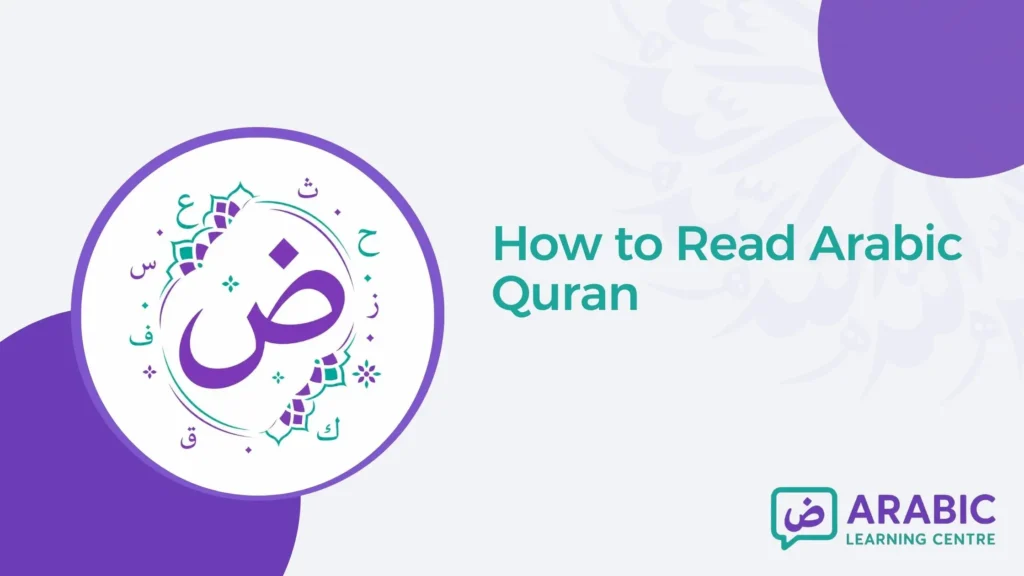
Opening the Mushaf and not knowing where to begin is one of the most common experiences among new Muslims and non-Arabic speakers worldwide. Over 80% of Quran readers globally are non-native Arabic speakers — and every single one of them started from zero. This guide gives you the exact sequence: what to learn first, what comes next, and which rules matter most before anything else.
1- Mastering the Arabic Alphabet Is the Non-Negotiable First Step
You cannot learn how to read Arabic Quran without first knowing the 28 Arabic letters and their sounds. This is not optional and cannot be skipped. Every word in the Quran is built from these letters — and mispronouncing a single letter can completely change a word’s meaning.
Allah (SWT) confirmed the language of the Quran directly:
“إِنَّا أَنزَلْنَاهُ قُرْآنًا عَرَبِيًّا لَّعَلَّكُمْ تَعْقِلُونَ ﴿٢﴾”
Inna anzalnahu qur’anan ‘arabiyyan la’allakum ta’qiloon
“Indeed, We have sent it down as an Arabic Qur’an that you might understand. (2).”
Every Arabic letter has three components that must be learned together — not separately:
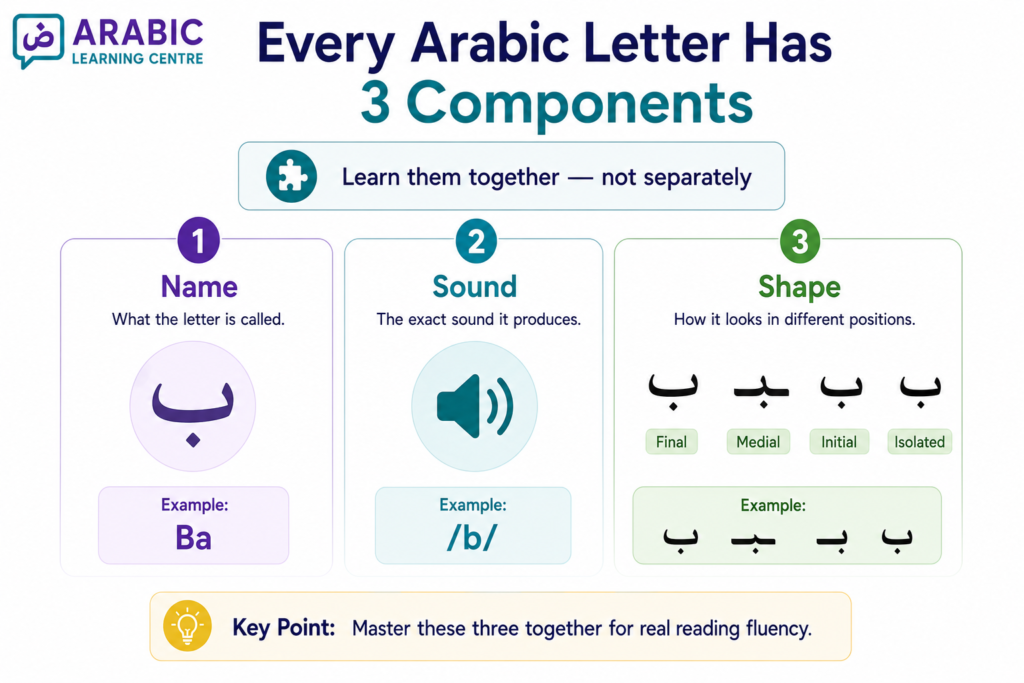
- Name: What the letter is called (e.g., Alif, Ba, Ta).
- Sound: The exact phonetic sound it produces.
- Shape: How it looks in isolated, initial, medial, and final forms.
The recommended learning pace is 5 letters per day. Most motivated beginners recognize all 28 letters within 7–14 days of consistent daily practice. Two groups of letters require special attention from Day 1:
- The six non-connecting letters — ا، د، ذ، ر، ز، و — never connect to the following letter. Recognizing them immediately tells you where one letter cluster ends inside a word.
- The ten letters with no English equivalent — ح، خ، ص، ض، ط، ظ، ع، غ، ق، ء — require native audio practice. English approximations mislead for these sounds.
At The Arabic Learning Centre, the Arabic Course for Islamic Studies builds Arabic letter recognition specifically in the Quranic context — with a certified native tutor correcting every letter from the first session.
Build your Quranic alphabet foundation with expert guidance.
2- Harakat Are the Vowel System That Makes Every Quranic Word Readable
Once you know the letters, harakat (حَرَكَات) are the next essential step. These are the small marks placed above and below Arabic letters that tell you exactly how to pronounce every vowel in the Quran.
The Quran is fully vowelized — every word carries its complete harakat. This makes it one of the most readable Arabic texts available to beginners. No guessing is required if you know what each mark means. The five harakat every Quran reader must know:
| Haraka | Mark | Sound | Example |
| Fatha | ـَ | Short “a” | بَ = ba |
| Kasra | ـِ | Short “i” | بِ = bi |
| Damma | ـُ | Short “u” | بُ = bu |
| Sukoon | ـْ | No vowel — letter stops | بْ = b |
| Shadda | ـّ | Letter doubled | بّ = bb |
Three long vowel marks extend the sound for two counts:
- Alif (ا) after fatha = long “aa” sound.
- Waw (و) after damma = long “oo” sound.
- Ya (ي) after kasra = long “ee” sound.
The correct learning sequence for harakat: learn fatha first and apply it to all 28 letters before adding kasra. Add kasra in Week 2. Add damma in Week 3. Add sukoon and shadda in Week 4. Never attempt all five simultaneously — the brain needs each mark to become automatic before the next is introduced.
Inside Our Classrooms
See how we make learning interactive and engaging! Watch a quick snippet of our live, conversational classes in action:
3- Noorani Qaida Is the Structured Bridge Between Letters and Quran Reading
The Noorani Qaida is the most widely used beginner’s primer for learning how to read Arabic Quran easy — used by tens of millions of children and adults worldwide before they open the Mushaf directly.
Named after its author Molvi Noor Muhammad Ludhyanvi, the Qaida is a 17-chapter instructional guide that builds Quranic reading in a specific sequence:
| Chapter Range | What It Teaches |
| Chapters 1–3 | Arabic alphabet in isolated forms — shapes and sounds |
| Chapters 4–6 | Letters with harakat — fatha, kasra, damma combinations |
| Chapters 7–9 | Sukoon and letter joining rules |
| Chapters 10–12 | Shadda, Madd (elongation), and Tanween |
| Chapters 13–15 | Compound letter combinations and Qalqalah |
| Chapters 16–17 | Short Quranic verses for first reading practice |
Students who skip the Noorani Qaida and go directly to the Quran consistently struggle with pronunciation errors that take years to correct. Students who complete it read with clarity and confidence from their first Surah. The Noorani Qaida is suitable for all ages and all starting levels:
- Children aged 4–10: Builds correct pronunciation before any bad habits form.
- Teenagers: Removes confusion in harakat, sukoon, and Madd.
- Adults and reverts: Provides the structured phonics foundation that self-study rarely produces.
Most learners complete the Noorani Qaida in 3–6 months with regular sessions of 20–30 minutes daily.
At The Arabic Learning Centre, the Al Azhar Arabic Course provides structured classical Arabic and Quranic reading instruction — with the same rigorous progression that the Noorani Qaida approach is built on.
Learn Quranic reading through a proven structured method.
Read Also: Learn How to Write and Read Arabic for Beginners
4- These Five Tajweed Rules Appear on Every Page of the Quran
Tajweed (تَجْوِيد) literally means “to make better” or “to beautify.” In Quranic recitation, it is the science of rules that govern exact pronunciation — ensuring that the Quran is recited exactly as it was revealed, without change to meaning or sound.
Scholars agree that applying basic Tajweed to the extent that meaning is not changed is an individual obligation (fard al-‘ayn) for every Muslim. These five rules appear on nearly every page of the Quran — learn them first:
Rule 1 — Makharij (Articulation Points)
Every Arabic letter originates from a specific point in the mouth or throat. The letter ق (Qaf) comes from the uvula. The letter ب (Ba) comes from both lips. Confusing these produces mispronunciation that changes meaning. Example: قَلْب (qalb — heart) versus كَلْب (kalb — dog).
Read Also: Is It Compulsory to Read the Quran in Arabic?
Rule 2 — Noon Sakinah and Tanween (Four Sub-Rules)
When a Noon with sukoon (نْ) or Tanween (ً ٍ ٌ) appears, four rules govern how it is pronounced based on the letter that follows:
| Rule | When It Applies | What to Do | Example |
| Izhar | Followed by ء ه ع ح غ خ | Pronounce Noon clearly — no merging | مِنْهُم = minhum |
| Idgham | Followed by ي ر م ل و ن | Merge Noon into the next letter | مِنْ رَبِّهِم = mir rabbihim |
| Iqlab | Followed by ب | Convert Noon sound to Meem with Ghunnah | مِنْ بَعْد = mim ba’d |
| Ikhfa | Followed by 15 other letters | Partially conceal Noon with Ghunnah | مِنْ تَحْتِهَا = partial n sound |
Rule 3 — Madd (Elongation)
The three Madd letters — Alif (ا), Waw (و), Ya (ي) — are extended in length depending on context. The natural Madd (Madd Asli) is always 2 counts. Contextual Madd rules extend to 4 or 6 counts depending on what follows. Madd symbols appear visually in the Mushaf as a horizontal tilde (~) over the relevant letter.
Read Also: How to Read Arabic Without Vowels?
Rule 4 — Qalqalah (Echo Sound)
Five specific letters — ق ط ب ج د — produce a bouncing echo sound when they carry a sukoon. Light Qalqalah applies mid-word. Heavy Qalqalah applies at the end of a word when stopping. Example: قُلْ أَعُوذُ بِرَبِّ الْفَلَقِ — the ق in الفلق carries heavy Qalqalah when you stop on it.
Read Also: Learn to Read Arabic App
Rule 5 — Waqf (Stopping Rules)
Waqf governs where and how to stop during recitation. The Mushaf contains specific stopping signs above words. The most essential signs for beginners are:
| Symbol | Meaning | What to Do |
| م | Waqf Lazim — mandatory stop | Must stop here |
| لا | Waqf Mamnu’ — prohibited stop | Do not stop here |
| ج | Waqf Jaiz — permissible stop | May stop or continue |
| ط | Waqf Mutlaq — full stop preferred | Stop is preferred |
Read Also: How to Read Arabic Letters?
5- This Daily Practice Plan Takes a Complete Beginner to Quran Reading
Learn how to read Arabic for Quran through a structured daily routine — not through occasional long sessions. Consistency across 20–30 minutes daily produces measurably faster progress than two hours on weekends.
The week-by-week progression:
- Week 1–2: Learn all 28 Arabic letters — 5 per day. Write each letter 10 times. Say the sound aloud while writing. Find each letter inside one Quranic word.
- Week 3–4: Learn all five harakat. Apply fatha to all 28 letters before adding kasra. Practice reading short vowelized syllables aloud — ba, bi, bu, ta, ti, tu.
- Month 2: Begin Noorani Qaida Chapters 1–6. Practice letter joining and harakat combinations inside Quranic words daily. Read aloud — never silently.
- Month 3: Continue Noorani Qaida Chapters 7–12. Begin learning Makharij for the 10 letters with no English equivalent. Listen to a qualified reciter and repeat immediately after.
- Month 4–6: Complete Noorani Qaida. Begin reading Surah Al-Fatiha with a teacher correcting every letter. Then move to the shortest Surahs — Al-Ikhlas (4 verses), Al-Falaq (5 verses), An-Nas (6 verses).
Three non-negotiable daily habits throughout every stage:
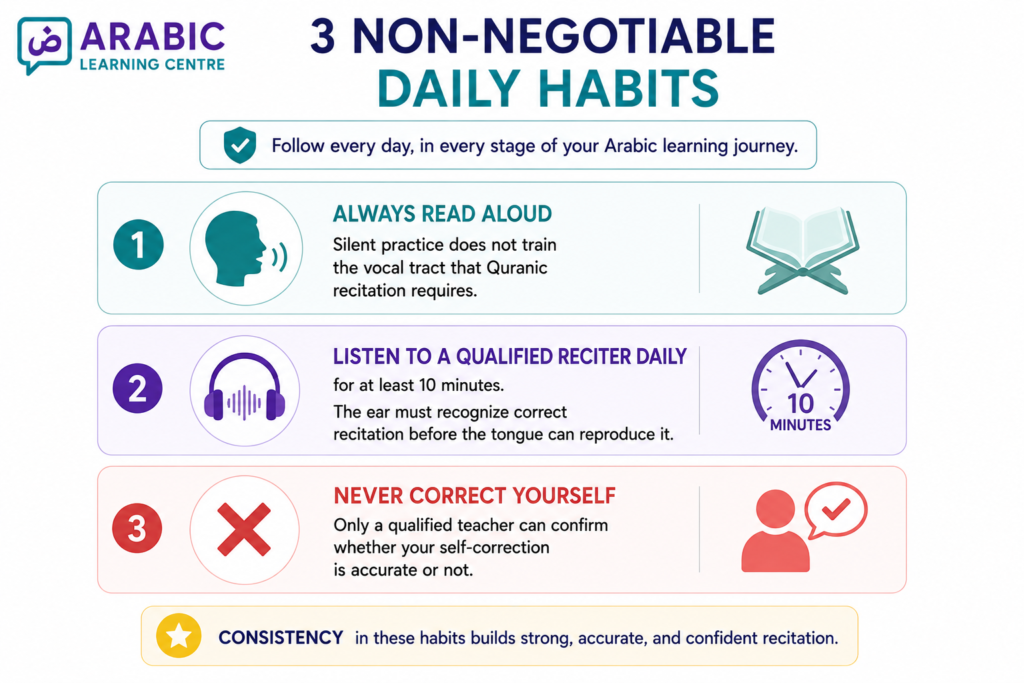
- Always read aloud — silent practice does not train the vocal tract that Quranic recitation requires.
- Listen to a qualified reciter daily for at least 10 minutes — the ear must recognize correct recitation before the tongue can reproduce it.
- Never correct yourself — only a qualified teacher can confirm whether your self-correction is accurate or not.
The reward for the struggling reciter is confirmed in an authenticated Hadith:
“الَّذِي يَقْرَأُ الْقُرْآنَ وَيَتَتَعْتَعُ فِيهِ وَهُوَ عَلَيْهِ شَاقٌّ لَهُ أَجْرَانِ”
“he who falters in it, and finds it difficult for him, will have two rewards.”
Every session of difficult recitation, every letter you struggle with and continue past — these are acts of worship that carry their own compounded reward.
Read Also: How to Read Arabic Indic Numbers
Don’t Just Take Our Word For It
Take a look inside our vibrant classes and see our students and teachers in action. Click below to watch our classroom experience:
Read Also: How to Read Arabic in English Letters?
Start Reading the Quran at The Arabic Learning Centre
The alphabet, the harakat, the Noorani Qaida, and the five essential Tajweed rules — every component of this guide is learnable independently. What self-study cannot provide is the real-time correction that prevents wrong pronunciation from becoming a permanent habit.
The Arabic Learning Centre provides exactly what Quran reading requires:
- Certified Arab tutors with native-level proficiency and specialized training in Quranic Arabic, Makharij, and Tajweed rules.
- One-on-one live sessions that move from the first Arabic letter through to reading full Surahs with correct Tajweed application.
- Real-time Makharij correction — the only method that reliably fixes the 10 Arabic sounds English cannot represent.
- Female Arabic teacher options for learners who prefer culturally sensitive instruction.
- Flexible scheduling across all global time zones — EST, PST, GMT, CET, IST, GST, and MYT.
- Monthly progress reports and written feedback after every session.
The Arabic Course for Islamic Studies and the Al Azhar Arabic Course at The Arabic Learning Centre build Quranic reading ability from the first letter through to fluent Surah recitation — with certified live instruction at every stage.
Courses We Offer:
- Online Arabic Course
- Classical arabic course
- Modern Standard Arabic Course
- Fusha Arabic Course
- Learn Saudi Arabic
- Arabic Course for Beginners
- Arabic Classes for Adults
- Arabic Classes for Ladies
- Advanced Arabic Course
- Intensive Arabic Course
Your free trial session is one step away
Conclusion
How to read Arabic Quran follows a clear, sequential path: master the 28 letters and their sounds, learn the five harakat marks, complete the Noorani Qaida with a qualified teacher, and apply the five essential Tajweed rules — Makharij, Noon Sakinah, Madd, Qalqalah, and Waqf. Every step builds directly on the previous one. None can be skipped without creating errors that compound over time.
The Quran was revealed to be recited. Every letter you learn, every rule you apply, every session of difficult practice — these are acts of worship. Register at The Arabic Learning Centre today and begin reading the Quran correctly, with certified native guidance from the very first letter.
FAQ
How to read Arabic Quran for complete beginners with no prior knowledge?
Start with the Arabic alphabet — 5 letters per day for 6 days. Add harakat in Week 3. Begin the Noorani Qaida in Month 2. Never attempt the Mushaf directly before completing the Qaida with a qualified teacher.
How to read Arabic in Quran when you already know some Arabic letters?
Begin with harakat practice — apply fatha, kasra, and damma to every letter you know. Then start the Noorani Qaida from Chapter 4. A placement assessment with a qualified teacher identifies exactly where your gap is.
How to read Arabic Quran easy without prior Arabic knowledge?
The Noorani Qaida is specifically designed for this — it builds from individual letters to full Quranic words in 17 structured chapters. Combined with daily listening to a qualified reciter, most beginners reach basic Surah reading within 4–6 months.
Learn how to read Arabic for Quran — how long does it realistically take?
Most dedicated beginners read short Surahs within 4–6 months of structured daily practice. Confident reading of the full Quran with basic Tajweed typically takes 12–18 months. Fluent recitation with complete Tajweed mastery takes 2–3 years of consistent study.
Is Tajweed obligatory when reading the Quran?
Scholars agree that applying basic Tajweed to the extent that meaning is preserved is an individual obligation for every Muslim. Advanced Tajweed mastery is a communal obligation — the Muslim community must have qualified reciters, but not every individual must reach expert level.
Related Articles
Learn Arabic