 Arabic Alphabet & Writing
You open an Arabic text and see ٢٣ — and have no idea what it says. Or you recognize that it says 23, but cannot read it aloud in Arabic. These are two different problems, and most guides solve only one of them. This guide solves both: it gives you every Arabic Indic digit symbol from 0 to 100, the Arabic word for each number, and the four formation rules that let you read any number from 1 to 100 correctly in Arabic — including the grammar rules that determine how numbers interact with the words around them.
1- Arabic Indic Numbers Are a Different Visual System from the Digits You Already Know
The first thing every beginner must understand is the naming problem. When English speakers say “Arabic numerals,” they mean 0, 1, 2, 3 — the digits used throughout Europe and the Americas. These were transmitted to medieval Europe through Arab mathematicians and are called Western Arabic or Hindu-Arabic numerals.
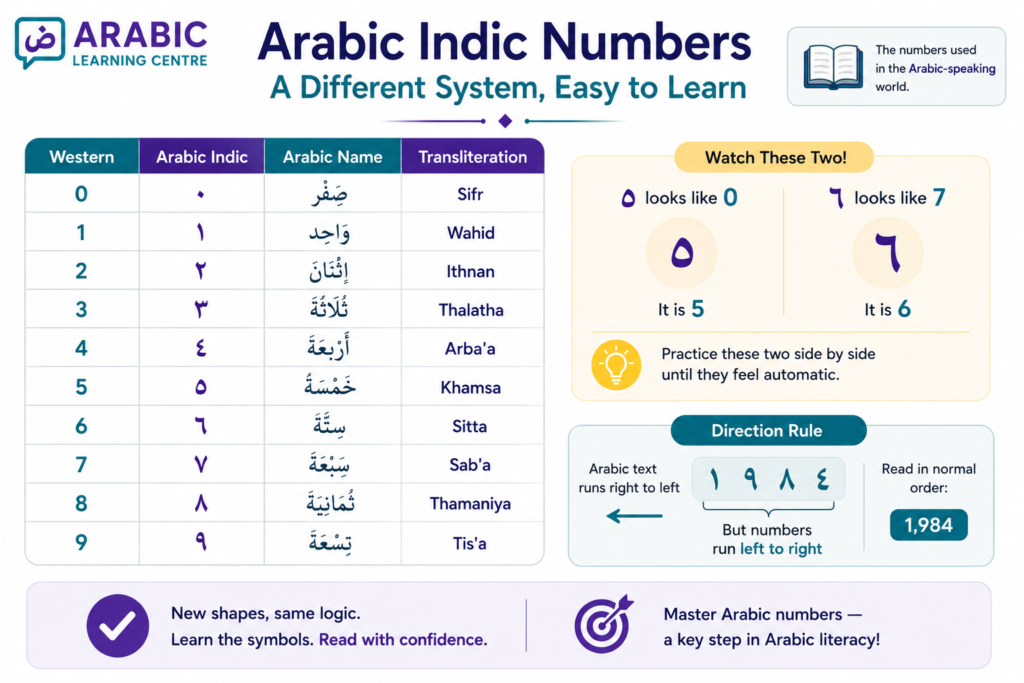
But if you open a book printed in Egypt, Saudi Arabia, or Iraq, the digits on the page look entirely different:
٠ ١ ٢ ٣ ٤ ٥ ٦ ٧ ٨ ٩
These are Eastern Arabic numerals — also called Arabic Indic numerals or الأرقام الهندية (al-arqam al-hindiyyah). They are the system used throughout the Arabic-speaking world and are what this guide covers entirely.
The complete symbol comparison — Western numerals alongside their Arabic Indic equivalents:
| Western | Arabic Indic | Arabic Name | Transliteration |
| 0 | ١ | صِفْر | Sifr |
| 1 | ٢ | وَاحِد | Wahid |
| 2 | ٢ | اِثْنَان | Ithnan |
| 3 | ٣ | ثَلَاثَة | Thalatha |
| 4 | ٤ | أَرْبَعَة | Arba’a |
| 5 | ٥ | خَمْسَة | Khamsa |
| 6 | ٦ | سِتَّة | Sitta |
| 7 | ٧ | سَبْعَة | Sab’a |
| 8 | ٨ | ثَمَانِيَة | Thamaniya |
| 9 | ٩ | تِسْعَة | Tis’a |
Two Arabic Indic digits cause consistent confusion for Western-trained learners:
- ٥ looks like a small circle and is frequently misread as 0 — it is 5.
- ٦ looks similar to a 7 — it is 6.
Deliberate side-by-side comparison practice for these two specific symbols resolves the confusion within days. Write them repeatedly next to their Western equivalents until the shapes feel automatic.
One directional rule applies to all multi-digit Arabic Indic numbers: even though Arabic text runs right to left, the digits within a number run left to right — exactly as in English. The number ١٩٨٤ is read as 1,984 in normal place-value order, not reversed.
At The Arabic Learning Centre, the Arabic Classes for Non-Arabic Speakers introduces Arabic Indic numbers from the very first lessons — building symbol recognition alongside vocabulary in a structured sequence designed for complete beginners.

Learn Arabic numbers with a certified native tutor from Day 1
2- Reading Arabic Indic Numbers 1 to 10 Builds the Foundation for Everything Else
Every number from 11 to 100 is built from the units 1 to 10. This makes the first ten numbers the single most important group to memorize — and to memorize correctly, including the gender forms that become essential in compound numbers.
The complete units table with both Arabic Indic symbols, Arabic script, and English pronunciation:
| Arabic Indic | Arabic Script | Transliteration | English |
| ١ | وَاحِد | Wahid | One |
| ٢ | اِثْنَان | Ithnan | Two |
| ٣ | ثَلَاثَة | Thalatha | Three |
| ٤ | أَرْبَعَة | Arba’a | Four |
| ٥ | خَمْسَة | Khamsa | Five |
| ٦ | سِتَّة | Sitta | Six |
| ٧ | سَبْعَة | Sab’a | Seven |
| ٨ | ثَمَانِيَة | Thamaniya | Eight |
| ٩ | تِسْعَة | Tis’a | Nine |
| ١٠ | عَشَرَة | Ashara | Ten |
The gender reversal rule — the most counterintuitive feature of Arabic numbers — applies directly to units 3 through 10. In formal Arabic, these numbers take the opposite gender of the noun they count. If the noun is masculine, the number appears in its feminine form, and vice versa.
The gender rule in practice:
| Noun Gender | Number Used | Example |
| Masculine noun (كِتَاب — book) | Feminine number form (ثَلَاثَة) | ثَلَاثَةُ كُتُب — three books |
| Feminine noun (سَيَّارَة — car) | Masculine number form (ثَلَاث) | ثَلَاثُ سَيَّارَات — three cars |
Numbers 1 and 2 follow the opposite rule — they agree with the noun’s gender, not reverse it. In spoken Arabic dialects, the reversal rule is frequently simplified or ignored entirely. For everyday conversation, learn the basic number words first and tackle gender agreement when you advance to formal Arabic.
Inside Our Classrooms
See how we make learning interactive and engaging! Watch a quick snippet of our live, conversational classes in action:
3- Arabic Indic Numbers 11 to 19 Follow the Teen Formation Pattern
How to read Arabic Indic numbers 1 to 100 requires mastering four separate formation patterns. The teens — numbers 11 through 19 — are the second pattern and follow a unit + ten structure that parallels English “-teen” endings.
The formula: unit + عَشَر (for masculine) or عَشْرَة (for feminine)
Numbers 11 and 12 are irregular and must be memorized separately:
| Arabic Indic | Arabic Script | Transliteration | English |
| ١١ | أَحَدَ عَشَرَ | Ahada ‘ashara | Eleven |
| ١٢ | اِثْنَا عَشَرَ | Ithna ‘ashara | Twelve |
| ١٣ | ثَلَاثَةَ عَشَرَ | Thalathata ‘ashara | Thirteen |
| ١٤ | أَرْبَعَةَ عَشَرَ | Arba’ata ‘ashara | Fourteen |
| ١٥ | خَمْسَةَ عَشَرَ | Khamsata ‘ashara | Fifteen |
| ١٦ | سِتَّةَ عَشَرَ | Sittata ‘ashara | Sixteen |
| ١٧ | سَبْعَةَ عَشَرَ | Sab’ata ‘ashara | Seventeen |
| ١٨ | ثَمَانِيَةَ عَشَرَ | Thamaniyata ‘ashara | Eighteen |
| ١٩ | تِسْعَةَ عَشَرَ | Tis’ata ‘ashara | Nineteen |
For teens 13–19: the unit keeps its -a ending and عَشَرَ is always pronounced with a final -a. Both parts are spoken as one compound — say thalathata ‘ashara as one breath, not two separate words.
The gender rule for teens: for 13–19, the unit part follows the same reversal rule as numbers 3–10. The عَشَر / عَشْرَة part determines the overall gender of the number.
At The Arabic Learning Centre, the Arabic Grammar Course teaches the teen number formation rules and gender agreement in structured live sessions — eliminating the guesswork that causes most beginners to use numbers incorrectly for months.
Master Arabic number grammar with live native instruction.
4- Arabic Indic Tens from 20 to 90 Follow a Single Predictable Pattern
The tens are the easiest group in the entire Arabic number system. They are formed from the unit roots with the suffix -oon/-een — the masculine sound plural pattern — making them immediately recognizable once you know units 1 through 9.
The complete tens table:
| Arabic Indic | Arabic Script | Transliteration | English |
| ٢٠ | عِشْرُون | Ishroon | Twenty |
| ٣٠ | ثَلَاثُون | Thalathoon | Thirty |
| ٤٠ | أَرْبَعُون | Arba’oon | Forty |
| ٥٠ | خَمْسُون | Khamsoon | Fifty |
| ٦٠ | سِتُّون | Sittoon | Sixty |
| ٧٠ | سَبْعُون | Sab’oon | Seventy |
| ٨٠ | ثَمَانُون | Thamanoon | Eighty |
| ٩٠ | تِسْعُون | Tis’oon | Ninety |
| ١٠٠ | مِئَة | Mi’a | One hundred |
The pattern is clear: take the unit word, add -oon for nominative case or -een for accusative/genitive. In everyday spoken Arabic, -een is the most commonly used ending across dialects and is grammatically correct in most contexts — when in doubt, use -een.
The tens do not change for gender.
عِشْرُون is always عِشْرُون regardless of whether the noun counted is masculine or feminine.
Read Also: How to Read Arabic Quran?
5- Compound Arabic Indic Numbers 21 to 99 Place the Unit Before the Ten
How to read Arabic Indic numbers in English becomes most practical at the compound stage — numbers 21 through 99 — because these are what appear on prices, addresses, ages, phone numbers, and dates in real Arabic text.
The compound formation rule is the direct opposite of English: Arabic places the unit first, then the conjunction و (wa — “and”), then the ten. The number 25 is literally “five and twenty.”
The complete compound formation pattern with examples:
| Arabic Indic | Formula | Arabic Script | Transliteration | English |
| ٢١ | 1 + wa + 20 | وَاحِد وَعِشْرُون | Wahid wa-‘ishroon | Twenty-one |
| ٢٥ | 5 + wa + 20 | خَمْسَة وَعِشْرُون | Khamsa wa-‘ishroon | Twenty-five |
| ٣٣ | 3 + wa + 30 | ثَلَاثَة وَثَلَاثُون | Thalatha wa-thalathoon | Thirty-three |
| ٤٧ | 7 + wa + 40 | سَبْعَة وَأَرْبَعُون | Sab’a wa-arba’oon | Forty-seven |
| ٥٢ | 2 + wa + 50 | اِثْنَان وَخَمْسُون | Ithnan wa-khamsoon | Fifty-two |
| ٦٨ | 8 + wa + 60 | ثَمَانِيَة وَسِتُّون | Thamaniya wa-sittoon | Sixty-eight |
| ٧٤ | 4 + wa + 70 | أَرْبَعَة وَسَبْعُون | Arba’a wa-sab’oon | Seventy-four |
| ٨٩ | 9 + wa + 80 | تِسْعَة وَثَمَانُون | Tis’a wa-thamanoon | Eighty-nine |
| ٩٦ | 6 + wa + 90 | سِتَّة وَتِسْعُون | Sitta wa-tis’oon | Ninety-six |
The gender rule for compounds: only the unit part (the number before wa) follows the reversal rule for 3–10. The tens word itself never changes for gender. This means compound number gender agreement is determined entirely by the unit digit.
The practical reading method for any compound Arabic Indic number:
- Identify the unit digit (the right digit in a two-digit number).
- Identify the tens digit (the left digit).
- Read: [unit name] + wa + [tens name].
- Example: ٤٧ → right digit is ٧ (sab’a) + wa + left digit ٤٠ (arba’oon) = sab’a wa-arba’oon.
At The Arabic Learning Centre, the Arabic Vocabulary Course builds number vocabulary alongside core Arabic words — giving learners the practical number fluency needed for real conversations, reading prices, and navigating Arabic text.
Read Also: How to Read Arabic Letters?

Build practical Arabic number fluency with expert guidance.
6- The Four Most Common Mistakes Beginners Make Reading Arabic Indic Numbers
Understanding what causes errors is as valuable as learning the correct system. These four mistakes appear consistently among beginners learning how to read Arabic Indic numbers — and each one has a direct, practical fix.
The four mistakes and their fixes:
- Misreading ٥ as 0 and ٦ as 7: These two digits are the most visually misleading for Western-trained eyes. Fix: write ٥ and ٦ side by side with their Western equivalents every day for one week until the shapes become automatic.
- Reading multi-digit numbers right to left: Arabic text runs right to left, but digit sequences within numbers run left to right. Fix: always read the leftmost digit as the highest place value — exactly as in English.
- Placing the ten before the unit in compound numbers: English says “twenty-five” (ten then unit), but Arabic says “five and twenty” (unit then ten). Fix: always identify the unit digit first, then add wa, then the ten.
- Applying the gender reversal rule to 1 and 2: Numbers 1 and 2 agree with the noun’s gender — they do not reverse it. Only numbers 3 through 10 follow the reversal rule. Fix: memorize this as two separate rules: 1–2 agree, 3–10 reverse.
Read Also: How to Read Arabic in English Letters?
Don’t Just Take Our Word For It
Take a look inside our vibrant classes and see our students and teachers in action. Click below to watch our classroom experience:
Start Reading Arabic Numbers at The Arabic Learning Centre
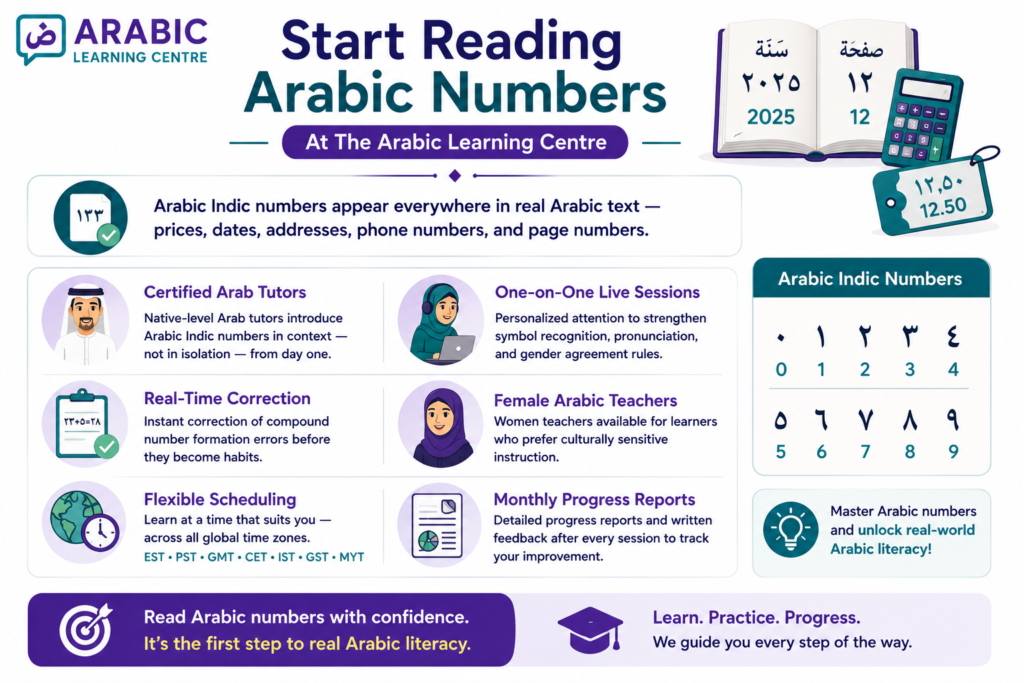
Arabic Indic numbers appear everywhere in real Arabic text — prices, dates, addresses, phone numbers, and page numbers. A beginner who cannot read them fluently is blocked from the most practical layer of Arabic literacy before reaching any vocabulary or grammar at all.
The Arabic Learning Centre builds Arabic Indic number recognition alongside every other Arabic literacy skill:
- Certified Arab tutors with native-level proficiency who introduce Arabic Indic numbers in context — not in isolation — from the very first session.
- One-on-one live sessions that address individual weaknesses in symbol recognition, pronunciation, and gender agreement rules.
- Real-time correction of compound number formation errors before they become habits.
- Female Arabic teacher options for learners who prefer culturally sensitive instruction.
- Flexible scheduling across all global time zones — EST, PST, GMT, CET, IST, GST, and MYT.
- Monthly progress reports and written feedback after every session.
Courses We Offer:
- Quranic Arabic Course
- Arabic Course for Islamic Studies
- Learn Arabic for New Muslims
- Learn Arabic Letters for Tajweed
- Al Azhar Arabic Course
- Madinah Arabic Course
- Online Arabic Classes for Kids
- Arabic Words Course for Kids
- Arabic Lessons for Kindergarten
- Arabic Elementary School
- Arabic Intermediate School
- Arabic High School
Book your free trial session now
Conclusion
How to read Arabic Indic numbers follows four clear patterns: units 1–10 are the foundation, teens 11–19 add عَشَر to the unit, tens 20–90 add the -oon suffix to the unit root, and compounds 21–99 place the unit before the ten with و (wa) between them. The gender reversal rule for numbers 3–10 is the one feature that requires deliberate study — everything else is pattern recognition that becomes automatic within weeks of daily practice.
FAQ
How to read Arabic Indic numbers for complete beginners with no prior knowledge?
Start with the 10 unit symbols — memorize each shape alongside its Arabic name and English value. Pay special attention to ٥ and ٦, which are the most commonly misread by Western learners.
How to read Arabic Indic numbers 1 to 100 in English?
Follow four steps: learn units 1–10, learn teens 11–19 using the unit + ‘ashara formula, learn tens 20–90 using the unit + oon suffix pattern, then learn compounds 21–99 using the unit + wa + ten structure.
How to read Arabic Indic numbers in English when they appear in Arabic text?
Read the digit sequence left to right — despite Arabic text running right to left, digit sequences within numbers follow left-to-right place value, identical to English number reading.
What is the gender reversal rule for Arabic numbers 3 to 10?
Numbers 3–10 take the opposite gender of the noun they count — masculine number with feminine noun, feminine number with masculine noun. Numbers 1 and 2 agree with the noun’s gender and do not reverse.
Do Arabic dialects use Arabic Indic numbers or Western numerals?
Both systems are used across the Arabic-speaking world. Eastern Arabic Indic numerals are common in the Gulf, Levant, and Egypt. Western numerals are more prevalent in North Africa — Morocco, Algeria, and Tunisia use Western digits in most everyday contexts.
Related Articles
Arabic Alphabet & Writing