 Learn Arabic
Learning how to learn to read Arabic online for free is entirely possible if you follow the right sequence.Most learners fail not because the resources aren’t there, but because they start in the wrong place, jump between apps without a clear path, or spend weeks on vocabulary before they can decode a single letter. This guide fixes that.
This guide is designed for anyone searching for how to learn to read Arabic online for free for beginners. Whether you’re a complete beginner or someone who recognises a few words but can’t yet read a full sentence, these ten steps will help you build confident reading skills.
Step 1: Understand the Correct Learning Sequence Before You Touch a Single App
The single biggest mistake Arabic learners make online is starting with vocabulary flashcards or phrasebooks before they can read the script. Arabic is a phonetic script — every letter has a sound, and those sounds follow consistent rules. If you can decode the letters, you can read anything. If you skip that foundation, you spend years guessing.
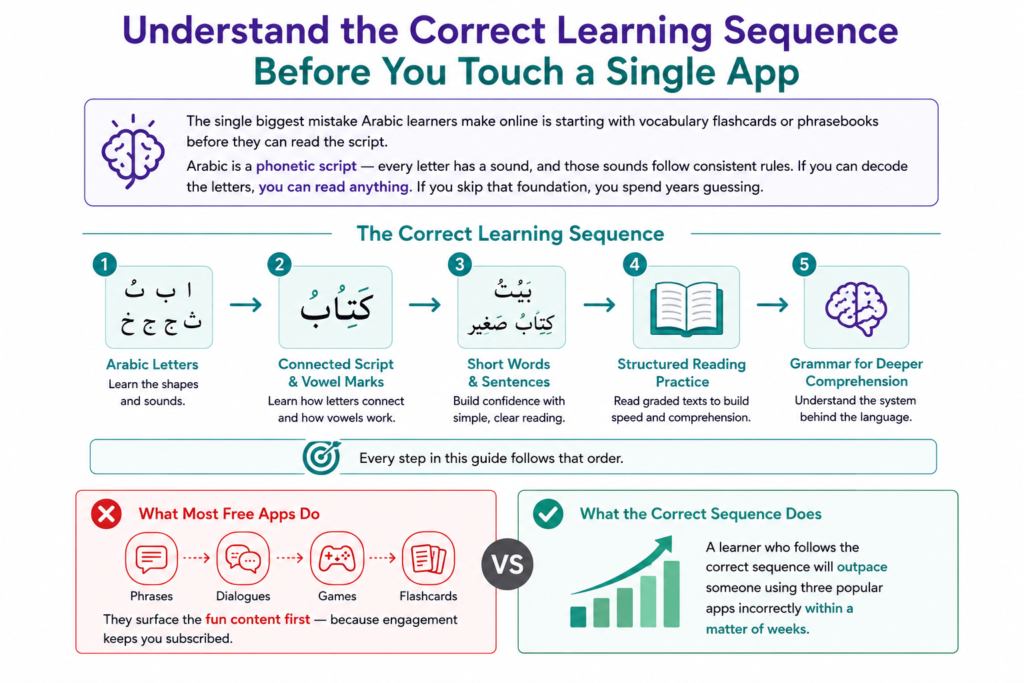
The correct sequence is: Arabic letters → connected script and vowel marks → short words and sentences → structured reading practice → grammar for deeper comprehension. Every step in this guide follows that order.
Most free apps don’t tell you this. They surface the fun content first — phrases, dialogues, games — because engagement keeps you subscribed. A learner who follows the correct sequence will outpace someone using three popular apps incorrectly within a matter of weeks.
Step 2: Learn the Arabic Alphabet First — All 28 Letters in All Four Forms
Before you can read Arabic confidently, you need to recognize every letter in all of its forms. Since most Arabic letters change shape depending on where they appear in a word, mastering these variations is the foundation of fluent reading.
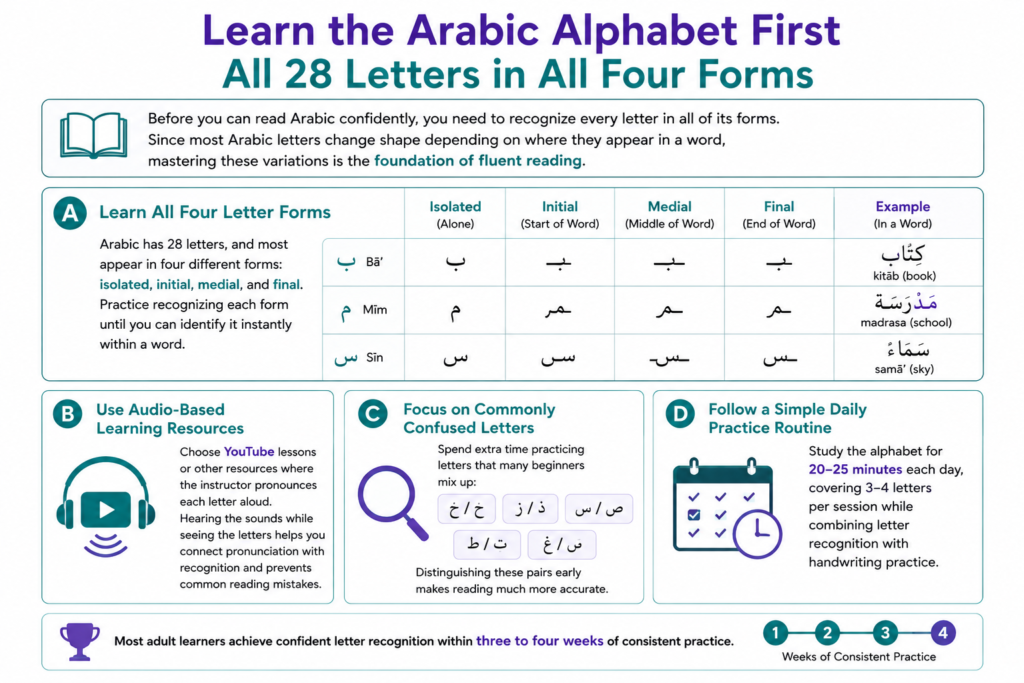
A. Learn All Four Letter Forms
Arabic has 28 letters, and most appear in four different forms: isolated, initial, medial, and final. Practice recognizing each form until you can identify it instantly within a word.
B. Use Audio-Based Learning Resources
Choose YouTube lessons or other resources where the instructor pronounces each letter aloud. Hearing the sounds while seeing the letters helps you connect pronunciation with recognition and prevents common reading mistakes.
C. Focus on Commonly Confused Letters
Spend extra time practicing letters that many beginners mix up, including ح / خ, ذ / ز, ص / س, ط / ت, and ع / غ. Distinguishing these pairs early makes reading much more accurate.
D. Follow a Simple Daily Practice Routine
Study the alphabet for 20–25 minutes each day, covering 3–4 letters per session while combining letter recognition with handwriting practice. Most adult learners achieve confident letter recognition within three to four weeks of consistent practice.
The Arabic Grammar Course at Arabic Learning Centre covers these exact foundations in a structured format designed for learners building toward confident reading.
Build a Strong Foundation in Arabic Grammar with a Free Trial

Step 3: Master Arabic Vowel Marks (Harakat) Before Reading Whole Words
Before reading complete Arabic words, you need to understand harakat. These short vowel marks guide pronunciation and help you distinguish between words that share the same letters but have different meanings.
| Harakah | Sound | Function |
| Fathah (َ) | a | Adds a short a sound to a letter. |
| Kasrah (ِ) | i | Adds a short i sound. |
| Dammah (ُ) | u | Adds a short u sound. |
| Sukoon (ْ) | — | Indicates that the letter has no vowel. |
| Shaddah (ّ) | Double consonant | Doubles the pronunciation of the letter. |
| Tanwin (ً ٍ ٌ) | -an, -in, -un | Marks indefinite noun endings. |
Arabic vowel marks don’t just affect pronunciation—they also change meaning and grammar. For example, كَتَبَ (he wrote) and كُتُبٌ (books) contain the same three letters, but the harakat create completely different words.
Before moving on to unvowelled Arabic texts, spend about two weeks practicing fully vowelled words and short sentences. Building confidence with harakat early makes every later stage of reading much easier.
Inside Our Classrooms
See how we make learning interactive and engaging! Watch a quick snippet of our live, conversational classes in action:
Step 4: Use ArabicPod101 for Structured Beginner Audio and Lessons
Once you can read basic letters and vowel marks, you need structured audio content that introduces Arabic in a logical progression — not random phrasebooks. ArabicPod101 is one of the most complete free resources at this stage. It offers a free sign-up with a one-week trial that unlocks content across all levels, from complete beginner to advanced.
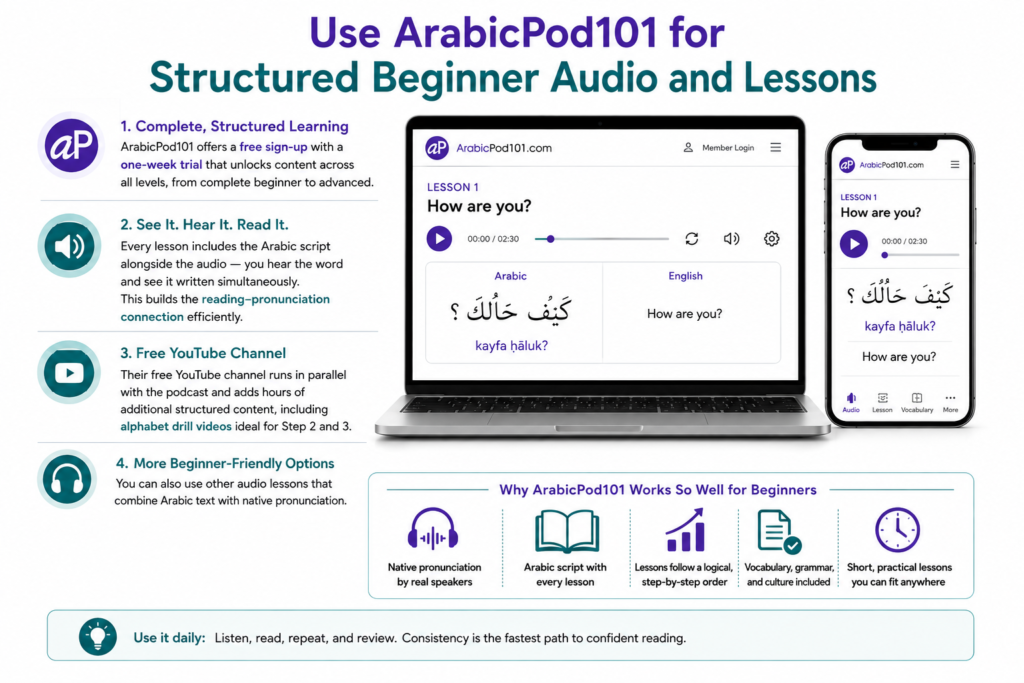
The core value of ArabicPod101 for readers specifically is that every lesson includes the Arabic script alongside the audio — you hear the word and see it written simultaneously. This is the most efficient way to build the reading-pronunciation connection that independent study often misses.
Their free YouTube channel runs in parallel with the podcast and adds hours of additional structured content, including alphabet drill videos ideal for Step 2 and 3.
You can also use other beginner-friendly audio lessons that combine Arabic text with native pronunciation.
Step 5: Follow a Structured Free Arabic Course
Apps can help you build a daily habit, but a structured course teaches reading, grammar, vocabulary, and sentence patterns in a logical sequence. If you’re learning Arabic online for free, choose one course and follow it consistently instead of switching between multiple apps.
Some popular free resources include:
- Madinah Arabic – A structured course for learning Modern Standard Arabic, suitable for beginners and non-native speakers.
- Live Lingua – Offers free Arabic learning materials, including Modern Standard Arabic and several dialects.
- BBC Languages Arabic – Provides beginner-friendly lessons that combine reading, listening, and basic language practice.
The key is not using every resource at once. Select one structured course, complete it step by step, and use the other resources only for additional practice.
For learners who want to move into advanced reading later, the Advanced Arabic Course at Arabic Learning Centre provides a structured progression from intermediate reading into complex text — a natural next step once free foundations are in place.
Join Our Advanced Arabic Course with a Free Trial

Step 6: Build Your Vocabulary Through Real Reading
A strong Arabic vocabulary develops through regular exposure to the language, not by memorizing long word lists. Every time you read a sentence, you learn more than just a new word—you also see how it is spelled, pronounced, and used in context. This makes vocabulary easier to remember and much easier to recognize when it appears again.
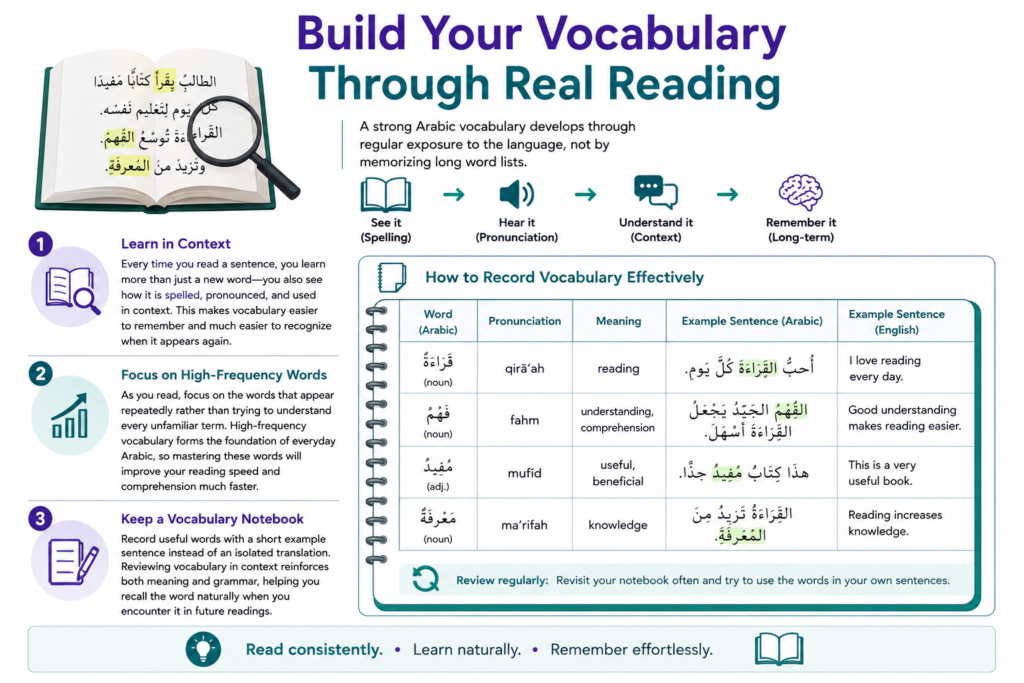
As you read, focus on the words that appear repeatedly rather than trying to understand every unfamiliar term. High-frequency vocabulary forms the foundation of everyday Arabic, so mastering these words will improve your reading speed and comprehension much faster than learning rare expressions.
Keep a simple vocabulary notebook and record useful words with a short example sentence instead of an isolated translation. Reviewing vocabulary in context reinforces both meaning and grammar, helping you recall the word naturally when you encounter it in future readings.
Step 7: Add Arabic Grammar Study to Unlock Faster Reading Comprehension
This step surprises most learners. Grammar feels like an advanced topic — something you do after you can already read. In Arabic, the opposite is true. Because Arabic is a case-marked language (word endings change based on grammatical function), a reader who understands basic grammar reads faster, makes fewer errors, and comprehends more on the first pass.
The two grammatical sciences that matter most for reading are Nahw (syntax — how words relate to each other in a sentence) and Sarf (morphology — how words are built from roots). Arabic uses a three-letter root system where a single root generates dozens of related words. Learning to recognise roots is more efficient than memorising each word independently: the root ك-ت-ب (k-t-b) gives you kataba (he wrote), kitaab (book), maktaba (library), kaatib (writer), maktub (written) — five words from three letters.
Even basic Nahw knowledge — understanding the three types of Arabic words (ism, fi’l, harf) and how case endings work — changes the reading experience fundamentally. A learner who recognises that الكتابُ is the subject and الكتابَ is the object has immediately doubled their reading accuracy in formal written Arabic.
Learners who are specifically working to read Arabic as a non-native speaker will find the Arabic Course for Non-Arabic Speakers at Arabic Learning Centre particularly well-matched to this stage — it bridges vocabulary and reading in a structured format designed for their exact starting point.
Join Our Arabic Classes for Non-Arabic Speakers with a Free Trial

Step 8: Start Reading Authentic Arabic Texts
Once you have a solid foundation in the Arabic alphabet, harakat, vocabulary, and basic grammar, it’s time to read authentic Arabic. Real-world texts expose you to natural sentence structures, common vocabulary, and writing styles that gradually build reading fluency.
Begin with materials that match your level, such as graded readers, children’s stories, short articles, and simple news reports. These texts provide enough familiar vocabulary to keep you reading while introducing new words in context.
Avoid choosing texts that are too difficult. If you need to look up every other word, the material is probably above your current level. Instead, select content where you understand most of the text and can infer the meaning of unfamiliar words from context.
As your confidence grows, gradually move on to longer articles, books, and authentic Arabic websites. Reading a wide variety of materials will strengthen your vocabulary, improve your comprehension, and prepare you to read Arabic comfortably in everyday situations.
Read Also: How to Learn Arabic in 7 Days?
Step 9: Reinforce Your Reading by Practicing Writing
Reading and writing reinforce each other because writing helps you recognize Arabic letters and their different forms more quickly. The more you write, the easier it becomes to identify connected letters, distinguish similar shapes, and read words accurately.
You don’t need to write long paragraphs. Instead, trace each letter in its four forms, copy new vocabulary by hand, and rewrite short sentences from your reading practice. This strengthens letter recognition, improves spelling awareness, and makes reading Arabic faster and more natural over time.
For learners ready to extend this into formal writing skills, the Arabic Writing Course at Arabic Learning Centre builds from foundational letter formation through to structured written composition.
Start Your Arabic Script Writing Course with a Free Trial

Read Also: How to Read Arabic Books?
Step 10: Maintain Progress with a Consistent Daily Routine
Consistent practice is the key to long-term success in learning Arabic. Rather than switching between multiple resources, follow a simple daily routine that gives equal attention to reading, listening, vocabulary, and grammar. Small, consistent study sessions produce better results than occasional long study periods.
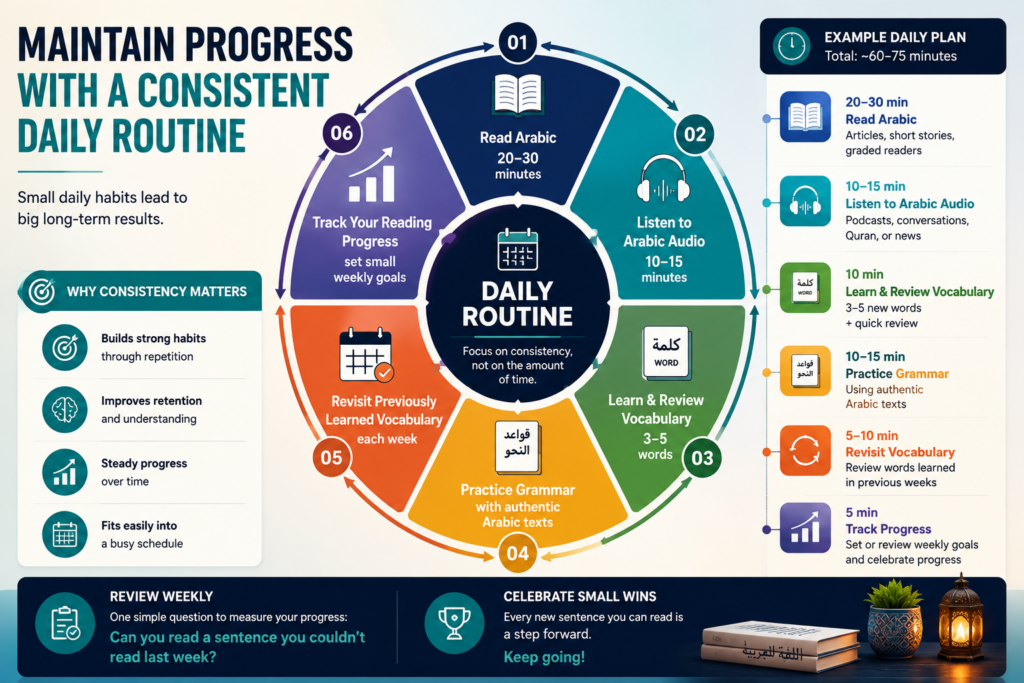
This routine is particularly effective for learners looking for how to learn to read Arabic online for free for adults, since it fits easily into a busy daily schedule.
- Read Arabic for 20–30 minutes every day.
- Listen to 10–15 minutes of native Arabic audio.
- Learn and review 3–5 new vocabulary words daily.
- Practice grammar using authentic Arabic texts.
- Revisit previously learned vocabulary each week.
- Track your reading progress with small weekly goals.
- Focus on consistency rather than the amount of time you study.
Review your progress weekly against one concrete benchmark: can you read a sentence you couldn’t read last week? That single question keeps the learning purposeful.
Read Also: How to Learn Arabic in One Month?
Don’t Just Take Our Word For It
Take a look inside our vibrant classes and see our students and teachers in action. Click below to watch our classroom experience:
Start Learning Arabic with a Structured Online Course
Free online resources are an excellent way to build your Arabic reading skills, but many learners eventually reach a point where they need more structure, personalized guidance, and consistent feedback. Following a clear learning path helps you progress faster, avoid common mistakes, and build confidence as you move from beginner reading to authentic Arabic texts.
At Arabic Learning Centre, our online courses are designed specifically for non-Arabic speakers who want to develop strong reading skills while improving their vocabulary, grammar, listening, and overall language proficiency. Explore our Arabic courses and choose the program that best matches your current level to continue your learning journey with confidence.
Courses We Offer:
- Business Arabic Course
- Learn Arabic from Zero
- Medical Arabic Course
- Learning Arabic for Non Arabic Speakers
- Learn Arabic in Saudi Arabia
- Learn to Read Arabic Course
- Arabic Grammar Course
- Arabic Speaking Course
- Arabic Script writing course
- Arabic Vocabulary Course
- Arabic Pronunciation Course
[Book Your Free Trial Lesson Today]

Conclusion
Learning how to read Arabic online for free doesn’t require expensive courses or years of trial and error. What matters most is following the right sequence—starting with the Arabic alphabet and harakat, then progressing to words, sentences, vocabulary, grammar, and authentic reading practice. Building each skill on top of the previous one creates a strong foundation for confident Arabic reading.
With the wide range of free online resources available today, anyone can begin learning from home at their own pace. Stay consistent, practice reading every day, and measure your progress regularly. Over time, you’ll find yourself reading Arabic more accurately, understanding more of what you read, and developing the confidence to tackle increasingly complex texts.
Frequently Asked Questions
How long does it take to learn to read Arabic online for free?
Most adult learners who study 30–45 minutes daily reach basic reading fluency in four to six months — meaning they can decode any Arabic word written with harakat (vowel marks). Reading unvowelled text, which is how most Arabic appears in the real world, typically requires an additional three to six months of reading practice and vocabulary building.
What is the best free website to learn Arabic reading online?
Madinah Arabic and ArabicPod101 are the strongest free structured resources for learning to read Arabic. Madinah Arabic provides a rigorous written curriculum for Modern Standard Arabic; ArabicPod101 adds audio and video content at every level. LingQ is the best free platform for reading practice once you can decode basic text.
Can I learn to read Arabic without learning to speak it?
Yes. Reading and speaking Arabic use the same letters and grammar, but they are distinct skills that can be developed independently. Many learners focus on reading Modern Standard Arabic for religious, literary, or academic purposes without actively developing spoken conversational fluency. The alphabet, vowel marks, and grammar steps in this guide apply directly to a reading-focused path.
Is Modern Standard Arabic or a dialect better for learning to read?
For reading purposes, Modern Standard Arabic (MSA) is the correct choice. Books, newspapers, websites, formal media, and religious texts across the entire Arab world are written in MSA. Dialects are primarily spoken and have no standardised written form. If your goal is reading — not conversation — MSA is the only logical starting point.
What is the biggest mistake beginners make when learning Arabic online?
The most common mistake is starting with vocabulary apps or phrasebooks before learning to read the Arabic script. This creates a dependency on transliteration (Arabic written in Latin letters) that must be unlearned later, and it delays the letter recognition that is the foundation of all Arabic reading. Always begin with the alphabet.
Do I need to learn Arabic grammar to read Arabic?
For basic reading of vowelled text (with harakat), grammar study is helpful but not essential in the first few weeks. For reading unvowelled Arabic — the kind found in everyday books, websites, and newspapers — basic grammar knowledge becomes necessary. Knowing how case endings work helps you predict which vowel a word carries, which is how fluent Arabic readers process text without written vowel marks.