 Learn Arabic
| Key Takeaways |
| Arabic verb forms follow the trilateral root system, making patterns learnable and predictable once the root logic clicks. |
| The ten main verb measures (أوزان, awzān) cover the vast majority of Arabic verbs and conjugation patterns learners encounter. |
| Memorizing the base form فَعَلَ (fa’ala) as a template lets you map any new verb onto familiar conjugation patterns. |
| Spaced repetition combined with root-pattern drilling is the most effective method for retaining Arabic verb conjugations long-term. |
| Beginners should master Past and Present tense conjugations for singular pronouns before tackling dual and plural forms. |
To memorize Arabic verb forms, you learn two things: the trilateral root (three base letters) and the pattern (وزن, wazn) that pattern is placed into.
Every Arabic verb is built on this root-plus-pattern system, which means you are not memorizing thousands of isolated words — you are memorizing a structured framework that generates them. Once that framework is in your mind, memorization becomes pattern recognition.
Arabic verb conjugation can feel overwhelming at first glance. But learners who approach it through the root system and systematic drilling find that the architecture of Arabic verbs becomes one of the language’s greatest gifts rather than its hardest obstacle. The methods below will show you exactly how to do that.
Why Is the Trilateral Root System the Foundation of Arabic Verb Memorization?
To memorize Arabic verb forms effectively, you must first understand that nearly every Arabic verb derives from a three-letter root (الجذر, al-jidhr). These three consonants carry the core semantic meaning, while vowel patterns and additional letters signal the grammatical form.
Take the root ك-ت-ب (k-t-b), carrying the meaning of writing. Every word derived from it — كَتَبَ (kataba, he wrote), كِتَابٌ (kitāb, a book), كَاتِبٌ (kātib, a writer) — is built on the same three consonants arranged in different vowel patterns.
Once you recognize the root, you begin to decode and predict vocabulary, which dramatically reduces the memorization load.
At The Arabic Learning Centre, our Arabic Grammar Course teaches learners to identify roots from lesson one — because this single skill accelerates vocabulary acquisition more than any other approach we have seen.
Start Learning Arabic Grammar with a Free Trial

How to Identify a Trilateral Root in Any Arabic Verb?
Remove prefixes, suffixes, and any added letters. What remains are usually three core consonants. The verb يَكْتُبُ (yaktubu, he writes) strips down to ك-ت-ب. The verb تَكَلَّمَ (takallama, he spoke) contains the root ك-ل-م.
Practice this extraction daily with five new verbs. You will find your reading speed in Arabic texts improving within weeks.
Shots Videos from Our Courses
What Are the Arabic Verb Measures (أوزان) and Why Do They Matter?
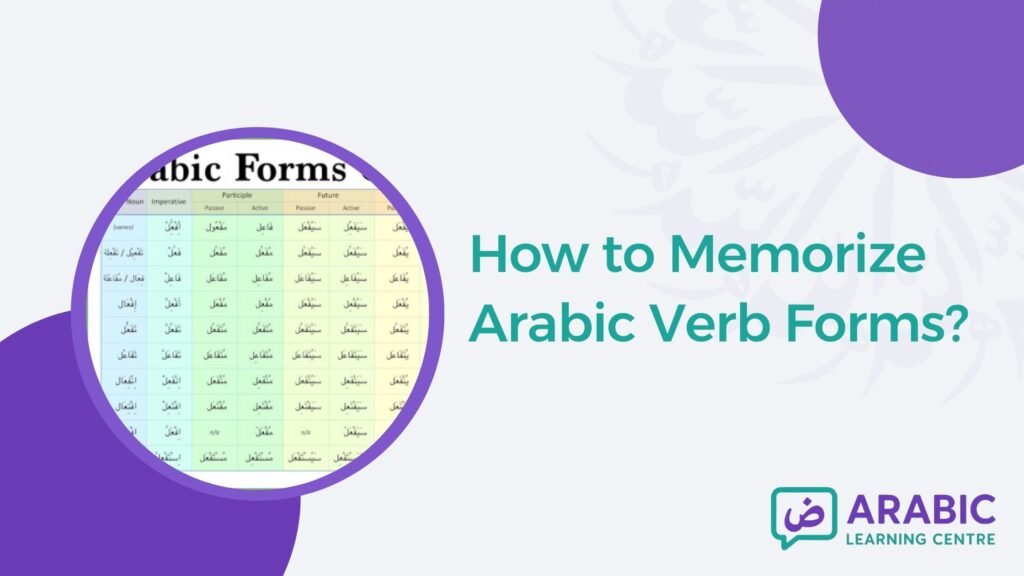
The أوزان (awzān), or verb measures, are the fixed vowel-and-letter templates that Arabic verb roots are placed into. Classical Arabic grammar identifies ten primary measures for derived verbs, with the first measure (Form I) being the simplest. Each measure carries a predictable meaning modification.
Understanding awzān means you can predict the meaning of an unfamiliar verb the moment you recognize which measure it belongs to. This transforms memorization from rote repetition into logical deduction.
| Measure | Pattern (with ف-ع-ل) | General Meaning Function |
| Form I | فَعَلَ / فَعِلَ / فَعُلَ | Base action |
| Form II | فَعَّلَ | Intensification or causation |
| Form III | فَاعَلَ | Reciprocal action between two parties |
| Form IV | أَفْعَلَ | Making someone do something (causative) |
| Form V | تَفَعَّلَ | Reflexive of Form II |
| Form VI | تَفَاعَلَ | Reflexive of Form III |
| Form VII | اِنْفَعَلَ | Passive sense |
| Form VIII | اِفْتَعَلَ | Reflexive or intensive |
| Form IX | اِفْعَلَّ | Colors and physical defects |
| Form X | اِسْتَفْعَلَ | Seeking or considering |
For practical memorization, focus on Forms I through IV first — these cover the majority of verbs in Modern Standard Arabic (Fusha) texts and conversation. Forms V through X extend your range as your fluency grows.
How to Memorize Arabic Verb Forms for Beginners?
For beginners, how to memorize Arabic verb forms starts with one template: فَعَلَ (fa’ala). This is the traditional Arabic grammar placeholder used in Nahw scholarship for millennia — the equivalent of “to do” as a neutral demonstration verb.
Every conjugation pattern you learn maps onto this template first. When you see an unfamiliar verb, you slot its root into the same positions as ف-ع-ل and apply the vowel pattern you already know.
Step One: Memorize the Past Tense Singular Conjugations First
Begin with Past Tense (الماضي, al-māḍī), singular pronouns only. This gives you six manageable conjugations before you touch dual or plural forms.
| Pronoun | Arabic | Transliteration | Translation (root ك-ت-ب) |
| He | كَتَبَ | kataba | He wrote |
| She | كَتَبَتْ | katabat | She wrote |
| You (masc.) | كَتَبْتَ | katabta | You wrote |
| You (fem.) | كَتَبْتِ | katabti | You wrote |
| I | كَتَبْتُ | katabtu | I wrote |
Drill these five forms with three different roots daily for one week. Students at The Arabic Learning Centre who follow this exact sequence consistently internalize the Past Tense singular pattern within ten to fourteen days of structured practice.
Step Two: Move to Present Tense Singular After Mastering Past
The Present Tense (المضارع, al-muḍāri’) adds prefixes and suffixes to signal person and gender. Using the same root ك-ت-ب:
يَكْتُبُ (yaktubu) — He writes تَكْتُبُ (taktubu) — She writes / You (masc.) write تَكْتُبِينَ (taktubīna) — You (fem.) write أَكْتُبُ (aktubu) — I write
The prefix يَ- signals third-person masculine. The prefix تَ- signals third-person feminine or second-person. The prefix أَ- signals first-person singular. These prefix rules apply across virtually all Form I verbs — once memorized, they transfer automatically.
To understand how Arabic tenses connect and interact with one another, our guide on tenses in Arabic gives learners a clear overview that complements verb form memorization.
Read also: Imperative Verb in Arabic
How to Memorize Arabic Verb Forms with Examples?
To memorize Arabic verb forms with examples, the most effective method is root drilling — taking a single root through every conjugation pattern you have learned before introducing a new root. This forces your brain to treat the pattern as the primary unit of knowledge, not the individual word.
Here is a structured drilling sequence using the root دَرَسَ (d-r-s, to study):
Past Tense: دَرَسَ (darasa) — “He studied” دَرَسَتْ (darasat) — “She studied” دَرَسْتَ (darasta) — “You (m.) studied”
Present Tense: يَدْرُسُ (yadrusu) — “He studies” تَدْرُسُ (tadrusu) — “She studies” أَدْرُسُ (adrusu) — “I study”
Drill this verbally, then in writing, then in a simple sentence: أَنَا أَدْرُسُ اللُّغَةَ الْعَرَبِيَّةَ (anā adrusu al-lugha al-‘arabiyya) — “I study the Arabic language.” Embedding verb forms into real sentences cements them far faster than isolated repetition.
Understanding how verbal sentences in Arabic are constructed gives learners the natural sentence frames needed to practice verb conjugations in context — an approach our instructors recommend alongside drilling.
Which Memory Techniques Work Best for Arabic Verb Conjugation?
Effective Arabic verb memorization uses three evidence-based techniques: spaced repetition, chunking by pattern, and active production. Passive reading of conjugation tables does not build reliable recall. Your memory requires active retrieval — forcing yourself to produce the form before checking.
1. Spaced Repetition:
Use flashcard systems where you review verb forms at increasing intervals — one day, three days, seven days, fourteen days. Focus your reviews on forms you got wrong in the previous session.
2. Chunking by Pattern:
Never memorize Past Tense and Present Tense of the same verb on the same day. Master one tense across multiple roots before introducing the second tense. Mixing patterns too early creates interference in memory consolidation.
3. Active Production:
After drilling any conjugation table, close it and write out the forms from memory. Then open it and compare. Every error you catch actively strengthens the correct neural pathway.
Our Arabic Course for Beginners structures all verb form instruction around exactly these three techniques, with certified Arabic instructors guiding learners through personalized drilling sessions in live one-on-one classes.
Join Our Arabic Course for Beginners With a Free Trial
How Do Weak Verbs Affect Memorization, and How Do You Handle Them?
Weak verbs (الأفعال المعتلة) — those whose trilateral root contains one of the three weak letters (و, ا, ي) — undergo phonological changes in conjugation that can confuse beginners. The root patterns stay the same, but certain vowels contract or are dropped for ease of pronunciation.
The verb قَالَ (qāla, he said) comes from the root ق-و-ل, but the و transforms into an alif in the Past Tense singular. Similarly, نَامَ (nāma, he slept) comes from ن-و-م. Recognizing the underlying root behind these changes is the key to managing weak verbs systematically.
In our instructors’ experience, learners who try to memorize weak verb conjugations in isolation — without understanding the root-change rules — consistently struggle more than those who learn the three categories of weak verbs (Assimilated, Hollow, and Defective) as systematic groups.
Treat each category as a distinct pattern set, not as exceptions to memorize individually.
Understanding how to conjugate verbs in Arabic in detail — including weak verb handling — provides learners with the complete conjugation framework that makes verb memorization far more manageable.
How Do Pronouns Attached to Verbs Affect Your Memorization Strategy?
Arabic verbs often absorb their object pronouns directly, creating compound forms that beginners sometimes mistake for unfamiliar vocabulary. These are Arabic attached pronouns — suffixes attached to the end of the conjugated verb.
كَتَبَهَا (katabahā) — “He wrote it (fem.)” أَعْطَيْتُهُ (a’ṭaytuhu) — “I gave it to him”
Memorize attached pronoun suffixes as a separate short list after you have stabilized your verb conjugations. Trying to learn them simultaneously with initial conjugation patterns overloads working memory and slows both down.
Our Students Reviews
Read also: Irregular Verbs in Arabic
Start Learning Arabic Verb Forms with Certified Instructors at The Arabic Learning Centre
Memorizing Arabic verb forms becomes far more efficient with structured guidance, expert feedback, and a curriculum designed specifically for non-native speakers. At The Arabic Learning Centre, our certified Arabic instructors take you through the root system, awzān, and conjugation patterns in a proven sequence that builds lasting fluency.
Why learners choose The Arabic Learning Centre:
- 1-on-1 personalized sessions with native-speaker certified instructors
- Flexible scheduling available 24/7
- Structured curriculum from absolute beginner through advanced grammar
- Free trial lesson with no commitment required
- Specialized tracks including Arabic Grammar Course, Arabic Course for Beginners, and Arabic Conversation Course
Book your free trial lesson today and begin building your Arabic verb foundation the right way from day one.
Check out our top courses in Arabic and choose the course you need to start learning Arabic today:
- Arabic Course for Beginners
- Arabic Script Writing Course
- Arabic Speaking Course
- Learn Arabic Letters for Tajweed
- Learning Arabic Grammar
- Arabic Vocabulary Course
- Fusha Arabic Course
- Classical Arabic Course
- Arabic Course for Islamic Studies
- Quranic Arabic Course
- Learn Arabic for New Muslims
Start with a FREE trial class and enhance your Arabic language skills

Conclusion
Memorizing Arabic verb forms is not about brute repetition — it is about learning the underlying architecture that generates those forms. The trilateral root system and the ten awzān patterns give every learner a logical framework that makes new verbs predictable rather than foreign.
Beginning with the Past Tense singular conjugations, applying the base template فَعَلَ across multiple roots, and then expanding systematically into Present Tense and derived forms builds genuine competence rather than surface recall.
With the right method and consistent daily practice — even twenty minutes per session — non-Arabic speakers develop reliable verb conjugation recall within six to ten weeks of structured study, Insha’Allah.
Frequently Asked Questions About How to Memorize Arabic Verb Forms
How Many Arabic Verb Forms Do Beginners Need to Memorize First?
Beginners should focus on twelve to fourteen conjugations: Past and Present Tense for singular pronouns (he, she, you masculine, you feminine, I). This gives functional coverage for basic conversation and reading. Dual and plural conjugations build naturally on these singular patterns once the foundational forms are secure.
Is It Better to Memorize Arabic Verbs by Root or by Individual Word?
Memorizing by root is significantly more effective than memorizing individual words in isolation. Each trilateral root generates multiple related words across different measures, so learning one root gives you access to a family of vocabulary items. Individual word memorization scales poorly and creates disconnected knowledge without grammatical transferability.
How Long Does It Take to Memorize the Most Common Arabic Verb Conjugation Patterns?
In our instructors’ experience, most adult learners internalize the Past and Present Tense singular conjugation patterns for Form I verbs within three to four weeks of daily fifteen to twenty minute drilling sessions. Extending that to dual and plural forms typically takes an additional three to five weeks of consistent practice.