 Arabic Grammar
| Key Takeaways |
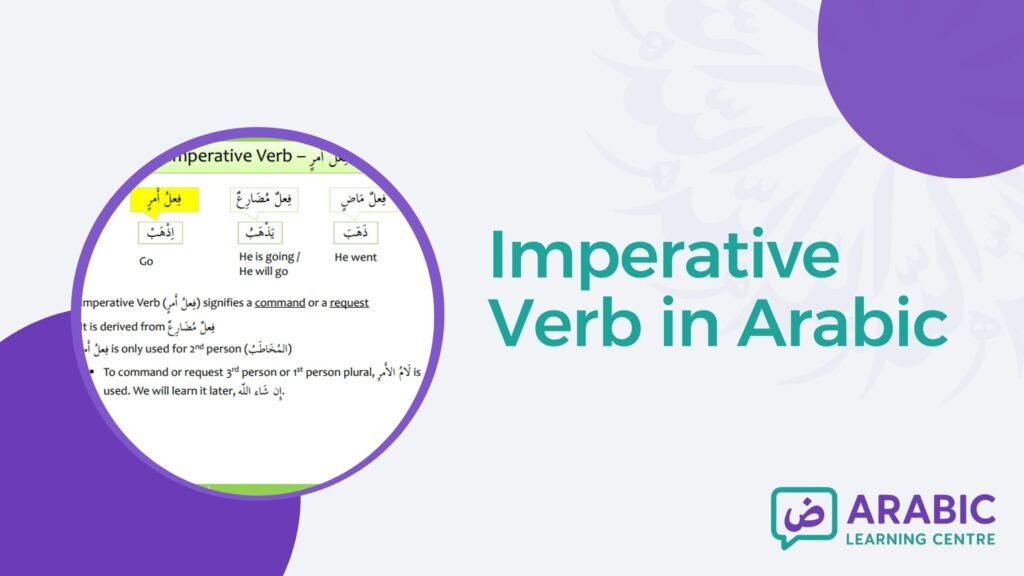
| The imperative verb in Arabic (فِعْلُ الأَمْر — fi’l al-amr) is formed directly from the present-tense verb by dropping the prefix and applying specific vowel rules. |
| Arabic imperatives change form based on the gender and number of the person being addressed: masculine singular, feminine singular, dual, and plural all differ. |
| The imperative is built from the second-person present tense (المُضَارِع) by removing the prefix مُضَارَعَة and adjusting the first letter’s vowel or adding a supporting Hamza. |
| Negative commands in Arabic use the present tense verb preceded by لَا (lā) — not the imperative form — making them structurally distinct from positive commands. |
The imperative verb in Arabic (فِعْلُ الأَمْر — fi’l al-amr) is used to give commands, make requests, or issue instructions directly to someone. It is one of the three core verb types in Arabic grammar alongside the past tense (الفِعْلُ المَاضِي) and the present tense (الفِعْلُ المُضَارِع), and it is formed systematically from the present-tense verb through a defined set of steps.
Once you grasp the formation rules and the gender-number variations, you can construct correct commands confidently and recognize them instantly when you read or listen to Arabic.
What Is the Imperative Verb in Arabic?
The imperative verb in Arabic (فِعْلُ الأَمْر) is the verb form used to command, request, or instruct the person you are directly addressing — the second person. The imperative verb in Arabic always addresses “you” (أَنْتَ, أَنْتِ, أَنْتُمَا, أَنْتُمْ, أَنْتُنَّ), and it changes its form to match the gender and number of that person.
Arabic does not use a separate word for “please” in the verb itself; the imperative form carries the command meaning on its own.
Before attempting to master this, make sure you have a solid grounding in how Arabic conjugates verbs in Arabic — because the imperative is built directly on the present-tense conjugation system.
Why the Imperative Matters for Real Conversational Arabic
At The Arabic Learning Centre, students in our Arabic Conversation Course encounter the imperative verb within the first few weeks — because functional spoken Arabic demands it. You cannot give directions, make simple requests, or follow Quranic instructions without it.
Enroll in Our Arabic Speaking Course Today With a Free Trial

How to Form the Imperative Verb in Arabic?
To form the imperative verb in Arabic, take the second-person present tense form, remove the prefix letter of present-tense conjugation (حَرْفُ المُضَارَعَة — the ت prefix), then examine the first root letter’s vowel. If that letter carries a sukoon (no vowel), add a supporting Hamza (هَمْزَةُ الوَصْل) at the beginning to make it pronounceable.
This three-step process applies to all sound (regular) Arabic verbs. Understanding what sukoon is in Arabic is essential here — because the sukoon on the first root letter is precisely what triggers the need for the supporting Hamza.
Step 1 — Take the Second-Person Masculine Singular Present Tense
Start with تَكْتُبُ (taktub — “you write”).
Step 2 — Remove the Present-Tense Prefix (ت)
This leaves: كْتُبُ — but it now begins with a sukoon, making it unpronounceable in Arabic phonology.
Step 3 — Add a Supporting Hamza (هَمْزَةُ الوَصْل)
The vowel on this Hamza is determined by the vowel on the second root letter:
| Vowel on 2nd Root Letter | Hamza Vowel | Example |
| Damma (ُ) | Damma (ُ) | اُكْتُبْ — uktub — “Write!” |
| Kasra (ِ) or Fatha (َ) | Kasra (ِ) | اِفْتَحْ — iftah — “Open!” |
This rule is documented in classical Nahw scholarship and applies consistently to trilateral verbs following the standard فَعَلَ pattern.
The Arabic Imperative Verbs List
One of the most common sources of error among learners is using a single imperative form for all addressees. Arabic imperatives are fully inflected — they change based on who you are speaking to. Here is the complete paradigm using the root ك-ت-ب (to write):
| Addressee | Arabic Pronoun | Imperative Form | Transliteration | Meaning |
| Masculine singular | أَنْتَ | اُكْتُبْ | uktub | Write! (to one male) |
| Feminine singular | أَنْتِ | اُكْتُبِي | uktubī | Write! (to one female) |
| Dual (both genders) | أَنْتُمَا | اُكْتُبَا | uktubā | Write! (to two people) |
| Masculine plural | أَنْتُمْ | اُكْتُبُوا | uktubū | Write! (to a group of men) |
| Feminine plural | أَنْتُنَّ | اُكْتُبْنَ | uktubna | Write! (to a group of women) |
Students at The Arabic Learning Centre working through our Arabic Grammar Course consistently find that memorising this five-form paradigm with a single high-frequency verb first — before moving to other roots — creates a template they apply automatically to new verbs.
Start Learning Arabic Grammar with a Free Trial

Read also: Irregular Verbs in Arabic
Imperative Verb in Arabic Examples
Seeing the imperative in full sentences is what moves it from grammar knowledge to communicative competence. Below are examples drawn from everyday speech and classical usage:
اُكْتُبِ اسْمَكِ هُنَا
Uktubi smaki hunā
Write your name here. (addressing a female)
اِجْلِسُوا مِنْ فَضْلِكُمْ
Ijlisū min fadlikum
Please sit down. (addressing a mixed or male group)
اِقْرَأْ هَذَا الكِتَابَ
Iqra’ hādhā l-kitāb
Read this book. (addressing one male)
اِسْمَعِي جَيِّدًا
Isma’ī jayyidan
Listen carefully. (addressing one female)
How to Form Negative Commands in Arabic?
Negative commands in Arabic do not use the imperative form at all. This surprises many learners who expect a simple “no + imperative” structure. Instead, Arabic uses لَا النَّاهِيَة (lā al-nāhiya — the prohibitive lā) followed by the present tense verb in its jussive (مَجْزُوم) form.
لَا تَكْتُبْ هُنَا
Lā taktub hunā
Do not write here. (to one male)
لَا تَكْتُبِي هُنَا
Lā taktubī hunā
Do not write here. (to one female)
This structure — لَا + مُضَارِع مَجْزُوم — is one of the most important distinctions in Arabic verbal grammar.
Understanding the verbal sentence in Arabic and how verb types interact within it will give you the context needed to use both affirmative and negative commands accurately.
What Changes in Hollow and Defective Verbs in the Imperative?
Regular trilateral verbs follow the steps above without complication. However, hollow verbs (الفِعْلُ الأَجْوَف — verbs with a weak middle root letter و or ي) and defective verbs (الفِعْلُ النَّاقِص — verbs with a weak final root letter) require adjustments.
How Hollow Verbs Form the Imperative
The root ق-و-ل (to say) in the present tense masculine singular is تَقُولُ. Removing the prefix gives قُلْ — the weak middle letter و contracts with the damma, and the result is a short, single-syllable imperative:
قُلِ الحَقَّ
Quli l-haqq
Say the truth.
No supporting Hamza is needed because the remaining first letter carries a vowel after contraction.
How Defective Verbs Form the Imperative
The root د-ع-و (to call/invite) gives the imperative اُدْعُ (ud’u) for masculine singular. The final weak letter و is dropped in certain paradigm positions, and the vowel pattern shifts accordingly.
These are areas where one-on-one guidance from a certified Arabic instructor makes a significant difference — in our instructors’ experience, learners who attempt to self-study weak verb patterns without structured feedback often internalize incorrect forms that require considerable effort to correct later.
Read also: How to Memorize Arabic Verb Forms?
Common Mistakes Learners Make with the Arabic Imperative
Three errors appear with notable regularity among non-Arabic speakers learning the imperative:
Mistake 1: Using a single imperative form regardless of the addressee’s gender or number.
Using اُكْتُبْ when addressing a woman (correct form: اُكْتُبِي) is a grammatical error that native speakers notice immediately. Arabic gender agreement is non-negotiable in the imperative system.
Mistake 2: Attempting to form a negative command with the imperative + لَا.
Saying لَا اُكْتُبْ is incorrect in standard Arabic; the correct form is لَا تَكْتُبْ using the jussive present tense.
Mistake 3: Applying the Hamza rule incorrectly for verbs whose present tense begins with a vowel.
Some learners add a Hamza where none is needed. Verbs from Form IV (the أَفْعَلَ pattern), for example, already begin with a Hamza in the imperative — أَكْرِمْ (akrim — “be generous/honour”). No supporting Hamza is added.
Learning to identify harakat in Arabic — the short vowel markers — with precision is foundational to avoiding these mistakes. Tashkeel tells you exactly which vowel rule to apply.
Shots Videos from Our Courses
Begin Learning Arabic Commands with Certified Instructors at The Arabic Learning Centre
The Arabic imperative is one of the most practically useful structures in the language — and one of the most rewarding to master. Knowing how to form it correctly, in all its gender and number variations, is a milestone that opens up real communicative ability.
The Arabic Learning Centre offers:
- Certified native Arabic instructors with extensive experience teaching non-Arabic speakers
- 1-on-1 personalized sessions tailored to your level and goals
- Flexible 24/7 scheduling — learn at times that suit your life
- A free trial lesson to experience the teaching approach before committing
- Structured curriculum in our Arabic Grammar Course and Arabic Course for Beginners
Book your free trial today and start giving commands correctly from day one.
Check out our top courses in Arabic and choose the course you need to start learning Arabic today:
- Arabic Course for Beginners
- Arabic Script Writing Course
- Arabic Speaking Course
- Learn Arabic Letters for Tajweed
- Learning Arabic Grammar
- Arabic Vocabulary Course
- Fusha Arabic Course
- Classical Arabic Course
- Arabic Course for Islamic Studies
- Quranic Arabic Course
- Learn Arabic for New Muslims
Start with a FREE trial class and enhance your Arabic language skills

Conclusion
The imperative verb in Arabic follows a logical, rule-governed formation process grounded in the present-tense conjugation system. Removing the prefix, checking the vowel on the first root letter, and adding a supporting Hamza when needed produces the correct base form every time.
Gender and number agreement is not optional — the five distinct imperative forms for masculine singular, feminine singular, dual, masculine plural, and feminine plural each carry grammatical meaning. Collapsing them into one form is an error that structured learning quickly corrects.
Negative commands operate on an entirely different structure — لَا + المُضَارِع المَجْزُوم — a distinction worth internalizing early. Quranic Arabic is rich with imperative forms, and recognizing them accurately transforms the reading and listening experience for every serious Arabic learner.
Frequently Asked Questions About the Imperative Verb in Arabic
What Is the Imperative Verb in Arabic Called?
The imperative verb in Arabic is called فِعْلُ الأَمْر (fi’l al-amr), literally “the verb of command.” It is one of three verb types in Arabic grammar alongside الفِعْلُ المَاضِي (past tense) and الفِعْلُ المُضَارِع (present/future tense). It always addresses the second person and inflects for gender and number of the person being commanded.
How Do You Form the Imperative Verb in Arabic for Beginners?
To form the Arabic imperative, take the second-person masculine singular present tense verb, remove the ت prefix, and check the first root letter. If it carries a sukoon, add a supporting هَمْزَةُ الوَصْل with a Kasra (unless the second root letter has a Damma, in which case use a Damma on the Hamza). This process works consistently for all regular trilateral verbs.
Is the Arabic Imperative the Same for Males and Females?
No — the imperative verb in Arabic has five distinct forms based on gender and number of the addressee. The masculine singular (اُكْتُبْ), feminine singular (اُكْتُبِي), dual (اُكْتُبَا), masculine plural (اُكْتُبُوا), and feminine plural (اُكْتُبْنَ) are all different. Using the wrong form is a grammatical error in Modern Standard Arabic and in Quranic Arabic.
How Do You Say “Don’t Do Something” in Arabic?
Negative commands in Arabic use لَا النَّاهِيَة (the prohibitive lā) followed by the present-tense verb in the jussive (مَجْزُوم) form — not the imperative form. For example, “Don’t write” is لَا تَكْتُبْ (to one male) or لَا تَكْتُبِي (to one female). This structure differs significantly from affirmative commands in Arabic grammar.
Related Articles
Arabic Grammar