 Learn Arabic

| Key Takeaways |
| A verbal sentence in Arabic (الجملة الفعلية) begins with a verb, followed by a subject and an optional object. |
| Arabic verbal sentences are classified by verb transitivity: intransitive (فعل لازم) and transitive (فعل متعدي) verbs. |
| Tense in Arabic verbal sentences is expressed through three forms: past (ماضي), present (مضارع), and command (أمر). |
| The subject (فاعل) in a verbal sentence must always agree with the verb in gender, following strict Nahw rules. |
| Verbal sentences differ fundamentally from nominal sentences (الجملة الاسمية), which begin with a noun or pronoun. |
A verbal sentence in Arabic (الجملة الفعلية — al-jumlah al-fi’liyyah) is any sentence that begins with a verb. This is the defining rule: the verb always comes first, followed by the subject (فاعل — fā’il), then the object (مفعول به — maf’ūl bihi) when present. Understanding this structure is foundational to Arabic grammar for non-native speakers.
Grasping verbal sentences early transforms how you read, write, and eventually speak Arabic. The verb-first structure governs the majority of classical Arabic texts — including Quranic Arabic — so learners who internalize this pattern gain access to an enormous body of language.
The sections below break down types, tenses, and real examples so the structure becomes second nature.
What Is the Basic Structure of a Verbal Sentence in Arabic?
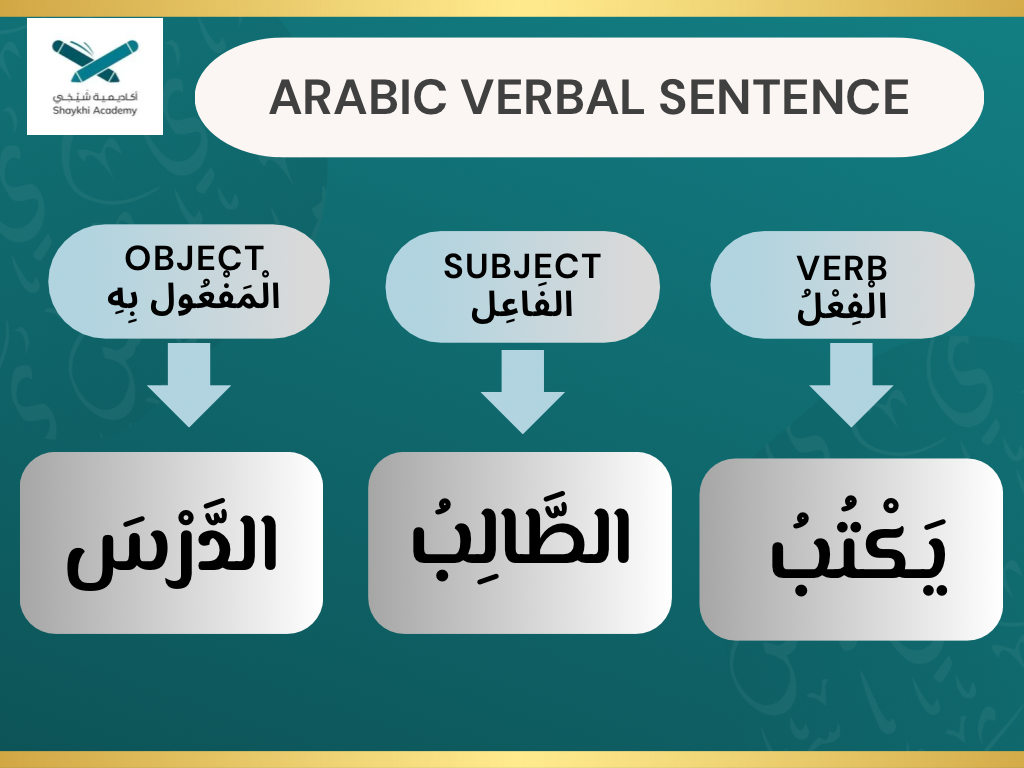
A verbal sentence in Arabic follows the order: Verb → Subject → Object (الفعل + الفاعل + المفعول به). The verb opens the sentence and carries tense, gender, and number markers.
The subject appears after the verb in the nominative case (marfū’), and the object — when required — follows in the accusative case (mansūb). This three-part pattern is the backbone of Arabic syntax.
Example of a Verbal Sentence
يكَتَبَ الطَّالِبُ الدَّرْسَ
Yatub aṭ-ṭālibu ad-darsa
“The student is writing the lesson.”
Here, كَتَبَ (kataba) is the verb (present tense, masculine), الطَّالِبُ (aṭ-ṭālibu) is the subject in the nominative case, and الدَّرْسَ (ad-darsa) is the object in the accusative case.
One aspect our certified instructors at The Arabic Learning Centre emphasize from the very first grammar lesson: the verb agrees with the subject in gender, but not in number when the subject comes after the verb.
When the subject follows the verb, the verb remains singular — even if the subject is plural. This is a core Nahw rule that trips up nearly every beginner.
If you are building your foundation in Arabic grammar, our Arabic Grammar Course covers verbal sentence structure systematically, with live practice and personalized feedback from native-speaking instructors.
Start Learning Arabic Grammar with a Free Trial

What Are the Types of Verbal Sentences Based on Verb Transitivity?
Verbal sentences in Arabic divide into two major types based on whether the verb requires a direct object: transitive (فعل متعدٍّ — fi’l muta’addin) and intransitive (فعل لازم — fi’l lāzim).
Transitive verbs transfer action to an object; intransitive verbs complete their meaning without one. This distinction determines the full structure of the sentence and is non-negotiable in Arabic Nahw.
1. Intransitive Verbal Sentence
An intransitive verb (فعل لازم) expresses a complete action with no object. The sentence contains only verb and subject.
Examples of Intransitive Verbal Sentence
جَلَسَ الوَلَدُ
Jalasa al-waladu
“The boy sat.”
ذَهَبَ المُعَلِّمُ
Dhahaba al-mu’allimu
“The teacher went.”
The verb here carries full meaning alone. No accusative noun follows. Students at The Arabic Learning Centre consistently find this the easier type to identify — once they recognize that no noun follows in accusative form, the sentence is intransitive.
2. Transitive Verbal Sentence
A transitive verb (فعل متعدٍّ) requires a direct object (مفعول به) to complete its meaning. That object takes the accusative case (nasb), marked by a fathah (ـَ) or tanwīn al-nasb (ـًا).
Examples of Transitive Verbal Sentence
فَتَحَ المُدِيرُ البَابَ
Fataḥa al-mudīru al-bāba
“The manager opened the door.”
قَرَأَ الطِّفْلُ كِتَاباً
Qara’a aṭ-ṭiflu kitāban
“The child read a book.”
Note how البَابَ and كِتَاباً both carry fathah endings — this is the accusative marker signalling each word is the object of a transitive verbal sentence.
How Do Verbal Sentences Change Across the Three Arabic Tenses?
Arabic verbal sentences express tense through three verb forms: the past tense (الفعل الماضي — al-fi’l al-māḍī), the present/imperfect tense (الفعل المضارع — al-fi’l al-muḍāri’), and the command form (فعل الأمر — fi’l al-amr). Each tense carries its own morphological pattern and grammatical implications for the sentence structure.
1. Verbal Sentences with the Past Tense (الماضي)
The past tense verb ends in a fathah for the third-person masculine singular and is built on the base root pattern فَعَلَ.
Examples of Verbal Sentences with the Past Tense
أَكَلَ الرَّجُلُ الخُبْزَ
Akala ar-rajulu al-khubza
The man ate the bread.”
خَرَجَتِ الْبِنْتُ مِنَ الْبَيْتِ
Kharajati al-bintu mina al-bayti
The girl left the house.”
Notice that the feminine subject الْبِنْتُ (al-bintu) causes the verb خَرَجَتْ (kharajat) to take the tā’ al-ta’nīth (تْ) — the feminine marker. Subject-verb gender agreement is a defining feature of Arabic verbal sentences.
2. Verbal Sentences with the Present Tense (المضارع)
The present-tense verb begins with one of four prefix letters — ي، ت، أ، ن — depending on person and gender. This is called the ḥurūf al-muḍāra’ah (حروف المضارعة).
Examples of Verbal Sentences with the Present Tense
يَكْتُبُ الطَّالِبُ الوَاجِبَ
Yaktubu aṭ-ṭālibu al-wājiba
The student is writing the homework.
تَذْهَبُ الأُمُّ إِلَى السُّوقِ
Tadhabu al-ummu ilā as-sūqi
The mother is going to the market.
In our instructors’ experience, the present-tense verbal sentence is where learners most frequently make i’rāb errors — particularly failing to apply the correct case endings on the subject when it follows a present-tense verb. Focused drilling on these patterns resolves the issue reliably within two to three weeks.
3. Verbal Sentences with the Command Form (فعل الأمر)
The command form (فعل الأمر) is unique: it has no explicit subject, because the subject is always the implied second person (you).
Examples of Verbal Sentences with the Command Form
اِقْرَأِ الكِتَابَ
Iqra’ al-kitāba
Read the book!
اِجْلِسْ هُنَا
Ijlis hunā
Sit here!
This makes the command verbal sentence structurally the shortest — verb plus optional object, no subject stated.
Shots Videos from Our Courses
How Does the Verb Agree with the Subject in a Verbal Sentence?
Subject-verb agreement in Arabic verbal sentences follows specific Nahw rules depending on word order. When the verb precedes the subject (standard verbal sentence order), the verb remains singular regardless of the subject’s number.
When the subject precedes the verb — which creates a nominal sentence — the verb must match the subject in number and gender.
| Scenario | Rule | Example |
| Verb before masculine singular subject | Verb: masculine singular | جَاءَ الرَّجُلُ (Jā’a ar-rajulu) — “The man came” |
| Verb before feminine singular subject | Verb: feminine singular (+ تْ) | جَاءَتِ المَرْأَةُ (Jā’ati al-mar’atu) — “The woman came” |
| Verb before masculine plural subject | Verb: masculine singular (NOT plural) | جَاءَ الرِّجَالُ (Jā’a ar-rijālu) — “The men came” |
| Verb before feminine plural subject | Verb: feminine singular | جَاءَتِ النِّسَاءُ (Jā’ati an-nisā’u) — “The women came” |
This table represents one of the most misunderstood rules in beginner Arabic. The verb-stays-singular-before-a-plural-subject rule is thoroughly covered in our Arabic Grammar Course for learners who want to move beyond surface-level grammar into real Nahw fluency.
Start Learning Arabic Grammar with a Free Trial

Read Also: How to Conjugate Verbs in Arabic?
How Does a Verbal Sentence Differ from a Nominal Sentence in Arabic?
A verbal sentence (الجملة الفعلية) begins with a verb, while a nominal sentence (الجملة الاسمية — al-jumlah al-ismiyyah) begins with a noun or pronoun. The nominal sentence consists of a mubtada’ (مبتدأ — subject) and a khabar (خبر — predicate), with no opening verb. This is not merely a stylistic difference — it reflects distinct grammatical logic and affects case endings throughout the sentence.
| Feature | Verbal Sentence (الجملة الفعلية) | Nominal Sentence (الجملة الاسمية) |
| Begins with | Verb (فعل) | Noun or pronoun (اسم/ضمير) |
| Subject name | فاعل (fā’il) | مبتدأ (mubtada’) |
| Subject case | Nominative (marfū’) | Nominative (marfū’) |
| Object/Predicate | مفعول به (maf’ūl bihi) — accusative | خبر (khabar) — nominative |
| Primary function | Describes an action | Describes a state or fact |
| Example | ذَهَبَ الرَّجُلُ — “The man went” | الرَّجُلُ مُعَلِّمٌ — “The man is a teacher” |
A practical way to remember this: if the sentence opens with action, it is verbal; if it opens with identity or description, it is nominal.
For learners working through Arabic grammar for beginners, mastering this distinction early prevents compounding errors in later stages.
Read Also: Types of Verbs in Arabic
Our Students Reviews
Start Learning Arabic Verbal Sentences with Certified Instructors
Understanding verbal sentence structure is the gateway to reading classical Arabic texts, following Quranic Arabic, and building real conversational ability. At The Arabic Learning Centre, our Arabic Grammar Course guides non-native speakers through Nahw step by step — with native-speaking certified instructors, flexible 24/7 scheduling, and 1-on-1 personalized sessions.
Why learn with us:
- Certified native Arabic instructors with 7+ years teaching non-speakers
- Structured curriculum from foundational grammar to advanced classical texts
- Flexible scheduling — morning, evening, weekends
- Free trial lesson — no commitment
Explore the Arabic Grammar Course and book your free trial today.
Check out our top courses in Arabic and choose the course you need to start learning Arabic today:
- Arabic Course for Beginners
- Arabic Script Writing Course
- Arabic Speaking Course
- Learn Arabic Letters for Tajweed
- Learning Arabic Grammar
- Arabic Vocabulary Course
- Fusha Arabic Course
- Classical Arabic Course
- Arabic Course for Islamic Studies
- Quranic Arabic Course
- Learn Arabic for New Muslims
Start with a FREE trial class and enhance your Arabic language skills

Conclusion
Verbal sentences are the engine of Arabic expression. Every action, every command, every narrative in classical and modern Arabic runs through the verb-first structure explored above. Learners who anchor this pattern early — verb, subject, object — find that reading Arabic texts becomes progressively more intuitive and less effortful.
The distinction between transitive and intransitive verbs, combined with tense recognition and subject-verb agreement rules, gives you a complete grammar lens through which to analyse any Arabic sentence you encounter. These are not abstract rules — they are the practical tools that make comprehension click.
If you are serious about how to learn Arabic with genuine depth, working through verbal sentence structures in context — with correction, feedback, and guided examples — accelerates progress far beyond passive study. Insha’Allah, the structure becomes natural with consistent, structured practice.
Read Also: Tenses in Arabic
Frequently Asked Questions About Verbal Sentences in Arabic
What is a verbal sentence in Arabic?
A verbal sentence in Arabic (الجملة الفعلية — al-jumlah al-fi’liyyah) is a sentence that begins with a verb, followed by a subject (فاعل) and optionally a direct object (مفعول به). The verb must agree with the subject in gender. This structure is the primary sentence type in classical Arabic and Quranic Arabic texts.
What is the difference between a verbal sentence and a nominal sentence in Arabic?
A verbal sentence begins with a verb (فعل) and describes an action. A nominal sentence begins with a noun or pronoun and consists of a subject (mubtada’) and a predicate (khabar) describing a state or fact. In a nominal sentence, both the subject and predicate are in the nominative case, whereas the verbal sentence’s object takes the accusative case.
Does the verb agree with the subject in number in a verbal sentence?
When the verb comes before the subject — standard verbal sentence order — it remains singular regardless of the subject’s number. A plural subject does not make the opening verb plural. However, when the subject precedes the verb, full agreement in gender and number is required, which technically shifts the sentence into nominal sentence territory.
What are examples of transitive verbal sentences in Arabic?
Transitive verbal sentences include verbs that act on a direct object. For example: فَهِمَ الطَّالِبُ الدَّرْسَ (Fahima aṭ-ṭālibu ad-darsa) — “The student understood the lesson” — where الدَّرْسَ is the accusative object. Another example: شَرِبَ الطِّفْلُ الماءَ (Shariba aṭ-ṭiflu al-mā’a) — “The child drank the water.”
How do I identify the subject (فاعل) in a verbal sentence?
The subject (فاعل) in a verbal sentence is the noun that performs the action and carries the nominative case (raf’), marked by a ḍammah (ـُ) ending or its equivalents. It directly follows the verb. Ask “who or what performed this action?” — the answer is the fā’il. It is always nominative, never accusative, distinguishing it clearly from the object.
Related Articles
Learn Arabic