 Arabic Grammar
| Key Takeaways |
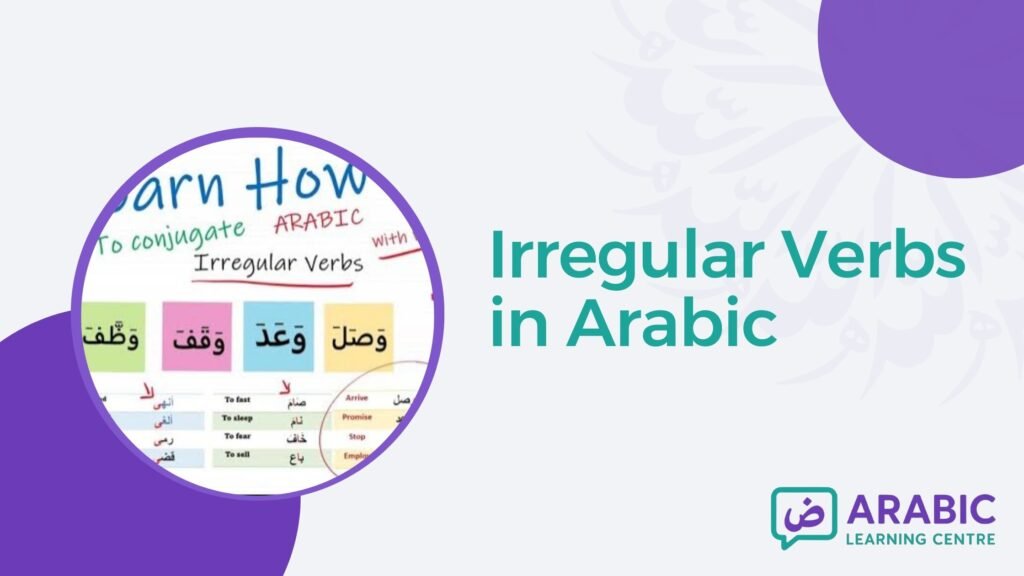
| Irregular verbs in Arabic are called الأفعال المعتلة (al-af’āl al-mu’tallah) and contain a weak letter (و، ي، ا) in their root. |
| Arabic grammarians classify irregular verbs into five main types based on the position and type of the weak letter within the root. |
| The weak letters و and ي frequently drop, change, or transform during conjugation, following predictable phonological rules in classical Nahw. |
Irregular verbs in Arabic (الأفعال المعتلة — al-af’āl al-mu’tallah) are verbs whose three-letter root contains at least one weak letter — either و (wāw), ي (yā’), or ا (alif).
These weak letters cause predictable spelling and pronunciation changes during conjugation that do not occur in sound (صحيح — ṣaḥīḥ) verbs. Once you learn the rules governing each verb type, the changes become entirely systematic.
What Are Irregular Verbs in Arabic?
Irregular verbs in Arabic, known as الأفعال المعتلة (al-af’āl al-mu’tallah), are verbs containing a حرف علة (ḥarf ‘illah — weak letter) in one or more positions of their triliteral root. Arabic grammar (Nahw) classifies these verbs into five distinct categories based on where the weak letter appears and which letters are involved.
Each category follows its own conjugation behaviour, and knowing the category immediately tells you what changes to expect.
The five main types recognised in classical Nahw are:
| Type (Arabic) | Transliteration | Description | Example Verb |
| المثال | al-Mithāl | Weak letter in root position 1 (فاء الفعل) | وَجَدَ — he found |
| الأجوف | al-Ajwaf | Weak letter in root position 2 (عين الفعل) | قَالَ — he said |
| الناقص | al-Nāqiṣ | Weak letter in root position 3 (لام الفعل) | دَعَا — he called |
| اللفيف المفروق | al-Lafīf al-Mafruq | Weak letters in positions 1 and 3 | وَقَى — he protected |
| اللفيف المقرون | al-Lafīf al-Maqrun | Weak letters in positions 2 and 3 | قَوِيَ — he became strong |
This table comes directly from the classification system established in the canonical Arabic grammar tradition — a system every classical Nahw text, from Ibn Ājurrūm’s Muqaddimah to Ibn Mālik’s Alfiyyah, builds upon.
If you are new to Arabic verb structure altogether, our guide on tenses in Arabic provides a helpful foundation before working through the irregular types.
At The Arabic Learning Centre, our Arabic Grammar Course walks students through each irregular verb category with live conjugation practice, ensuring these patterns move from memorised rules into genuine spoken and written fluency.
Start Learning Arabic Grammar with a Free Trial

How Do al-Mithāl Verbs Work in Arabic?
المثال (al-Mithāl) verbs have و or ي as their first root letter. In the past tense (māḍī), these verbs often behave like sound verbs. The irregularity appears in the present tense (muḍāri’), where the initial weak letter drops entirely in most conjugation patterns.
This is the rule: when و appears as the first root letter and is followed by a kasrah in the present tense pattern, it drops. Consider:
وَجَدَ (Past) → يَجِدُ (Present — the و drops)
Wajada → Yajidu
“He found → He finds”
Compare this to the sound verb كَتَبَ / يَكْتُبُ — no letter drops. The و in وَجَدَ disappears precisely because it falls between a fatḥah and a kasrah in the present pattern — a phonological environment where weak wāw cannot survive according to Arabic morphophonological rules.
Other common المثال verbs:
- وَصَلَ (waṣala) → يَصِلُ (yaṣilu) — to arrive
- وَضَعَ (waḍa’a) → يَضَعُ (yaḍa’u) — to place
- وَرِثَ (waritha) → يَرِثُ (yarithu) — to inherit
Shots Videos from Our Courses
How Do al-Ajwaf Verbs Behave During Conjugation?
الأجوف (al-Ajwaf — “hollow”) verbs contain a weak letter و or ي as their second root letter. These are among the most common irregular verbs in Arabic and show the most dramatic changes during conjugation. In the past tense, the middle weak letter lengthens into a long vowel.
In the present tense, it also appears as a long vowel. But when suffixes beginning with a consonant are added, the middle letter drops entirely.
The governing principle: the middle weak letter contracts or drops when it becomes phonologically difficult to pronounce within a given conjugation pattern.
كَانَ (kāna) — he was (root: ك-و-ن):
| Form | Arabic | Transliteration | Meaning |
| Past (he) | كَانَ | kāna | he was |
| Past (she) | كَانَتْ | kānat | she was |
| Past (they m.) | كَانُوا | kānū | they were |
| Present (he) | يَكُونُ | yakūnu | he is / he will be |
| Present (she) | تَكُونُ | takūnu | she is / she will be |
| Jussive (he) | يَكُنْ | yakun | let him be / he was not |
Notice how in the jussive (majzūm) form يَكُنْ, the long vowel shortens and the ن receives سكون (sukūn). Understanding what sukoon does in Arabic is directly relevant here — it is the sukūn placed on the final letter that triggers the contraction of the middle vowel.
Another key Ajwaf verb:
قَالَ (qāla) — he said (root: ق-و-ل):
قَالَ → يَقُولُ → Jussive: يَقُلْ
Qāla → Yaqūlu → Yaqul
“He said → He says → (He did not say)”
Read also: Tanween in Arabic
How Do al-Nāqiṣ Verbs Change in Arabic?
الناقص (al-Nāqiṣ — “deficient”) verbs carry a weak letter و or ي as their final root letter. These verbs are called “deficient” because the final weak letter frequently changes form, lengthens, or drops depending on the vowel environment around it.
They are extremely common in Arabic — many of the most frequently used verbs belong to this category.
The core rule for الناقص verbs: the final weak letter adapts its written and spoken form based on the vowel preceding it and the suffix following it, following the classical rules of الإعلال (al-i’lāl — phonological mutation of weak letters).
دَعَا (da’ā) — he called/invited (root: د-ع-و):
| Form | Arabic | Transliteration |
| Past (he) | دَعَا | da’ā |
| Past (she) | دَعَتْ | da’at |
| Past (they m.) | دَعَوْا | da’aw |
| Present (he) | يَدْعُو | yad’ū |
| Present (they m.) | يَدْعُونَ | yad’ūna |
مَشَى (mashā) — he walked (root: م-ش-ي):
| Form | Arabic | Transliteration |
| Past (he) | مَشَى | mashā |
| Past (she) | مَشَتْ | mashat |
| Past (they m.) | مَشَوْا | mashaw |
| Present (he) | يَمْشِي | yamshī |
| Present (they m.) | يَمْشُونَ | yamshūna |
Students in The Arabic Learning Centre’s Arabic Course for Beginners regularly find that الناقص verbs cause the most confusion in written Arabic because the final letter’s written form changes visually — a learner who has not studied this rule will misread or misspell these forms under time pressure.
Connecting verb patterns to the broader grammar system — including how harakat in Arabic govern vowel change — makes these patterns far more intuitive than rote memorisation alone.
Join Our Arabic Course for Beginners With a Free Trial
What Exercises Help Learners Practise Arabic Irregular Verbs?
Practising irregular verbs in Arabic requires three progressive stages: recognition, controlled production, and free application. Each stage builds on the one before. Skipping straight to free use before recognition is solid leads to deep-rooted conjugation errors that are difficult to correct later.
Stage 1 — Recognition:
Read a passage of Arabic text and circle every verb. Identify its root and classify it as sound (ṣaḥīḥ) or one of the five irregular types.
Stage 2 — Controlled Production:
Complete these conjugation tables by filling in the missing forms:
| Verb | Root | Type | Past (he) | Present (he) | Jussive (he) |
| قَالَ | ق-و-ل | الأجوف | قَالَ | يَقُولُ | ـ |
| دَعَا | د-ع-و | الناقص | دَعَا | ـ | يَدْعُ |
| وَصَلَ | و-ص-ل | المثال | وَصَلَ | ـ | يَصِلْ |
(Answers: يَقُلْ / يَدْعُو / يَصِلُ)
Stage 3 — Free Application:
Write three original sentences in Arabic using one verb from each category above. Check that your vowel endings (harakat) are correct for the syntactic role of each verb in its sentence.
In our instructors’ experience at The Arabic Learning Centre, students who complete structured conjugation table exercises for two weeks — even just 15 minutes daily — internalise irregular verb patterns far more durably than those who rely on passive reading alone.
Our Students Reviews
Read also: Nominal Sentence in Arabic
Begin Mastering Arabic Grammar with Certified Instructors at The Arabic Learning Centre
Irregular verbs are one of the most high-frequency and high-impact grammar areas in Arabic. Mastering them transforms your reading, writing, and spoken comprehension across both Modern Standard Arabic and Classical Fusha.
The Arabic Learning Centre offers:
- Arabic Grammar Course — covering all irregular verb types with structured conjugation practice
- Certified native Arabic instructors with specialist grammar expertise
- Flexible 1-on-1 sessions available 24/7 to fit your schedule
- Personalised feedback on your conjugation exercises and written work
- Free trial lesson — no commitment required
Book your free trial lesson and start working through irregular verbs with an expert instructor who understands exactly where non-native speakers struggle — and how to fix it.
Check out our top courses in Arabic and choose the course you need to start learning Arabic today:
- Arabic Course for Beginners
- Arabic Script Writing Course
- Arabic Speaking Course
- Learn Arabic Letters for Tajweed
- Learning Arabic Grammar
- Arabic Vocabulary Course
- Fusha Arabic Course
- Classical Arabic Course
- Arabic Course for Islamic Studies
- Quranic Arabic Course
- Learn Arabic for New Muslims
Start with a FREE trial class and enhance your Arabic language skills

Conclusion
Irregular verbs in Arabic follow consistent, learnable rules derived from the behaviour of weak letters (و، ي، أ) within the triliteral root. Each of the five verb types — المثال، الأجوف، الناقص، اللفيف المفروق، اللفيف المقرون — has its own predictable conjugation behaviour, and understanding the phonological logic behind the changes makes them far less daunting than they first appear.
The path forward is systematic. Start with الأجوف verbs like كَانَ and قَالَ since they appear constantly in Arabic text and speech. Build conjugation tables for each type, apply them in sentences drawn from authentic Arabic sources, and review your verbal sentence structure in Arabic to see how these verbs function in real grammatical context.
Frequently Asked Questions About Irregular Verbs in Arabic
What makes a verb irregular in Arabic?
A verb is irregular in Arabic when its triliteral root contains a weak letter — either و (wāw), ي (yā’), or أ (hamzah). These letters cause phonological changes during conjugation — dropping, lengthening, or transforming — that do not occur in sound (ṣaḥīḥ) verbs. Classical Nahw grammar classifies these changes under the rules of الإعلال (al-i’lāl).
How many types of irregular verbs exist in Arabic?
Arabic grammar recognises five main types of irregular (mu’tall) verbs: المثال (weak first letter), الأجوف (weak middle letter), الناقص (weak final letter), اللفيف المفروق (weak first and third letters), and اللفيف المقرون (weak second and third letters). Hamzah verbs are sometimes treated as a separate sixth category in extended classifications.
What is the most common irregular verb type in Arabic?
الأجوف (al-Ajwaf — hollow verbs) and الناقص (al-Nāqiṣ — deficient verbs) are the most frequently encountered irregular types in everyday Arabic. Verbs like كَانَ (was), قَالَ (said), جَاءَ (came), and دَعَا (called) appear constantly in Quranic text, Modern Standard Arabic, and spoken conversation, making these the highest-priority categories to study first.
Related Articles
Arabic Grammar