 Arabic Grammar
| Key Takeaways |
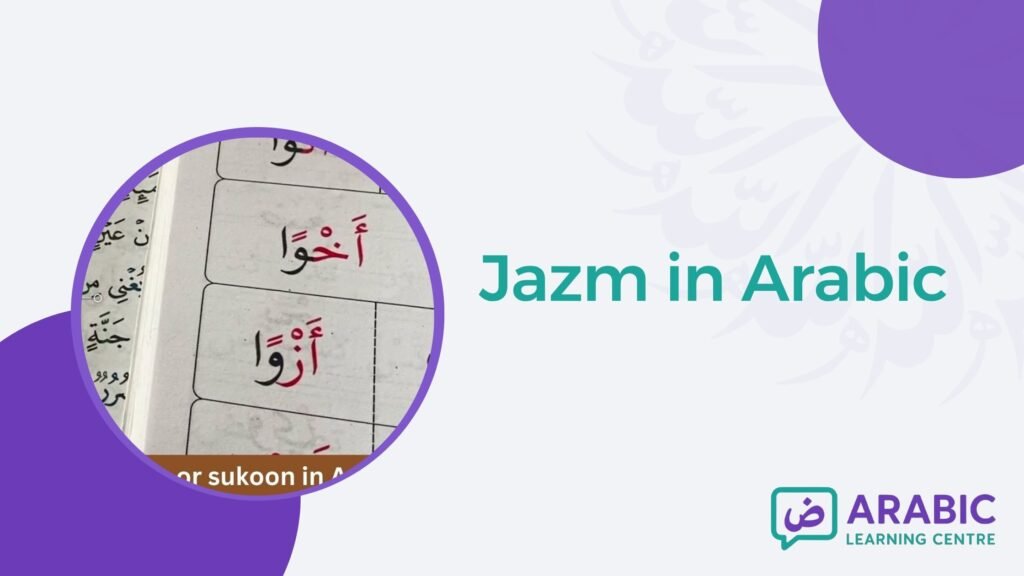
| Jazm is the jussive grammatical state in Arabic that removes the final vowel or drops the weak letter from a present-tense verb. |
| Jazm is triggered by specific particles called jawāzim (جَوَازِم), including لَمْ, لَا النَّاهِيَة, and لَمَّا. |
| When jazm is applied to a sound verb, the final short vowel is dropped and replaced with sukūn (ْ) on the last root letter. |
| Weak verbs — those ending in و, ي, or ا — lose their final weak letter entirely when placed in the jussive state. |
Jazm in Arabic is the grammatical state that places a present-tense verb (الفِعْل المُضَارِع) into the jussive mood, signalling negation, prohibition, or a conditional relationship. It functions as one of three grammatical states a مُضَارِع verb can enter — alongside the indicative (مَرْفُوع) and subjunctive (مَنْصُوب) — and its sign is either a sukūn on the final letter or deletion of the final weak letter.
Understanding jazm opens a door to reading Arabic correctly — whether in the Quran, classical texts, or formal Modern Standard Arabic. Every negative command, every conditional sentence, and every prohibition relies on this rule. Get it wrong, and the meaning of the verb shifts entirely.
What Is Jazm in Arabic?
Jazm (جَزْم) is the jussive grammatical state applied exclusively to the مُضَارِع (present/imperfect) verb in Arabic. It indicates that the action is negated in the past, prohibited in the present, or conditioned upon another action. Its grammatical sign — called عَلَامَة الجَزْم — is either a sukūn (ْ) placed on the final consonant of the verb or the complete deletion of the final weak letter.
In classical Nahw terminology, الجَزْم is the third of three grammatical states for the imperfect verb. Classical grammarians including Sībawayhi in Al-Kitāb treat it as the verb’s equivalent of the majrūr state for nouns — a marker of grammatical dependency.
How Jazm Differs from Raf’ and Nasb in Arabic Verbs
| Grammatical State | Arabic Term | Verb Ending (Sound Verb) | Trigger |
| Indicative | مَرْفُوع | ends with ضَمَّة (ُ) | default state |
| Subjunctive | مَنْصُوب | ends with فَتْحَة (َ) | nasb particles (أَنْ، لَنْ، كَيْ…) |
| Jussive | مَجْزُوم | ends with سُكُون (ْ) | jazm particles (لَمْ، لَا النَّاهِيَة…) |
This table is the foundation. Students at The Arabic Learning Centre who study through our Arabic Grammar Course are taught this three-state framework in the earliest stages of verb study — because every advanced grammar concept builds on it.
Start Learning Arabic Grammar with a Free Trial

What Are the Particles That Cause Jazm?
The particles that trigger jazm are called الجَوَازِم — literally “the jussive operators.” They are divided into two groups: particles that govern a single verb, and particles that govern two verbs simultaneously in conditional sentences.
1. Jawāzim That Govern One Verb
These particles place a single مُضَارِع verb directly into the jussive state:
لَمْ — negates a past action using a present-tense verb form. لَمْ يَذْهَبْ Lam yadh-hab “He did not go.”
لَمَّا — negates a past action that was still ongoing or expected. لَمَّا يَصِلْ Lammā yaṣil “He has not yet arrived.”
لَا النَّاهِيَة — the prohibitive لَا, used to issue commands in the negative. لَا تَكْذِبْ Lā takdhib “Do not lie.”
لَامُ الأَمْر — the imperative لام, used to issue a third-person command. لِيَكْتُبْ Liyaktub “Let him write.”
Understanding sukūn in Arabic is essential before applying jazm, because sukūn is the primary sign of the jussive state on sound verbs.
2. Jawāzim That Govern Two Verbs (Conditional Particles)
These particles create an if-then structure — the first verb is the condition, the second is the response:
| Particle | Arabic | Meaning |
| إِنْ | إِنْ | if |
| مَنْ | مَنْ | whoever |
| مَا | مَا | whatever |
| مَهْمَا | مَهْمَا | whatever / no matter what |
| أَيْنَمَا | أَيْنَمَا | wherever |
| مَتَى | مَتَى | whenever |
إِنْ تَدْرُسْ تَنْجَحْ
In tadrus tanjaḥ
If you study, you will succeed.
Both تَدْرُسْ and تَنْجَحْ here end with sukūn — both are in the jussive state due to إِنْ.
Shots Videos from Our Courses
How Does Jazm Change the Form of Sound Verbs?
For sound verbs (الأَفْعَال الصَّحِيحَة) — those whose three root letters are all consonants with no weak letters — jazm removes the final short vowel and replaces it with sukūn on the last root letter.
Before jazm: يَكْتُبُ (yaktubu — “he writes”) — the ضَمَّة marks the indicative state.
After jazm with لَمْ: لَمْ يَكْتُبْ (lam yaktub — “he did not write”) — the ضَمَّة is removed and sukūn appears.
This is the most straightforward application of jazm, and it is where beginners should focus first. In our instructors’ experience, students who master this pattern on sound verbs before moving to weak verbs retain the rule far more reliably.
How Does Jazm Affect Weak Verbs in Arabic?
Weak verbs (الأَفْعَال المُعْتَلَّة) behave differently under jazm — instead of receiving sukūn, they lose their final weak letter entirely. This is called الحَذْف (deletion), and it is the sign of jazm for these verb types.
Arabic grammarians identify three types of weak verbs relevant to jazm:
1. Verbs Ending in Wāw (وَاو)
Before jazm: يَدْعُو (yadʿū — “he calls/invites”)
After jazm with لَمْ: لَمْ يَدْعُ (lam yadʿu)
The و is deleted entirely. This is the sign of jazm.
2. Verbs Ending in Yāʾ (يَاء)
Before jazm: يَرْمِي (yarmī — “he throws”)
After jazm with لَمْ: لَمْ يَرْمِ (lam yarmi)
The ي is deleted. The verb’s base meaning remains — only the final letter is dropped.
3. Verbs Ending in Alif (أَلِف)
Before jazm: يَخْشَى (yakhshā — “he fears”)
After jazm with لَمْ: لَمْ يَخْشَ (lam yakhsha)
The ا is deleted. These verbs — called الأَفْعَال النَّاقِصَة — consistently drop the final alif under jazm.
Students who have studied conjugating verbs in Arabic will recognize that this pattern of deletion is consistent across verb conjugation paradigms — jazm simply makes it visible in another grammatical context.
Read also: Heavy and Light Letters in Arabic
How Does Jazm Work in the Five Verb Forms?
The five verb forms (الأَفْعَال الخَمْسَة) are present-tense verbs conjugated for the dual or second-person plural. In the indicative, these forms end with نُون (ن). Under jazm, that final نُون is deleted — this deletion is the sign of jazm for these forms.
| Pronoun | Indicative (مَرْفُوع) | Jussive after لَمْ |
| أَنْتُمَا (you two) | تَكْتُبَانِ | لَمْ تَكْتُبَا |
| أَنْتُمْ (you all) | تَكْتُبُونَ | لَمْ تَكْتُبُوا |
| هُمَا (they two) | يَكْتُبَانِ | لَمْ يَكْتُبَا |
| هُمْ (they) | يَكْتُبُونَ | لَمْ يَكْتُبُوا |
| أَنْتِ (you, f.) | تَكْتُبِينَ | لَمْ تَكْتُبِي |
This is a point where many learners make errors. Students at The Arabic Learning Centre regularly confuse the deletion of نُون in the five forms with the subjunctive — but the triggers are different. Jazm particles govern the jussive; nasb particles govern the subjunctive.
What Is the Difference Between لَمْ and لَا النَّاهِيَة in Jussive Negation?
لَمْ and لَا النَّاهِيَة are both jazm particles, but they serve entirely different grammatical functions. لَمْ negates a completed past action — it says “did not.” لَا النَّاهِيَة prohibits a present or future action — it says “do not.”
Both place the verb in the jussive state with sukūn or deletion, but confusing them produces a meaning error, not just a grammatical one.
لَمْ يَذْهَبِ الطَّالِبُ
Lam yadh-habi al-ṭālibu
The student did not go. (negation of past)
لَا تَذْهَبْ
Lā tadh-hab
Do not go. (prohibition)
Notice how the verb changes its final marker — both carry sukūn, but the communicative purpose is completely different.
Learning to navigate these distinctions is exactly why structured study matters. Our Arabic Course for Beginners with certified instructors walks students through each jussive particle with targeted drills — not just theoretical explanations.
Join Our Arabic Course for Beginners With a Free Trial
How to Identify Jazm in Arabic Sentences?
To identify jazm in an Arabic sentence, locate the مُضَارِع verb and check its final letter. If the verb ends with sukūn, has had its final weak letter deleted, or has lost its final نُون in the five forms — it is in the jussive state.
Then trace backward to find the governing particle. Identifying both the sign and the governor confirms jazm with certainty.
Practical identification steps:
- Find the present-tense verb
- Check the last letter — is there sukūn, deletion of a weak letter, or loss of نُون?
- Scan the preceding words for a jazm particle (لَمْ، لَمَّا، لَا النَّاهِيَة، إِنْ…)
- If both sign and particle are present, jazm is confirmed
Understanding harakat in Arabic is a prerequisite for this identification skill — without reading short vowels accurately, jussive signs are invisible. Students who have studied how many harakat are in Arabic will recognise sukūn as one of the six core diacritical markers.
Our Students Reviews
Read also: Arabic Grammar Exercises
Start Learning Arabic Grammar with Certified Instructors at The Arabic Learning Centre
Jazm is one of the three essential states every Arabic grammar student must master. With the right instruction, it becomes second nature.
The Arabic Learning Centre’s Arabic Grammar Course offers:
- Certified native Arabic instructors with 7+ years of teaching non-native speakers
- Personalised 1-on-1 sessions tailored to your current level
- Flexible scheduling — available 24 hours a day, 7 days a week
- Structured curriculum from basic verb states through conditional sentences
- Free trial lesson — no commitment required
Whether you are beginning your Arabic journey for the first time or strengthening your grammar foundation, our certified teachers are ready to guide you.
Check out our top courses in Arabic and choose the course you need to start learning Arabic today:
- Arabic Course for Beginners
- Arabic Script Writing Course
- Arabic Speaking Course
- Learn Arabic Letters for Tajweed
- Learning Arabic Grammar
- Arabic Vocabulary Course
- Fusha Arabic Course
- Classical Arabic Course
- Arabic Course for Islamic Studies
- Quranic Arabic Course
- Learn Arabic for New Muslims
Start with a FREE trial class and enhance your Arabic language skills

Conclusion
Jazm marks a present-tense verb as jussive — indicating negation, prohibition, or conditionality. Its sign is sukūn on sound verbs, deletion of the final weak letter on weak verbs, and deletion of نُون on the five forms.
The particles that trigger jazm divide clearly into those governing a single verb (لَمْ، لَمَّا، لَا النَّاهِيَة، لَامُ الأَمْر) and those governing two verbs in conditional structures (إِنْ، مَنْ، مَا…). Knowing which particle you are working with determines both the grammatical form and the communicative meaning.
With consistent practice and qualified guidance, jussive verb forms become automatic. The patterns are logical, the signs are visible, and once internalized, they unlock accurate reading of Quranic Arabic, classical texts, and Modern Standard Arabic — all of which depend on this rule.
Frequently Asked Questions About Jazm in Arabic
What Is the Meaning of Jazm in Arabic Grammar?
Jazm (جَزْم) refers to the jussive grammatical state of a present-tense Arabic verb. It is triggered by specific particles called جَوَازِم and its sign is either sukūn on the final letter of a sound verb or complete deletion of the final weak letter in weak verbs.
What Are the Most Common Jazm Particles in Arabic?
The most commonly used jazm particles are لَمْ (for past negation), لَمَّا (for negation of ongoing past action), لَا النَّاهِيَة (for prohibition), لَامُ الأَمْر (for third-person commands), and إِنْ (for conditional sentences requiring two jussive verbs).
How Is Jazm Different from Nasb in Arabic Verbs?
Jazm places a verb in the jussive state with sukūn or letter deletion, and is triggered by jussive particles like لَمْ and لَا النَّاهِيَة. Nasb places a verb in the subjunctive with a فَتْحَة and is triggered by different particles including أَنْ, لَنْ, and كَيْ. Both states alter the verb’s default indicative ending.
How Does Jazm Affect the Five Verb Forms (الأَفْعَال الخَمْسَة)?
For the five verb forms — conjugated for the dual and masculine plural — the sign of jazm is the deletion of the final نُون. For example, تَكْتُبُونَ becomes لَمْ تَكْتُبُوا when placed in the jussive state. This deletion is consistent and applies whenever any jazm particle governs these forms.
Related Articles
Arabic Grammar