 Arabic Grammar
| Key Takeaways |
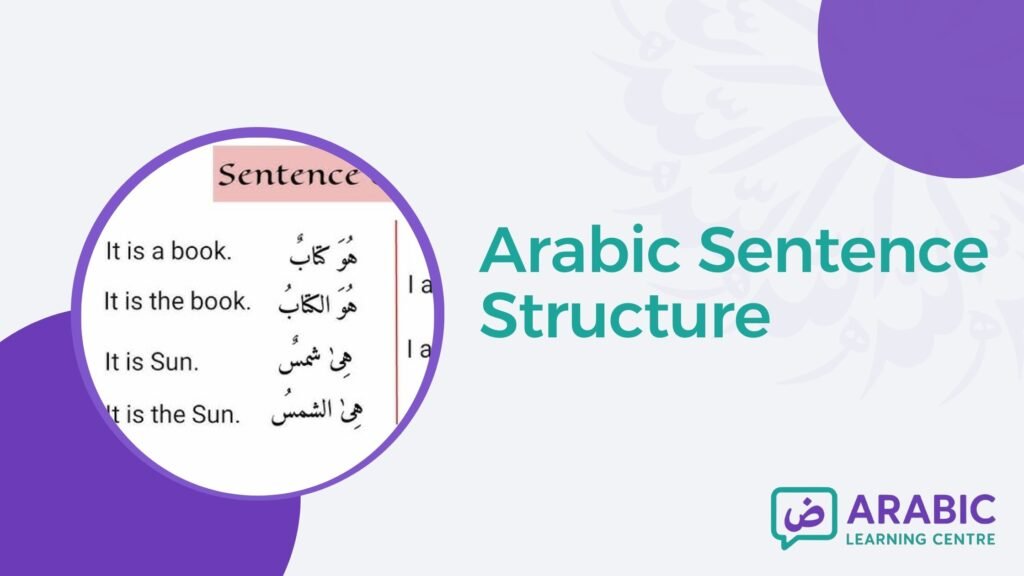
| Arabic sentences follow two primary structures: the nominal sentence (جُمْلَةٌ اسْمِيَّةٌ) beginning with a noun, and the verbal sentence (جُمْلَةٌ فِعْلِيَّةٌ) beginning with a verb. |
| The nominal sentence consists of a subject (مُبْتَدَأ mubtada’) and a predicate (خَبَر khabar), which together form a complete, standalone statement. |
| Arabic verbs agree with their subjects in gender and number, but verbal sentences place the verb before the subject, unlike typical English word order. |
| Case endings (إعراب i’rab) signal the grammatical role of every noun — nominative, accusative, or genitive — making word order more flexible than in English. |
Arabic sentence structure organizes around two core patterns: the nominal sentence, which opens with a noun, and the verbal sentence, which opens with a verb. Arabic uses a system of grammatical endings called إعراب (i’rab) to signal each word’s role — giving the language a flexibility that many learners initially find unfamiliar, but ultimately liberating.
Once you understand these two sentence types and the agreement rules that govern them, reading and producing Arabic sentences becomes far more systematic. The grammar of Arabic is not arbitrary — it is deeply logical, and that logic rewards every learner who approaches it patiently and methodically.
What Are the Two Types of Arabic Sentence Structure?
Arabic sentence structure divides into two types defined by how each sentence opens. A جُمْلَةٌ اسْمِيَّةٌ (jumlah ismiyyah — nominal sentence) begins with a noun or pronoun. A جُمْلَةٌ فِعْلِيَّةٌ (jumlah fi’liyyah — verbal sentence) begins with a verb. This opening word is not stylistic — it determines the grammatical category of the entire sentence and the agreement rules that apply within it.
This distinction sits at the heart of classical Arabic grammar (Nahw) and is treated extensively in foundational references such as Ibn Ājarurrūm’s Al-Ājarrūmiyyah, one of the most widely studied beginner grammar texts in the Arabic scholarly tradition.
| Sentence Type | Arabic Term | Opens With | Example |
| Nominal Sentence | جُمْلَةٌ اسْمِيَّةٌ | Noun / Pronoun | الْبَيْتُ كَبِيرٌ |
| Verbal Sentence | جُمْلَةٌ فِعْلِيَّةٌ | Verb | ذَهَبَ الطَّالِبُ |
If you are just beginning your Arabic studies, our Arabic Grammar Course at The Arabic Learning Centre builds sentence structure from the ground up with certified Arabic instructors who work one-to-one with each student.
Start Learning Arabic Grammar with a Free Trial

How Does the Nominal Sentence Work in Arabic Sentence Structure?
The nominal sentence (جُمْلَةٌ اسْمِيَّةٌ) consists of two mandatory components: the مُبْتَدَأ (mubtada’ — subject) and the خَبَر (khabar — predicate). The mubtada’ is always a definite noun or pronoun in the nominative case, marked by a dammah (ُ) ending. The khabar completes the meaning and agrees with the subject in gender and number.
Understanding the Mubtada’ (Subject) in Arabic Sentence Structure
The مُبْتَدَأ (mubtada’) must carry the nominative case ending — a dammah (ـُ) on the final letter. It is typically definite, formed either by attaching the definite article ال (al-) or by being a proper noun or attached pronoun.
Example:
الْبَيْتُ كَبِيرٌ
Al-baytu kabīrun
The house is large.
Here, الْبَيْتُ (al-baytu) is the mubtada’ — definite, nominative. You will notice Arabic drops the verb “to be” entirely in present-tense nominal sentences. This is not an omission; the copula simply does not exist in Arabic present tense.
For a deeper look at how definiteness shapes Arabic grammar, the article on definite articles in Arabic covers the rules for ال (al-) and its interaction with sun and moon letters.
Understanding the Khabar (Predicate) in Arabic Sentence Structure
The خَبَر (khabar) completes the nominal sentence by describing or identifying the mubtada’. It takes four possible forms, each still grammatically classified as a khabar:
- A single adjective or noun: الْوَلَدُ مَرِيضٌ — “The boy is sick.”
- A prepositional phrase: الْكِتَابُ عَلَى الطَّاوِلَةِ — “The book is on the table.”
- A complete nominal sentence: الطَّالِبُ أَبُوهُ مُدَرِّسٌ — “The student — his father is a teacher.”
- A complete verbal sentence embedded as predicate.
At The Arabic Learning Centre, our instructors observe that the prepositional khabar is where most early-stage learners make their first consistent error.
Students frequently omit the genitive case on the noun following the preposition, producing عَلَى الطَّاوِلَةَ instead of the correct عَلَى الطَّاوِلَةِ. Catching this early prevents it from becoming a fossilized mistake.
Shots Videos from Our Courses
How Does the Verbal Sentence Work in Arabic Sentence Structure?
The verbal sentence (جُمْلَةٌ فِعْلِيَّةٌ) places the verb first, followed by the subject (فَاعِل fa’il) and then the object (مَفْعُولٌ بِهِ maf’ul bih) when one exists. This Verb-Subject-Object (VSO) order is the classical Arabic default — though Subject-Verb-Object (SVO) is also grammatically acceptable and produces a nominal sentence when the subject leads.
For a practical breakdown of how Arabic verbal sentences are constructed, including past and present tense forms, that resource offers clear worked examples.
Example:
كَتَبَ الطَّالِبُ الدَّرْسَ
Kataba aṭ-ṭālibu ad-darsa
The student wrote the lesson.
| Element | Arabic | Role | Case Marker |
| Verb | كَتَبَ | Action | (ـَ) |
| Subject (فَاعِل) | الطَّالِبُ | Doer | Nominative (ـُ) |
| Object (مَفْعُولٌ بِهِ) | الدَّرْسَ | Receiver | Accusative (ـَ) |
How Does Verb Agreement Work in Arabic Verbal Sentences?
When the verb precedes its subject in a verbal sentence, it agrees only in gender — not in number. This is one of the most counterintuitive rules for beginners.
ذَهَبَ الطُّلَّابُ
Dhahaba aṭ-ṭullābu
The students went. — uses the singular masculine verb ذَهَبَ even though الطُّلَّابُ is plural.
Once the subject moves before the verb (forming a nominal sentence instead), full agreement in both gender and number becomes obligatory.
To build the conjugation knowledge behind this rule, the guide to conjugating verbs in Arabic is an excellent companion resource.
Read also: Past Continuous Tense in Arabic
What Role Do Case Endings Play in Arabic Sentence Structure?
إعراب (i’rab — grammatical inflection) is the system of short vowel endings that marks every noun’s grammatical function. It is not decorative — it carries meaning.
Remove the case endings and ambiguity enters; retain them and the sentence’s structure becomes unambiguous regardless of word order.
| Case | Arabic Term | Marker | Grammatical Function |
| Nominative | مَرْفُوع | ـُ / ـٌ (dammah) | Subject (mubtada’, fa’il) |
| Accusative | مَنْصُوب | ـَ / ـً (fathah) | Object, adverbial |
| Genitive | مَجْرُور | ـِ / ـٍ (kasrah) | After prepositions, in idafa |
The dammah, fathah, and kasrah vowel markers you see on case endings are part of the broader حَرَكَات (harakat) system. For a full breakdown of how these vowels function, the article on harakat in Arabic explains each marker with clear examples. Understanding how many harakat exist in Arabic also helps learners place i’rab in its full grammatical context.
Students at The Arabic Learning Centre who invest three to four weeks in recognizing these case endings consistently before tackling full sentences progress through our Arabic Grammar Course noticeably faster than those who skip this stage.
Start Learning Arabic Grammar with a Free Trial

How Does the Idafa Construction Affect Arabic Sentence Structure?
The إضافة (idafah — genitive construct) is one of Arabic’s most productive grammatical tools. It links two nouns in a possessive or descriptive relationship by placing them consecutively, with the first noun (mudaf) always indefinite in meaning and the second (mudaf ilayhi) always in the genitive case.
Example:
كِتَابُ الطَّالِبِ
Kitābu aṭ-ṭālibi
The student’s book
The first noun كِتَابُ loses its tanwin (nunation) and cannot take ال. The second noun الطَّالِبِ takes the genitive kasrah ending. This two-word chain functions as a single noun phrase within a larger sentence.
Idafah in a full sentence:
كِتَابُ الطَّالِبِ جَدِيدٌ
Kitābu aṭ-ṭālibi jadīdun
The student’s book is new.
The idafah phrase acts as the mubtada’, and جَدِيدٌ is the khabar. Understanding this construction is essential to reading Arabic text fluently — it appears in virtually every paragraph of Modern Standard Arabic writing.
How Does Negation Work in Arabic Sentence Structure?
Negating a sentence in Arabic depends on the sentence type and tense. The key negation particles are:
- لَا (lā) — negates nominal sentences and commands
- لَيْسَ (laysa) — negates nominal sentences in present tense; takes accusative on the khabar
- لَمْ (lam) — negates past meaning using the jussive (مَجْزُوم) present tense form
- لَنْ (lan) — negates future meaning using the subjunctive (مَنْصُوب) present form
Examples:
لَيْسَ الْبَيْتُ كَبِيرًا
Laysa al-baytu kabīran
The house is not large.
Note: لَيْسَ converts the khabar from nominative (كَبِيرٌ) to accusative (كَبِيرًا). This grammatical shift is one that beginners frequently miss.
Practice Exercises: Applying Arabic Sentence Structure
Working with examples actively — not just reading them — is what converts passive understanding into usable grammar. Below are graded exercises designed to reinforce the core patterns covered above.
Exercise 1: Identify the Sentence Type
For each sentence, identify whether it is nominal (اسْمِيَّة) or verbal (فِعْلِيَّة):
- الْمَدْرَسَةُ قَرِيبَةٌ — Al-madrasatu qarībatun
- يَشْرَبُ الْوَلَدُ الْمَاءَ — Yashrabu al-waladu al-mā’a
- الْمُعَلِّمُ فِي الْفَصْلِ — Al-mu’allimu fī al-faṣli
(Answers: 1 — Nominal; 2 — Verbal; 3 — Nominal with prepositional khabar)
Exercise 2: Apply Correct Case Endings
Fill in the correct final vowel (dammah, fathah, or kasrah):
- ذَهَبَ الطَّالِب__ إِلَى الْمَكْتَبَة__ (Subject → nominative; after preposition → genitive)
- قَرَأَتِ الْبِنْت__ الْكِتَاب__ (Subject → nominative; object → accusative)
Exercise 3: Build Your Own Nominal Sentence
Using the model [مُبْتَدَأ] + [خَبَر], write three sentences describing objects around you. Add the ال prefix to make the subject definite and choose a matching adjective for the khabar.
Our Arabic Course for Beginners at The Arabic Learning Centre incorporates exercises exactly like these — graded, structured, and reviewed by a certified Arabic instructor in every live session.
Our Students Reviews
Join Our Arabic Course for Beginners With a Free Trial
Read also: Types of Sentences in Arabic
Start Learning Arabic Sentence Structure with Certified Instructors at The Arabic Learning Centre
Mastering Arabic sentence structure is the foundation everything else builds on — grammar, reading, conversation, and Quranic understanding.
The Arabic Learning Centre offers:
- One-to-one sessions with certified native Arabic instructors
- Flexible scheduling, 24/7 availability
- Structured curriculum progressing from sentence fundamentals to advanced grammar
- Free trial lesson — no commitment required
Explore our Arabic Grammar Course or begin with our Arabic Course for Beginners — whichever fits your current level. Your first lesson is waiting.
Check out our top courses in Arabic and choose the course you need to start learning Arabic today:
- Arabic Course for Beginners
- Arabic Script Writing Course
- Arabic Speaking Course
- Learn Arabic Letters for Tajweed
- Learning Arabic Grammar
- Arabic Vocabulary Course
- Fusha Arabic Course
- Classical Arabic Course
- Arabic Course for Islamic Studies
- Quranic Arabic Course
- Learn Arabic for New Muslims
Start with a FREE trial class and enhance your Arabic language skills

Conclusion
Arabic sentence structure is not a barrier — it is a gateway. Once the distinction between the nominal and verbal sentence becomes second nature, reading Arabic text transforms from decoding into genuine comprehension. The mubtada’ and khabar, the fa’il and maf’ul bih, the case endings that tie it all together — these are not abstract rules. They are the architecture of one of humanity’s oldest and most precise literary languages.
Every learner who has sat in our sessions at The Arabic Learning Centre and experienced that first moment of reading a full Arabic sentence without help describes the same feeling: clarity. The grammar clicked, and the language opened up. That moment is closer than most beginners expect.
Frequently Asked Questions About Arabic Sentence Structure
What Is the Difference Between a Nominal and a Verbal Sentence in Arabic?
A nominal sentence (جُمْلَةٌ اسْمِيَّةٌ) begins with a noun or pronoun and consists of a subject (mubtada’) and predicate (khabar). A verbal sentence (جُمْلَةٌ فِعْلِيَّةٌ) begins with a verb followed by the subject (fa’il). The opening word determines which grammatical rules and agreement patterns apply throughout the rest of the sentence.
How Do Case Endings Affect Arabic Sentence Structure?
Case endings (i’rab) mark whether a noun is the subject (nominative — dammah), object (accusative — fathah), or follows a preposition (genitive — kasrah). These endings allow Arabic to signal grammatical relationships through inflection rather than fixed word order, giving the language structural flexibility that English does not have.
Is Arabic Sentence Structure the Same in Modern Standard Arabic and Classical Arabic?
The core sentence structure — nominal versus verbal sentences, mubtada’ and khabar, fa’il and maf’ul bih — is consistent across both Modern Standard Arabic (MSA) and Classical Arabic (Fusha). Dialectical Arabic often drops case endings and varies word order, but formal written Arabic and Quranic Arabic follow the same structural principles described in traditional Nahw scholarship.
Related Articles
Arabic Grammar