 Arabic Grammar
| Key Takeaways |
| The Noorani Qaida is a structured Arabic phonics primer designed to teach Quranic letter recognition, pronunciation, and reading rules from scratch. |
| It was authored by Noor Muhammad Haqqani and remains the most widely used foundational reading tool for non-Arabic speakers learning Quranic Arabic. |
| The Qaida covers the Arabic alphabet, letter forms, vowel marks (harakat), sukoon, shadda, madd, and basic Tajweed rules in a carefully sequenced progression. |
| Children, adult beginners, and new Muslims are all primary beneficiaries, as no prior Arabic knowledge is required to begin. |
| Structured teaching of the Noorani Qaida — especially with a certified instructor — significantly accelerates accurate Quran reading compared to self-study. |
The Noorani Qaida is a step-by-step phonics primer built specifically to teach non-Arabic speakers how to read Quranic Arabic letters and words correctly. It begins with individual letters, progresses through vowel sounds, and introduces core Tajweed reading rules — all before the student ever opens a full Quran. For any learner starting from zero, it is the most direct path to functional Quranic reading.
What makes the Qaida so effective is its strict sequencing. Every new concept builds precisely on the one before it — a design philosophy that mirrors how children first acquire reading in any language.
Learners who complete it with proper guidance typically move into Quran recitation with genuine confidence in letter pronunciation and basic reading rules, not just recognition.
What Is the Noorani Qaida?
The Noorani Qaida is a phonics-based Arabic reading primer that teaches the 28 letters of the Arabic alphabet, their positional forms, vowel markings (harakat), and foundational Tajweed rules in a structured sequence. It is designed specifically for learners with no prior knowledge of Arabic script or Quranic recitation.
The word Qaida (قاعدة) literally means “rule” or “foundation” in Arabic. The name reflects the book’s function exactly — it lays the grammatical and phonetic foundation on which all Quranic reading is built.
Unlike general Arabic literacy programs, the Noorani Qaida is oriented entirely toward Quranic reading rather than spoken or written Modern Standard Arabic.
It consists of approximately 16–17 structured lessons, each introducing a new phonetic layer. A learner moves from isolated letter recognition through letter combination, then into voweled syllables, words with sukoon, shadda, madd (prolongation), and finally into select Tajweed application rules. Every stage is designed to be mastered before the next is introduced.
What Is the Origin of the Noorani Qaida?
The Noorani Qaida was authored by Noor Muhammad Haqqani, a Pakistani Islamic scholar and educator, in the late 20th century. The name “Noorani” derives directly from his first name and has since become the standard title for this primer across the Muslim world.
Haqqani developed the Qaida in response to a genuine pedagogical problem: millions of Muslims with no background in Arabic were attempting to learn Quranic recitation without a systematic phonics foundation.
Traditional methods of rote repetition after a teacher were inconsistent in outcome. The Qaida provided a replicable, structured alternative.
The method gained rapid widespread adoption across South Asia, the Middle East, and eventually Europe, North America, and Australia — wherever Muslim diaspora communities needed accessible Quranic literacy education. Today it is used in Islamic schools, mosque programs, and online Arabic classes globally.
It is worth noting that several editions and adaptations of the Noorani Qaida now exist. While the core content remains consistent, some editions have been expanded with audio support, color-coded letters, or modified progression.
For learners, the core Noorani Qaida curriculum — regardless of edition — follows the same foundational sequence.
Shots Videos from Our Courses
Why Is the Noorani Qaida Important for Arabic Learners?
The Noorani Qaida is important because it solves the single most common failure point in early Quranic reading: learners attempting to recite before they have correctly internalized the Arabic phoneme system. Without this foundation, pronunciation errors become deeply habitual and extremely difficult to correct later.
At The Arabic Learning Centre, our certified instructors observe this pattern consistently. Students who arrive having self-studied Quran for months — or even years — without a structured phonics primer often carry persistent mispronunciations that require significant remedial work.
The ع (ayn) is routinely articulated as a plain vowel rather than from its correct deep-throat makhraj (point of articulation). The distinction between ق (qaf) and ك (kaf) is frequently lost. These are precisely the errors the Noorani Qaida’s systematic letter-by-letter approach is designed to prevent.
The Qaida is also important because it introduces Tajweed principles at the point of first contact — not as an advanced add-on. By the time a student finishes the Qaida, they have already encountered the rules of madd (vowel prolongation), sukoon (resting letters), and shadda (doubled consonants).
These are not abstract theoretical rules for them — they have practiced them at the syllable level, in simple words, before meeting them in full Quranic verses.
Our Learn to Read Arabic Course is built around this exact progression, ensuring learners encounter Tajweed as a natural feature of how Arabic sounds rather than a separate discipline to memorize.
Start Reading Arabic with a FREE Trial

What Are the Goals of the Noorani Qaida?
The Noorani Qaida has five clearly defined learning objectives, each building toward independent and accurate Quranic reading:
| Goal | What the Learner Achieves |
| Letter recognition | Identifies all 28 Arabic letters in isolation |
| Positional mastery | Reads each letter in initial, medial, final, and isolated forms |
| Vowel sound accuracy | Correctly pronounces fatha (a), kasra (i), damma (u) and their tanween variants |
| Basic Tajweed reading | Applies sukoon, shadda, madd, and qalqala at word level |
| Connected text reading | Reads multi-letter joined Arabic words without diacritical support |
The final goal is the most significant. Quranic text is not always fully voweled in printed copies. A student who can read only fully diacritically marked (mushakkal) Arabic is still dependent on the vowel markings being present.
The Noorani Qaida trains letter-shape recognition and phonemic awareness together so that, over time, learners begin to predict pronunciation from context and word patterns — the beginning of genuine reading independence.
Explore our Arabic Course for Beginners if you are looking for a structured first step that aligns with these goals from day one.
Join Our Arabic Course for Beginners With a Free Trial

Who Is the Noorani Qaida Designed For?
The Noorani Qaida is designed for any learner with zero prior knowledge of Arabic script who wants to read the Quran. It is not an Arabic grammar course — it is a phonics and script reading primer. Three learner groups benefit most directly.
1. Children Beginning Quranic Literacy
Children aged 4–10 are the most traditional audience for the Noorani Qaida. Its progression mirrors how phonics reading education is structured in primary schools: simple sounds before complex ones, isolated elements before connected text.
Children in this age range typically complete the Qaida within 3–6 months of consistent daily practice with an instructor.
Our online Arabic classes for kids are structured around exactly this phonics-first methodology, adapted for the attention span and learning style of younger students.
Enroll your child in our Arabic Classes for KIDS with a free trial

2. Adult Beginners and New Muslims
Adult learners — including new Muslims who have taken Shahada and now want to connect with Quranic recitation — represent a significant and growing segment.
The Noorani Qaida’s explicit sequencing is, if anything, better suited to adult cognitive learning patterns than to children’s. Adults understand why a rule exists, which accelerates retention.
Our instructors at The Arabic Learning Centre consistently find that adult beginners who study the Noorani Qaida with a certified instructor — rather than apps or unstructured self-study — reach functional Quranic reading significantly faster. The personalized error correction simply cannot be replicated by automated tools.
Book a FREE session with one of our native Arabic-certified teachers
3. Non-Native Arabic-Speaking Muslims
Muslims from South Asia, Southeast Asia, Africa, Europe, and the Americas who grew up reciting Quranic verses by rote — without understanding the underlying phonetic system — also benefit substantially from the Noorani Qaida.
It allows them to understand what they are reading phonetically, correct longstanding pronunciation habits, and progress to Tajweed-accurate recitation.
What Does the Arabic Alphabet Noorani Qaida Teach About Letters?
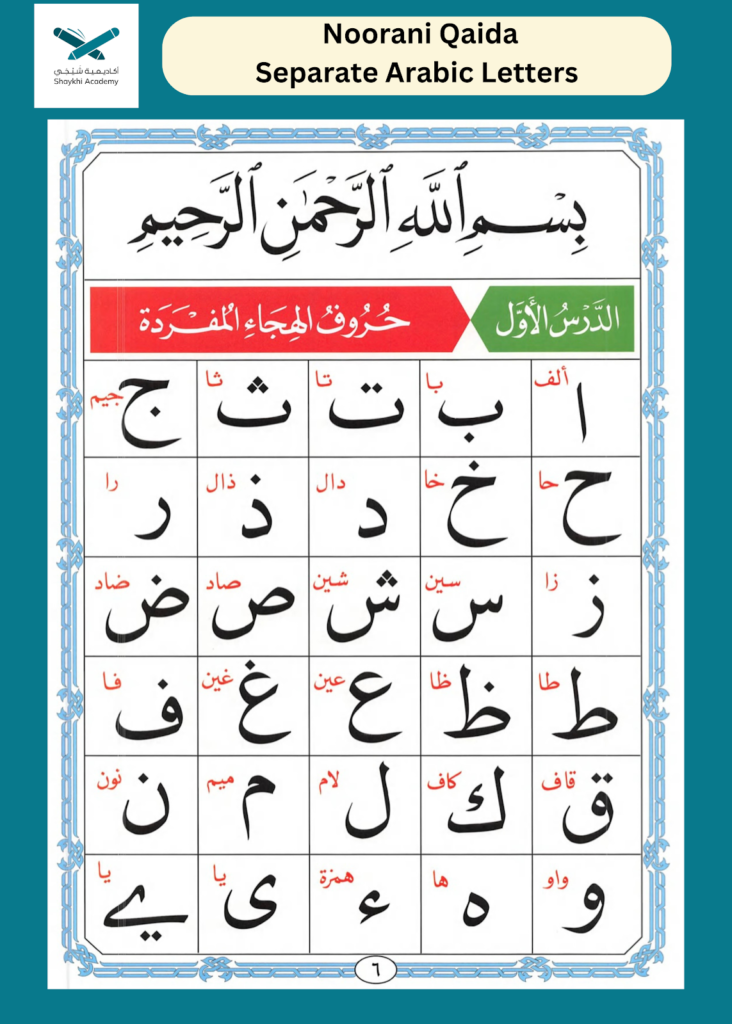
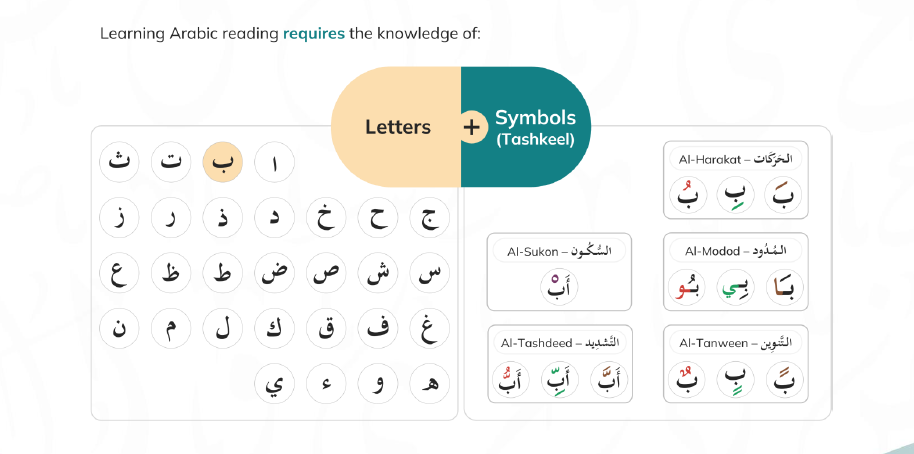
The Arabic alphabet Noorani Qaida teaches each of the 28 letters in a precise pedagogical order — not the standard alif-ba-ta alphabetical sequence, but grouped by phonetic similarity and visual similarity of letter form. This grouping is one of its most practically effective design decisions.
Letter Forms Across Four Positions
A critical challenge for new learners is that each Arabic letter has up to four distinct visual forms depending on its position in a word:
| Position | Example — Letter ع (Ayn) |
| Isolated | ع |
| Initial | عَلِيٌّ |
| Medial | مَعَ |
| Final | سَمِعَ |
The Noorani Qaida introduces these forms gradually, beginning with isolated forms and moving to connected forms only after a student can confidently recognize the isolated shape.
This prevents the very common error of students being able to name a letter in isolation but failing to recognize it mid-word.
Letters Grouped by Phonetic Similarity
The Qaida specifically groups letters that beginners consistently confuse:
- ب / ت / ث — distinguished only by dot placement
- ج / ح / خ — distinguished by dot placement and pharyngeal depth
- د / ذ — distinguished by the presence or absence of the dot
- ق / ف — distinguished by dot count and their very different points of articulation
This grouping forces the student to attend closely to the distinguishing features of each letter rather than learning them in isolation from one another.
How Are Vowels and Pronunciation Taught in the Noorani Qaida?
Vowels in the Noorani Qaida are introduced through the harakat system — the short vowel diacritical marks placed above or below letters that indicate pronunciation:
| Harakah | Arabic | Sound | Example |
| Fatha | ـَ | Short “a” | بَ = ba |
| Kasra | ـِ | Short “i” | بِ = bi |
| Damma | ـُ | Short “u” | بُ = bu |
| Tanween Fath | ـً | Final “-an” | كِتَابًا |
| Tanween Kasr | ـٍ | Final “-in” | كِتَابٍ |
| Tanween Damm | ـٌ | Final “-un” | كِتَابٌ |
| Sukoon | ـْ | No vowel | بْ = b |
| Shadda | ـّ | Doubled consonant | بَّ = bb |
In our instructors’ experience at The Arabic Learning Centre, the fatha and kasra sounds cause the most early confusion for English speakers — the short “a” of fatha and the short “i” of kasra are frequently reversed in the first two to three weeks.
Explore and Study Al-Menhaj Book for Free
This is almost always because English speakers anchor to visual cue first rather than to the auditory distinction. Instructors address this by drilling auditory discrimination before visual association.
Our Arabic Pronunciation Course addresses makhraj (articulatory position) in detail — knowledge that transforms how quickly students master these distinctions.
What Are the Arabic Noorani Qaida Lessons?
The Noorani Qaida book consists of seventeen lessons, ordered in a stepwise manner to introduce the Arabic letters to students, teach students how to pronounce the Arabic letters accompanied by different diacritic marks, and then enable them to link the Arabic letters forming words.
Below is a summary of the contents of the Arabic Noorani Qaida book.
| Arabic Noorani Qaida Lessons | Content |
| Lesson 1 | Separate Arabic letters |
| Lesson 2 | Compound letters (Al-huruf Al-Murakaba) |
| Lesson 3 | Abbreviated Letters (Al-huruf Al-Muqatha’ah) |
| Lesson 4 | Vowel letters, short vowels (Al-Huruf Al-Mutahareka) |
| Lesson 5 | Nunated letters (Al-huruf AlMunawana) |
| Lesson 6 | Revision on vowel letters (Harakat) and Nunation (Tanween) |
| Lesson 7 | Small Alif, Yaa’, and Waw |
| Lesson 8 | Long vowels and incomplete vowels (Madd and Leen letters) |
| Lesson 9 | Revision on Nunation, long vowels, and incomplete vowels. |
| Lesson 10 | Non vowel letters (Al-sukun) |
| Lesson 11 | Revision on non-vowel letters |
| Lesson 12 | Shaddah |
| Lesson 13 | Revision on Shaddah |
| Lesson 14 | Revision on Shaddah and Sukun |
| Lesson 15 | Revision on two Mushaddad letters in one word |
| Lesson 16 | Revision on Shaddah and Sukun with Madd (lengthening/ elongation) |
| Lesson 17 | General Revision |
How to Teach the Noorani Qaida Effectively
Teaching the Noorani Qaida well requires more than reading through its pages in order. Effective instruction follows five core principles grounded in Arabic phonics pedagogy.
Begin with Auditory Modeling Before Visual Introduction
Before a student sees a new letter or vowel mark, the instructor demonstrates its sound. The student listens, attempts repetition, and receives correction — only then is the written symbol introduced. This mirrors how children acquire spoken language before literacy. Reversing this sequence — showing the letter first — often causes visual dependency that makes pronunciation correction harder later.
1. Drill Single Concepts to Mastery Before Progressing
Each new phonetic concept in the Qaida should be drilled until the student achieves consistent, automatic recognition — not merely correct performance when concentrating. The standard benchmark is: a student can read a column of the current lesson’s content without hesitation before the next lesson begins.
2. Use Repetition With Variation, Not Repetition Alone
Instructors at The Arabic Learning Centre find that drilling the same syllable sequence repeatedly produces surface memorization rather than genuine phonemic internalization. Effective drill varies the order, mixes in previously learned letters, and uses random presentation — forcing the student to process each letter independently rather than sequence-predicting.
Read Also: Arabic Numerals – Full Guide
3. Correct Pronunciation at the Point of Error
When a student mispronounces a letter — particularly the phonemically challenging letters such as ع (ayn), غ (ghayn), ح (ha), خ (kha), and ق (qaf) — the correction should happen immediately, at the moment of the error. Allowing repeated mispronunciation to continue, even briefly, reinforces the incorrect articulatory pattern.
Read Also: How Did Arabic Spread?
4. Track Progress Against the Lesson Map, Not a Calendar
Students progress at different rates through the Noorani Qaida. Competency, not time spent, is the appropriate metric. A student who has genuinely mastered lessons 1–8 is better positioned than one who has rushed through all 17 without mastery.
Our online Arabic classes for kids and adult programs both track progress against lesson mastery benchmarks rather than session count.
For learners pursuing Quranic Arabic specifically, our Quranic Arabic Course follows the Noorani Qaida foundation with a structured curriculum that moves into Tajweed application and Quranic vocabulary development.
You can also explore our guide on how to learn Arabic for Quran for a broader roadmap of the journey from script to recitation.
Read Also: Arabic Language – Full Guide
Our Students Reviews
Read Also: Why Is the Quran in Arabic?
Begin Learning with Certified Instructors at The Arabic Learning Centre
The Noorani Qaida works — but only when taught correctly. Self-study using apps or videos leaves pronunciation errors undetected and uncorrected.
The Arabic Learning Centre offers:
- Certified native Arabic instructors specializing in Quranic literacy
- Flexible 1-on-1 sessions available 24/7 to suit any time zone
- Structured Noorani Qaida curriculum with progress tracking
- Dedicated programs for children, adults, new Muslims, and sisters
- A free trial lesson to experience the method before committing
Explore our Learn to Read Arabic Course or our Arabic Course for Islamic Studies — and start reading the Quran the way it was meant to be recited.
Check out our top courses in Arabic and choose the course you need to start learning Arabic today:
- Arabic Course for Beginners
- Arabic Script Writing Course
- Arabic Speaking Course
- Learn Arabic Letters for Tajweed
- Learning Arabic Grammar
- Arabic Vocabulary Course
- Fusha Arabic Course
- Classical Arabic Course
- Arabic Course for Islamic Studies
- Quranic Arabic Course
- Learn Arabic for New Muslims
Start with a FREE trial class and enhance your Arabic language skills

Conclusion
The Noorani Qaida remains the most effective phonics primer for non-Arabic speakers beginning Quranic reading because its design aligns with how humans actually acquire reading skills — sound before symbol, isolated before connected, simple before complex.
Its enduring relevance nearly four decades after its authorship speaks to a genuine pedagogical insight: mastering the foundation accelerates everything that follows. A student who truly knows the Qaida reads Quranic Arabic with a confidence that rote recitation alone never produces.
Read Also: What Is Classical Arabic?
Frequently Asked Questions About the Noorani Qaida
What Is the Noorani Qaida and Is It Suitable for Complete Beginners?
The Noorani Qaida is a structured Arabic phonics primer that teaches Quranic letter recognition, short vowels, and basic Tajweed rules from absolute scratch. It requires no prior knowledge of Arabic script or pronunciation. Any learner — child or adult, Muslim or language learner — can begin with Lesson 1 with no prerequisites whatsoever.
How Long Does It Take to Complete the Noorani Qaida?
Most children aged 5–10 complete the Noorani Qaida in 4–6 months with daily practice of 15–20 minutes and a certified instructor. Motivated adult learners often complete it in 10–14 weeks. Pace depends on lesson mastery, not sessions attended — each lesson should be internalized before progression to the next.
Can Adults Learn the Noorani Qaida, or Is It Only for Children?
The Noorani Qaida is equally effective for adults. Adult learners benefit from understanding the rationale behind each phonetic rule, which children typically cannot access. Adults often progress through the conceptual lessons faster than children and achieve accurate pronunciation more quickly when they work with a certified instructor who provides real-time correction.
What Is the Difference Between the Noorani Qaida and Standard Arabic Alphabet Learning?
The Noorani Qaida is specifically oriented toward Quranic reading — it introduces letters in phonetically grouped sequences, incorporates harakat vowel marks from the earliest lessons, and integrates foundational Tajweed rules throughout. Standard Arabic alphabet learning for Modern Standard Arabic focuses on letter names and shapes without this Tajweed and phonics integration. The two curricula serve related but distinct goals. For a broader introduction to the Arabic alphabet, visit our Arabic Alphabet for Kids guide.
Do I Need to Know Arabic Grammar Before Starting the Noorani Qaida?
No. The Noorani Qaida is a reading primer, not a grammar course. It teaches phonics and script recognition — how to sound out Arabic letters and words correctly. Arabic grammar (Nahw) is a separate discipline studied after reading fluency is established. Our Arabic Grammar Course and the Arabic Grammar for Quran resource are appropriate next steps once reading foundation is secure.
Related Articles
Arabic Grammar