 Arabic Grammar
| Key Takeaways |
| Arabic adjectives always follow the noun they describe, unlike English where adjectives precede nouns. |
| Every Arabic adjective must match its noun in four categories: gender, number, definiteness, and grammatical case. |
| The definite article ال (al-) must be added to both noun and adjective when the noun is definite. |
| Arabic adjectives for non-human plurals always take the feminine singular form, a rule that surprises most beginners. |
Placing an adjective before the noun, or forgetting to add ال to the adjective when the noun is definite makes a sentence grammatically incorrect in Modern Standard Arabic (Fusha).
Mastering adjective agreement is not optional grammar polish; it is the structural core of how Arabic sentences are built.
What Are Adjectives in Arabic?
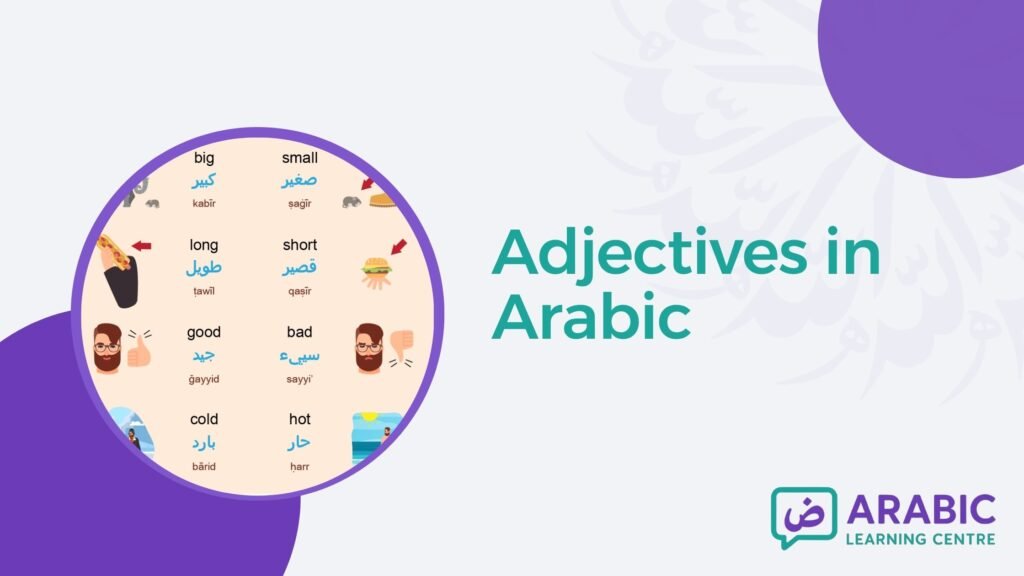
Adjectives in Arabic — known as الصِّفَة (as-sifa) or النَّعْت (an-na’t) in classical Nahw terminology — always come after the noun they describe. This is the foundational rule every beginner must internalize first. An Arabic adjective must then agree with its noun in four grammatical properties: gender (جِنْس), number (عَدَد), definiteness (تَعْرِيف وَتَنْكِير), and case (إعْرَاب).
What Is the Basic Rule for Adjectives in Arabic?
Adjectives in Arabic follow the noun they modify and must agree with it in gender, number, definiteness, and case. This four-way agreement system is what distinguishes Arabic adjective grammar from European languages.
A learner who grasps this agreement framework early builds a grammatical foundation that applies across all subsequent Arabic learning — from vocabulary expansion to sentence composition.
The Arabic term for an adjective used as a noun modifier in this way is النَّعْت (an-na’t), and the noun it describes is called المَنْعُوت (al-man’ūt). Classical Nahw grammar treats the adjective as a dependent element that “follows” (تَابِع, tābi’) its noun.
Consider these foundational examples:
كِتَابٌ كَبِيرٌ
kitābun kabīrun
A big book
Both noun and adjective are indefinite, masculine singular.
البَيْتُ الكَبِيرُ
al-baytu al-kabīru
The big house
Both take ال, making the phrase definite.
Students at The Arabic Learning Centre regularly encounter this pattern in their first lessons of the Arabic Grammar Course — and the instructors there consistently observe that learners who practice agreement drills early avoid the compounding errors that appear later in more complex sentence structures.
Start Learning Arabic Grammar with a Free Trial

How Does Gender Agreement Work for Arabic Adjectives?
Arabic adjectives agree in gender with their noun. Masculine nouns take masculine adjectives; feminine nouns take feminine adjectives. Feminine adjectives are formed by adding the suffix ة (-a, the ta’ marbuta) to the masculine base form.
This is the same pattern governing nouns and verbs throughout Arabic grammar.
| Noun | Adjective | Meaning |
| وَلَدٌ (waladun) — masculine | طَوِيلٌ (tawīlun) | “A tall boy” |
| بِنْتٌ (bintun) — feminine | طَوِيلَةٌ (tawīlatun) | “A tall girl” |
| مَدِينَةٌ (madīnatun) — feminine | كَبِيرَةٌ (kabīratun) | “A big city” |
| مَسْجِدٌ (masjidun) — masculine | كَبِيرٌ (kabīrun) | “A big mosque” |
The challenge our certified instructors at The Arabic Learning Centre observe most frequently is that learners assume gender from meaning — they treat words referring to women as feminine and words referring to men as masculine, then stop there.
But Arabic grammatical gender also applies to all inanimate nouns. A شَجَرَةٌ (shajaratun, tree) is feminine. A بَابٌ (bābun, door) is masculine. Gender must be learned with each noun, not inferred.
If you are still building your core vocabulary foundation, the Arabic Vocabulary Course at The Arabic Learning Centre is designed to teach nouns together with their grammatical gender from the outset.
Enroll in Our Arabic Vocabulary Course to Get Your Free Trial

Shots Videos from Our Courses
How Does Number Agreement Work for Arabic Adjectives?
Arabic adjective number agreement follows three categories: singular (مُفْرَد), dual (مُثَنَّى), and plural (جَمْع). For singular and dual nouns, the adjective mirrors the noun’s number directly.
For plural nouns, the rule bifurcates based on whether the noun refers to humans or non-humans — and this is where most intermediate learners make errors.
1. Adjective Agreement for Human Plurals
For plurals referring to humans (men, women, people), the adjective takes the corresponding plural form.
الطُّلَّابُ المُجْتَهِدُونَ
aṭ-ṭullābu al-mujtahidūna
The diligent students (male) — masculine sound plural.
الطَّالِبَاتُ المُجْتَهِدَاتُ
aṭ-ṭālibātu al-mujtahidātu
The diligent students (female) — feminine sound plural.
2. Adjective Agreement for Non-Human Plurals
For all non-human plurals — objects, animals, abstract things — the adjective takes the feminine singular form, regardless of the plural’s apparent gender.
الكُتُبُ الكَبِيرَةُ
al-kutubu al-kabīratu
The big books
كُتُب (books) is a broken plural; the adjective is feminine singular كَبِيرَة.
This rule — called the rule of جَمْع غَيْر العَاقِل (jam’ ghayr al-‘āqil, the non-rational plural) — is one of the most counter-intuitive patterns for learners coming from European languages.
Our instructors at The Arabic Learning Centre address this directly through visual contrast drills. You can learn how Arabic broken plurals function in detail through our Arabic broken plurals guide.
Read also: Sun and Moon Letters in Arabic
How Does Definiteness Agreement Work in Arabic Adjective Phrases?
An Arabic adjective matches the definiteness of its noun. When the noun carries the definite article ال (al-), the adjective must also carry ال. When the noun is indefinite (no ال, ending in tanwin), the adjective is also indefinite with tanwin. Mismatching definiteness is one of the most common errors in early intermediate Arabic writing.
| Indefinite Phrase | Definite Phrase |
| طَالِبٌ ذَكِيٌّ (ṭālibun dhakiyyun) — “A smart student” | الطَّالِبُ الذَّكِيُّ (aṭ-ṭālibu adh-dhakiyyu) — “The smart student” |
| سَيَّارَةٌ سَرِيعَةٌ (sayyāratun sarī’atun) — “A fast car” | السَّيَّارَةُ السَّرِيعَةُ (as-sayyāratu as-sarī’atu) — “The fast car” |
There is an important structural point here: a definite noun + indefinite adjective is NOT an adjective phrase — it is a predicate sentence (جُمْلَةٌ إِسْمِيَّةٌ). For example, الطَّالِبُ ذَكِيٌّ (aṭ-ṭālibu dhakiyyun) means “The student is smart” — a complete nominal sentence, not a noun-adjective phrase. This distinction is foundational.
You can explore the structure of Arabic nominal sentences further in our guide on verbal and nominal sentences in Arabic.
Understanding definiteness in Arabic also requires a solid grasp of the definite article ال itself. Our detailed guide on definite articles in Arabic covers every rule, including the solar and lunar letter distinctions.
How Does Grammatical Case Affect Arabic Adjectives?
Arabic adjectives also follow their noun in grammatical case (i’rāb). There are three cases in Arabic Nahw: the nominative (رَفْع, raf’), the accusative (نَصْب, naṣb), and the genitive (جَرّ, jarr). Whatever case ending the noun carries, the adjective carries the same.
| Case | Noun | Adjective | Meaning |
| Nominative (subject) | الوَلَدُ | الطَّوِيلُ | “The tall boy” (subject) |
| Accusative (object) | الوَلَدَ | الطَّوِيلَ | “the tall boy” (object) |
| Genitive (after preposition) | الوَلَدِ | الطَّوِيلِ | “of/for the tall boy” |
Case endings are expressed through harakat (short vowel diacritical marks). Learners who have not yet studied harakat fully should first read our guide on harakat in Arabic and how many harakat are in Arabic.
What Are the Most Common Mistakes Beginners Make with Arabic Adjectives?
Beginners most frequently place the adjective before the noun, forget to add ال to the adjective in definite phrases, or use a masculine plural adjective with non-human plural nouns. These three errors are predictable — and correctable once the underlying rules are explicit.
1. Placing the Adjective Before the Noun
Learners whose first language is English instinctively write كَبِيرٌ بَيْتٌ (kabīrun baytun) instead of the correct بَيْتٌ كَبِيرٌ (baytun kabīrun).
This is understandable — the English “big house” puts the adjective first. In Arabic, however, this word order produces an ungrammatical phrase.
2. Forgetting the Definite Article on the Adjective
Writing البَيْتُ كَبِيرٌ when intending “the big house” is another frequent error. As explained above, this actually reads as “the house is big” — a sentence, not a noun phrase. The correct noun phrase is البَيْتُ الكَبِيرُ.
3. Applying Human Plural Agreement to Non-Human Nouns
Writing الكُتُبُ الكِبَارُ (using the broken plural of كَبِير) instead of the correct الكُتُبُ الكَبِيرَةُ (feminine singular) is the third consistent error our instructors observe across student levels.
Practical Exercises to Apply Arabic Adjective Agreement
Apply the agreement rules above with these exercises. Form correct Arabic adjective-noun phrases for each prompt.
Exercise Set A — Supply the correct adjective form:
- A beautiful [feminine] garden — حَدِيقَةٌ + جَمِيل → ?
- The old [masculine] man — الرَّجُلُ + عجوز→ ?
- Big books (non-human plural) — الكُتُبُ + كَبِير → ?
Answers:
- حَدِيقَةٌ جَمِيلَةٌ (ḥadīqatun jamīlatun)
- الرَّجُلُ العجوز (ar-rajulu al-ajuzu)
- الكُتُبُ الكَبِيرَةُ (al-kutubu al-kabīratu) — feminine singular adjective for non-human plural
Exercise Set B — Identify the error and correct it:
- ~~الطَّالِبُ ذَكِيُّ~~ — What is wrong?
- ~~كَبِيرٌ مَسْجِدٌ~~ — What is wrong?
Corrections:
- The adjective lacks ال — corrected: الطَّالِبُ الذَّكِيُّ (noun-adjective phrase) OR intended as a sentence: الطَّالِبُ ذَكِيٌّ (with tanwin on the adjective).
- Adjective precedes the noun — corrected: مَسْجِدٌ كَبِيرٌ.
For learners who want to practice these patterns with a certified Arabic instructor in a live 1-on-1 setting, The Arabic Learning Centre’s Arabic Course for Beginners includes structured grammar drills from the first session.
Our Students Reviews
Join Our Arabic Course for Beginners With a Free Trial

Read also: Types of Laam in Arabic Grammar
Begin Mastering Arabic Grammar with Certified Instructors at The Arabic Learning Centre
Arabic adjective agreement is learnable — and with the right structured guidance, most students internalize the four agreement rules within their first month of systematic study.
The Arabic Learning Centre offers:
- 1-on-1 sessions with certified native Arabic instructors
- Flexible scheduling available 24/7 to fit any time zone
- A structured Arabic Grammar Course covering Nahw rules from foundational to advanced
- Free trial lessons — no commitment required
Book your free trial lesson today and begin building the grammatical accuracy that makes Arabic sentences clear, correct, and confident.
Check out our top courses in Arabic and choose the course you need to start learning Arabic today:
- Arabic Course for Beginners
- Arabic Script Writing Course
- Arabic Speaking Course
- Learn Arabic Letters for Tajweed
- Learning Arabic Grammar
- Arabic Vocabulary Course
- Fusha Arabic Course
- Classical Arabic Course
- Arabic Course for Islamic Studies
- Quranic Arabic Course
- Learn Arabic for New Muslims
Start with a FREE trial class and enhance your Arabic language skills

Conclusion
Mastering Arabic adjective agreement means committing four rules to active memory: position (after the noun), gender match, number match with the non-human plural exception, and definiteness match. These rules are consistent and logical — once internalized, they apply to every Arabic adjective a learner will ever encounter.
The distinction between a noun-adjective phrase and a predicate sentence — the difference between الرَّجُلُ الطَّوِيلُ (“the tall man”) and الرَّجُلُ طَوِيلٌ (“the man is tall”) — is one of the most practically useful grammar insights at the beginner level. It affects both reading comprehension and speaking accuracy.
Frequently Asked Questions About Adjectives in Arabic
Do Arabic Adjectives Come Before or After the Noun?
Arabic adjectives always follow the noun they modify — this is the opposite of English word order. The adjective كَبِير (kabīr, big) placed after بَيْتٌ (baytun, house) gives بَيْتٌ كَبِيرٌ (“a big house”). Placing the adjective before the noun is grammatically incorrect in Modern Standard Arabic (Fusha).
How Many Ways Must an Arabic Adjective Agree with Its Noun?
An Arabic adjective must agree with its noun in four grammatical categories: gender (masculine or feminine), number (singular, dual, or plural), definiteness (with or without the definite article ال), and grammatical case (nominative, accusative, or genitive). All four must match simultaneously for the phrase to be grammatically correct.
Why Do Plural Adjectives Sometimes Take the Feminine Singular Form?
In Arabic, non-human plurals — nouns referring to objects, animals, or abstract things — take a feminine singular adjective, regardless of the noun’s own gender or plural form. This rule applies to broken plurals and sound plurals alike when the referent is non-human. For example, كُتُب (books) takes كَبِيرَة (feminine singular), not a plural adjective form.
Related Articles
Arabic Grammar