 Arabic Grammar
| Key Takeaways |
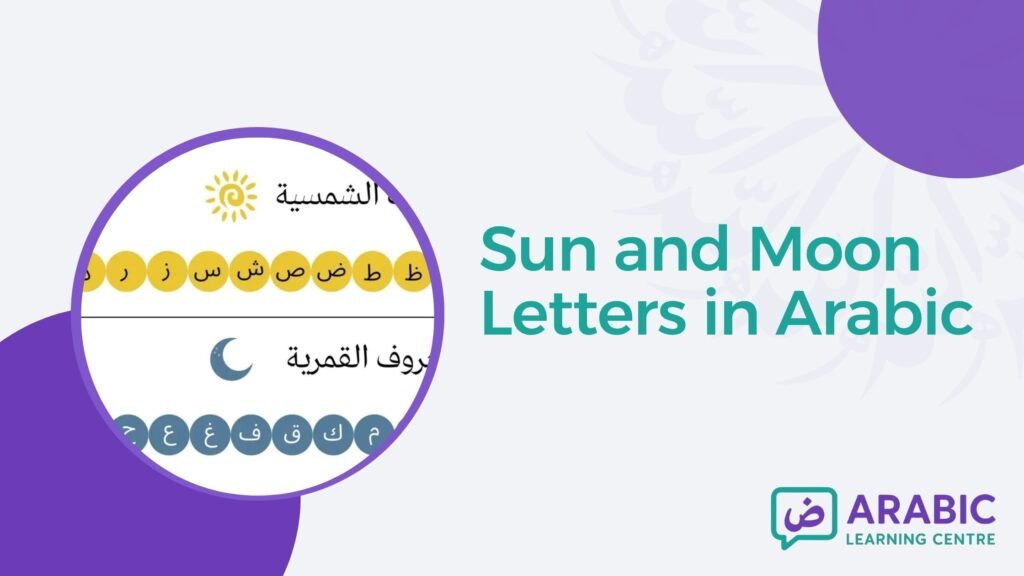
| Arabic has 28 letters divided into 14 sun letters (حروف شمسية) and 14 moon letters (حروف قمرية) based on how they interact with the definite article ال. |
| Sun letters assimilate the ل of ال, replacing it with a doubled sound of the following letter, marked by a shaddah (ّ). |
| Moon letters leave the ل of ال fully pronounced; the definite article sounds exactly as written: اَلْ (al-). |
Sun and moon letters in Arabic determine how the definite article ال (al-) is pronounced in front of every noun and adjective. When a word begins with a sun letter, the ل assimilates into that letter, producing a doubled consonant. When a word begins with a moon letter, the ل is fully pronounced as written.
This single rule governs the correct pronunciation of thousands of Arabic words. Adult learners who understand it early develop far more natural and accurate speech.
What Are the Sun and Moon Letters in Arabic?
Sun and moon letters are the two categories into which all 28 Arabic alphabet letters are divided, based on how they respond to the definite article ال. The 14 sun letters (الحروف الشمسية — al-ḥurūf al-shamsiyyah) cause the ل of ال to assimilate completely. The 14 moon letters (الحروف القمرية — al-ḥurūf al-qamariyyah) leave the ل unchanged and fully pronounced.
The Arabic names themselves teach the rule. The word شمس (shams, “sun”) begins with ش — a sun letter — so the definite article becomes الشَّمْس (ash-shams), not al-shams. The word قمر (qamar, “moon”) begins with ق — a moon letter — so the article stays الْقَمَر (al-qamar).
Classical Arabic grammarians used these two words as the mnemonic that has survived for over a thousand years.
If you want to explore more foundational concepts like this, our guide on definite articles in Arabic is an excellent next step.
Why Does the Rule of Sun and Moon Letters in Arabic Exist?
The sun and moon classification is not arbitrary. It is rooted in makhraj (مَخْرَج — place of articulation). All 14 sun letters are articulated at or near the same region as ل itself: the tip of the tongue against or near the upper front teeth and alveolar ridge. Pronouncing ل followed immediately by another tongue-tip letter creates an articulatory clash — the tongue cannot cleanly complete ل before moving to the next sound. Assimilation is the language’s natural resolution.
Moon letters, by contrast, are articulated in parts of the mouth or throat entirely separate from the ل position — the back of the throat, the lips, the back of the tongue. There is no articulatory conflict, and so the ل sounds cleanly and fully.
Understanding this as a physiological reality, not a memorization task, is the approach The Arabic Learning Centre’s Arabic Grammar Course takes — and students consistently report that the rule clicks much faster when the articulatory logic is made explicit.
Start Learning Arabic Grammar with a Free Trial

Full Table with Examples of the 14 Sun Letters in Arabic
The 14 sun letters must be memorized. The table below presents each one with a sample word showing the full effect on the definite article.
| Letter | Name | Word with ال | Transliteration | Meaning |
| ت | tā’ | اَلتِّينُ | at-tīn | The fig |
| ث | thā’ | اَلثَّلْجُ | ath-thalj | The snow |
| د | dāl | اَلدَّرْسُ | ad-dars | The lesson |
| ذ | dhāl | اَلذَّهَبُ | adh-dhahab | The gold |
| ر | rā’ | اَلرَّجُلُ | ar-rajul | The man |
| ز | zāy | اَلزَّيْتُ | az-zayt | The olive oil |
| س | sīn | اَلسَّمَاءُ | as-samā’ | The sky |
| ش | shīn | اَلشَّمْسُ | ash-shams | The sun |
| ص | ṣād | اَلصَّبْرُ | aṣ-ṣabr | The patience |
| ض | ḍād | اَلضَّوْءُ | aḍ-ḍaw’ | The light |
| ط | ṭā’ | اَلطَّعَامُ | aṭ-ṭa’ām | The food |
| ظ | ẓā’ | اَلظِّلُّ | aẓ-ẓill | The shadow |
| ل | lām | اَللَّيْلُ | al-layl | The night |
| ن | nūn | اَلنُّورُ | an-nūr | The light/radiance |
Notice that ل itself is a sun letter. When a word begins with ل, the ل of ال merges into it, producing the doubled لّ heard in اَللَّيْلُ (al-layl). The shaddah (ّ) over the first letter of the word is the written signal that assimilation has occurred.
Shots Videos from Our Courses
Full Table with Examples of the 14 Moon Letters in Arabic
The moon letters leave ال completely unchanged. The ل sounds clearly in every case.
| Letter | Name | Word with ال | Transliteration | Meaning |
| أ / ا | alif/hamzah | اَلْأَمْرُ | al-amr | The matter |
| ب | bā’ | اَلْبَيْتُ | al-bayt | The house |
| ج | jīm | اَلْجَمَالُ | al-jamāl | The beauty |
| ح | ḥā’ | اَلْحَقُّ | al-ḥaqq | The truth |
| خ | khā’ | اَلْخَيْرُ | al-khayr | The good |
| ع | ‘ayn | اَلْعِلْمُ | al-‘ilm | The knowledge |
| غ | ghayn | اَلْغَيْبُ | al-ghayb | The unseen |
| ف | fā’ | اَلْفَجْرُ | al-fajr | The dawn |
| ق | qāf | اَلْقَلْبُ | al-qalb | The heart |
| ك | kāf | اَلْكِتَابُ | al-kitāb | The book |
| م | mīm | اَلْمَاءُ | al-mā’ | The water |
| هـ | hā’ | اَلْهُدَى | al-hudā | The guidance |
| و | wāw | اَلْوَقْتُ | al-waqt | The time |
| ي | yā’ | اَلْيَوْمُ | al-yawm | The day |
A practical mnemonic: the 14 moon letters spell out this phrase when grouped — ابغ حجك وخف عقيمه — a classical memory device Arabic grammarians compiled.
While not in common use today, students at The Arabic Learning Centre who memorize this phrase find they can recall all moon letters without hesitation.
Our Arabic Course for Beginners covers this rule in depth within the early modules, ensuring learners build correct pronunciation habits from their first lessons.
Join Our Arabic Course for Beginners With a Free Trial
Read also: Arabic Sentence Structure
How to Recognize and Pronounce the Assimilation Correctly?
When you see a word with ال and the first letter of the word carries a shaddah (ّ), you are looking at a sun letter word. The shaddah signals that the ل has been absorbed.
Step 1: See the written form — اَلشَّمْسُ
Step 2: Recognize the shaddah on ش — this tells you ل is silent.
Step 3: Pronounce it as: ash-shams — holding the ش sound slightly longer than normal to reflect the doubling.
The doubling is not decorative. A shaddah always indicates a geminated (doubled) consonant. In sun letter words, the doubled consonant is the sun letter itself, absorbing the ل that preceded it.
For learners working on Arabic pronunciation, this is one of the most high-frequency application points they will encounter. Understanding harakat in Arabic — particularly the shaddah — is the prerequisite for reading these forms accurately.
A Common Error: Pronouncing the ل in Sun Letter Words
In our instructors’ experience at The Arabic Learning Centre, the most consistent error beginners make is pronouncing اَلشَّمْسُ as al-shams rather than ash-shams. This occurs because learners read ال as a fixed block and apply it uniformly.
The written shaddah corrects this — but only if the learner knows what to look for.
Building the habit of scanning the first letter of every noun before applying ال is a skill that develops within two to three weeks of focused daily practice.
Practical Exercises to Apply the Sun and Moon Letter Rule
Application is where the rule becomes automatic. Work through these exercises systematically.
Exercise 1: Classify Each Letter
Identify whether each letter below is a sun letter or moon letter before checking the key.
| Letter | Sun or Moon? |
| ر | ? |
| ق | ? |
| ن | ? |
| م | ? |
| ش | ? |
| ك | ? |
Answer key: ر = Sun | ق = Moon | ن = Sun | م = Moon | ش = Sun | ك = Moon
Exercise 2: Write and Pronounce the Definite Article Form
Add ال to each word below and write the correct transliteration:
| Word | Meaning | With ال | Transliteration |
| نَهْر | River | اَلنَّهْرُ | an-nahr |
| كِتَاب | Book | اَلْكِتَابُ | al-kitāb |
| ذَهَب | Gold | اَلذَّهَبُ | adh-dhahab |
| وَلَد | Boy | اَلْوَلَدُ | al-walad |
| صَبَاح | Morning | اَلصَّبَاحُ | aṣ-ṣabāḥ |
| بَيْت | House | اَلْبَيْتُ | al-bayt |
Read also: Types of Laam in Arabic Grammar
Exercise 3: Listening Discrimination
Read each pair aloud and identify which follows the sun letter rule and which the moon letter rule:
اَلرَّحْمَةُ (ar-raḥmah) — The mercy → Sun letter (ر)
اَلْحِكْمَةُ (al-ḥikmah) — The wisdom → Moon letter (ح)
اَلسَّلَامُ (as-salām) — The peace → Sun letter (س)
اَلْإِسْلَامُ (al-Islām) — Islam → Moon letter (ا)
Practicing these pairs aloud — not silently — is what builds the auditory distinction. Students who spend five minutes daily reading aloud with diacritical marks (tashkeel) consistently internalize this rule within ten to fourteen days.
Our guide on how many harakat in Arabic provides the full foundation for reading with tashkeel accurately.
Our Students Reviews
Read also: Conditional Sentences in Arabic
Begin Mastering Arabic Grammar with Certified Instructors at The Arabic Learning Centre
Sun and moon letters are one of the earliest grammar milestones — and one of the most rewarding when it clicks. Correct pronunciation of ال transforms how Arabic sounds coming out of your mouth.
The Arabic Learning Centre offers:
- 1-on-1 sessions with certified native Arabic instructors
- Flexible scheduling available 24/7 to fit any time zone
- Structured progression from Arabic script reading through advanced grammar
- A free trial lesson to experience the method firsthand
Explore our Arabic Grammar Course or start from the foundations with our Arabic Course for Beginners.
Check out our top courses in Arabic and choose the course you need to start learning Arabic today:
- Arabic Course for Beginners
- Arabic Script Writing Course
- Arabic Speaking Course
- Learn Arabic Letters for Tajweed
- Learning Arabic Grammar
- Arabic Vocabulary Course
- Fusha Arabic Course
- Classical Arabic Course
- Arabic Course for Islamic Studies
- Quranic Arabic Course
- Learn Arabic for New Muslims
Start with a FREE trial class and enhance your Arabic language skills

Conclusion
The sun and moon letter rule is not just a pronunciation detail — it is the mechanism behind how Arabic’s definite article functions across every noun and adjective in the language. Grasping it early means every new vocabulary word you encounter comes with its correct spoken form already built in.
The 14 sun letters assimilate the ل of ال through articulatory necessity; the 14 moon letters leave it intact for the same physical reason. This is language working the way it was designed to work — efficiently, logically, and beautifully.
Frequently Asked Questions About Sun and Moon Letters in Arabic
What Is the Easiest Way to Remember Which Letters Are Sun Letters?
The most reliable method is to learn the rule by articulation: all 14 sun letters are produced with the tongue tip near or touching the upper teeth or alveolar ridge — the same area used for ل. If you feel your tongue tip rise when pronouncing a letter, it is almost certainly a sun letter. Pair this with the classical mnemonic ابغ حجك وخف عقيمه for moon letters, and you have both sets covered systematically.
Does the Assimilation Change the Written Arabic — or Only the Pronunciation?
The assimilation affects both writing and pronunciation in standard Arabic with tashkeel (vocalization marks). The shaddah (ّ) appears over the sun letter to indicate the doubled consonant. In unvocalized Arabic text — the form most commonly printed — the shaddah is omitted, and readers are expected to apply the rule from knowledge. This is why building the habit with fully voweled text first is the correct instructional sequence.
Why Is ل Listed as a Sun Letter — Doesn’t It Merge With Itself?
Yes — and that is precisely why ل is a sun letter. When a word beginning with ل takes the definite article, the ل of ال and the ل of the word merge into a single geminated لّ (doubled ل). This is the same assimilation process as all other sun letters; ل simply assimilates into itself. The result is the familiar اَللَّيْلُ (al-layl) — “the night” — where the doubled ل is clearly audible.
Related Articles
Arabic Grammar