 Arabic Grammar
| Key Takeaways |
| Arabic grammar recognizes multiple distinct types of Laam (لام), each serving a different syntactic and semantic function in sentences. |
| Laam Al-Ta’rif (لام التعريف) is the definite article attached to nouns, functioning identically to “the” in English grammar. |
| Some types of Laam are jussive (jaazima), meaning they cause the following verb to take the sukoon or appear in the majzoom form. |
| Laam Al-Amr (لام الأمر) expresses a third-person command and is one of the most practically useful Laam types for learners. |
The types of Laam in Arabic grammar include at least eight distinct categories, each with a unique grammatical role — from forming definite nouns to expressing purpose, emphasis, command, and ownership.
Far from being a single letter with one function, Laam (لام) is one of the most grammatically versatile letters in the Arabic language, and understanding its types is a turning point for any serious learner.
What Are the Main Types of Laam in Arabic Grammar?
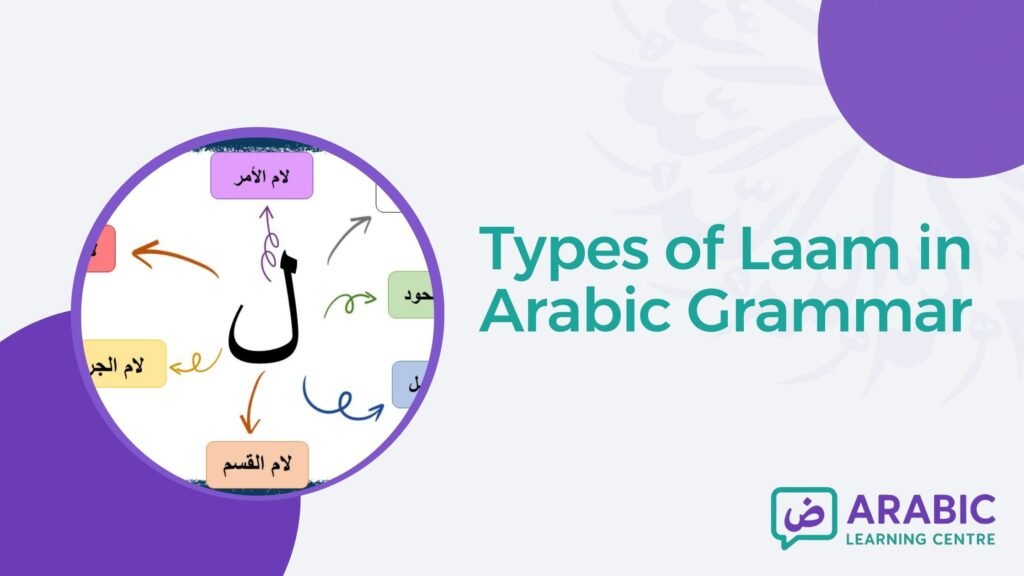
Laam in Arabic grammar is classified into two broad grammatical categories: Laam Al-Jarr (لام الجر), which is a preposition that puts the following noun into the genitive case (majroor), and Laam Al-Jaazima (لام الجازمة), which is a particle that puts the following verb into the jussive mood (majzoom). Within and beyond these two categories, classical Nahw scholars identify eight or more specific types based on their meaning and grammatical effect.
If you want to study these distinctions with a certified Arabic instructor who can walk you through each type with live examples, The Arabic Learning Centre’s Arabic Grammar Course provides exactly that structured environment — with 1-on-1 sessions available 24/7.
Start Learning Arabic Grammar with a Free Trial

1. Laam Al-Ta’rif (لام التعريف) Work as the Definite Article
Laam Al-Ta’rif (لام التعريف) is the definite article in Arabic, equivalent to “the” in English. It is always written attached to the noun that follows it, preceded by the Hamzat Al-Wasl (همزة الوصل), giving the combined form الـ. It makes any indefinite noun definite and does not change the grammatical case of the noun itself.
This is the first Laam type every beginner encounters, and rightly so — it appears in nearly every Arabic sentence. Before understanding its nuances, though, learners need solid grounding in Arabic harakat (the short vowel marks that signal grammatical endings).
If you are not yet confident with those, the article on harakat in Arabic is essential reading before going further.
The Solar and Lunar Letters Rule That Every Learner Must Know
Laam Al-Ta’rif behaves differently depending on the first letter of the word it attaches to. When it precedes one of the fourteen solar letters (الحروف الشمسية) — such as ن، ر، ش، س — the Laam itself is assimilated and the following letter is doubled with a shaddah (شدّة). When it precedes a lunar letter (حرف قمري), the Laam is pronounced clearly.
| Noun Type | Example | Pronunciation |
| Solar (Laam assimilated) | الشَّمْسُ | Ash-shamsu (“the sun”) |
| Lunar (Laam pronounced) | الْقَمَرُ | Al-qamaru (“the moon”) |
| Solar | النَّهْرُ | An-nahru (“the river”) |
| Lunar | الْبَيْتُ | Al-baytu (“the house”) |
At The Arabic Learning Centre, our instructors notice that students reliably confuse solar and lunar letters in their first month of study — nearly always because they are applying English phonetic logic to Arabic.
The moment a student physically practices the assimilation out loud, rather than reading about it, the rule becomes intuitive within one to two weeks.
Shots Videos from Our Courses
2. Laam Al-Amr (لام الأمر)
Laam Al-Amr (لام الأمر) is a jussive particle that places the verb following it into the majzoom (jussive) form, conveying a third-person command or instruction. Laam Al-Amr is translated as “let him/her/them do…” and is used when the speaker is directing someone who is not directly addressed — a third party.
This type is among the most practically valuable for learners of Quranic Arabic and Classical Arabic (Fusha), as it appears regularly in both contexts.
It is one of only four tools in Arabic grammar for expressing commands, alongside the direct imperative (فِعْل الأمر), prohibition (لا الناهية), and certain conditional constructions.
Example:
لِيَقُمْ كُلُّ طَالِبٍ
Liyaqum kullu tālibin
Let every student stand.
Notice how يقوم loses its final waw and takes sukoon — that is the jussive effect of Laam Al-Amr at work. To understand why that sukoon appears and how it behaves across different verb forms, the guide on sukoon in Arabic provides the foundation you need.
3. Laam Al-Jarr (لام الجر)
Laam Al-Jarr (لام الجر) is a preposition that places the noun following it into the genitive case (majroor). In classical Nahw, it carries multiple sub-meanings depending on context — the most common being ownership/possession (milk), purpose/benefit (ta’leel), and sometimes a causative sense. It is one of the nineteen prepositions (حروف الجر) recognized in Arabic grammar.
This single Laam type carries more semantic weight than most learners initially realize. Consider these three usages:
| Laam Al-Jarr Meaning | Arabic Example | Translation |
| Ownership | الْكِتَابُ لِلطَّالِبِ | “The book belongs to the student.” |
| Purpose | جِئْتُ لِلتَّعَلُّمِ | “I came for the purpose of learning.” |
The grammatical behavior is identical across all three meanings — the noun following Laam Al-Jarr always takes a kasra (or its equivalent tanween kasra for indefinite nouns) — but the contextual meaning shifts entirely based on the sentence.
4. Laam Al-Ta’leel (لام التعليل)
Laam Al-Ta’leel (لام التعليل) expresses purpose or cause — equivalent to “in order to” or “so that” in English. Grammatically, it is a type of Laam Al-Jarr and puts the noun or masdar (verbal noun) following it in the genitive case. However, scholars of Nahw distinguish it by meaning precisely because it introduces a reason or objective rather than ownership.
This distinction matters enormously in Quranic recitation and in reading classical Arabic texts, where Laam Al-Ta’leel frequently introduces the divine purpose behind commands and prohibitions.
Example from Quranic Arabic:
أَقِمِ الصَّلَاةَ لِذِكْرِي
Aqimi as-salāta li-dhikrī
Establish prayer for My remembrance.” (Taha: 14)
Here لِذِكْرِي — Laam followed by the masdar “remembrance” — expresses purpose, not ownership.
Read also: Conditional Sentences in Arabic
5. Laam Al-Tawkid (لام التوكيد)
Laam Al-Tawkid (لام التوكيد), the Laam of emphasis, is a particle used to reinforce and affirm a statement. It appears at the beginning of a khabar (predicate) following the particle إنَّ,
Unlike the previous types, this Laam does not change the grammatical case of what follows it directly. Its function is purely semantic — to intensify the truthfulness or weight of the statement being made.
Example with إنَّ:
إِنَّ اللهَ لَغَفُورٌ رَحِيمٌ
Inna -llāha la-ghafūrun rahīm
“Indeed, Allah is truly Most Forgiving, Most Merciful.”
The لـ before غَفُورٌ is Laam Al-Tawkid — it intensifies the affirmation without changing the noun’s grammatical status.
Students in our Arabic Course for Beginners at The Arabic Learning Centre frequently encounter this Laam in Quranic study and initially misread it as Laam Al-Jarr.
The key distinguishing sign: Laam Al-Tawkid is always written attached to the word that follows it, but the word it attaches to remains in its nominative (marfoo’) case — not genitive.
Join Our Arabic Course for Beginners With a Free Trial
A Summary Table of the Main Types of Laam in Arabic Grammar
The table below consolidates the most important Laam types, their grammatical effects, and their primary uses — a reference you can return to repeatedly as you advance through Arabic grammar study.
| Laam Type | Arabic Name | Grammatical Effect | Primary Meaning |
| Definite Article | لام التعريف | None on case | Makes noun definite (“the”) |
| Preposition | لام الجر | Genitive (majroor) | Possession, purpose, benefit |
| Purpose | لام التعليل | Genitive (majroor) | “In order to,” cause |
| Command | لام الأمر | Jussive (majzoom) verb | 3rd-person command (“Let him…”) |
| Emphasis | لام التوكيد | None on case | Affirms and intensifies |
| Inception | لام الابتداء | None on case | Opens nominal sentence with emphasis |
| Oath Response | لام جواب القسم | None directly | Affirms the oath’s content |
| Prohibition partner | لا الناهية + لام | Jussive (majzoom) | Negative command |
Understanding how verbs respond to jussive particles like Laam Al-Amr also connects directly to how you conjugate verbs in Arabic — the two topics reinforce each other significantly.
Our Students Reviews
Start Mastering Arabic Grammar with Certified Instructors at The Arabic Learning Centre
The types of Laam in Arabic grammar are one of the most rewarding topics to master — once clear, they unlock correct reading of Quranic Arabic, classical texts, and Modern Standard Arabic simultaneously.
The Arabic Learning Centre offers:
- Certified native Arabic instructors with deep Nahw expertise
- 1-on-1 personalized sessions tailored to your exact level
- Flexible 24/7 scheduling to fit any timezone or routine
- Structured grammar curriculum — from beginner to advanced
- A free trial lesson to experience the teaching method firsthand
Explore the Arabic Grammar Course or, if you are starting from the foundations, the Arabic Course for Beginners is the right place to begin. Insha’Allah, structured learning with expert guidance makes the difference every time.
Check out our top courses in Arabic and choose the course you need to start learning Arabic today:
- Arabic Course for Beginners
- Arabic Script Writing Course
- Arabic Speaking Course
- Learn Arabic Letters for Tajweed
- Learning Arabic Grammar
- Arabic Vocabulary Course
- Fusha Arabic Course
- Classical Arabic Course
- Arabic Course for Islamic Studies
- Quranic Arabic Course
- Learn Arabic for New Muslims
Start with a FREE trial class and enhance your Arabic language skills

Read also: Sun and Moon Letters in Arabic
Conclusion
The types of Laam in Arabic grammar are not arbitrary variations of a single letter — each one is a precise grammatical tool with a defined function within the Arabic sentence. The definite article لام التعريف makes nouns specific. The prepositional لام الجر signals ownership, purpose, or benefit.
The commanding لام الأمر transforms verbs into third-person directives. And the emphatic types — لام التوكيد and لام الابتداء — add rhetorical weight without altering grammatical case.
Each Laam type follows consistent, learnable rules that classical Nahw scholars systematized centuries ago and that remain the foundation of Arabic instruction today.
Frequently Asked Questions About Types of Laam in Arabic Grammar
How Many Types of Laam Are There in Arabic Grammar?
Classical Arabic grammar scholars, including Ibn Hisham in Mughni Al-Labib, identify between eight and fourteen types of Laam depending on the level of classification used. For practical learners, the six to eight most important types cover the vast majority of usage in Modern Standard Arabic, Quranic Arabic, and classical texts.
Does Laam Al-Amr Always Change the Verb Form?
Yes — Laam Al-Amr is a jussive particle (jaazim) and always puts the following present-tense verb (fi’l mudaari’) into the majzoom form. For regular verbs, this means adding a sukoon to the final letter. For verbs ending in a weak letter, the weak letter is dropped. This grammatical effect is non-negotiable and applies in every usage.
Why Does the Laam in الـ Sometimes Sound Silent?
The Laam in الـ is not truly silent — it assimilates into the following solar letter, which then doubles (indicated by shaddah). What sounds like a silent Laam is actually a fully assimilated one. The letter ل is itself a solar letter, which is why اللهُ (Allah) and اللَّيْلُ (the night) both show this assimilation pattern.
Related Articles
Arabic Grammar