 Arabic Alphabet & Writing
| Key Takeaways |
| Arabic broken plurals (جمع التكسير) are irregular plural forms that change a word’s internal root structure, not just its ending. |
| Most Arabic nouns form plurals by breaking and reshaping the root letters into one of roughly 30 established plural patterns. |
| The most common broken plural patterns — such as أَفْعَال (af’āl) and فُعُول (fu’ūl) — cover the majority of everyday Arabic vocabulary. |
| Non-native learners cannot reliably predict broken plural forms by rule alone; deliberate memorization paired with pattern recognition is necessary. |
| Consistent exposure to Arabic vocabulary in context — especially through structured courses — significantly accelerates broken plural acquisition. |
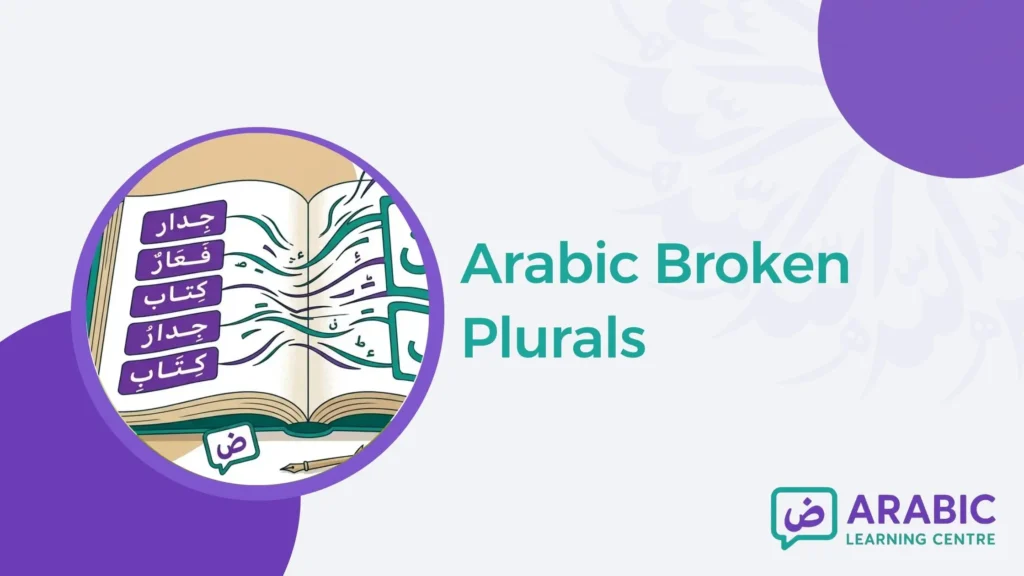
Arabic broken plurals are irregular plural forms in which the internal vowel structure of a word is reshaped around its root consonants, rather than simply adding a suffix. They exist alongside the more predictable sound plurals (جمع المذكر السالم and جمع المؤنث السالم), but broken plurals are far more common in everyday Arabic speech and writing.
Understanding them is non-negotiable for reading Arabic texts, following conversations, or studying the Quran. Once you recognise the underlying consonantal root system and the most frequent patterns, what initially looks like chaos begins to resolve into something learnable — and genuinely logical.
What Are Arabic Broken Plurals and Why Do They Work This Way?
Arabic broken plurals (جمع التكسير — jam’ al-taksīr) are plural forms generated by altering the vowel pattern — and sometimes the consonant structure — of a singular noun or adjective.
The term taksīr literally means “breaking,” which accurately describes what happens: the word’s template is broken apart and rebuilt into a new pattern around the same root consonants.
Arabic builds most of its vocabulary from three-consonant (trilateral) roots. The root ك-ت-ب (k-t-b), for example, carries the meaning of writing.
Singular and plural words derived from this root retain those three consonants but arrange them into different vowel templates — called أوزان (awzān), or “scales” — to signal different grammatical meanings.
This is why كِتَاب (kitāb, “a book”) becomes كُتُب (kutub, “books”). The root consonants ك-ت-ب remain intact; only the vowel template shifts.
Why Broken Plurals Cannot Be Memorised by a Single Rule
Unlike English, where adding “-s” covers the vast majority of plurals, Arabic has approximately 30 established broken plural patterns — and most nouns follow only one of them. There is no universal rule connecting a singular pattern reliably to its plural. Knowing that a word is on the فَاعِل (fā’il) template, for instance, does not tell you definitively which broken plural pattern it will use.
This is the point where many learners feel discouraged. At The Arabic Learning Centre, our Arabic Grammar Course addresses broken plurals systematically — linking each pattern to high-frequency vocabulary so students build productive recognition early rather than trying to memorise every form in isolation.
Start Learning Arabic Grammar with a Free Trial

The Most Important Broken Plural Patterns in Arabic
The most frequently encountered broken plural patterns in Arabic cover the majority of common vocabulary. Mastering the top six to eight patterns gives a learner functional recognition for most Arabic texts and conversations. The table below presents the core patterns with examples.
| Broken Plural Pattern | Singular Example | Plural Form | Meaning |
| أَفْعَال (af’āl) | بَاب (bāb) | أَبْوَاب (abwāb) | doors |
| فُعُول (fu’ūl) | قَلْب (qalb) | قُلُوب (qulūb) | hearts |
| فِعَال (fi’āl) | جَبَل (jabal) | جِبَال (jibāl) | mountains |
| أَفْعُل (af’ul) | نَهْر (nahr) | أَنْهُر (anhur) | rivers |
| فُعَلَاء (fu’alā’) | كَرِيم (karīm) | كُرَمَاء (kuramā’) | generous ones |
| فِعْلَان (fi’lān) | شَابّ (shābb) | شُبَّان (shabbān) | young men |
| أَفْعِلَة (af’ila) | سِلَاح (silāḥ) | أَسْلِحَة (asliḥa) | weapons |
These patterns are not arbitrary. Each belongs to a specific morphological category, and experienced Arabic instructors can often predict the likely plural of an unfamiliar word based on its singular pattern — even if not with certainty.
How the أَفْعَال Pattern Works in Practice?
The أَفْعَال pattern is arguably the single most productive broken plural in Modern Standard Arabic. It applies broadly to singular nouns on the فَعْل (fa’l) and فِعْل (fi’l) templates.
وَقْت (waqt, “time”) → أَوْقَات (awqāt, “times”) شَكْل (shakl, “form”) → أَشْكَال (ashkāl, “forms”)
Once a learner internalises this pattern, they gain immediate recognition across dozens of everyday words — a strong early return on investment for the effort required.
Shots Videos from Our Courses
How Do Arabic Broken Plurals Differ From Sound Plurals?
Broken plurals differ from sound plurals in that they alter the word’s internal structure, while sound plurals simply add a suffix without touching the singular form. This distinction is fundamental to Arabic grammar and shapes how plurals behave grammatically in a sentence.
Sound masculine plurals add ـُونَ (-ūna) in the nominative or ـِينَ (-īna) in the accusative and genitive. Sound feminine plurals add ـَات (-āt). The singular form remains recognisable throughout.
مُعَلِّم (mu’allim, “teacher”) → مُعَلِّمُونَ (mu’allimūn, “teachers”) — sound plural
كِتَاب (kitāb, “book”) → كُتُب (kutub, “books”) — broken plural
The grammatical behaviour of broken plurals adds another layer: broken plurals of non-human nouns are treated as feminine singular for the purposes of verb and adjective agreement.
This is one of the most consistent and learnable rules in Arabic grammar, and it applies regardless of the plural’s own morphological pattern.
So الكُتُبُ الجَدِيدَةُ (al-kutubu al-jadīdah, “the new books”) uses the feminine adjective جَدِيدَةُ, not the masculine جَدِيدُ — even though كِتَاب is grammatically masculine in its singular form.
Students in our Arabic Course for Beginners often find this rule initially counterintuitive, but it becomes automatic with consistent reading practice.
Join Our Arabic Course for Beginners With a Free Trial

Why Do Non-Native Learners Struggle With Broken Plurals?
The core difficulty is that broken plurals must largely be memorised individually, because no single phonological or morphological rule predicts every plural form from its singular with certainty.
At The Arabic Learning Centre, the error pattern we observe most consistently among intermediate learners is applying a sound plural ending to a noun that takes a broken plural — producing forms that are grammatically transparent but unnatural in standard usage.
A learner might say كِتَابَات (kitābāt) instead of the correct كُتُب (kutub). The logic is understandable — the ـَات suffix works reliably for many nouns — but native speakers and classical texts overwhelmingly prefer the broken plural for high-frequency words.
The Role of Frequency in Broken Plural Acquisition
High-frequency vocabulary accelerates acquisition. The broken plurals learners encounter most often — in daily conversation, in the Quran, and in news media — are the ones that consolidate fastest.
Passive exposure matters, but active recall through structured vocabulary practice is what converts recognition into production.
Our Arabic vocabulary course organises vocabulary acquisition around root families and pattern groups, which is why students working through that programme typically consolidate the core broken plural inventory within eight to twelve weeks of consistent study — faster than learners memorising words in isolation.
Enroll in Our Arabic Vocabulary Course to Get Your Free Trial

Types of Arabic Broken Plural
The broken plural in Arabic is divided into four kinds: The Plural of Fewness (جمع القلة), and the Plural of Abundance (جمع الكثرة), What are they?
Arabic broken plurals fall into two main categories: the Plural of Fewness (جمع القلة) and the Plural of Abundance (جمع الكثرة). The Plural of Fewness typically ranges from three to ten and features over 30 distinct patterns, such as “غرفة” to “غرف.”
The Plural of Abundance is used for larger numbers and follows other specific templates, like “بحر” to “أبحر.” These forms enrich Arabic’s linguistic diversity and provide deeper insights into its structure.
1- The Plural of Fewness (جمع القلة)
Plural of paucity is the plural that is not less than three and exceeds ten. This type has many weights and formulas that exceed thirty weights. The well-known standard ones are twenty-three, which are as follows:
A. فُعْل Fu`l:
It is consistent in every masculine singular on the weight of “أَفْعَل” or feminine on the weight of “فَعْلاء” on the condition that the singular in both cases is derived and denotes a color or defect, such as: redأحمر and حمراء: and the plural is حُمْر.
B.
فُعُل Fu`ul:
It is measured in the description that is on the weight of “فَعول” with the meaning of فاعل, such as: patient صَبور, and the plural is صُبُر. This weight is measured in every masculine or feminine quadrilateral noun that has a long vowel before its lam ل, such as: عماد, and the plural is عُمُد.
C. فُعَلFu’l:
It is used in the noun with the pattern “فُعْلَة” such as: room غُرفة and the plural is غُرف, and it is also used in the description with the pattern “فُعْلى” feminine “أفعل” such as: كُبرى and the plural is كُبَر.
D. فِعَلFi’l:
It is used in every complete noun with the pattern “فِعْلة” such as: كسرة and the plural is كِسَر.
E. فُعَلَةFu’lah:
It is used in every description of a rational male with the pattern فاعل with a weak lam ending with يya or وwaw such as: رامٍ and the plural is رُمَاة.
F. فَعَلَةFa’lah:
It is used in every description with the pattern فاعل for a rational male with a sound lam such as: كامل and the plural is كَمَلَة.
G. فَعْلَىFa’la:
It is used in every description that indicates an emergency affliction such as death or pain and includes seven types of weights, which are (فَعِيل -فَعِيل – فَعِل – فاعل – فَيْعَيل – أَفْعَل – فَعْلَان) Example: صريع and the plural صَرْعَى, which is in the weight “فَعِيل “
H. فِعَلَةFi’lah:
It is used in every sound noun with the weight “فُعْل” such as قُرْط and the plural is قِرَطَة.
I.
فُعَّل Fu’a’ll:
It is used in every description with the sound Lam لwith the weight “فاعل” or “فاعلة” such as قاعد and the plural is قُعَّد.
J.
فُعّال fu’aal:
It is used in every description with the sound Lam ل for a masculine with the weight “فاعل” such as صائم and the plural is صُوّام.
K.
فِعَال Fi’aal:
It is used in many weights of words, and examples of this weight include: كلب and the plural is كِلَاب.
L.
فُعُوْلFu’ul:
Such as كَبِد, plural كُبُود.
M.
فِعْلَان Fi’laan:
Such as غُلام, plural غِلْمان.
N.
فُعْلَان Fu’laan:
Such as ظهر, plural ظُهْران, and بلد, plural بُلْدان.
P.
أفْعِلاء Af’ilā:
It is used in every description with the pattern “فعيل” if the lam is weak or doubled, such as: عزيز, plural أعزّاء.
Q.
فَوَاعِل Fawā’il:
It is used in the patterns of the second of which is an extra alif أ or a waw و not attached to the quinqueliteral, and the patterns are: “فاعلة وفَوْعل وفاعِل وفاعِلَاء” such as: جوهر, plural جواهر.
R.
فَعَائِل Fa’a’il:
It is used in every quadrilateral, whether it is a noun or a feminine adjective, verbally or semantically feminine, with a third long vowel, such as: سحابة, plural سحائب.
S. فَعَالِيFa’a’ali:
Such as صحراء, plural صحارٍ.
U.
فَعَالَى Fa’a’ala:
Such as صحراء, plural صَحَارَى, and كسلان, plural كَسَالَى.
V. فَعاَليّFa’a’ali:
It is used in every trilateral with a silent ع, at the end of which is a double ي following the three letters, such as: كرسي, plural كراسي.
W.
فَعَالل Fa’a’alil:
It is used in quadrilateral and quintiliteral, such as: جعفر, plural جعافر, and وسفرجل, plural سفارج.
X.
شبه فَعَالل Semi-Fa`alil:
These are weights for the plural of plurals. These weights are similar to the previous formula “فعالل” in the number of letters and in their sukoon or vowel marking, even if the vowel is different in type between the two, leading to a difference in the morphological weight.
It includes many formulas, including مفاعل, such as منابر, فعائل, such as صحائف, فياعل, such as صيارف, أفاعل, such as أكابر, and فعاعل, such as سلالم.
2- Plural of Abundance (جمع الكثرة)
The plural of paucity is the plural that is not less than three and not more than ten and has four standard weights explained as follows:
A.
أفْعُلAf’ul:
It comes in every singular noun “not an adjective” on the weight of ” فَعْل” with a sound ع and not و and is not doubled, such as: بحر and the plural is أبحر. Likewise, it is measured in every feminine quadrilateral noun with a moral feminization before its last letter with a long vowel; such as: عُقاب and the plural is أعْقُب.
B.
أفْعَالAf’al:
This weight is measured in everything in which the previous weight is not measured; such as: ثوب and the plural is أثواب.
C.
أفْعِلةAf’ilah:
It is standard in every singular noun that is not an adjective, masculine, quadrilateral, and before its last letter is a long vowel; such as: طعام and the plural is أطعمة. Likewise, it is measured in every noun on the weight of: فِعال or فَعَال if the ع and ل of each of them are of the same gender, or its ل is a vowel; Towards: زِمام, plural أزمة, and قباب, plural أقْبِية.
D.
فِعْلَة Fi`lah:
It is limited to hearing, and it has been said about it: It is a collective noun that has no plural; due to its lack of consistency; such as: ولد, plural وِلْدة, and فتى, plural فِتْية.
Broken Plurals in Quranic Arabic
Broken plurals appear throughout the Quran with very high frequency, and accurate recognition is necessary to understand Quranic sentence structure and meaning. Many of the most theologically significant Arabic words appear in their broken plural forms in Quranic verses.
Consider أَنْبِيَاء (anbiyā’, “prophets”), the broken plural of نَبِيّ (nabī’), which follows the أَفْعِيَاء pattern. Or آيَات (āyāt, “signs/verses”), which is a sound feminine plural — worth noting because learners sometimes assume all Quranic plurals are broken.
The key Quranic broken plurals a learner should prioritise include:
- قُلُوب (qulūb, “hearts”) — from قَلْب
- أَنْفُس (anfus, “souls/selves”) — from نَفْس
- أَيَّام (ayyām, “days”) — from يَوْم
- عُلَمَاء (‘ulamā’, “scholars”) — from عَالِم
For learners whose primary goal is Quranic comprehension, our Quranic Arabic Course addresses broken plurals specifically within the context of Quranic vocabulary and sentence structure — a more targeted approach than a general grammar curriculum alone.
Join Our Quranic Arabic Course With a Free Trial

You can also build a strong foundation through our supporting resource: learn Quranic vocabulary — which organises high-frequency Quranic words by root, making broken plural recognition part of vocabulary learning from the outset.
Read Aldo: Arabic Attached Pronouns
Practical Strategies for Memorising Arabic Broken Plurals
The most effective method for memorising Arabic broken plurals combines pattern recognition with root-based vocabulary grouping, reinforced through reading authentic Arabic texts regularly. No single technique works in isolation — the learners who consolidate these forms fastest use at least three complementary approaches simultaneously.
1. Learning Plurals Alongside Their Singulars From Day One
Never learn a new Arabic noun without simultaneously learning its plural. This is non-negotiable. A vocabulary entry for بَيْت (bayt, “house”) is incomplete without بُيُوت (buyūt, “houses”).
Treating both forms as a single vocabulary unit from the outset eliminates the need for a separate “plural review” phase later.
2. Grouping Words by Broken Plural Pattern
Once you know that أَبْوَاب (abwāb), أَوْقَات (awqāt), and أَشْكَال (ashkāl) all follow the أَفْعَال pattern, you have a retrieval cluster. Adding new words that fit this pattern becomes progressively easier because the template is already encoded.
This is pattern-based memorisation, and it reflects how Arabic itself organises morphological knowledge.
Read Also: Types of Verbs in Arabic
3. Reading Authentic Texts — Not Just Flashcards
Flashcard systems accelerate initial memorisation, but broken plurals only consolidate into long-term productive knowledge through reading.
Arabic news (such as Al-Jazeera Arabic), Quranic commentary, and graded readers all provide the contextual repetition that converts recognition into automatic recall.
Our how to learn Arabic guide expands on building a sustainable reading habit for non-native learners at every level.
Our Students Reviews
Read Also: Connecting Arabic Letters Practice
Begin Mastering Arabic Grammar With Certified Instructors at The Arabic Learning Centre
Arabic broken plurals are one of the most rewarding grammar topics to master — because once the patterns click, your vocabulary comprehension expands dramatically.
The Arabic Learning Centre offers:
- Certified native Arabic instructors with years of teaching non-native speakers
- 1-on-1 personalised sessions tailored to your level and goals
- Flexible 24/7 scheduling to fit any time zone
- Free trial lesson — no commitment required
Whether you are starting from scratch or working to sharpen your grammar, our Arabic Grammar Course and Arabic Course for Beginners provide the structured, expert-guided environment where broken plurals — and Arabic grammar broadly — finally become manageable.
Explore our Arabic Grammar Course or start with our beginners’ programme today.
Check out our top courses in Arabic and choose the course you need to start learning Arabic today:
- Arabic Course for Beginners
- Arabic Script Writing Course
- Arabic Speaking Course
- Learn Arabic Letters for Tajweed
- Learning Arabic Grammar
- Arabic Vocabulary Course
- Fusha Arabic Course
- Classical Arabic Course
- Arabic Course for Islamic Studies
- Quranic Arabic Course
- Learn Arabic for New Muslims
Start with a FREE trial class and enhance your Arabic language skills

Conclusion
Arabic broken plurals follow recognisable patterns built on the root-and-template system at Arabic’s core. The أَفْعَال, فُعُول, and فِعَال patterns alone cover an enormous share of the vocabulary non-native learners encounter daily.
The grammar rule that non-human broken plurals take feminine singular agreement is consistent and learnable — and applying it correctly immediately elevates a learner’s written and spoken Arabic to a noticeably higher register.
Consistent exposure to authentic Arabic texts, combined with learning singulars and plurals together as paired units, produces faster consolidation than any amount of isolated drilling. The patterns reward the effort invested.
Read Also: Tenses in Arabic
Frequently Asked Questions About Arabic Broken Plurals
What Is the Difference Between a Broken Plural and a Sound Plural in Arabic?
A broken plural reshapes a noun’s internal vowel structure around its root consonants, producing a form that looks significantly different from the singular. A sound plural simply adds a suffix — ـُونَ / ـِينَ for masculine or ـَات for feminine — without altering the singular form. Broken plurals are more common for non-human nouns; sound plurals are standard for human agent nouns and loanwords.
How Many Broken Plural Patterns Are There in Arabic?
Classical Arabic grammar scholarship identifies approximately 30 broken plural patterns, though some sources list more when accounting for rare or archaic forms. For practical purposes, mastering the ten most frequent patterns — including أَفْعَال, فُعُول, فِعَال, and أَفْعِلَة — gives non-native learners functional recognition for the overwhelming majority of vocabulary they will encounter in Modern Standard Arabic and Quranic texts.
Do Broken Plurals Affect Verb Agreement in Arabic?
Yes — this is one of the most important grammatical consequences of broken plurals. Broken plurals referring to non-human nouns (objects, animals, abstract concepts) are treated as feminine singular for purposes of verb and adjective agreement. This means verbs preceding them take the third-person feminine singular form, and adjectives following them use the feminine singular pattern, regardless of the noun’s gender in its singular form.
Can I Predict a Broken Plural From the Singular Form?
Partially. Experienced learners can make educated predictions based on a noun’s singular pattern, and certain singular patterns strongly favour specific plural forms. However, no rule predicts every broken plural with certainty — Arabic has genuine exceptions and competing patterns. The standard guidance from Arabic grammarians and experienced instructors is to learn each noun’s plural alongside its singular rather than relying entirely on pattern-based inference.
Are Broken Plurals Used in Spoken Arabic Dialects?
Yes — broken plurals are central to all major Arabic dialects, including Egyptian, Levantine, Gulf, and Moroccan Arabic. The specific plural forms sometimes differ from Modern Standard Arabic, but the underlying root-and-template system is the same. Learners who master broken plurals in MSA find that dialectal plurals become considerably easier to acquire, because the morphological logic is already internalised. Our resource on how to speak Arabic covers how MSA grammar foundations support dialect acquisition.
Related Articles
Arabic Alphabet & Writing