 Arabic Grammar
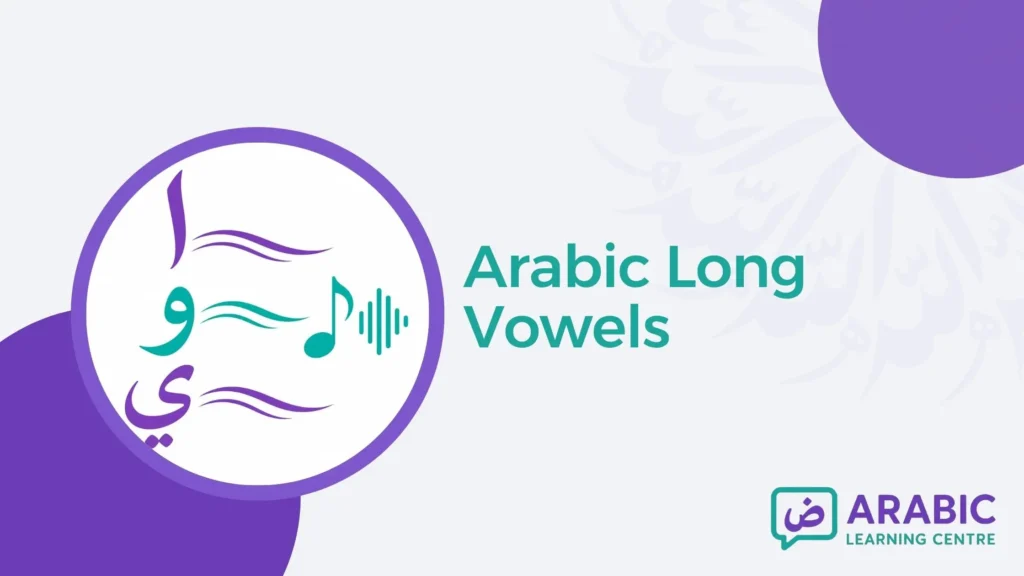
Long vowels are an important part of Arabic pronunciation because they show when a vowel sound should be stretched. Without understanding them, beginners may read Arabic words too quickly or pronounce them incorrectly.
In Arabic, long vowels are written as full letters inside the word, not as small marks above or below letters. The three main long vowel letters are ا, و, and ي.
What Are Arabic Long Vowels?
Arabic long vowels are letters that extend the sound of a short vowel before them. They are sometimes called حروف المد because they create a lengthened sound in pronunciation.
The three long vowel letters are:
| Arabic Letter | Sound | Common English-Like Sound |
| ا | long aa | like “aa” |
| و | long oo / uu | like “oo” in “moon” |
| ي | long ee / ii | like “ee” in “see” |
For example, باب is pronounced baab, not bab. The ا stretches the sound and makes it longer.
The Three Long Vowel Letters In Arabic
The Arabic language has three main letters that work as long vowels. Each one is connected to a specific stretched sound.
These letters are not optional pronunciation marks. They are part of the written word, which means removing or ignoring them can affect spelling, pronunciation, and sometimes meaning.
Alif ا For The Long Aa Sound
Alif ا is used to stretch the a sound. It usually comes after a letter that has an a sound before it.
Examples:
باب
baab
door
كتاب
kitaab
book
قال
qaal
he said
In these words, Alif does not create a new consonant sound. Its role is to lengthen the vowel before it.
Waw و For The Long Oo Sound
Waw و can work as a long vowel when it stretches the u / oo sound. In this case, it is not pronounced like the English w.
Examples:
نور
noor
light
سوق
sooq
market
دروس
doroos
lessons
Here, the letter و makes the sound longer and smoother. This is why learners should not pronounce it too quickly.
Build Strong Arabic Foundations Before Reaching Advanced Levels
Before moving into advanced Arabic grammar, classical texts, and professional-level language use, learners need a strong foundation in pronunciation. Mastering Arabic long vowels helps you read accurately, speak more naturally, and understand word patterns with greater confidence.
With the Advanced Arabic Course at Arabic Learning Centre, you can build on this foundation and develop higher-level Arabic skills, from complex grammar to literary analysis and academic reading.
Join the Advanced Arabic Course today and take your Arabic from clear pronunciation to true language mastery.
Ya ي For The Long Ee Sound
Ya ي can work as a long vowel when it stretches the i / ee sound. In this role, it is not pronounced like the English y at the beginning of a word.
Examples:
كبير
kabeer
big
جميل
jameel
beautiful
قريب
qareeb
near
In these words, ي extends the vowel sound and helps the word flow correctly.
How Long Vowels Work In Arabic Words
Long vowels usually come after a matching short vowel sound. This means the sound before the long vowel prepares the pronunciation.
A simple way to understand it is:
- ا stretches an a sound.
- و stretches a u / oo sound.
- ي stretches an i / ee sound.
For example:
بَ = ba
با = baa
بُ = bu
بو = boo
بِ = bi
بي = bee
The difference is mainly the length of the sound. The long form should be held longer when reading.
Why Long Vowels Matter In Arabic Reading
Long vowels help learners read Arabic words correctly because they are part of the word’s structure. If a learner skips them, the word may sound weak, unclear, or even different.
They also help beginners recognize common Arabic patterns. Once you notice ا, و, and ي inside words, you start reading more fluently and pronouncing words more naturally.
For example:
كتاب
kitaab
book
If the long aa sound is shortened too much, the word does not sound natural.
Long Vowels Compared With Short Vowel Sounds
The focus here is on long vowels, but a small comparison helps make the idea clearer. Short vowels are quick sounds, while long vowels are stretched sounds written with full letters.
Short vowels are usually marks like َ, ُ, and ِ. Long vowels are actual letters: ا, و, and ي. This is one of the main differences between them.
Example:
بَ
ba
short sound
با
baa
long sound
So the learner should not only look at the letter, but also listen to how long the sound is.
Build A Strong Arabic Foundation As A Non-Arabic Speaker
Arabic long vowels are one of the first pronunciation skills non-Arabic speakers need to master because they affect reading accuracy, word meaning, and speaking confidence. Through Arabic Classes for Non-Arabic Speakers at Arabic Learning Centre, beginners can learn Arabic sounds, letters, vowels, grammar, and sentence structure step by step with clear guidance.
Join Arabic Classes for Non-Arabic Speakers today and start reading Arabic long vowels with accuracy and confidence.
Shots Videos from Our Courses
When Waw And Ya Are Not Long Vowels
The letters و and ي do not always work as long vowels. Sometimes they work as normal consonants.
For example:
ولد
walad
boy
Here, و sounds like w, not a long vowel.
Another example:
يد
yad
hand
Here, ي sounds like y, not a long vowel.
This means learners should understand the word context and listen carefully to pronunciation.
Common Mistakes With Long Vowels
Beginners often make mistakes because ا, و, and ي can be simple letters in the alphabet, but they can also stretch sounds in words.
The most common mistake is reading the long vowel too quickly. For example, نور should sound like noor, not nur.
Another mistake is treating و and ي as consonants every time. In words like نور and كبير, they are long vowels, not normal w or y sounds.
How To Practice Long Vowels
The best way to practice long vowels is to read short words slowly and stretch the sound clearly. Start with simple words, then repeat them until the difference becomes natural.
Practice groups like:
باب — كتاب — قال
for the long aa sound.
نور — سوق — دروس
for the long oo sound.
كبير — جميل — قريب
for the long ee sound.
Reading aloud is important because long vowels are not only a spelling rule. They are mainly a pronunciation skill.
Read Also: Arabic Short Vowels With Examples
Our Students Reviews
Read Also: Definite Articles – The In Arabic
Improve Your Arabic Pronunciation With Guided Long Vowel Practice
Now that you understand how Arabic long vowels (ا، و، ي) work and why they matter for correct pronunciation and smooth reading, the next step is turning this knowledge into real speaking and reading skills.
At the Arabic Learning Centre, you don’t just learn rules—you practice them the right way. Their structured lessons help you clearly hear the difference between short and long vowels, pronounce words naturally, and build strong reading fluency step by step.
Instead of guessing whether a word should be ba or baa, nur or noor, you’ll train your ear and tongue through guided practice with experienced instructors. This makes a huge difference, especially for beginners who want to avoid common pronunciation mistakes early on.
Start your Arabic learning journey today with Arabic Learning Centre and turn Arabic long vowels into clear, confident pronunciation.
Courses We Offer:
- Online Arabic Classes for Kids
- Arabic Words for Kids
- Arabic Lessons for Kindergarten
- Arabic Elementary School
- Arabic Intermediate School
- Arabic High School
Conclusion
Arabic Long Vowels are the three letters ا, و, and ي when they are used to stretch vowel sounds inside Arabic words. They are full letters, not small marks, and they are essential for correct pronunciation and fluent reading.
Alif ا gives the long aa sound, Waw و gives the long oo sound, and Ya ي gives the long ee sound. Once learners understand these three letters, Arabic reading becomes clearer and easier.
Read Also: Arabic Hollow Verbs
Frequently Asked Questions
What Are Arabic Long Vowels?
Arabic long vowels are the letters ا, و, and ي when they stretch sounds inside words. They create long aa, oo, and ee sounds.
What Is The Long Aa Sound In Arabic?
The long aa sound is usually represented by ا. For example, باب is pronounced baab.
What Is The Long Oo Sound In Arabic?
The long oo sound is usually represented by و. For example, نور is pronounced noor.
What Is The Long Ee Sound In Arabic?
The long ee sound is usually represented by ي. For example, كبير is pronounced kabeer.
Are Long Vowels Written As Full Letters?
Yes. Long vowels are written as full Arabic letters inside the word, unlike short vowels, which are written as small marks.
Can Waw And Ya Be Consonants Too?
Yes. و can sound like w, as in ولد, and ي can sound like y, as in يد. They become long vowels only when they stretch the sound before them.