 Arabic Vocabulary & Speaking
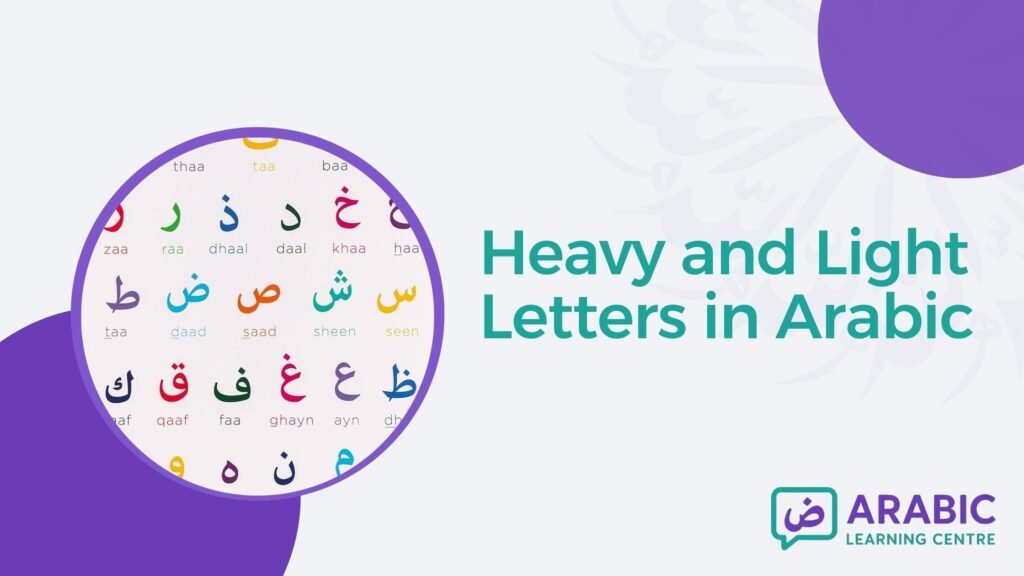
| Key Takeaways |
| Arabic has 7 heavy letters called huroof al-tafkheem, pronounced with the back of the tongue raised toward the palate. |
| The 7 heavy letters in Arabic are: خ، ص، ض، ط، ظ، غ، ق — memorised by scholars using the phrase خُصَّ ضَغْطٍ قِظ. |
| Light letters (huroof al-tarqeeq) use the front of the tongue and mouth cavity, producing a thin, forward sound. |
| Consistent daily practice of makhraj (articulation point) exercises is the most reliable method for mastering heavy letter pronunciation. |
Heavy and light letters in Arabic are one of the most consequential distinctions a learner must master. The Arabic alphabet divides into two phonetic categories: huroof al-tafkheem (heavy or full-mouth letters) and huroof al-tarqeeq (light or empty-mouth letters). Getting this distinction right is not optional — it separates intelligible Arabic from Arabic that native speakers misunderstand entirely.
The stakes are practical. A beginner who pronounces ط (heavy) like ت (light) will produce words that confuse, offend, or simply fail to communicate. If you are building your Arabic from the ground up, understanding the Arabic alphabet through the lens of tafkheem and tarqeeq gives you one of the fastest pronunciation upgrades available.
What Are Heavy and Light Letters in Arabic?
Heavy letters in Arabic (حروف التفخيم — huroof al-tafkheem) are letters pronounced with the back of the tongue elevated toward the soft palate, filling the mouth cavity with a deep, resonant sound. Light letters (حروف الترقيق — huroof al-tarqeeq) are produced with the tongue lying flat and the sound projecting forward and thinly through the front of the mouth.
This distinction comes directly from the classical science of Tajweed and Nahw scholarship. Every Arabic phonetician from Al-Khalil ibn Ahmad al-Farahidi onward has documented this binary division as structurally essential to the language.
The terms tafkheem (تفخيم) and tarqeeq (ترقيق) translate literally as “fattening” and “thinning” — which describes exactly what happens inside the mouth. Heavy letters feel full. Light letters feel narrow.
Shots Videos from Our Courses
What Are the 7 Heavy Letters in Arabic (Huroof Al-Tafkheem)?
The 7 heavy letters in Arabic are memorised through the classical mnemonic phrase:
خُصَّ ضَغْطٍ قِظ
Khussha Daghthin Qidh
This phrase contains all seven letters with no additions:
| Letter | Name | Transliteration |
| خ | Kha | kh |
| ص | Saad | ṣ |
| ض | Daad | ḍ |
| ط | Taa (heavy) | ṭ |
| ظ | Dhaa (heavy) | ẓ |
| غ | Ghayn | gh |
| ق | Qaaf | q |
These seven are always heavy — their tafkheem does not depend on the surrounding vowels or context.
At The Arabic Learning Centre, our Arabic Pronunciation Course addresses each of these letters individually, with targeted makhraj training in 1-on-1 sessions so students build the muscle memory that classroom drilling alone rarely achieves.
Begin Pronouncing Arabic Fluently with a Free Trial

How to Pronounce Heavy Letters in Arabic?
How to pronounce heavy letters in Arabic begins with understanding makhraj — the precise articulation point, or “exit point,” of each sound. Heavy letters activate the back and middle of the oral cavity, while light letters activate the front.
Here is the makhraj breakdown for each of the 7 heavy letters:
Where Is the Articulation Point for خ (Kha)?
خ is produced at the back of the mouth where the soft palate meets the throat. The tongue pulls back, the throat opens, and air passes with friction. This is the same region activated by the German ch in Bach — though the Arabic خ sits slightly further back.
Example:
خَبَر khabar “News”
Where Is the Articulation Point for ص، ض، ط، ظ?
These four letters share a defining feature: they are emphatic (مُفَخَّمة) versions of their lighter counterparts س، د، ت، ذ. The tongue presses against the upper teeth or alveolar ridge exactly as it does for the light version — but the back of the tongue simultaneously rises, hollowing the front of the mouth and projecting sound backward.
| Heavy Letter | Light Counterpart | Difference |
| ص (Saad) | س (Seen) | Back tongue raised; deep resonance |
| ض (Daad) | د (Dal) | Side of tongue presses upper molars |
| ط (Taa heavy) | ت (Taa light) | Back tongue raised; fuller cavity |
| ظ (Dhaa heavy) | ذ (Dhal light) | Back tongue raised; thick interdental |
Example — heavy vs. light minimal pair:
طَالِب — ṭālib — “Student” (heavy ط) تَالِي — tālī — “Following” (light ت)
Where Is the Articulation Point for غ (Ghayn) and ق (Qaaf)?
غ is produced in the uvular region — slightly further forward than خ — with vibration of the uvula. It carries the quality of a voiced gargling sound and is among the letters students at The Arabic Learning Centre spend the most additional time on.
ق is a full stop produced by the back of the tongue pressing firmly against the soft palate, then releasing. Unlike ك (Kaaf), which is produced further forward, ق resonates deeply from the throat.
Example:
قَلْب qalb “Heart”
Compare this to كَلْب (kalb, “dog”) — one letter, different articulation point, entirely different meaning.
What Are Light Letters in Arabic (Huroof Al-Tarqeeq)?
Light letters in Arabic are all letters of the Arabic alphabet that are not among the 7 heavy ones. They are produced with the tongue flat and the sound flowing forward through a comparatively narrow oral cavity.
The remaining 21 letters — including ب، ت، ث، ج، د، ذ، ر، ز، س، ش، ف، ك، ل، م، ن، و، هـ، ي، ء، ح، ع — are light by default.
However, three letters carry a conditional status worth understanding:
| Letter | Normally | Condition for Heaviness |
| ر (Ra) | Can be heavy OR light | Heavy when vowelled with Fatha or Dhamma; light when vowelled with Kasra |
| ل (Lam) | Light | Becomes heavy only in the word اللَّه (Allah) when preceded by Fatha or Dhamma |
| أ (Alif) | Follows preceding letter | Takes the quality of the letter before it |
This conditional behaviour of ر and the لام الجلالة (Lam of the word Allah) is a topic that Tajweed scholars — including Ibn al-Jazari in his seminal work Al-Muqaddimah Al-Jazariyyah — addressed with precision.
Understanding how harakat in Arabic affect pronunciation is inseparable from mastering this conditional switching.
Read also: Arabic Noun Patterns
How Do Full Mouth Letters in Arabic Differ from Empty Mouth Letters?
Full mouth heavy letters in Arabic produce a sound that resonates throughout the entire oral cavity. The technical description in Arabic phonetics is that the mouth feels “full” because the back of the tongue rises, compressing the air space and amplifying low-frequency resonance.
Empty mouth letters — the light letters — produce sound that exits toward the front teeth and lips. The mouth cavity is comparatively “empty” because the tongue lies low and does not redirect sound backward.
A useful physical exercise: pronounce the English word “ball” — your mouth feels full. Now pronounce “bill” — the sound sits at the front. This is the closest English approximation of the tafkheem/tarqeeq distinction, though Arabic carries this contrast further than English ever does.
For learners who also want to read and understand Arabic harakat, this full/empty distinction becomes even clearer when vowel marks are visible — because the accompanying vowel visually signals how the cavity should feel.
Why Does Mispronouncing Heavy Letters in Arabic Change Meaning?
Confusing heavy and light Arabic letters is not a minor accent issue — it produces genuine miscomprehension. Arabic is a root-based language where a single phoneme change shifts the root entirely.
Consider these commonly confused pairs:
| Heavy Pronunciation | Meaning | Light Mistaken Version | Meaning |
| صَبَر (ṣabar) | Patience | سَبَر (sabar) | To probe/test |
| ضَرَب (ḍaraba) | He struck | دَرَبَ (daraba) | He trained |
| طَلَب (ṭalaba) | He requested | تَلَبَ — not a standard root | Meaningless |
At The Arabic Learning Centre, our certified instructors observe that learners coming from European language backgrounds — particularly French and Spanish speakers — conflate ص with س, and ط with ت, in nearly every intake assessment.
The fix is not more listening but targeted makhraj drilling: repeating the letter in isolation, then in CV syllables (consonant + vowel), then in full words.
This three-stage process produces measurable improvement within two to three weeks of consistent practice.
If you are working to build accurate pronunciation from the foundation, our Arabic Course for Beginners is specifically structured around articulation-point training for non-native speakers.
Join Our Arabic Course for Beginners With a Free Trial
Practical Exercises to Master Tafkheem Letters in Arabic
Tafkheem letters in Arabic are best internalized through physical awareness exercises, not passive listening alone. The following sequence is used by our certified instructors at The Arabic Learning Centre:
Exercise 1 — Mirror Jaw Drop Technique
Place a mirror in front of your face. Pronounce ق and observe whether your jaw drops noticeably and the back of your mouth opens. If your jaw stays flat, the letter is not being produced at the correct makhraj. Repeat ten times until the jaw drop becomes automatic.
Exercise 2 — Minimal Pair Contrast Drilling
Select a heavy/light minimal pair — for example, ص and س. Alternate between them slowly:
سَالِم / صَالِح sālim / ṣāliḥ “Safe” / “Righteous”
Feel where each sound sits in your mouth. Write down the difference in physical sensation. This metacognitive awareness is what separates learners who plateau from learners who progress.
Exercise 3 — Vowel-Context Practice
Practise each heavy letter with all three short vowels — Fatha (—َ), Kasra (—ِ), Dhamma (—ُ) — because the heaviness must be maintained regardless of vowel context.
طَ، طِ، طُ ṭa, ṭi, ṭu
Understanding what sukoon in Arabic does to these letters — removing the vowel entirely and leaving the consonant “bare” — is the next level of this exercise. A sukoon-marked heavy letter still carries full tafkheem.
Our Students Reviews
Read also: Dual Nouns in Arabic
Start Mastering Arabic Pronunciation with Certified Instructors at The Arabic Learning Centre
Understanding the distinction between heavy and light Arabic letters is the foundation of correct pronunciation. Without this, every word you produce carries an accent that native speakers immediately detect.
The Arabic Learning Centre offers:
- 1-on-1 sessions with certified native Arabic instructors
- Structured makhraj training from day one
- Flexible scheduling available 24/7
- A free trial lesson to begin immediately
Whether you are learning Arabic from scratch or correcting pronunciation habits formed without proper guidance, our Arabic Course for Beginners and Arabic Pronunciation Course provide the structured, expert-led environment where tafkheem and tarqeeq become natural — not theoretical.
Check out our top courses in Arabic and choose the course you need to start learning Arabic today:
- Arabic Course for Beginners
- Arabic Script Writing Course
- Arabic Speaking Course
- Learn Arabic Letters for Tajweed
- Learning Arabic Grammar
- Arabic Vocabulary Course
- Fusha Arabic Course
- Classical Arabic Course
- Arabic Course for Islamic Studies
- Quranic Arabic Course
- Learn Arabic for New Muslims
Start with a FREE trial class and enhance your Arabic language skills

Conclusion
Mastering the 7 heavy letters in Arabic — خ، ص، ض، ط، ظ، غ، ق — requires more than memorization. It requires physical awareness of where sound is produced in the mouth and consistent practice under qualified guidance.
The light letters of Arabic provide the contrast that makes heavy letters audible. Training your ear and your articulation point to distinguish these two groups is one of the highest-return investments a beginner can make.
Insha’Allah, with structured daily practice and accurate guidance, the distinction between tafkheem and tarqeeq moves from conscious effort to automatic habit — and that is the point where Arabic truly begins to flow.
Frequently Asked Questions About Heavy and Light Letters in Arabic
What Are the 7 Heavy Letters in Arabic?
The 7 heavy letters in Arabic are خ، ص، ض، ط، ظ، غ، ق, traditionally memorised through the mnemonic phrase خُصَّ ضَغْطٍ قِظ. These letters are always pronounced with the back of the tongue raised toward the soft palate, producing a deep, full-mouth resonance regardless of the surrounding vowels or word context.
What Does Tafkheem Mean in Arabic Pronunciation?
Tafkheem (تفخيم) means “fattening” or “heaviness” in the context of Arabic phonetics. It refers to the manner of producing a letter with the back of the tongue elevated, which fills the oral cavity with resonance. Its opposite, tarqeeq (ترقيق), means “thinning” — the default mode of all non-heavy Arabic letters, produced with the tongue lying flat.
Does the Letter Ra (ر) Count as a Heavy or Light Letter in Arabic?
ر (Ra) is conditional. It is pronounced heavy (tafkheem) when it carries a Fatha or Dhamma vowel, or when it is sukoon-marked and preceded by a Fatha or Dhamma. It is pronounced light (tarqeeq) when it carries or is preceded by a Kasra vowel. This conditional switching is documented in classical Tajweed scholarship and is a key topic in any serious Arabic pronunciation curriculum.
Why Is Learning Heavy Letters Important for Quranic Arabic?
In Quranic recitation, mispronouncing a heavy letter as light — or vice versa — constitutes a lahn (لَحْن), a recitation error. Classical Tajweed scholars classified this as lahn jali (manifest error) when it changes meaning, and lahn khafi (hidden error) when it distorts phonetic rules without altering the apparent meaning. For learners focused on Quranic Arabic, accurate tafkheem is not optional.
Related Articles
Arabic Vocabulary & Speaking