 Arabic Grammar
| Key Takeaways |
| Arabic demonstrative pronouns change form based on the gender, number, and distance of the noun they point to. |
| The two core near demonstratives are هَذَا (hādhā) for masculine and هَذِهِ (hādhihi) for feminine singular nouns. |
| Far demonstratives ذَلِكَ (dhālika) and تِلْكَ (tilka) indicate objects or people at a distance from the speaker. |
| Arabic demonstrative pronouns always precede a definite noun and must agree with it in gender but not always in number. |
| Dual and plural demonstrative forms exist and follow predictable patterns once the singular forms are mastered. |
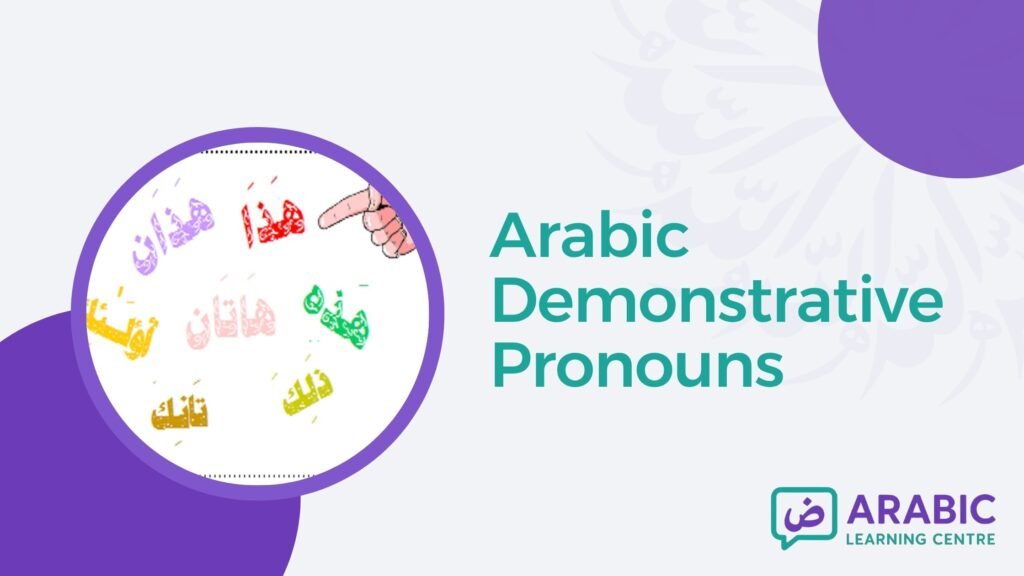
Arabic demonstrative pronouns are words that point to a specific person, object, or idea — equivalent to “this,” “that,” “these,” and “those” in English. In Arabic, they change form based on three factors: grammatical gender (masculine or feminine), number (singular, dual, or plural), and proximity (near or far).
Every Arabic learner needs these forms early, because they appear constantly in spoken conversation, written Modern Standard Arabic (Fusha), and Quranic text.
What makes them slightly more challenging than their English equivalents is the gender agreement rule. Arabic nouns carry grammatical gender, and the demonstrative pronoun must match that gender precisely.
What Are Demonstrative Pronouns in Arabic?
Arabic demonstrative pronouns (أسماء الإشارة — asmāʾ al-ishāra) are a category of noun in the Arabic grammatical system (النحو — al-Nahw) that point to something specific. They agree with the gender of the noun they modify and vary depending on whether the object is near or far.
Unlike English, Arabic has separate forms for masculine and feminine, making gender recognition foundational to using them correctly.
In classical Nahw scholarship, أسماء الإشارة are classified as a subset of definite nouns, which is why they always refer to something identifiable.
When you say هَذَا الكِتَابُ (hādhā al-kitābu — “this book”), both the demonstrative and the noun are treated as definitively identified in the discourse.
Understanding this connection to definiteness helps learners avoid a common early error: pairing a demonstrative with an indefinite noun. We will address that directly in the section on sentence structure below.
If you are just beginning your study of Arabic grammar, our Arabic Grammar Course at The Arabic Learning Centre introduces these foundational concepts through structured, one-on-one sessions with certified instructors — ensuring you build the right habits from day one.
Start Learning Arabic Grammar with a Free Trial

Near Demonstrative Pronouns in Arabic: “This” and “These”
Near demonstrative pronouns in Arabic refer to something close to the speaker — equivalent to “this” (singular) and “these” (plural) in English. The singular near forms are هَذَا (hādhā) for masculine nouns and هَذِهِ (hādhihi) for feminine nouns.
These two forms are among the first demonstratives every learner encounters and, in our instructors’ experience at The Arabic Learning Centre, they are the ones that students use most frequently in early conversation practice.
A. Singular Near Demonstratives: هَذَا and هَذِهِ
| Pronoun | Transliteration | Meaning | Used With |
| هَذَا | hādhā | This | Masculine singular nouns |
| هَذِهِ | hādhihi | This | Feminine singular nouns |
Masculine singular example:
هَذَا كِتَابٌ
hādhā kitābun
This is a book.
هَذَا الطَّالِبُ مُجْتَهِدٌ
hādhā al-ṭālibu mujtahidun
This student is hardworking. (masculine)
Feminine singular example:
هَذِهِ مَدْرَسَةٌ
hādhihi madrasatun
This is a school.
هَذِهِ الطَّالِبَةُ مُجْتَهِدَةٌ
hādhihi al-ṭālibatu mujtahidatun
This student is hardworking. (feminine)
Notice that feminine Arabic nouns typically end in ة (tāʾ marbūṭa). Recognizing this ending is the fastest way to select the correct demonstrative.
For a deeper understanding of how Arabic noun endings work, our guide on harakat in Arabic explains the short vowel system that governs these endings in full detail.
B. Plural Near Demonstrative: هَؤُلَاءِ
For human beings (rational beings — العقلاء, al-ʿuqalāʾ) in the plural, Arabic uses هَؤُلَاءِ (hāʾulāʾi) — meaning “these people.”
هَؤُلَاءِ الطُّلَّابُ مُجْتَهِدُونَ
hāʾulāʾi al-ṭullābu mujtahidūna
These students are hardworking.
For non-human plurals (objects, animals, abstract concepts), Arabic grammar treats them as feminine singular — a rule that surprises most learners. So “these books” uses هَذِهِ (feminine singular), not a separate plural form.
هَذِهِ الكُتُبُ مُفِيدَةٌ
hādhihi al-kutubu mufīdatun
These books are useful.
This rule — that non-human plurals behave grammatically as feminine singular — is one of the most counterintuitive aspects of Arabic grammar for English speakers.
Our article on Arabic broken plurals covers noun pluralization in detail, which directly affects how you apply this demonstrative agreement rule.
Shots Videos from Our Courses
Far Demonstrative Pronouns in Arabic: “That” and “Those”
Far demonstrative pronouns in Arabic indicate something at a distance from the speaker. The masculine singular form is ذَلِكَ (dhālika — “that”) and the feminine singular is تِلْكَ (tilka — “that”).
These correspond to the English “that” and “those” and follow the same gender agreement rules as the near forms.
A. Singular Far Demonstratives: ذَلِكَ and تِلْكَ
| Pronoun | Transliteration | Meaning | Used With |
| ذَلِكَ | dhālika | That | Masculine singular nouns |
| تِلْكَ | tilka | That | Feminine singular nouns |
Masculine far example:
ذَلِكَ الرَّجُلُ مُعَلِّمٌ
dhālika al-rajulu muʿallimun
That man is a teacher.
Feminine far example:
تِلْكَ السَّيَّارَةُ جَدِيدَةٌ
tilka al-sayyāratu jadīdatun
That car is new.
B. Plural Far Demonstrative: أُولَئِكَ
For human beings in the plural at a distance, Arabic uses أُولَئِكَ (ūlāʾika — “those people”).
أُولَئِكَ الأَطْفَالُ مُؤَدَّبُونَ
ūlāʾika al-aṭfālu muʾaddabūna
Those children are well-mannered.
As with near plural demonstratives, non-human plurals at a distance take the feminine singular form تِلْكَ.
تِلْكَ البُيُوتُ قَدِيمَةٌ
tilka al-buyūtu qadīmatun
Those houses are old.
Whether you are an absolute beginner or building on existing knowledge, our Arabic Course for Beginners provides the systematic foundation to progress with confidence. Book your free trial lesson today.
Join Our Arabic Course for Beginners With a Free Trial
The Complete Arabic Demonstrative Pronouns Table
Having all forms in one reference point helps learners see the full pattern clearly. Study this table alongside the examples above.
| Category | Masculine | Feminine | Transliteration (M / F) | Meaning |
| Near — Singular | هَذَا | هَذِهِ | hādhā / hādhihi | This |
| Near — Dual | هَذَانِ | هَاتَانِ | hādhāni / hātāni | These two |
| Near — Plural (human) | هَؤُلَاءِ | هَؤُلَاءِ | hāʾulāʾi | These (people) |
| Far — Singular | ذَلِكَ | تِلْكَ | dhālika / tilka | That |
| Far — Dual | ذَانِكَ | تَانِكَ | dhānika / tānika | Those two |
| Far — Plural (human) | أُولَئِكَ | أُولَئِكَ | ūlāʾika | Those (people) |
Read also: Arabic Subject Pronouns
How to Use Arabic Demonstrative Pronouns in Sentences?
Arabic demonstrative pronouns function in two main sentence patterns, and confusing them is one of the most consistent errors students make in early grammar study.
Pattern 1: Demonstrative + Definite Noun (Noun Phrase)
When a demonstrative pronoun modifies a definite noun (a noun with ال — the definite article), the result is a noun phrase meaning “this/that [noun].”
هَذَا الوَلَدُ = “this boy” (noun phrase, not a complete sentence)
The noun carries the definite article ال, and the demonstrative precedes it. For a full understanding of how the definite article operates in Arabic, see our guide on definite articles in Arabic.
Pattern 2: Demonstrative + Indefinite Noun (Nominal Sentence)
When the demonstrative is followed by an indefinite noun (no ال), the result is a complete nominal sentence (jumlah ismiyyah) with implied “is/are.”
هَذَا كِتَابٌ = “This is a book.” (complete sentence)
The absence of ال on the second noun signals that this is a full predicate sentence. This distinction is taught in classical Nahw as the difference between المبتدأ والخبر (al-mubtadaʾ wa-l-khabar — subject and predicate) and a simple noun phrase.
Our article on verbal sentences in Arabic covers related sentence construction principles that complement this understanding.
Dual Demonstrative Pronouns in Arabic
Dual demonstratives point to exactly two items. They are هَذَانِ (hādhāni — masculine) and هَاتَانِ (hātāni — feminine) for near reference, and ذَانِكَ (dhānika) and تَانِكَ (tānika) for far reference.
هَذَانِ الكِتَابَانِ مُفِيدَانِ
hādhāni al-kitābāni mufīdāni
These two books are useful.
هَاتَانِ الطَّالِبَتَانِ مُجْتَهِدَتَانِ
hātāni al-ṭālibatāni mujtahidatāni
These two (female) students are hardworking.
Our Arabic Course for Kids gives dedicated attention to these classical grammatical forms within their simple Arabic context.
Enroll your child in our Arabic Classes for KIDS with a free trial

Practice Exercises: Arabic Demonstrative Pronouns
These exercises reinforce the core patterns. Work through them before checking the answers below.
Exercise 1: Choose the Correct Demonstrative
Fill in the blank with the correct demonstrative pronoun:
- _______ الكِتَابُ جَدِيدٌ (This book is new — masculine, near)
- _______ المَدِينَةُ كَبِيرَةٌ (That city is big — feminine, far)
- _______ الأَوْلَادُ طِوَالٌ (These boys are tall — plural human, near)
- _______ السَّيَّارَةُ سَرِيعَةٌ (That car is fast — feminine, far)
Exercise 2: Translate into Arabic
- “This teacher (m.) is kind.”
- “That house is old.”
- “These students (f.) are hardworking.”
- “This is a university.” (indefinite sentence)
Exercise 1 — Answers
- هَذَا الكِتَابُ جَدِيدٌ
- تِلْكَ المَدِينَةُ كَبِيرَةٌ
- هَؤُلَاءِ الأَوْلَادُ طِوَالٌ
- تِلْكَ السَّيَّارَةُ سَرِيعَةٌ
Exercise 2 — Answers
- هَذَا المُعَلِّمُ لَطِيفٌ
- ذَلِكَ البَيْتُ قَدِيمٌ
- هَؤُلَاءِ الطَّالِبَاتُ مُجْتَهِدَاتٌ
- هَذِهِ جَامِعَةٌ
Students at The Arabic Learning Centre regularly find that writing out these exercises by hand — rather than just reading the answers — accelerates retention of the gender agreement rules significantly.
Muscle memory and visual recognition of the Arabic script work together in a way that passive reading cannot replicate.
Common Mistakes Learners Make with Arabic Demonstrative Pronouns
Beginners consistently make four predictable errors with demonstrative pronouns. Knowing them in advance helps you avoid them.
Mistake 1: Using masculine هَذَا with feminine nouns.
Learners often default to هَذَا regardless of noun gender. Any noun ending in ة (tāʾ marbūṭa) requires هَذِهِ or تِلْكَ.
Mistake 2: Using plural demonstratives for non-human plural nouns.
Non-human plural nouns (objects, animals, abstract things) always take the feminine singular demonstrative — هَذِهِ or تِلْكَ — not the human plural forms.
Mistake 3: Adding ال to the noun in a predicate sentence.
هَذَا الكِتَابُ means “this book” (noun phrase). هَذَا كِتَابٌ means “this is a book” (sentence). Adding ال to create a predicate sentence is incorrect.
Mistake 4: Mispronouncing ذَلِكَ.
The ذ (dhāl) sound is a voiced interdental fricative — produced with the tongue lightly between the teeth, producing a voiced “th” sound as in the English word “the.” Learners who have not studied Arabic pronunciation formally often replace it with a “z” or “d” sound.
Our article on how to pronounce Arabic covers the precise articulation points (makhārij al-ḥurūf) for sounds like ذ.
Our Students Reviews
Read also: Arabic Object Pronouns
Begin Mastering Arabic Grammar at The Arabic Learning Centre
Arabic demonstrative pronouns are a foundational grammar topic — master them early, and every subsequent grammar point builds on a solid base. If you are ready to take your Arabic learning beyond individual rules and into a structured, progressive curriculum, The Arabic Learning Centre is here to support you.
Our Arabic Grammar Course offers:
- One-on-one sessions with certified native Arabic instructors
- Flexible scheduling available 24/7 to suit your lifestyle
- Structured curriculum built on classical Nahw scholarship
- Free trial lesson — no commitment required
Check out our top courses in Arabic and choose the course you need to start learning Arabic today:
- Arabic Course for Beginners
- Arabic Script Writing Course
- Arabic Speaking Course
- Learn Arabic Letters for Tajweed
- Learning Arabic Grammar
- Arabic Vocabulary Course
- Fusha Arabic Course
- Classical Arabic Course
- Arabic Course for Islamic Studies
- Quranic Arabic Course
- Learn Arabic for New Muslims
Start with a FREE trial class and enhance your Arabic language skills

Conclusion
Mastering Arabic demonstrative pronouns requires understanding three variables simultaneously: gender, number, and proximity. The near forms هَذَا and هَذِهِ and far forms ذَلِكَ and تِلْكَ handle the majority of everyday use cases for singular nouns.
The non-human plural rule — that objects, animals, and abstract plurals take the feminine singular demonstrative — is the single most important exception to internalize. Once this rule clicks, learners find that a large portion of Arabic text suddenly becomes easier to parse.
Regular exposure through structured reading and conversation practice, combined with deliberate gender recognition exercises, is what moves these forms from memorized tables to automatic usage. The grammar is consistent and learnable — it simply requires repeated, guided practice to become instinctive.
Frequently Asked Questions About Arabic Demonstrative Pronouns
What Is the Difference Between هَذَا and هَذِهِ in Arabic?
هَذَا (hādhā) is the near demonstrative pronoun for masculine singular nouns, meaning “this” when pointing to a masculine noun. هَذِهِ (hādhihi) is the near demonstrative for feminine singular nouns and for all non-human plural nouns. The distinction is based entirely on grammatical gender, not natural gender or the speaker’s gender.
How Do You Say “That” in Arabic?
“That” in Arabic is ذَلِكَ (dhālika) for masculine singular nouns and تِلْكَ (tilka) for feminine singular nouns. For human plural at a distance, Arabic uses أُولَئِكَ (ūlāʾika — “those people”). For non-human plural at a distance, the feminine singular تِلْكَ is used regardless of the noun’s original gender.
Do Arabic Demonstrative Pronouns Change Based on the Speaker’s Gender?
No. Arabic demonstrative pronouns do not change based on the speaker’s gender. They change only based on the gender, number, and proximity of the noun being pointed to. This is a common misunderstanding among beginners comparing Arabic to other Semitic language features.
Why Does Arabic Use Feminine Singular Demonstratives for Plural Objects?
This is a classical Arabic grammatical convention documented in Nahw scholarship — non-rational (non-human) plural nouns are treated grammatically as feminine singular. This applies to Arabic broken plurals and sound plurals alike. The rule is consistent and, once internalized, becomes automatic with practice.