 Arabic Vocabulary & Speaking
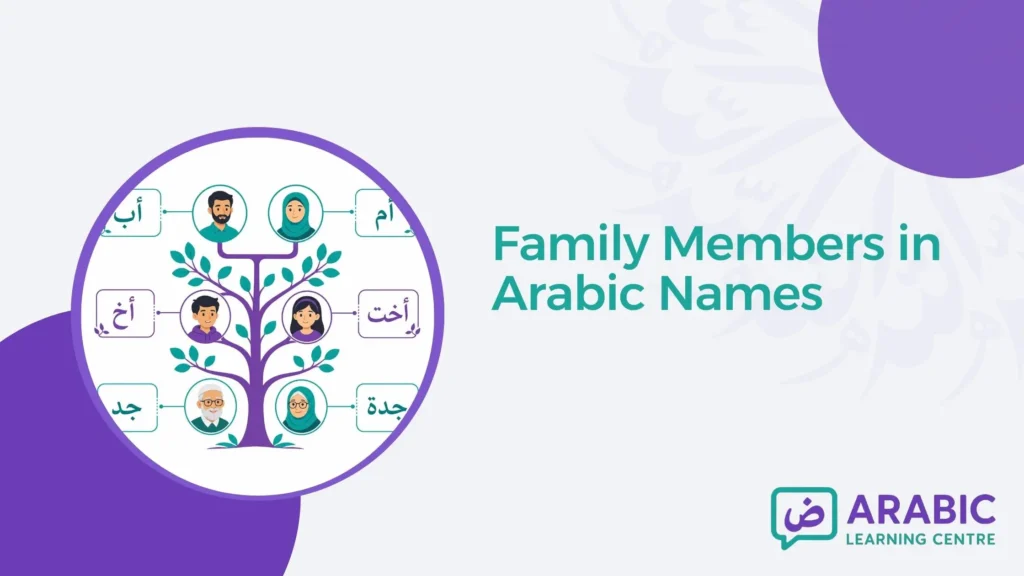
A grandmother calling her grandson “ya habibi” across a crowded room. An older brother correcting his sister’s pronunciation at the dinner table. Arabic family life is loud, layered, and full of words that carry more warmth than their English equivalents ever could.
This guide covers family members in Arabic for immediate and extended relatives, correct spelling and pronunciation, gender rules, and practical sentence patterns for introducing your own family in Arabic conversation.
Essential Arabic Family Vocabulary for Beginners
The core family in Arabic vocabulary set contains around twelve words that appear constantly in daily conversation. Learning these first builds a foundation for every other relationship term you will encounter later.
Arabic distinguishes gender in almost every noun, including family terms. This means “father” and “mother,” or “brother” and “sister,” follow entirely separate word patterns rather than adding a simple suffix.
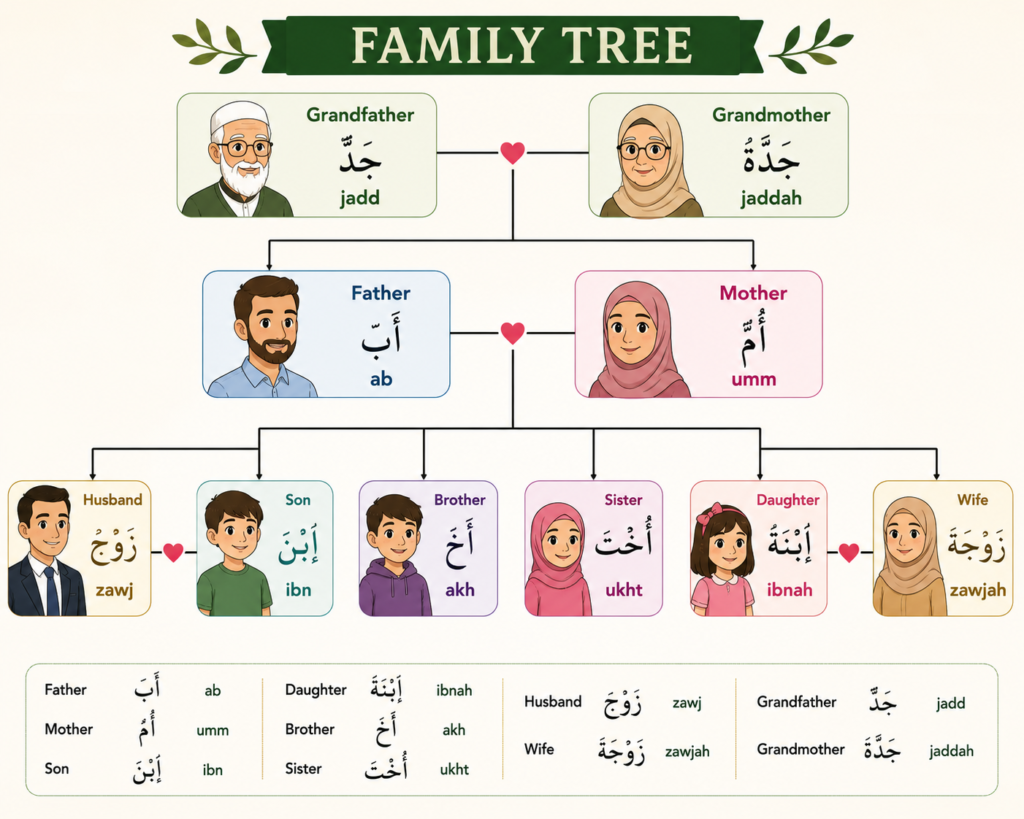
Notice the recurring pattern: adding a tāʾ marbūṭah (ة) to a masculine root often produces the feminine form. This is one of the first morphological patterns beginners should internalize, since it repeats across hundreds of Arabic nouns beyond family vocabulary.
Students who want to move past memorization and understand why these patterns exist benefit from structured instruction rather than vocabulary lists alone. The Fusha Arabic Course at The Arabic Learning Centre builds this exact kind of grammatical foundation from the very first lesson, pairing vocabulary with the morphology behind it.
Book Your Free Trial for Fusha Arabic Course Now!

Family Members in Arabic: Names for Extended Relatives Including Aunts, Uncles and Cousins
Arabic extended family terms are more specific than English ones, distinguishing between maternal and paternal sides for aunts, uncles, and even cousins. This precision reflects the cultural importance placed on lineage.
An English speaker says “uncle” for four different relatives. Arabic requires choosing the correct term depending on whether the uncle is the father’s brother, the mother’s brother, or married into the family by marriage.
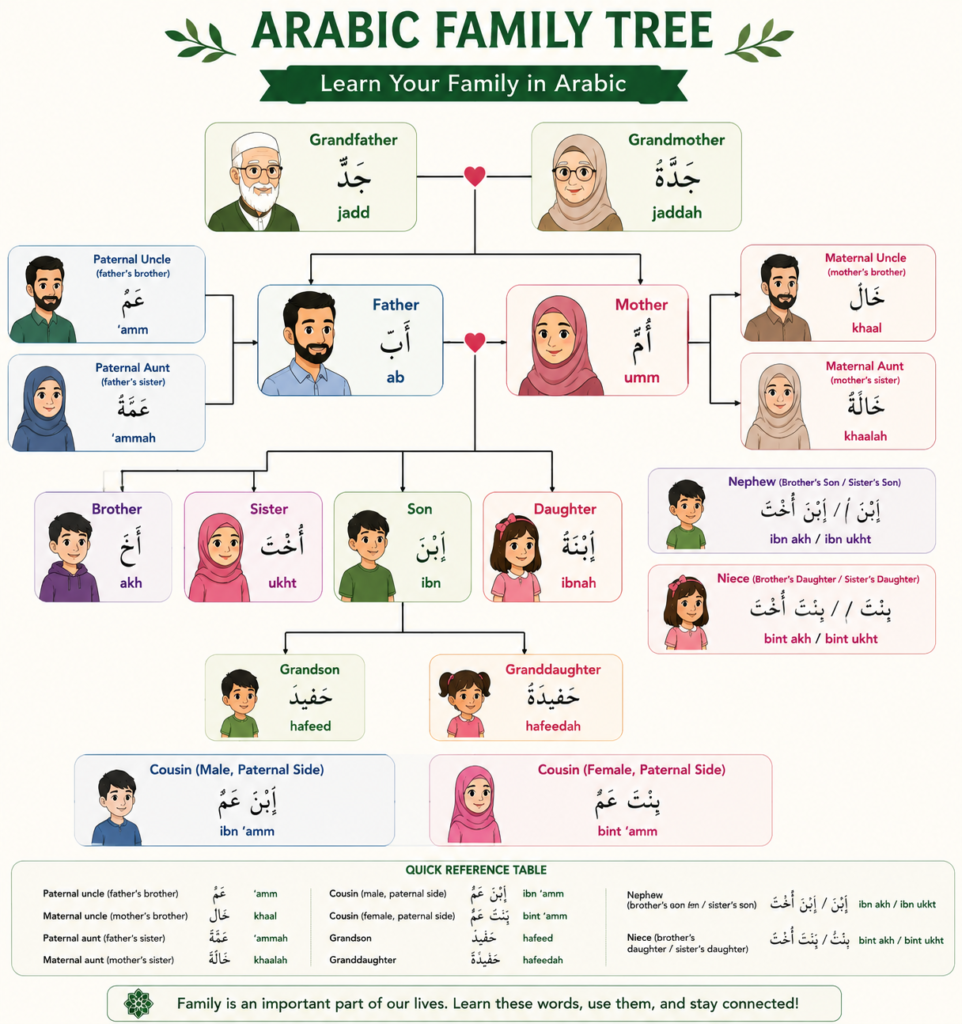
Cousin terms are compound constructions built from “son of” or “daughter of” plus the aunt or uncle term. This construction, called an idāfah (possessive phrase), is worth practicing separately since it governs many other relationship and ownership expressions in Arabic.
Learners preparing for real family gatherings, weddings, or extended visits abroad often need this vocabulary fast and accurately. The Arabic Vocabulary Course offered by The Arabic Learning Centre groups terms by real-life scenario rather than alphabetical order, which speeds up practical recall considerably.
Book Your Free Trial for Arabic Vocabulary Course Now!
Pronunciation Guidance for Arabic Family Terms Difficult for English Speakers
Three sounds in Arabic family vocabulary consistently trip up English speakers: the ﻉ (‘ayn), the ﺡ (ḥaa), and the doubled consonants marked by a shaddah. Getting these right changes meaning, not just accent.
The ‘ayn in “عَمّ” (‘amm, paternal uncle) is a voiced pharyngeal sound with no English equivalent. It is produced by constricting the throat, not the mouth, and beginners often substitute a glottal stop instead.
Doubled consonants matter too. “أُمّ” (umm, mother) has a doubled م sound, held slightly longer than a single م. Shortening it can make the word ambiguous to native listeners.
| Arabic Letter | Sound Description | Common English Mistake |
| ع (‘ayn) | Voiced pharyngeal, throat-constricted | Replaced with a glottal stop or silent |
| ح (ḥaa) | Voiceless pharyngeal fricative | Confused with English “h” |
| Shaddah (ّ) | Doubled/lengthened consonant | Consonant pronounced too quickly |
Correcting these habits early prevents them from becoming permanent. The Arabic Speaking Course at The Arabic Learning Centre pairs every learner with a native tutor who listens for exactly these substitutions and corrects them in live sessions, something recorded lessons alone cannot do.
Book Your Free Trial for Arabic Speaking Course Now!
Introducing Family Members in Arabic Through Common Sentence Patterns
Introducing family members in Arabic follows a simple possessive structure: the family word plus a possessive pronoun suffix attached directly to the noun. No separate word for “my” is needed.
To say “my father,” Arabic attaches the suffix ي (-ee) to أب, producing أبي (abee). The same suffix attaches to nearly every family noun, making this one pattern worth mastering completely.
| English | Arabic | Transliteration |
| My father | أَبي | abee |
| My mother | أُمّي | ummee |
| My brother | أَخي | akhee |
| My sister | أُخْتي | ukhtee |
| This is my family | هَذِهِ عائِلَتي | hadhihi ‘aa’ilatee |
A common learner mistake is adding a separate possessive word, mirroring English “my father” structure, and producing an incorrect double possessive. Arabic possession lives inside the noun’s ending, not beside it.
Inside Our Classrooms
See how we make learning interactive and engaging! Watch a quick snippet of our live, conversational classes in action:
Read Also: Food in the Arabic Language for Beginners Learners
Family Members in Arabic: Female Terms and Grammatical Gender Rules
Every family relationship term in Arabic has a distinct feminine form, and these forms follow predictable morphological rules once the underlying pattern is understood. This section isolates that pattern clearly.
The most common rule adds a tāʾ marbūṭah (ة) to the masculine root: عَمّ (‘amm, uncle) becomes عَمَّة (‘ammah, aunt). This same ة ending marks feminine gender across most Arabic nouns and adjectives, not only family terms.
Some feminine family terms are irregular and must be memorized separately rather than derived.
أُمّ (umm, mother) and أُخْت (ukht, sister) do not derive from a masculine root at all.
| Masculine | Feminine | Rule Type |
| عَمّ (‘amm) | عَمَّة (‘ammah) | Regular: add ة |
| خَال (khaal) | خَالَة (khaalah) | Regular: add ة |
| جَدّ (jadd) | جَدَّة (jaddah) | Regular: add ة |
| أَب (ab) | أُمّ (umm) | Irregular: separate root |
| أَخ (akh) | أُخْت (ukht) | Irregular: separate root |
Recognizing which pattern applies to a new word saves significant memorization time later, since the regular ة pattern extends well beyond family vocabulary into professions, nationalities, and adjectives.
Female learners preparing to discuss family matters in culturally appropriate settings, or those who prefer a female instructor for these conversations, often choose Arabic Classes for Ladies, where a native female tutor guides discussion of family and household topics specifically.
Book Your Free Trial for Arabic Classes for Ladies Now!
Read Also: Vegetables in Arabic
Family Members in Arabic Letters and Correct Spelling with Diacritics
Correct spelling of family terms depends on harakat, the short vowel diacritics placed above and below letters. Omitting them, as is standard in everyday printed Arabic, does not remove their grammatical importance.
Without diacritics, أخت could theoretically be misread by a beginner unfamiliar with the word. Native readers rely on context and memorized word shapes, but learners benefit from practicing the fully vowelled form first.
Writing family words by hand, rather than only reading them, reinforces the connection between each letter’s isolated, initial, medial, and final shapes.
أخ (akh, brother) uses only two letters, but both change shape depending on position within longer words.
Students building genuine Arabic literacy, not just spoken fluency, need dedicated handwriting and script practice. The Arabic Script Writing Course focuses specifically on letter-shape mastery, starting with short, high-frequency words like family terms before progressing to full sentences.
Read Also: Muslim Greeting in Arabic
Structured Vocabulary Building Techniques for Mastering Family Terms
Spaced repetition, root-based grouping, and scenario-based recall are the three techniques a certified instructor uses to move family vocabulary from short-term memory into long-term fluency.
Root-based grouping works particularly well for family terms because so many share a three-letter root pattern. Grouping أَخ (akh), أُخْت (ukht), and related derivatives together strengthens recall through structural association rather than rote repetition alone.
Scenario-based recall means practicing vocabulary inside a realistic situation, such as introducing your family at a gathering, rather than isolated flashcards. This mirrors how the words actually get used.
A structured curriculum sequences these techniques deliberately rather than leaving vocabulary acquisition to chance. This progression, from beginner recognition through advanced conversational use, defines the Advanced Arabic Course pathway at The Arabic Learning Centre.
Book Your Free Trial for Advanced Arabic Course Now!

Everyday Conversational Example Using Family Vocabulary
عِنْدي أُخْت وَأَخ
‘Indee ukht wa akh
“I have a sister and a brother.”
This short sentence combines the possessive construction عِنْدي (‘indee, “I have”) with two immediate family nouns, making it an ideal first sentence for absolute beginners to memorize and adapt.
Read Also: Colors in Arabic Explained for English-Speaking Learners at Every Level
Don’t Just Take Our Word For It
Take a look inside our vibrant classes and see our students and teachers in action. Click below to watch our classroom experience:
Begin Your Arabic Language Journey with Expert Guidance at The Arabic Learning Centre
Mastering family members in Arabic opens the door to real conversations, deeper cultural understanding, and genuine connection with Arabic-speaking relatives, friends, and communities.
The Arabic Learning Centre offers:
- Native Arabic tutors guiding pronunciation and grammar from day one
- A structured curriculum spanning beginner to advanced levels
- Live sessions combined with recorded materials for flexible review
- Scheduling across global time zones at accessible pricing
Courses We Offer:
- Quranic Arabic Course
- Arabic Course for Islamic Studies
- Learn Arabic for New Muslims
- Learn Arabic Letters for Tajweed
- Al Azhar Arabic Course
- Madinah Arabic Course
- Online Arabic Classes for Kids
- Arabic Words Course for Kids
- Arabic Lessons for Kindergarten
- Arabic Elementary School
- Arabic Intermediate School
- Arabic High School
Book your free trial today and start speaking with confidence.
Book your free trial lesson today!

Conclusion
Arabic family vocabulary distinguishes gender, lineage side, and possession through internal morphological patterns rather than separate words, making structural understanding more valuable than isolated memorization.
Extended family terms in Arabic, especially for aunts, uncles, and cousins, are more specific than English equivalents, reflecting cultural emphasis on maternal versus paternal lineage.
Correct pronunciation of sounds like ع and ح, alongside accurate spelling with diacritics, separates conversational competence from genuine long-term fluency in family and everyday vocabulary.
Frequently Asked Questions
The Arabic Word for Family Members Explained
The general Arabic word for family is عَائِلَة (‘aa’ilah), while individual relatives each carry their own distinct term such as أَب (ab, father) or أُخْت (ukht, sister). There is no single blanket word covering every relative.
Some regions also use أُسْرَة (usrah) interchangeably with عَائِلَة, particularly in more formal or written Modern Standard Arabic contexts like official documents and news reports.
Why Arabic Has Separate Words for Maternal and Paternal Uncles?
Arabic distinguishes خَال (khaal, maternal uncle) from عَمّ (‘amm, paternal uncle) because inheritance, lineage, and family structure historically tracked the paternal line separately from the maternal line.
This distinction still shapes everyday speech today, even though inheritance law is rarely the topic of conversation. Learners should treat these as entirely separate vocabulary items, not variations of one word.
How Many Words Exist for Family Members in Arabic?
A functional beginner vocabulary for family members in Arabic includes roughly twenty to twenty-five core terms, covering immediate relatives, in-laws, and one generation each of aunts, uncles, and cousins.
Advanced learners eventually add rarer terms for great-grandparents, in-laws by marriage, and step-relations, but the twenty-term core set covers nearly all everyday conversation needs.
Does Arabic Have a Different Word for Older and Younger Siblings?
Modern Standard Arabic does not require separate words for older versus younger brother or sister; أَخ (akh) and أُخْت (ukht) apply regardless of birth order. Age can be specified with an added descriptive phrase if needed, such as أَخي الْأَكْبَر (akhee al-akbar, “my older brother”).
What Is the Correct Way to Say My Family in Arabic?
The phrase for “my family” is عَائِلَتي (‘aa’ilatee), formed by attaching the possessive suffix ي directly to عَائِلَة (family). This same suffix pattern applies consistently across nearly every Arabic family noun.
Related Articles
Arabic Vocabulary & Speaking