 Arabic Vocabulary & Speaking
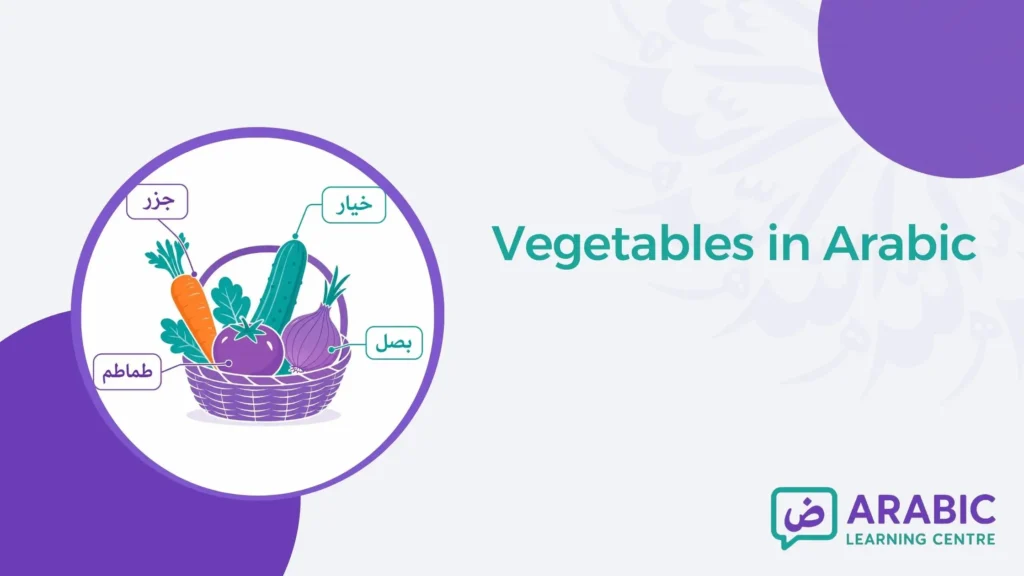
Standing in a souq in Amman or scanning a menu in Cairo, many learners freeze the moment vegetables come up in conversation. Grocery lists, cooking shows, and family dinners all lean on this vocabulary daily, yet it rarely gets the structured attention grammar rules receive.
This guide breaks down vegetables in Arabic with accurate pronunciation, grammatical gender, plural patterns, and real conversational sentences. You will also find practical memorization strategies suited to how adult learners actually retain new words over time.
Essential Vegetable Names in Arabic Every Beginner Should Learn
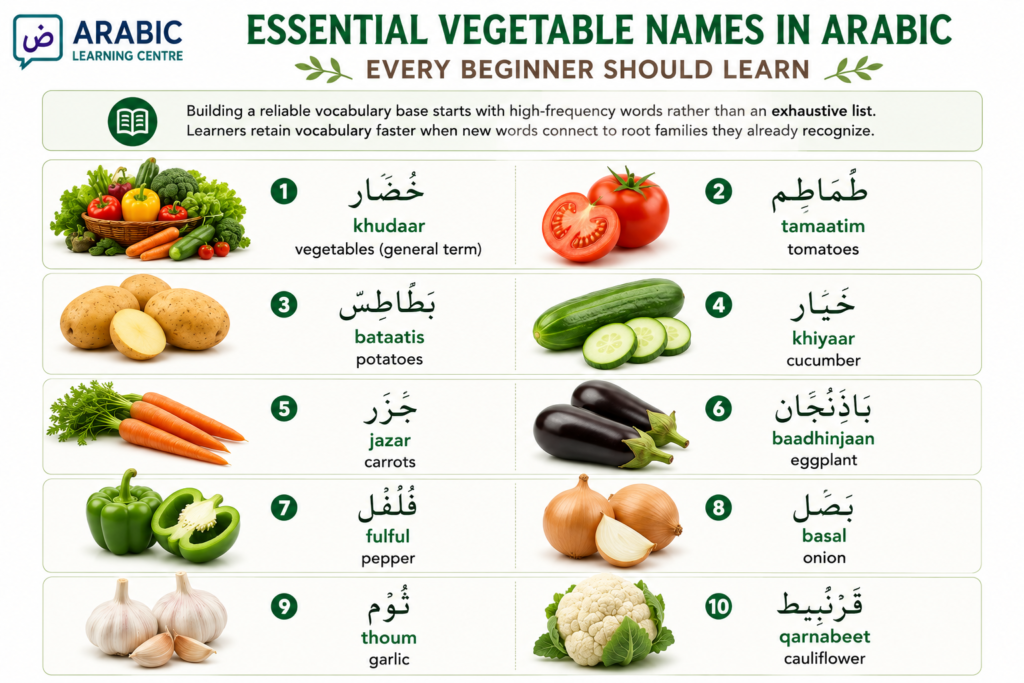
Building a reliable vocabulary base starts with high-frequency words rather than an exhaustive list. Learners retain vocabulary faster when new words connect to root families they already recognize.
The table below lists common vegetables in Arabic with transliteration and English meaning, ordered from most to least frequent in daily speech.
| Arabic | Transliteration | English |
| خُضَار | khudaar | vegetables (general term) |
| طَمَاطِم | tamaatim | tomatoes |
| بَطَاطِس | bataatis | potatoes |
| خِيَار | khiyaar | cucumber |
| جَزَر | jazar | carrots |
| بَاذِنجَان | baadhinjaan | eggplant |
| فُلْفُل | fulful | pepper |
| بَصَل | basal | onion |
| ثُوم | thoum | garlic |
| قَرْنَبِيط | qarnabeet | cauliflower |
Explore the Arabic Learning Centre’s Arabic Vocabulary Course, where words are grouped by theme and root rather than memorized in isolation.
Book Your Free Trial for Arabic Vocabulary Course Now!

High Frequency Vegetable Terms for Everyday Conversation
The word خُضَار (khudaar) functions as the general category term, similar to how “vegetables” works in English. Native speakers use it constantly at markets, in recipes, and when describing meals to guests or family.
Learners who master this core set of ten words can already follow most grocery conversations and recipe instructions. Expanding beyond this list becomes far easier once these anchor words feel automatic.
Pronunciation Rules for Arabic Vegetable Names That Non-Native Speakers Often Mistake
Three sounds absent from English consistently trip up learners of vegetables in Arabic: ق (qaf), ع (ain), and خ (kha). Getting these right early prevents pronunciation habits that become harder to correct later.
1. The Qaf Sound in Words Like Qarnabeet
ق is a deep, uvular stop produced far back in the throat, unlike the English “k” made with the tongue mid-mouth. In قَرْنَبِيط (qarnabeet, cauliflower), many beginners substitute a soft “k,” which native listeners register as a different word entirely.
Practice by placing a hand on your throat and feeling the vibration when producing ق versus ك. This tactile feedback method is one instructors in the Arabic Speaking Course use during live sessions to correct pronunciation in real time.
2. The Ain Sound in Words Like Baadhinjaan
ع has no equivalent in English and often gets flattened into a simple vowel or glottal stop by beginners. In بَاذِنجَان (baadhinjaan, eggplant), the ع appears mid-word and shapes the entire syllable around it.
Native tutors typically model this sound through repeated listening and mirrored throat positioning rather than written description alone. Written transliteration can only approximate ع; audio modeling from a native speaker remains the fastest route to accuracy.
3. The Kha Sound in Words Like Khiyaar and Khudaar
خ is a raspy, guttural sound similar to the “ch” in the Scottish “loch.” Both خِيَار (khiyaar, cucumber) and خُضَار (khudaar, vegetables) open with this sound, making it worth mastering early given how often these words appear.
English speakers often substitute a plain “h” or “k,” which changes meaning rather than just accent. Consistent drilling on minimal pairs helps the ear distinguish خ from these similar-sounding letters.
Inside Our Classrooms
See how we make learning interactive and engaging! Watch a quick snippet of our live, conversational classes in action:
Grammatical Gender and Plural Patterns for Arabic Vegetable Vocabulary
Most vegetable names in Arabic follow the same gender rule as other nouns: words ending in tاء مربوطة (taa marbuta) are grammatically feminine, while most others are masculine.
طَمَاطِم (tamaatim, tomatoes) and جَزَر (jazar, carrots) are both masculine despite referring to food items with no inherent gender.
Understanding gender agreement matters immediately because adjectives, verbs, and demonstrative pronouns must match the noun. This is a foundational concept covered thoroughly in the Arabic Grammar Course, where the root and pattern system is taught alongside gender rules rather than as a separate topic.
Book Your Free Trial for Arabic Grammar Course Now!

Singular and Plural Forms Using the Root and Pattern System
Arabic plurals rarely follow a simple suffix rule like English “-s.” Instead, many vegetable nouns take broken plurals, where the internal vowel pattern of the word changes entirely.
| Singular | Plural | Meaning |
| بَصَلَة (basala) | بَصَل (basal) | onion/onions |
| فُلْفُلَة (fulfula) | فُلْفُل (fulful) | pepper/peppers |
| بَاذِنجَانَة (baadhinjaana) | بَاذِنجَان (baadhinjaan) | eggplant/eggplants |
Notice that the singular form often adds ة to an already-plural-sounding base word. This pattern, called the “noun of unity” (اسم الوحدة), is common across Arabic vegetable and fruit vocabulary and worth memorizing as a category.
Practical Sentences Using Vegetables in Arabic for Daily Conversation
Vocabulary only becomes useful once it appears inside natural sentences learners will actually say. Below are everyday phrases that combine vegetable vocabulary with common verbs and question structures.
أُرِيدُ كِيلُو طَمَاطِم مِنْ فَضْلِكَ
Ureedu keeloo tamaatim min fadlik
“I would like a kilo of tomatoes, please.”
هَل عِنْدَكُم خِيَار طَازَج؟
Hal indakum khiyaar taazaj?
“Do you have fresh cucumbers?”
لَا أُحِبُّ الفُلْفُل الحَار
Laa uhibbu al-fulful al-haar
“I don’t like spicy peppers.”
Read Also: Muslim Greeting in Arabic
Common Mistakes When Forming Vegetable-Related Sentences
Beginners frequently drop the definite article ال when it should attach to the vegetable noun, especially after adjectives like حَار (haar, spicy). The correct structure requires the article on both the noun and its adjective, as shown in the third example above.
Another frequent error involves verb-noun gender agreement when describing quantities. Building confidence with these structures in real conversation is exactly what the Arabic Speaking Course targets through guided speaking practice with native tutors.
Book Your Free Trial for Arabic Speaking Course Now!

Read Also: Colors in Arabic Explained for English-Speaking Learners at Every Level
Effective Strategies for Memorizing Arabic Vegetable Vocabulary Long Term
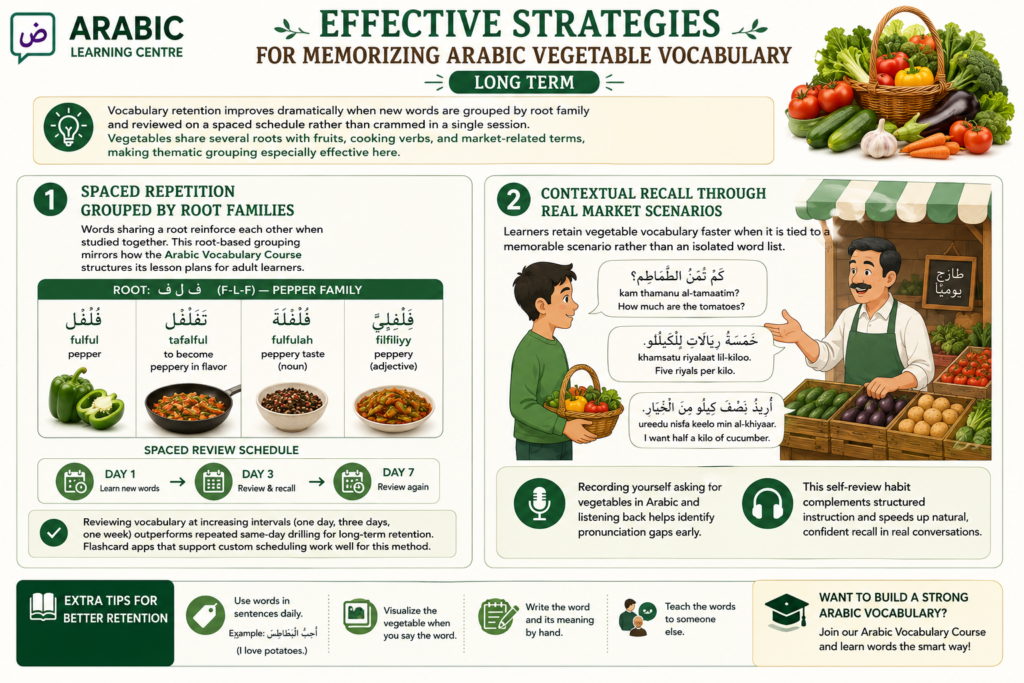
Vocabulary retention improves dramatically when new words are grouped by root family and reviewed on a spaced schedule rather than crammed in a single session. Vegetables share several roots with fruits, cooking verbs, and market-related terms, making thematic grouping especially effective here.
1. Spaced Repetition Grouped by Root Families
Words sharing a root, such as فُلْفُل (fulful, pepper) and تَفَلْفُل (tafalful, to become peppery in flavor), reinforce each other when studied together. This root-based grouping mirrors how the Arabic Vocabulary Course structures its lesson plans for adult learners.
Reviewing vocabulary at increasing intervals (one day, three days, one week) outperforms repeated same-day drilling for long-term retention. Flashcard apps that support custom scheduling work well for this method.
Read Also: Family Members in Arabic Names
2. Contextual Recall Through Real Market Scenarios
Learners retain vegetable vocabulary faster when it is tied to a memorable scenario rather than an isolated word list. Practicing a mock grocery conversation, even alone, activates recall pathways that flat memorization does not.
Recording yourself asking for vegetables in Arabic and listening back helps identify pronunciation gaps early. This self-review habit complements structured instruction and speeds up natural, confident recall during real conversations.
Don’t Just Take Our Word For It
Take a look inside our vibrant classes and see our students and teachers in action. Click below to watch our classroom experience:
Begin Your Arabic Language Journey with Expert Guidance at The Arabic Learning Centre
Learning vegetables in Arabic is one small step toward genuine conversational fluency, and structured guidance makes that step far more efficient. The Arabic Learning Centre offers:
- Native Arabic tutors with pedagogical training
- Structured curricula from beginner to advanced levels
- Live sessions plus recorded materials for flexible review
- Scheduling across global time zones
- Affordable, accessible pricing for international learners
Courses We Offer:
- Quranic Arabic Course
- Arabic Course for Islamic Studies
- Learn Arabic for New Muslims
- Learn Arabic Letters for Tajweed
- Al Azhar Arabic Course
- Madinah Arabic Course
- Online Arabic Classes for Kids
- Arabic Words Course for Kids
- Arabic Lessons for Kindergarten
- Arabic Elementary School
- Arabic Intermediate School
- Arabic High School
Book a free trial today and start building real vocabulary and speaking confidence with guided, expert support.
Book your free trial lesson today!

Conclusion
Mastering vegetables in Arabic starts with accurate pronunciation of ق, ع, and خ, since these sounds carry no English equivalent and often shift meaning entirely when substituted incorrectly by beginners.
Grammatical gender and broken plural patterns shape how vegetable nouns behave in real sentences, making them essential grammar points rather than optional details worth skipping over during early study.
Root-based spaced repetition, paired with real conversational practice and native tutor feedback, turns vegetables in Arabic from a memorized list into vocabulary a learner can use with genuine, everyday confidence.
Frequently Asked Questions
What Is the General Word for Vegetables in Arabic?
The general word for vegetables in Arabic is خُضَار (khudaar), used the same way English speakers use “vegetables” as a category term. It appears constantly in markets, recipes, and everyday household conversation.
Learners often meet this word before any specific vegetable name, since it covers the whole category. Mastering khudaar early makes it easier to ask general questions at a market or restaurant.
How Many Vegetable Words Should a Beginner Learn First?
A beginner should start with ten to twelve high-frequency vegetable words, including tomatoes, potatoes, cucumber, carrots, onion, and garlic. This core set covers the vast majority of everyday market and recipe conversations.
Adding more specialized vegetables becomes far easier once these anchor words are automatic. The Arabic Vocabulary Course structures exactly this kind of gradual, root-based expansion for adult learners.
Do Arabic Vegetable Nouns Have Grammatical Gender?
Yes, every Arabic vegetable noun carries grammatical gender, and most take the masculine form despite naming a food item with no inherent gender. A smaller group ending in taa marbuta is feminine.
Gender agreement affects adjectives, verbs, and demonstrative pronouns paired with the noun, making it essential grammar rather than a minor detail. This concept is covered in depth in the Arabic Grammar Course.
Why Do Some Vegetable Plurals Look Completely Different From the Singular?
Many Arabic vegetable nouns use broken plurals, where the internal vowel pattern changes rather than a suffix being added. For example, بَصَلَة (basala, one onion) becomes بَصَل (basal, onions) with no shared suffix.
This pattern, called the noun of unity, is common across Arabic food vocabulary. Recognizing it early prevents confusion when reading recipes, menus, or shopping lists written in Arabic.
What Is the Fastest Way to Memorize Vegetables in Arabic?
Grouping vegetable words by shared root families and reviewing them on a spaced schedule produces the fastest, most durable retention. Pairing new words with real market or cooking scenarios reinforces recall further.
Recording pronunciation attempts and comparing them against native audio also accelerates progress. Structured, guided practice with a native tutor remains the most reliable shortcut for building lasting vocabulary confidence.
Related Articles
Arabic Vocabulary & Speaking