 Arabic Vocabulary & Speaking
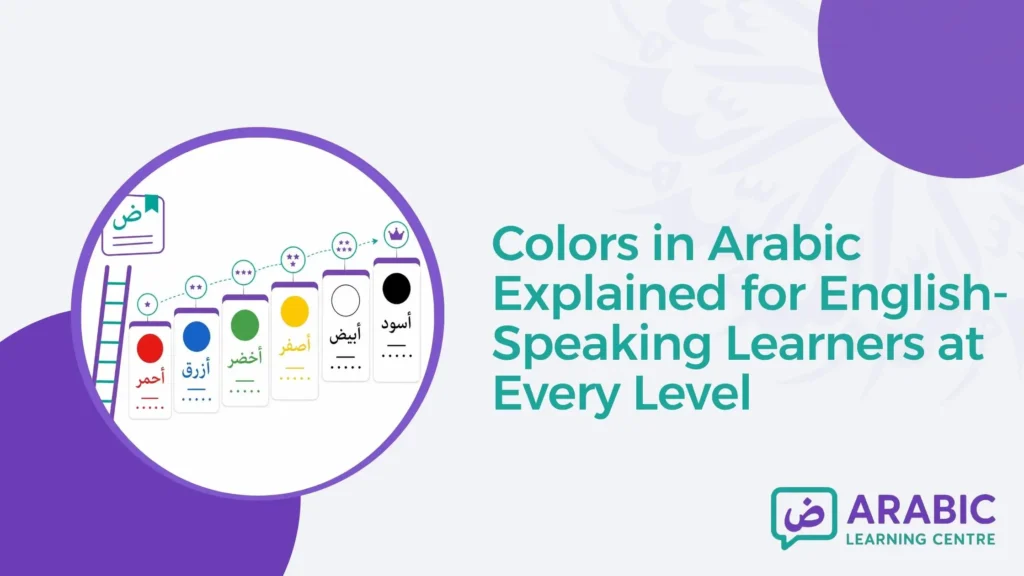
A child pointing at a red apple and a grandmother pointing at the same red apple use two different words if one speaks English and the other speaks Arabic, yet both are naming the same shade. That small gap is where every Arabic learner’s color vocabulary begins.
Colors in Arabic follow a grammatical logic that English speakers rarely expect from adjectives. Mastering colors in Arabic with harakat, their masculine and feminine forms, and their plural patterns gives learners a working vocabulary they can use in real sentences, not just a memorized list of nouns.
Learning the Basic Colors in Arabic Alphabet Before Adding Grammar Rules
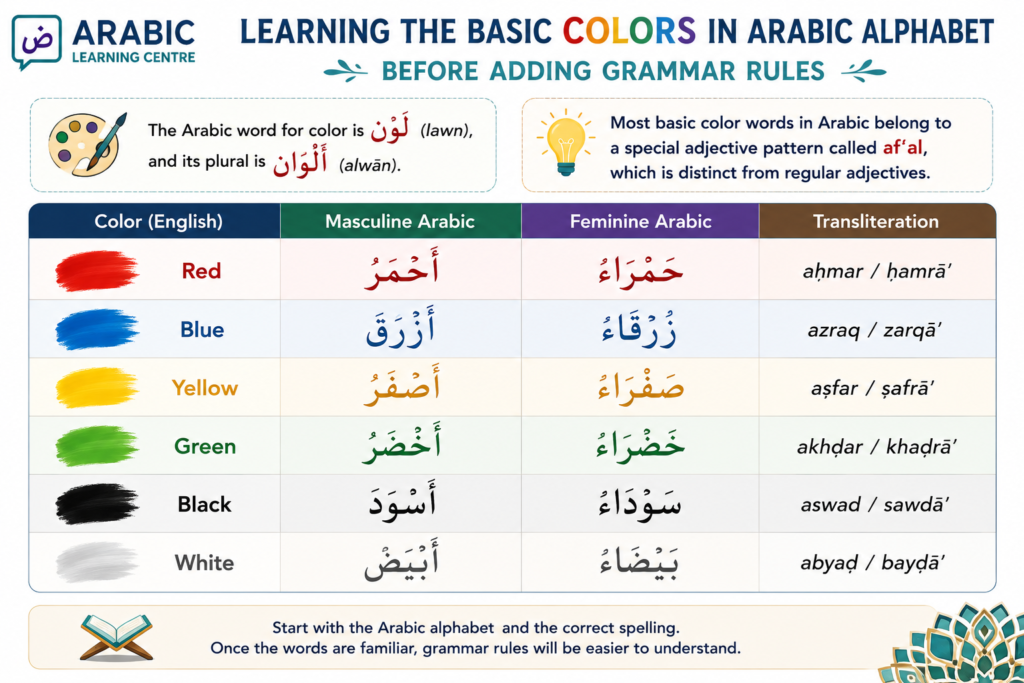
The Arabic word for color is لَوْن (lawn), and its plural is أَلْوَان (alwān). Before tackling grammar, learners need the raw vocabulary written correctly in the Arabic alphabet.
Most basic color words in Arabic belong to a special adjective pattern called af’al, which is distinct from regular adjectives. This pattern explains why colors behave differently from words like “big” or “small” in a sentence.
Students at The Arabic Learning Centre typically encounter this pattern early in the Arabic Vocabulary Course, where color words serve as the first real-world example of a recurring morphological shape. Recognizing the shape early prevents confusion later with other af’al pattern words.
Book Your Free Trial for Arabic Vocabulary Course Now!

Reading Colors in Arabic with Harakat for Accurate Pronunciation
Featured answer: colors in Arabic with harakat are written with short vowel marks above and below the letters to show exact pronunciation, since color adjectives follow a fixed internal vowel pattern that changes meaning if mispronounced.
Diacritics matter enormously here because the af’al pattern relies on precise short vowels. The word أَحْمَر (aḥmar) carries a fatha, sukun, and fatha in a fixed sequence that native speakers absorb early.
Non-native learners who skip harakat often flatten every color word into the same rhythm. This creates pronunciation that Arabic speakers can understand, but that sounds noticeably foreign.
Practicing with fully vocalized texts, rather than modern unvocalized newspaper Arabic, builds accurate muscle memory faster. This is one reason beginner materials at the academy present every new color with complete diacritical marking before removing the training wheels.
Comparing Short Vowel Sounds That English Speakers Often Confuse
English speakers frequently blur the fatha and kasra sounds in rapid speech, turning aḥmar into something closer to ihmar. Slowing down and isolating each syllable corrects this within a few practice sessions.
The damma sound in words like أَصْفَر also gives English speakers trouble, since English has no direct equivalent to the short “u” rounding used in Arabic. Listening drills paired with repetition fix this reliably.
Inside Our Classrooms
See how we make learning interactive and engaging! Watch a quick snippet of our live, conversational classes in action:
Understanding Common Colors in Arabic Names and Their English Meanings
Many Arabic personal names and place names derive directly from color roots, which is why colors in Arabic names appear so frequently across the Arabic-speaking world. Recognizing these roots helps learners decode unfamiliar vocabulary independently.
The name Akhdar relates directly to green, while Baida connects to white through the feminine form. These naming patterns are not coincidental; they reflect the same root and pattern system used throughout Arabic morphology.
| Name Element | Related Color | Root Meaning |
| Akhdar | Green (أَخْضَر) | Fresh, verdant |
| Zarqa | Blue (زَرْقَاء) | Blue-eyed, azure |
| Baida | White (بَيْضَاء) | Fair, bright |
| Sawda | Black (سَوْدَاء) | Dark-complexioned |
Understanding how color roots extend into personal names strengthens a learner’s grasp of the broader root and pattern system, one of the most important structural concepts in Arabic morphology overall.
Applying Correct Adjective Agreement Rules When Describing Colored Objects
Color adjectives in Arabic must agree with the noun they describe in gender, and this rule trips up almost every beginner. A masculine noun takes the masculine color form, and a feminine noun takes the feminine form automatically.
For example, كِتَابٌ أَحْمَرُ (kitābun aḥmar) means “a red book,” while سَيَّارَةٌ حَمْرَاء (sayyāratun ḥamrā’) means “a red car.” The noun’s gender, not the object’s actual appearance, determines which form is correct.
This is precisely the kind of rule that a structured Arabic Grammar Course addresses directly, walking learners through gender agreement across multiple adjective categories, not colors alone. Isolated memorization rarely produces lasting fluency here.
Book Your Free Trial for Arabic Grammar Course Now!

Recognizing Irregular Agreement Patterns with Certain Nouns
Broken plural nouns referring to non-human groups take feminine singular color adjectives regardless of the noun’s own gender. This exception surprises even intermediate learners who have already memorized the basic agreement rule.
For instance, كُتُبٌ حَمْرَاء (kutubun ḥamrā’) means “red books,” using the feminine singular color form even though kutub is a broken plural of a masculine noun. This pattern applies consistently across non-human plurals.
Distinguishing Broken Plural Patterns Used for Arabic Color Adjectives
Color adjectives have their own dedicated plural forms used specifically when describing groups of people. These plurals do not follow the regular sound plural endings that most other adjectives use.
| Color | Masculine Plural | Feminine Plural |
| Red | حُمْر | حُمْر |
| Blue | زُرْق | زُرْق |
| Black | سُود | سُود |
| White | بِيض | بِيض |
Notice that masculine and feminine human plurals share an identical form for most basic colors, which simplifies memorization considerably. This pattern only applies when the color describes people directly, such as “the red-haired men.”
Practicing Everyday Phrases That Use Arabic Colors in English Conversation Context
Featured answer: learners build practical fluency by pairing Arabic colors in English conversation with everyday situational phrases, such as asking about clothing, describing objects, or discussing preferences during real dialogue practice.
A common everyday exchange looks like this:
مَا لَوْنُ قَمِيصِكَ؟
Mā lawnu qamīṣika?
“What is the color of your shirt?”
Responding naturally requires combining the color vocabulary with basic sentence structure, something drilled extensively inside the Arabic Speaking Course through guided conversation practice with native tutors. Speaking confidence grows fastest through repeated, low-pressure dialogue like this.
Book Your Free Trial for Arabic Speaking Course Now!

Read Also: Food in the Arabic Language for Beginners Learners
Building Descriptive Sentences Around Clothing and Everyday Objects
Describing clothing is one of the most common early speaking tasks assigned to beginners, since it combines nouns, colors, and possessive pronouns in one manageable sentence. Practicing this daily accelerates recall speed considerably.
Learners should rotate through different nouns, genders, and colors rather than repeating the same sentence. This variation forces active retrieval instead of passive memorization, which produces far stronger long-term retention.
Read Also: Vegetables in Arabic
Avoiding Common Mistakes Non-Native Speakers Make with Arabic Color Adjectives
The single most frequent error is applying the masculine color form to feminine nouns out of habit, since many textbooks introduce masculine forms first. Correcting this requires deliberate practice pairing each new noun with its correct gendered color.
A second frequent mistake involves placing the color adjective before the noun, mirroring English word order. Arabic adjectives, including colors, follow the noun they describe, never precede it.
A third common error is dropping the definite article agreement, writing الكتاب أحمر instead of الكتاب الأحمر when the noun itself is already definite. Both words must carry the definite article together in a descriptive phrase.
Read Also: Muslim Greeting in Arabic
Building a Structured Vocabulary Practice Routine for Mastering Arabic Colors
Consistent, spaced repetition works far better than cramming an entire color list in one sitting. Reviewing five to six colors daily across a full week embeds both spelling and gender agreement more reliably than a single intensive session.
Flashcards should include the fully vocalized Arabic word, its transliteration, its feminine counterpart, and one example sentence. This four-part format matches how the material is taught inside the Fusha Arabic Course, where vocabulary is never memorized in isolation.
Book Your Free Trial for Fusha Arabic Course Now!

Using Written Practice to Reinforce Script Recognition
Writing each color word by hand, rather than only reading it, strengthens recognition of the Arabic script’s connected letterforms. This is particularly useful for beginners still adjusting to right-to-left script direction.
Pairing handwriting drills with the Arabic Script Writing Course gives learners guided feedback on letter connections specific to color words, since several colors contain tricky letter combinations like the doubled sīn in أَسْوَد.
Read Also: Family Members in Arabic Names
Don’t Just Take Our Word For It
Take a look inside our vibrant classes and see our students and teachers in action. Click below to watch our classroom experience:
Begin Your Arabic Language Journey with Expert Guidance at The Arabic Learning Centre
Mastering colors in Arabic takes more than a word list; it requires understanding gender agreement, plural patterns, and pronunciation together as one connected system.
The Arabic Learning Centre offers:
- Native Arabic tutors guiding pronunciation and grammar from day one
- A structured curriculum spanning beginner to advanced levels
- Live sessions combined with recorded materials for flexible review
- Scheduling across global time zones at accessible pricing
Courses We Offer:
- Online Arabic Course
- Classical arabic course
- Modern Standard Arabic Course
- Fusha Arabic Course
- Learn Saudi Arabic
- Arabic Course for Beginners
- Arabic Classes for Adults
- Arabic Classes for Ladies
- Advanced Arabic Course
- Intensive Arabic Course
Book your free trial today and start speaking with confidence.
Book your free trial lesson today!

Conclusion
Arabic color adjectives follow the distinct af’al pattern, requiring masculine and feminine forms that agree with the noun’s gender rather than the object’s real-world appearance in every sentence.
Harakat marks are essential for correct pronunciation, since short vowel changes within the af’al pattern can shift meaning entirely if diacritics are ignored during early study.
Consistent, spaced practice combining vocabulary, gendered sentence building, and handwriting produces far stronger retention than memorizing an isolated list of Arabic color names alone.
Frequently Asked Questions About Colors in Arabic
What is the Arabic word for color?
The Arabic word for color is لَوْن (lawn), with the plural form أَلْوَان (alwān). Most basic color adjectives follow the af’al pattern, giving each color a distinct masculine and feminine form.
How many basic colors exist in Arabic?
Arabic has around eight core basic colors following the af’al pattern, including red, blue, yellow, green, black, and white. Additional shades and modern colors borrow different grammatical patterns and vocabulary structures.
Why do Arabic colors change form for masculine and feminine nouns?
Arabic color adjectives must agree in gender with the noun they describe, not with the object’s real-world appearance. A feminine noun like سَيَّارَة (car) always takes the feminine color form, such as حَمْرَاء.
Do Arabic colors have a separate plural form?
Yes, color adjectives use dedicated broken plural forms, such as حُمْر for red, but only when describing groups of people. Non-human plural nouns instead take the feminine singular color form regardless of the noun’s own gender.
Are harakat necessary when learning Arabic colors?
Yes, harakat are essential because the af’al pattern relies on a fixed sequence of short vowels. Omitting diacritics during early study often produces flattened pronunciation that native speakers notice immediately.
Related Articles
Arabic Vocabulary & Speaking