 Learn Arabic
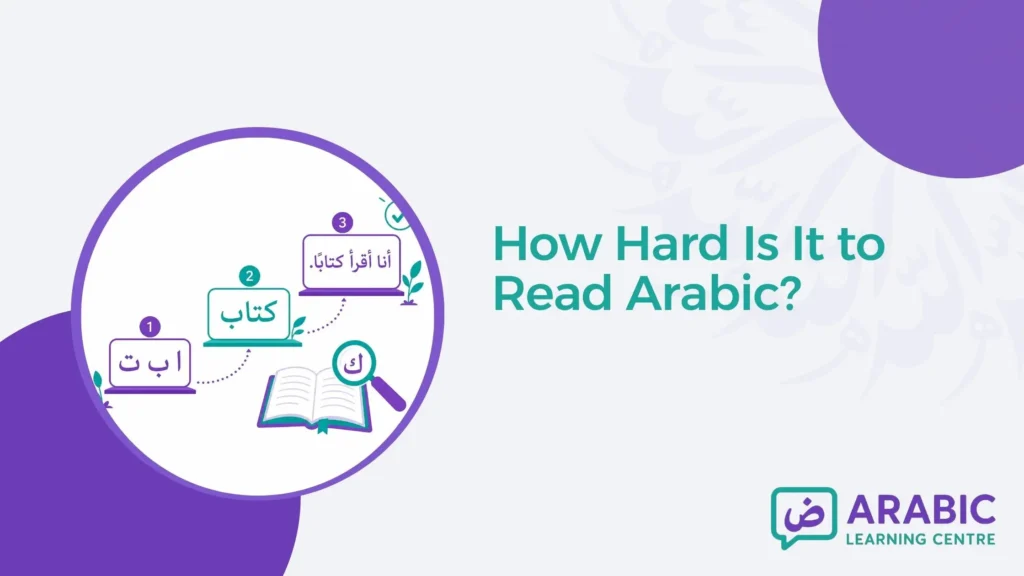
Learning to read Arabic presents a unique challenge for English speakers, not because the language is irrational, but because its writing system, phonology, and structure operate on principles that have no parallel in European languages. Understanding exactly where the difficulty lies makes the process far more navigable.
The honest answer to how hard it is to read Arabic is: harder than most Western languages at first, but not indefinitely hard. The initial steepness comes from a genuinely unfamiliar script, a vowel system that is mostly invisible in standard text, and a set of sounds that require muscular retraining. Once those three elements are understood, progress accelerates quickly.
1. The Arabic Script Is a New System, Not Just a New Alphabet
For most English speakers, the Arabic alphabet takes two to four weeks of focused daily practice to recognize reliably. That is a manageable timeline, far shorter than the years required to reach reading fluency in Chinese or Japanese.
How hard is it to read the Arabic alphabet? Arabic uses 28 letters, all consonants. Every letter has up to four written forms depending on where it falls in a word: isolated, initial, medial, or final. This positional variation is the main reason learners initially find the script overwhelming.
| Letter | Isolated | Initial | Medial | Final |
| ب (Ba) | بـ | بـ | ـبـ | ـب |
| ع (‘Ayn) | ع | عـ | ـعـ | ـع |
| ن (Nun) | ن | نـ | ـنـ | ـن |
The Arabic Script Writing Course at The Arabic Learning Centre addresses this directly, teaching letter forms in their four positional shapes from the first lesson, using a progression that connects isolated recognition to full word-reading within weeks.
Book Your Free Trial for Arabic Script Course Now!

2. The Hidden Vowel System Is the Core Reading Difficulty
The deepest reason why learning to read Arabic is consistently underestimated is the vowel system. Arabic short vowels, the harakat (diacritical marks), are present in the Quran and beginner textbooks, but are almost absent from newspapers, books, websites, and everyday written text.
This means a fluent Arabic reader is not reading every letter. They are parsing consonant skeletons and supplying the vowels from grammatical knowledge and context. For a beginner, this is genuinely difficult. For an intermediate learner with solid grammar foundations, it becomes a natural reading mode.
How hard is it to read Arabic without vowel marks? Without harakat, a word like كتب could be read as kataba (he wrote), kutiba (it was written), kutub (books), or kātib (a writer).
Context and grammar distinguish them. This is not guesswork for a trained reader; it is pattern recognition built over structured exposure.
The practical implication for learners: reading ability and grammar knowledge are inseparable in Arabic. You cannot read fluently without building grammatical competence alongside script recognition.
This is the single most important insight an instructor can give a new learner, and it shapes the entire teaching methodology at The Arabic Learning Centre.
Inside Our Classrooms
See how we make learning interactive and engaging! Watch a quick snippet of our live, conversational classes in action:
3. Arabic Sounds That Do Not Exist in English Create a Real Pronunciation Barrier
How hard it is to read the Arabic alphabet is partly a question about sound, not just symbol recognition. Several Arabic phonemes have no equivalent in English, and mispronouncing them while reading aloud reinforces incorrect neural patterns.
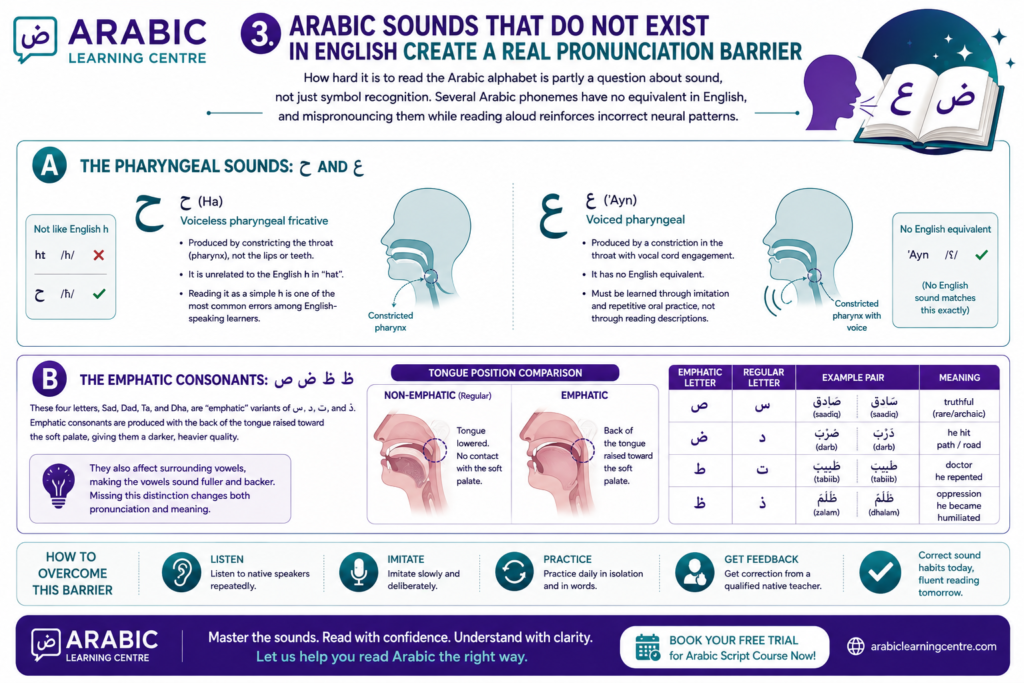
A. The Pharyngeal Sounds: ح and ع
The letter ح (Ha) is a voiceless pharyngeal fricative, produced by constricting the throat, not the lips or teeth. It is unrelated to the English h in “hat.” Reading it as a simple h is one of the most common errors among English-speaking learners.
The letter ع (‘Ayn) is a voiced pharyngeal, a constriction in the throat with vocal cord engagement. It has no English equivalent and must be learned through imitation and repetitive oral practice, not through reading descriptions.
B. The Emphatic Consonants: ص ض ط ظ
These four letters, Sad, Dad, Ta, and Dha, are “emphatic” variants of س, د, ت, and ذ. Emphatic consonants are produced with the back of the tongue raised toward the soft palate, giving them a darker, heavier quality. They also affect surrounding vowels, making the vowels sound fuller and backer. Missing this distinction changes both pronunciation and meaning.
For learners who want structured guidance built around this kind of realistic schedule, The Arabic Learning Centre’s Arabic Classes for Adults is designed precisely for adult learners with limited daily windows.
Book Your Free Trial for Arabic Classes for Adults Now!

4. Connected Script Requires Active Training to Read at Speed
Unlike printed English letters, which stand separately, Arabic letters within a word are joined in a continuous flow. This connected writing, with letters changing shape as they join, means that reading Arabic is not the same skill as recognizing isolated letters.
A learner who can identify all 28 letters in isolation will still struggle to read words at first because the shapes blend, contract, and sometimes become nearly unrecognizable in mid-word positions. The ع (‘Ayn) in its medial form ـعـ looks almost nothing like its isolated form ع.
The solution is not more alphabet drilling. It is word-level and phrase-level reading practice from early on, using graded texts with harakat, alongside explicit teaching of medial and final letter forms.
5. Quranic Arabic and Modern Standard Arabic Have Different Reading Demands
How hard it is to read Arabic to learn depends significantly on which variety the learner is targeting.
| Feature | Modern Standard Arabic (MSA) | Quranic Arabic |
| Vowel marking | Mostly absent in texts | Fully marked in the Mushaf |
| Vocabulary | Contemporary and classical blend | Classical, 7th-century register |
| Reading rules | Standard grammar applies | Tajweed rules are mandatory |
| Difficulty for beginners | Script + grammar + context | Script + Tajweed + classical vocabulary |
Quranic Arabic is, paradoxically, easier to read aloud for beginners in one specific way: the Quran is always printed with full harakat, removing the ambiguity of vowel-less text.
The challenge in Quranic reading shifts from vowel inference to Tajweed precision: applying rules of assimilation (Idgham), elongation (Madd), nasalization (Ghunnah), and stopping (Waqf) correctly.
بِسْمِ ٱللَّهِ ٱلرَّحْمَـٰنِ ٱلرَّحِيمِ
Bismillāhi r-Raḥmāni r-Raḥīm
“In the name of Allah, the Entirely Merciful, the Especially Merciful.” (Al-Fatihah 1:1)
Every word above carries complete vowel marking. Reading it correctly requires knowing not just the letters but the Tajweed rules that govern how sounds interact across word boundaries.
Common Mistakes Learners Make When Learning to Read Arabic
Learners who try to read Arabic without structured guidance tend to make the same recurring errors.
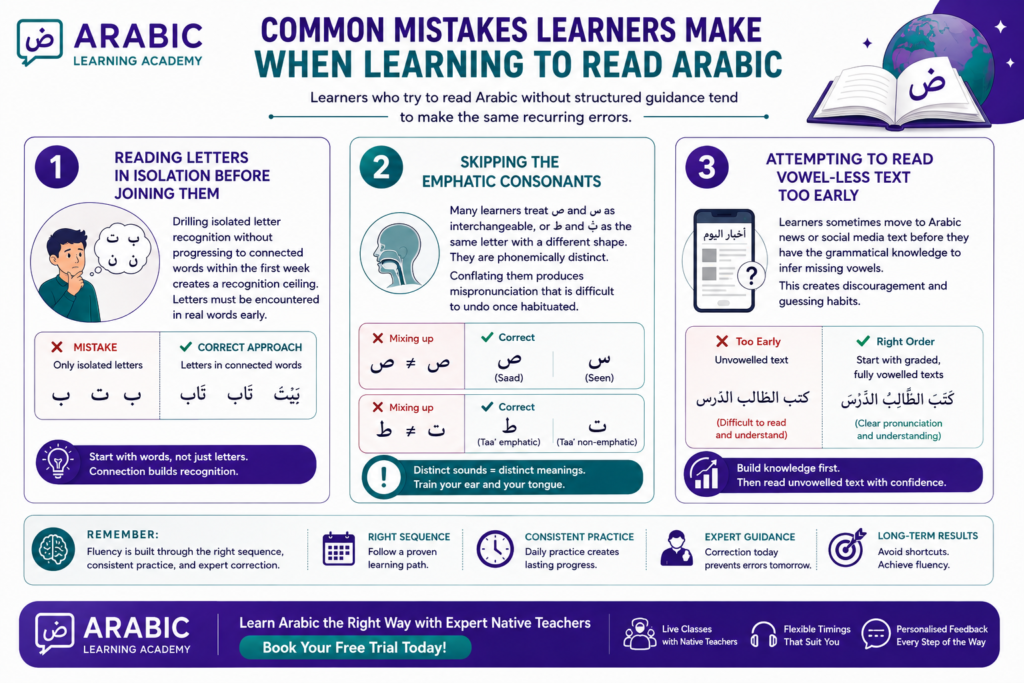
1. Reading Letters in Isolation Before Joining Them
Drilling isolated letter recognition without progressing to connected words within the first week creates a recognition ceiling. Letters must be encountered in real words early.
2. Skipping the Emphatic Consonants
Many learners treat ص and س as interchangeable, or ط and ت as the same letter with a different shape. They are phonemically distinct. Conflating them produces mispronunciation that is difficult to undo once habituated.
Read Also: Does Arabic Read Right to Left?
3. Attempting to Read Vowel-Less Text Too Early
Learners sometimes move to Arabic news or social media text before they have the grammatical knowledge to infer missing vowels. This creates discouragement and guessing habits. Graded, fully vowelled texts should precede unvowelled reading by at least six months of structured study.
Learners who work through The Arabic Learning Centre’s Fusha Arabic Course receive dedicated phonetics instruction for exactly these sounds in the early weeks of the programme.
Book Your Free Trial for Fusha Arabic Course Now!

Read Also: Can I Learn Arabic in 3 Months?
A Realistic Timeline for Reading Arabic at Each Level
How hard it is to read Arabic to learn is partly a question of how long it takes to reach functional reading.
| Stage | Milestone | Approximate Duration (Consistent Study) |
| Pre-A1 | Recognize all 28 letters in isolation | 1–2 weeks |
| A1 | Read simple vowelled words aloud | 4–8 weeks |
| A2 | Read fully vowelled sentences with fluency | 3–6 months |
| B1 | Begin reading partially vowelled texts | 6–12 months |
| B2+ | Read unvowelled standard Arabic text | 18–36 months |
These timelines assume consistent daily study of 30–60 minutes. Learners with live instruction progress through the early stages significantly faster than self-study learners because mispronunciation and script errors are corrected immediately rather than compounding.
Read Also: Basic Arabic Reading Practice For Beginners
Don’t Just Take Our Word For It
Take a look inside our vibrant classes and see our students and teachers in action. Click below to watch our classroom experience:
Start Reading Arabic with Expert Guidance at The Arabic Learning Centre Today!
The Arabic Learning Centre offers structured, expert-led courses that take learners from absolute beginner to confident reader, across Modern Standard Arabic, Quranic Arabic, and Classical Arabic. Every course is taught by native Arabic tutors who understand exactly where non-native speakers struggle and how to correct it.
Why learners choose The Arabic Learning Centre:
- Native tutors with specialist Arabic-pedagogy training
- Structured progression from script recognition to full reading fluency
- Live sessions and recorded materials for flexible scheduling
- Available across time zones at competitive pricing
- Free trial to assess your current level before committing
Courses We Offer:
- Business Arabic Course
- Learn Arabic from Zero
- Medical Arabic Course
- Learning Arabic for Non Arabic Speakers
- Learn Arabic in Saudi Arabia
- Learn to Read Arabic Course
- Arabic Grammar Course
- Arabic Speaking Course
- Arabic Script writing course
- Arabic Vocabulary Course
- Arabic Pronunciation Course
Book your free trial today and begin reading Arabic with a structured method that works.
Book your free trial lesson today!

Conclusion
Learning to read Arabic can feel challenging at first because of its unfamiliar script, connected letter forms, hidden short vowels, and distinctive sounds. However, these difficulties are concentrated in the early stages and become more manageable with structured practice.
Progress depends on building the right skills in sequence: recognizing positional letter forms, reading vowelled text, developing accurate pronunciation, and gradually learning to interpret unvowelled words through grammar and context. Consistent practice makes reading increasingly automatic.
The learning path also depends on the learner’s goal, whether reading Modern Standard Arabic, Quranic Arabic, or classical texts. With appropriate materials, regular practice, and expert guidance, beginners can develop reliable reading skills and steadily progress toward fluent Arabic reading.
Frequently Asked Questions
Is Arabic hard to read compared to other foreign languages?
Arabic is harder to read initially than most European languages for English speakers, but the difficulty is front-loaded. The script, positional letter forms, and vowel system present genuine early barriers. Once those are cleared, typically within the first three to six months of structured study, reading progress follows a more standard curve.
Does reading Arabic require learning grammar first?
For basic, vowelled text, such as the Quran or beginner textbooks, minimal grammar knowledge is needed. For reading unvowelled standard Arabic text, which is most printed and digital Arabic content, grammatical competence is essential. Without it, a reader cannot supply the missing short vowels that determine word meaning and function.
Can an adult learn to read Arabic without prior language experience?
Yes. Adults with no prior Arabic exposure regularly reach functional reading ability with consistent daily study. The absence of cognates between Arabic and English is a real disadvantage compared to, say, learning Spanish, but it does not make Arabic unlearnable. Most adult beginners can read simple, fully vowelled Arabic sentences within two to three months.
Is reading Quranic Arabic harder than reading Modern Standard Arabic?
For beginners, Quranic Arabic is in one way easier to read aloud: the Quran is always printed with full harakat (vowel markings), so no vowel inference is required. The added difficulty is Tajweed, the precise recitation rules governing sound interactions, elongations, and nasalization that are obligatory in Quranic recitation but absent from standard reading instruction.
How long does it take to read Arabic fluently without vowel marks?
Reaching fluency in unvowelled Arabic text typically requires 18 to 36 months of consistent, structured study at 30–60 minutes per day. This timeline shortens significantly with live instruction, because mispronunciation and script-reading errors are corrected immediately rather than becoming habituated patterns over months of self-study.
Is it possible to read Arabic without being able to speak it?
Technically, yes, reading and speaking draw on overlapping but distinct skill sets. Many learners of Quranic Arabic, for example, develop strong recitation and reading ability without conversational fluency.
In practice, however, oral production reinforces phoneme recognition, which improves reading speed. Keeping both skills developing in parallel produces faster overall progress.
What is the single most common mistake beginners make when learning to read Arabic?
The most common mistake is conflating letters that look similar in their isolated forms but are phonemically and graphically distinct in connected text. The pairs ح/خ, ص/س, ط/ت, and ض/د cause the most confusion. Treating them as variants of the same letter produces both pronunciation errors and reading misidentification that compound over time if not corrected early.