 Arabic Vocabulary & Speaking
Walk into a mosque, a Muslim household, or even a text message thread between Muslim friends, and you will hear the same few words exchanged again and again. They carry warmth, blessing, and centuries of shared meaning. Learning them properly is often a new student’s first real step into the Arabic language.
This guide breaks down the standard muslim greeting in Arabic, its exact pronunciation, its grammatical structure, and the correct responses. You will also find the everyday variations of muslim greetings in Arabic used across different contexts, from formal gatherings to casual conversations among friends.
The Standard Muslim Greeting in Arabic and Its Meaning
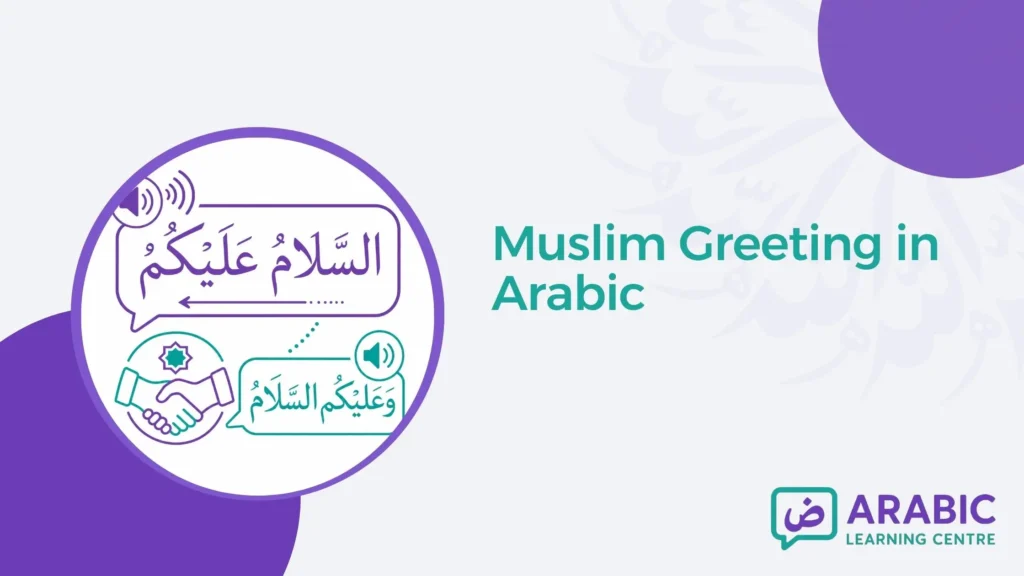
The core muslim greeting in Arabic is السَّلَامُ عَلَيْكُمْ (As-salamu alaykum), meaning “peace be upon you.” It is rooted in the word salam, meaning peace, and functions as both a greeting and a prayer for the listener.
This phrase is not a casual hello. Structurally, it is a nominal sentence (jumla ismiyya) in Classical Arabic, where السَّلَامُ (peace) is the subject and عَلَيْكُمْ (upon you) is the predicate phrase built from the preposition ala plus the second-person plural pronoun suffix -kum.
Non-native learners frequently mispronounce the emphatic س (seen) sound or shorten the long vowels, turning “salamu” into a clipped “salam-oo.” Correct pronunciation preserves each madd (elongation) mark, giving the phrase its full, resonant rhythm.
Students who want to master this rhythm properly, along with the wider grammar patterns behind Arabic greetings, often start with The Arabic Learning Centre’s Arabic Speaking Course, where native tutors correct pronunciation live rather than leaving learners to guess from transliteration alone.
Book Your Free Trial for Arabic Speaking Course Now!
Correct Pronunciation of As Salamu Alaykum for Non Native Speakers
The phrase breaks into four syllabic units: As-sa-LA-mu a-LAY-kum. English speakers commonly stress the wrong syllable, emphasizing the first sound instead of the elongated middle vowel.
The table below maps each sound to its closest English approximation, since transliteration alone often misleads beginners into flattening the vowels.
| Arabic Segment | Transliteration | English Sound Comparison | Common Learner Mistake |
| السَّلَامُ | As-salamu | “sa-LAH-moo” with a held middle vowel | Rushing through the long “aa” |
| عَلَيْ | alay | “uh-LIE,” rhymes with “sky” | Pronouncing it as “ah-lay” |
| كُمْ | kum | short, clipped “koom” | Softening the final “m” |
The emphatic س here is a plain seen, not the heavier ص (sad), which is a distinction many beginners blur. Confusing these two letters changes meaning in other words and is one of the most persistent errors among English-speaking learners.
Inside Our Classrooms
See how we make learning interactive and engaging! Watch a quick snippet of our live, conversational classes in action:
Correct Grammatical Response to the Muslim Greeting in Arabic
The proper reply to As-salamu alaykum is وَعَلَيْكُمُ السَّلَامُ (Wa alaykumu as-salam), meaning “and upon you be peace.” Reversing the word order signals a returned, reciprocal blessing rather than a repeated statement.
Grammatically, the response inverts the sentence: the predicate phrase عَلَيْكُمُ now comes first, followed by the subject السَّلَامُ. This inversion is intentional and follows classical Arabic rhetorical convention for courteous replies.
A frequent learner mistake is simply repeating the same phrase back verbatim. While understood, it lacks the grammatical reciprocity that native speakers expect and misses the subtle politeness built into the reversal.
Some Muslims extend the response further, adding وَرَحْمَةُ اللَّهِ وَبَرَكَاتُهُ (wa rahmatullahi wa barakatuh), meaning “and the mercy of Allah and His blessings.” This longer form is considered more complete and spiritually rewarding to offer.
Extended Forms of Muslim Greetings in Arabic Across Formal and Informal Settings
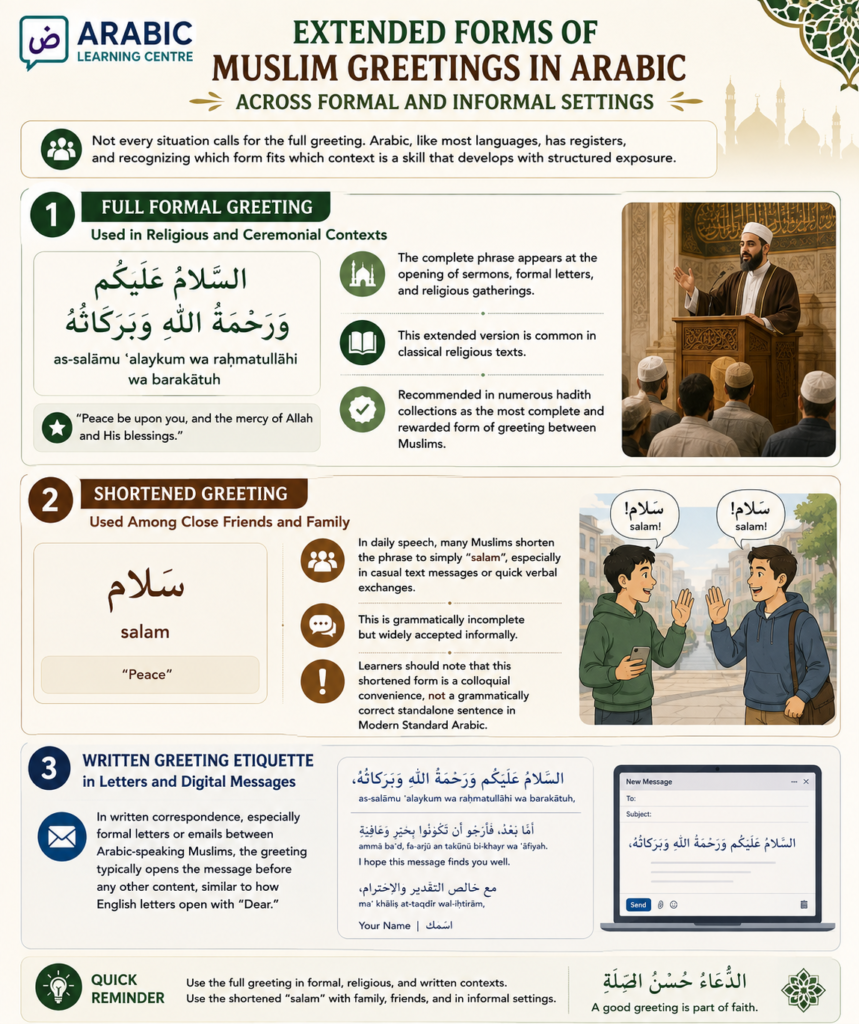
Not every situation calls for the full greeting. Arabic, like most languages, has registers, and recognizing which form fits which context is a skill that develops with structured exposure.
1. Full Formal Greeting Used in Religious and Ceremonial Contexts
The complete phrase, السَّلَامُ عَلَيْكُمْ وَرَحْمَةُ اللَّهِ وَبَرَكَاتُهُ, appears at the opening of sermons, formal letters, and religious gatherings. It carries the fullest expression of the blessing.
This extended version is common in classical religious texts and is recommended in numerous hadith collections as the most complete and rewarded form of greeting between Muslims.
2. Shortened Greeting Used Among Close Friends and Family
In daily speech, many Muslims shorten the phrase to simply سَلَام (salam), especially in casual text messages or quick verbal exchanges. This is grammatically incomplete but widely accepted informally.
Learners should note that this shortened form is a colloquial convenience, not a grammatically correct standalone sentence in Modern Standard Arabic. Formal writing and religious contexts still require the full phrase.
3. Written Greeting Etiquette in Letters and Digital Messages
In written correspondence, especially formal letters or emails between Arabic-speaking Muslims, the greeting typically opens the message before any other content, similar to how English letters open with “Dear.”
Digital communication has also introduced abbreviated typing such as “AS” or “salam” in Latin script among younger bilingual speakers, though these shortcuts are discouraged in any formal or academic Arabic writing.
Quranic and Prophetic Foundation Behind the Muslim Greeting in Arabic
The greeting of peace is not a cultural custom alone. It has direct textual roots in the Quran and in the recorded sayings of the Prophet Muhammad, peace be upon him.
وَإِذَا حُيِّيتُم بِتَحِيَّةٍ فَحَيُّوا بِأَحْسَنَ مِنْهَا أَوْ رُدُّوهَا
Wa itha huyyitum bitahiyyatin fahayyu bi ahsana minha aw ruduha
“And when you are greeted with a greeting, greet [in return] with one better than it or return it [in a like manner].” (An-Nisa 4:86)
This verse establishes the grammatical and social logic behind the reciprocal response discussed earlier. Returning a greeting equally, or with something better, is a textual command, not merely a polite habit.
Students pursuing deeper study of these textual foundations, and the Classical Arabic grammar used across the Quran and hadith literature, typically benefit from The Arabic Learning Centre’s Arabic Course for Islamic Studies, which is structured to connect grammar directly to primary religious texts.
Book Your Free Trial for Arabic Course for Islamic Studies Now!
Common Vocabulary Building Strategy for Mastering Arabic Greetings and Related Phrases
Greetings are rarely used in isolation. Native speakers pair them with follow-up questions and responses, forming a small but essential vocabulary cluster every beginner should memorize together.
The table below groups the core exchange phrases that typically follow the initial greeting in everyday conversation.
| Arabic Phrase | Transliteration | English Meaning |
| كَيْفَ حَالُكَ؟ | Kayfa haluka? | How are you? (to a male) |
| كَيْفَ حَالُكِ؟ | Kayfa haluki? | How are you? (to a female) |
| بِخَيْرٍ، الْحَمْدُ لِلَّه | Bikhayrin, alhamdulillah | I am well, praise be to Allah |
| مَعَ السَّلَامَة | Ma’a as-salama | Goodbye (literally, “with safety”) |
Notice that الْحَمْدُ لِلَّه (alhamdulillah) attaches naturally to nearly every positive response, reflecting how deeply gratitude to Allah is woven into ordinary Arabic speech patterns.
Building vocabulary in clusters like this, rather than memorizing isolated words, mirrors how The Arabic Learning Centre’s Arabic Vocabulary Course structures its lessons, grouping functional phrases so learners retain them through real conversational context.
Book Your Free Trial for Arabic Vocabulary Course Now!
Correct Usage Rules for When to Use the Muslim Greeting in Arabic
Cultural and religious etiquette shape when this greeting applies, and misapplying it is a common source of confusion for new learners navigating Arabic-speaking or Muslim social spaces.
Appropriate Contexts for Offering the Greeting
The greeting is traditionally offered between Muslims and is considered a recommended act of good conduct. It is also commonly extended to guests, regardless of faith, as a gesture of hospitality and welcome.
Entering a room, meeting someone after time apart, or beginning a phone call are all standard moments where the greeting naturally opens the interaction, much like “hello” functions in English.
Read Also: Food in the Arabic Language for Beginners Learners
Situations Where a Simpler Greeting Is More Suitable
In mixed or secular professional settings, a neutral مَرْحَبًا (marhaban), meaning “welcome” or “hello,” is often more contextually appropriate than the religious greeting, particularly in international business Arabic.
Recognizing this distinction between religiously rooted greetings and neutral conversational Arabic is part of the broader cultural fluency that separates textbook Arabic from natural, situationally aware speech.
Read Also: Vegetables in Arabic
Writing the Muslim Greeting in Arabic Script Correctly
Reading the phrase is one skill; writing it correctly by hand or on a keyboard is another, and beginners frequently drop or misplace the diacritical marks that shape correct pronunciation.
The connecting letters within السَّلَامُ عَلَيْكُمْ shift form depending on their position in the word, following the standard initial, medial, and final letter shapes of the Arabic script.
The shadda (ّ) over the س doubles its sound, a detail often omitted by beginners typing quickly, which subtly changes the phonetic weight of the entire opening word.
Mastering these script mechanics, including harakat placement and letter-joining rules, is foundational work covered step by step in The Arabic Learning Centre’s Arabic Script Writing Course, designed specifically for learners moving from recognition to confident handwriting.
Book Your Free Trial for Arabic Script Course Now!
Read Also: Colors in Arabic Explained for English-Speaking Learners at Every Level
Structured Learning Path for Mastering Arabic Greetings and Beyond
Greetings form only the entry point into a much larger grammatical and cultural system. Progressing beyond memorized phrases requires structured exposure to sentence patterns, morphology, and listening practice.
| Learner Stage | Primary Focus | Recommended Course |
| Beginner | Alphabet, greetings, basic sentences | Arabic Classes for Non-Arabic Speakers |
| Intermediate | Grammar, root patterns, vocabulary expansion | Arabic Grammar Course |
| Advanced | Classical texts, Quranic Arabic, literary analysis | Advanced Arabic Course |
This staged approach reflects how The Arabic Learning Centre structures its curriculum, moving learners methodically from a first greeting to genuine fluency across reading, writing, listening, and speaking.
Read Also: Family Members in Arabic Names
Don’t Just Take Our Word For It
Take a look inside our vibrant classes and see our students and teachers in action. Click below to watch our classroom experience:
Begin Your Arabic Learning Journey with Expert Guidance at The Arabic Learning Centre
Mastering the muslim greeting in Arabic is a small but meaningful first step toward genuine fluency in reading, writing, and speaking Arabic with confidence.
The Arabic Learning Centre offers:
- Native Arabic tutors with certified teaching experience
- A structured curriculum spanning beginner to advanced levels
- Live sessions combined with recorded materials for flexible review
- Scheduling across multiple time zones for international students
- Affordable pricing with a genuinely global reach
Courses We Offer:
- Online Arabic Course
- Classical arabic course
- Modern Standard Arabic Course
- Fusha Arabic Course
- Learn Saudi Arabic
- Arabic Course for Beginners
- Arabic Classes for Adults
- Arabic Classes for Ladies
- Advanced Arabic Course
- Intensive Arabic Course
Ready to move beyond memorized phrases into real conversational Arabic? Book your free trial today and start learning with a dedicated native tutor.
Book your free trial lesson today!
Conclusion
A single greeting carries grammar, history, and faith within a few short syllables, making it one of the richest starting points for any serious Arabic learner to study closely.
From the reciprocal response structure to the Quranic verse that commands it, this phrase connects directly to centuries of linguistic and religious tradition.
Whether spoken formally in a mosque or shortened between friends over text, mastering its correct form opens the door to deeper, more confident Arabic communication.
Frequently Asked Questions
What does the muslim greeting in Arabic literally mean?
السَّلَامُ عَلَيْكُمْ literally means “peace be upon you.” The word salam (peace) functions as the subject of the sentence, while alaykum attaches the blessing directly to the listener.
Beyond the literal translation, the phrase carries the weight of a prayer. Saying it aloud is understood as invoking protection and well-being on the person being addressed, not simply a social formality.
Is it correct to say salam alaykum instead of the full greeting?
سَلَام عَلَيْكُم without the initial “As-” is grammatically informal but widely understood and used in everyday speech. It drops the definite article prefix attached to salam in the complete form.
Formal writing, religious sermons, and academic Arabic still require the full السَّلَامُ عَلَيْكُمْ. Learners should reserve the shortened version for casual, spoken exchanges among friends.
How should non-Muslims respond to the muslim greeting in Arabic?
A polite response is simply مَرْحَبًا (marhaban) or “hello,” or returning the greeting itself if comfortable doing so. Neither response requires religious belief, since the phrase is widely used as a courteous, welcoming gesture.
Many non-Arab, non-Muslim visitors to Arabic-speaking regions choose to return the greeting exactly as given, which is generally received warmly and considered a sign of cultural respect.
Why does the response reverse the word order of the original greeting?
The response وَعَلَيْكُمُ السَّلَامُ reverses the subject and predicate to signal a distinct, reciprocal blessing rather than a mechanical echo. This inversion follows a classical rhetorical convention for courteous replies in Arabic.
Simply repeating the identical phrase back is understood, but native speakers recognize the reversed structure as the grammatically and socially correct response.
Related Articles
Arabic Vocabulary & Speaking