 Arabic Grammar
Unmarked Arabic text looks like a wall of consonants to anyone who learned the language with vowel guides. The harakat disappear in newspapers, classical books, and the Quran’s unvowelled copies — and most learners freeze when they do. But fluent readers are not guessing. They are applying a set of systems — pattern recognition, grammar rules, vocabulary recall, and contextual inference — that make the missing vowels almost predictable.
Learning how to read Arabic without harakat is not about memorising more vocabulary than everyone else. It is about training the right mental processes in the right order, so that reading unmarked text feels natural rather than stressful.
Step 1: Understand Why Arabic Can Be Read Without Harakat
The first step in learning how to read Arabic without harakat is understanding why the system works at all — because it is not guesswork.
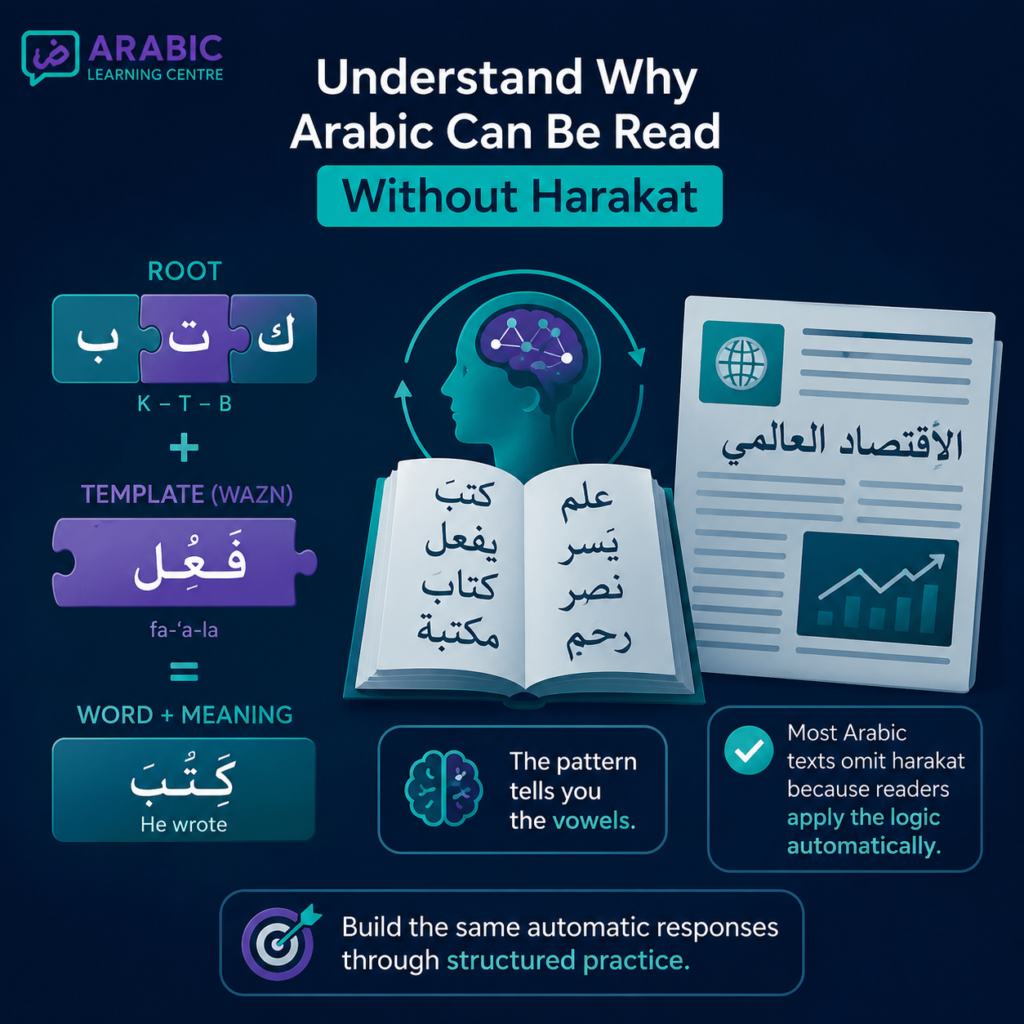
Arabic is a root-based language. Almost every word descends from a three-letter root that slots into a fixed template, called a wazn (وَزْن). The root tells you the core meaning; the template tells you the grammatical function — and the template determines the vowels. Once you know the template, you know the vowels, even if they are not written.
The majority of written Arabic — newspapers, websites, classical texts — omits harakat because educated native readers apply this logic automatically. Your goal is to build the same automatic responses through structured practice, not to wish the marks would come back.
Step 2: Master the Six Core Arabic Word Patterns First
Understanding Arabic word patterns is the single highest-return investment you can make when learning how to read Arabic without harakat.
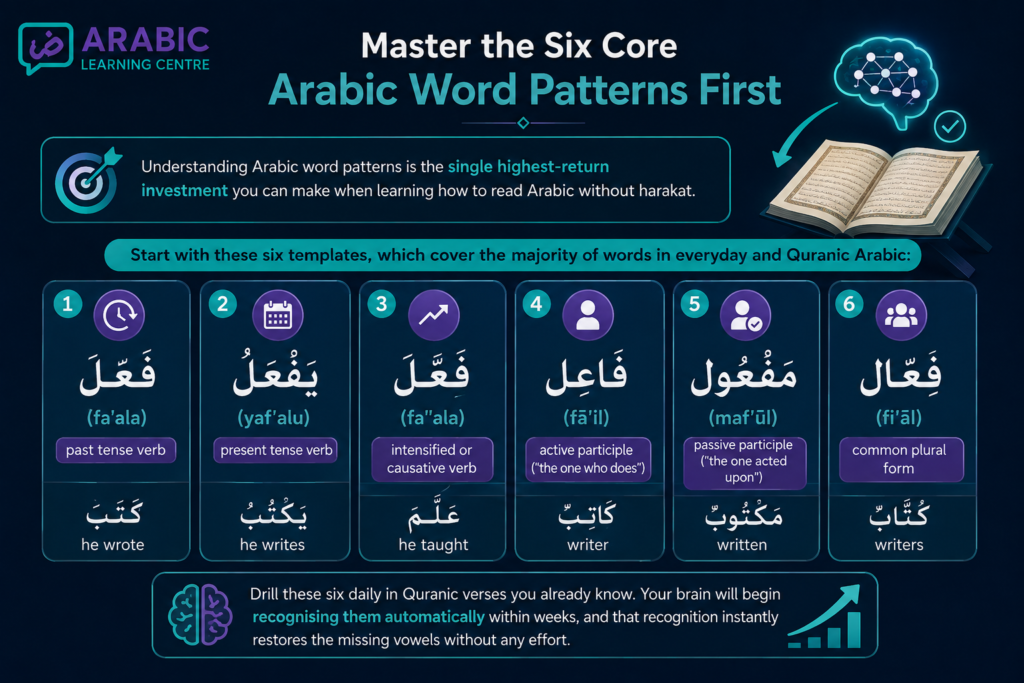
Start with these six templates, which cover the majority of words in everyday and Quranic Arabic:
- فَعَلَ (fa’ala) — past tense verb
- يَفْعَلُ (yaf’alu) — present tense verb
- فَعَّلَ (fa”ala) — intensified or causative verb
- فَاعِل (fā’il) — active participle (“the one who does”)
- مَفْعُول (maf’ūl) — passive participle (“the one acted upon”)
- فِعَال (fi’āl) — common plural form
Drill these six daily in Quranic verses you already know. Your brain will begin recognising them automatically within weeks, and that recognition instantly restores the missing vowels without any effort.
If you want to build this skill with proper guidance from the start, working with an experienced Arabic teacher will shorten your learning curve significantly — a qualified instructor can identify which patterns you misread and correct them before they become habits.
Begin Your Arabic Learning Journey with a Free Trial

Inside Our Classrooms
See how we make learning interactive and engaging! Watch a quick snippet of our live, conversational classes in action:
Step 3: Build Vocabulary Recognition to 500 High-Frequency Words
Vocabulary is the second engine of unvowelled reading. When you already know a word, its missing vowels are irrelevant — you supply them from memory instantly.
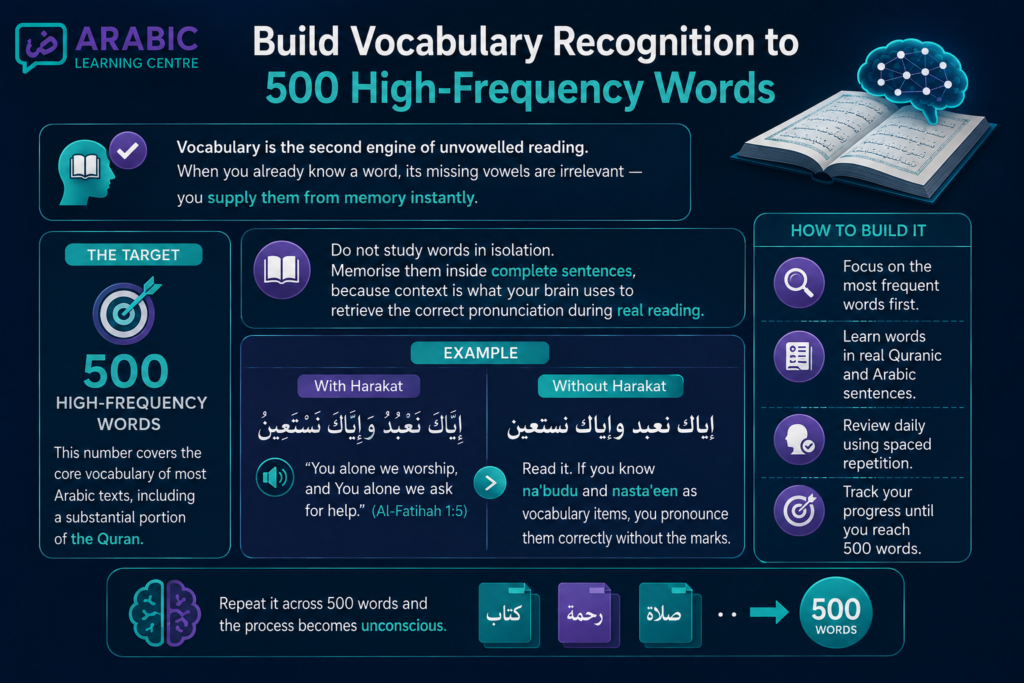
The practical target for beginners is 500 high-frequency words. This number covers the core vocabulary of most Arabic texts, including a substantial portion of the Quran. Do not study words in isolation. Memorise them inside complete sentences, because context is what your brain uses to retrieve the correct pronunciation during real reading.
Use this verse as an example:
إِيَّاكَ نَعْبُدُ وَإِيَّاكَ نَسْتَعِينُ
“You alone we worship, and You alone we ask for help.” (Al-Fatihah 1:5)
Strip the harakat and read it. If you know na’budu and nasta’een as vocabulary items, you pronounce them correctly without the marks. That is the mechanism. Repeat it across 500 words and the process becomes unconscious.
Step 4: Learn the Three Grammatical Cases — They Tell You the Final Vowel
Grammar knowledge is what allows you to read Arabic without tashkeel accurately at sentence level, not just word level. Arabic uses three grammatical cases, and each one corresponds to a specific vowel on the word’s final letter:
| Case | Arabic Term | Vowel Sound | Typical Usage |
| Nominative | Raf’ | Damma (u) | Subject, predicate |
| Accusative | Nasb | Fatha (a) | Direct object, adverbs |
| Genitive | Jarr | Kasra (i) | After prepositions, possessives |
This means that once you identify a word’s grammatical role in a sentence — which the word order and prepositions tell you — you know its final vowel automatically.
A common mistake at this stage: learners try to apply case rules to isolated words. Cases only make sense inside sentences. Always practise grammar in full sentence context, not vocabulary lists.
For adults building this skill from an intermediate level, a structured Arabic course for adults that covers Nahw (syntax) alongside reading practice is the most efficient path forward.
Build Real Arabic Skills with Personalized Lessons

Step 5: Start Reading Memorised Quranic Verses Without Marks
This is the most underused technique in learning how to read Arabic without harakat — and one of the most effective. Take five verses you have memorised perfectly, write them on paper without any harakat, and read them back.
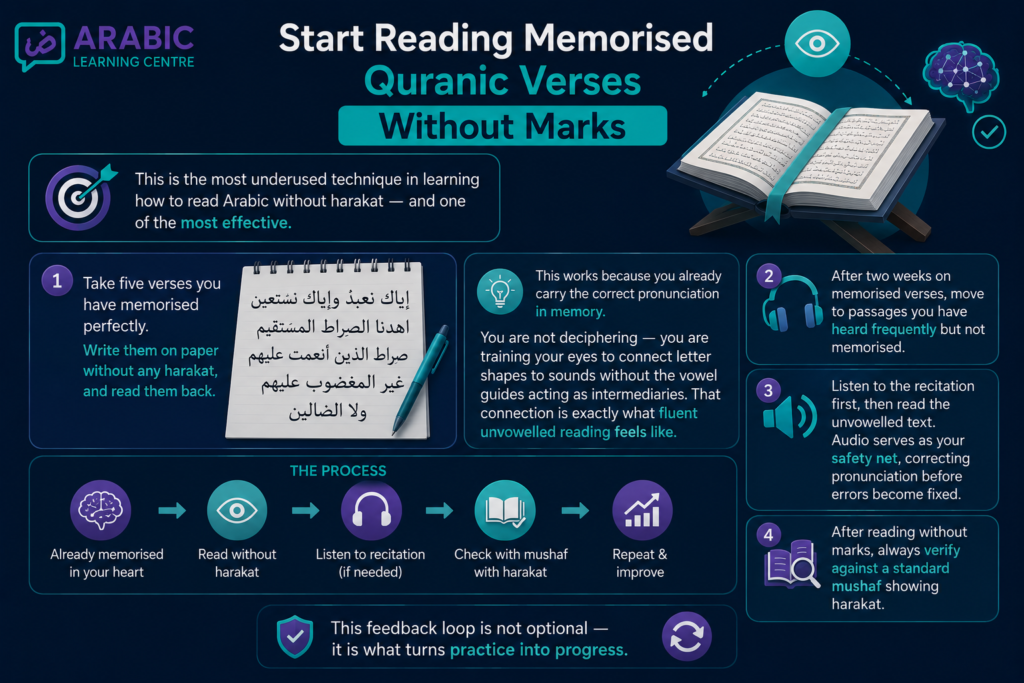
This works because you already carry the correct pronunciation in memory. You are not deciphering — you are training your eyes to connect letter shapes to sounds without the vowel guides acting as intermediaries. That connection is exactly what fluent unvowelled reading feels like.
After two weeks on memorised verses, move to passages you have heard frequently but not memorised. Listen to the recitation first, then read the unvowelled text. Audio serves as your safety net, correcting pronunciation before errors become fixed.
After reading without marks, always verify against a standard mushaf showing harakat. This feedback loop is not optional — it is what turns practice into progress.
Step 6: Use Context to Predict Vowels in Unfamiliar Text
Context is the third engine of unvowelled reading, working alongside patterns and vocabulary. Arabic sentences follow predictable structural rules: verbal sentences (فعل + فاعل) typically open with a verb carrying fatha; nominal sentences (مبتدأ + خبر) typically open with a subject carrying damma.
Reading entire sentences rather than individual words activates this system. Your brain uses the sentence’s meaning and structure together to narrow down which vowel fits — and in most cases only one vowel does fit.
A practical method: when you read a word you cannot immediately pronounce, read the rest of the sentence first. Return to the unknown word. In most cases, the sentence’s meaning and grammar have already supplied the answer.
For learners reaching advanced Arabic, this contextual reading skill is what separates intermediate students from truly fluent readers. A dedicated advanced Arabic course builds exactly this capacity alongside complex grammar structures.
Take Your Arabic to the Next Level with Expert Guidance

Read Also: How to Read Arabic Calligraphy
Step 7: Read Arabic Newspapers and Unvowelled Digital Texts Regularly
Genuine fluency in reading Arabic without harakat — including how to read Arabic without harakat free — requires exposure to real-world text. Newspapers, websites, and modern Arabic literature rarely include tashkeel. They are your training ground.
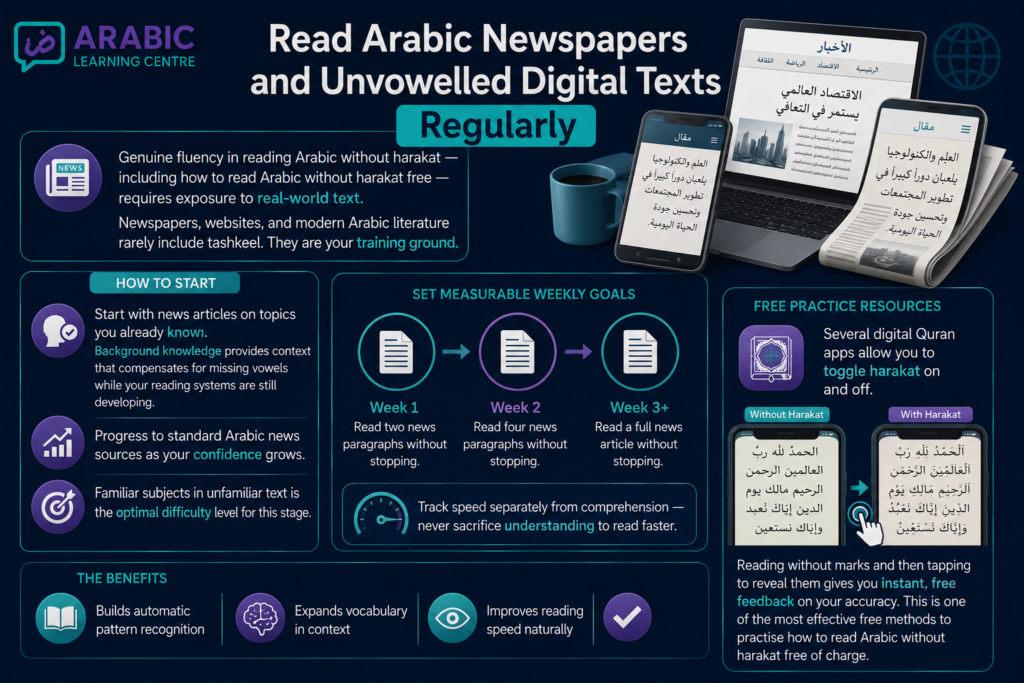
Start with news articles on topics you already know. Background knowledge provides context that compensates for missing vowels while your reading systems are still developing. Familiar subjects in unfamiliar text is the optimal difficulty level for this stage.
Progress to standard Arabic news sources as your confidence grows. Set measurable weekly goals: read two news paragraphs without stopping, then four, then a full article. Track speed separately from comprehension — never sacrifice understanding to read faster.
A note on free practice resources: Several digital Quran apps allow you to toggle harakat on and off. Reading without marks and then tapping to reveal them gives you instant, free feedback on your accuracy. This is one of the most effective free methods to practise how to read Arabic without harakat free of charge.
Read Also: How to Read Arabic Dates?
Step 8: Build a Consistent Daily Practice Routine
Consistency determines progress more than any single method. Twenty focused minutes daily produces faster results than three hours on a weekend, because the brain consolidates language skills through repeated short exposures, not occasional marathon sessions.
A simple 20-minute daily session structure:
| Minutes | Activity | Goal |
| 0–5 | Pattern drills | Strengthen template recognition |
| 5–10 | Vocabulary review | Build word recall speed |
| 10–15 | Grammar exercise | Reinforce case-ending logic |
| 15–20 | Reading practice | Apply all three systems together |
Set monthly targets that are specific and countable: read five new unvowelled pages, identify twenty new word patterns, master thirty new vocabulary items. Vague goals (“get better at reading”) do not generate the accountability that keeps practice consistent.
For sisters who prefer a focused learning environment with female instructors, a structured Arabic course for ladies offers the same systematic progression in a comfortable setting.
Study Arabic with Experienced Female Instructors

Read Also: How to Read Arabic for Beginners?
Don’t Just Take Our Word For It
Take a look inside our vibrant classes and see our students and teachers in action. Click below to watch our classroom experience:
Master Reading Arabic Without Harakat with Arabic Learning Centre
Reading unvowelled Arabic is a learnable, teachable skill. The systems described here — patterns, grammar, vocabulary, context — work when they are practised in the right order with proper feedback.
Arabic Learning Centre offers structured courses taught by certified native Arabic instructors, designed to take you from harakat-dependent reading to confident unvowelled fluency. Every student receives a personalised learning plan, flexible scheduling across Western time zones, and live pronunciation feedback in every session.
Book your free trial class today and begin the transition from guessing vowels to reading Arabic the way fluent readers do — automatically, accurately, and independently.
Courses We Offer:
- Online Arabic Course
- Classical arabic course
- Modern Standard Arabic Course
- Fusha Arabic Course
- Learn Saudi Arabic
- Arabic Course for Beginners
- Arabic Classes for Adults
- Arabic Classes for Ladies
- Advanced Arabic Course
- Intensive Arabic Course

Conclusion
Learning how to read Arabic without harakat is not about removing a crutch — it is about building three independent systems: root-pattern recognition, grammatical case knowledge, and contextual inference. Each one contributes a different layer of information. Together, they make the correct vowel almost always recoverable, even in unfamiliar text.
The progression matters. Start with memorised Quranic verses, advance to semi-familiar passages, then move to modern newspapers and unvowelled literature. At every stage, verify against marked text to close the feedback loop. Practise daily in short, structured sessions rather than occasional long ones.
Within months of this approach, reading Arabic without tashkeel shifts from an obstacle into a natural state — the way Arabic has always been read by those who know the language well.
Frequently Asked Questions
Reading Arabic without harakat raises many questions, especially for learners transitioning from fully vowelled texts. Here are clear, practical answers to the most common questions to help you build confidence and read more accurately.
What is the best starting point for reading Arabic without harakat?
The best starting point is the Quranic verses you have already memorised. Write them without harakat and read them back. Because you already hold the correct pronunciation in memory, this method trains eye-to-sound connection without the risk of reinforcing wrong vowels.
How long does it take to read Arabic without harakat confidently?
Most learners who practise daily using pattern recognition, grammar case rules, and vocabulary memorisation reach functional unvowelled reading within three to six months. Progress depends heavily on consistency and the quality of feedback received during practice.
Can I learn how to read Arabic without harakat free?
Yes. Free methods include digital Quran apps that let you toggle harakat on and off, listening to recitations while following unvowelled text, and reading Arabic news websites. These tools provide real practice and immediate verification at no cost.
What is the difference between harakat and tashkeel?
Harakat and tashkeel refer to the same system of short vowel marks used in Arabic writing. Harakat (حَرَكَات) is the more classical term referring to the “movements” of the letters, while tashkeel (تَشْكِيل) refers to the act of marking or shaping the text. Reading Arabic without harakat and reading Arabic without tashkeel are the same challenge.
Why does standard written Arabic not include harakat?
Standard Arabic omits harakat because educated readers reconstruct vowels from root patterns, grammatical rules, and context — all systems that become automatic through formal Arabic education. Harakat are included in the Quran, children’s books, and language-learning materials where precision is essential and the reader cannot yet be expected to supply vowels independently.
Is grammar really necessary for reading unvowelled Arabic?
Yes — particularly for word endings. The grammatical case system (raf’, nasb, jarr) directly controls the final vowel of most words. Without knowing which case applies, you cannot reliably pronounce word endings in running text. Grammar is not optional; it is the rule system that makes the final layer of unvowelled reading accurate.
Related Articles
Arabic Grammar