 Arabic Alphabet & Writing
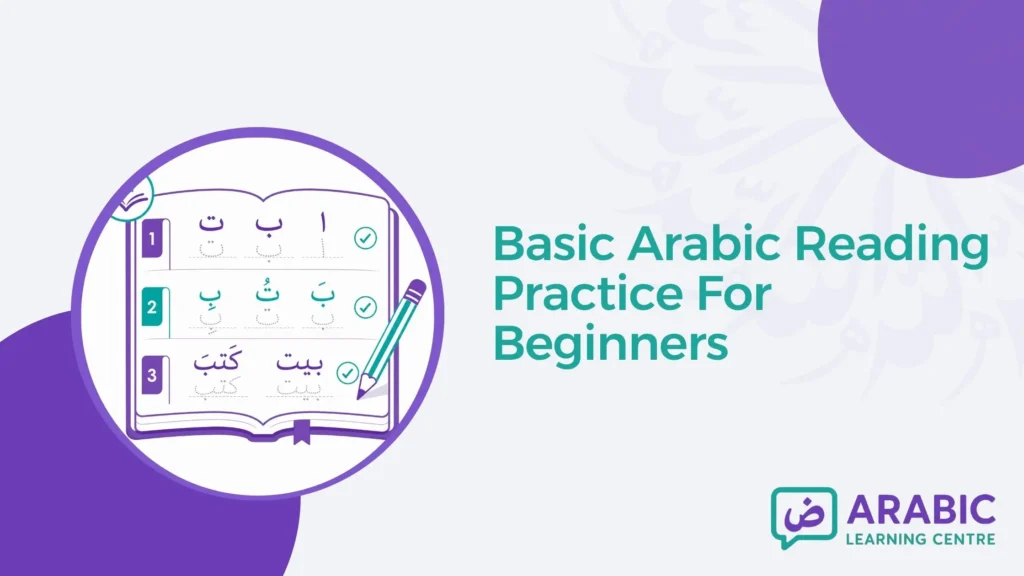
Arabic script looks intimidating the first time you see it flow right to left across a page. Curved letters connect and shift shape, and vowels hide as small marks above and below.
Yet consistent basic Arabic reading practice builds real fluency faster than most learners expect. This guide breaks down the alphabet, diacritics, pronunciation, and daily routines that turn hesitant reading into confident, accurate Arabic literacy.
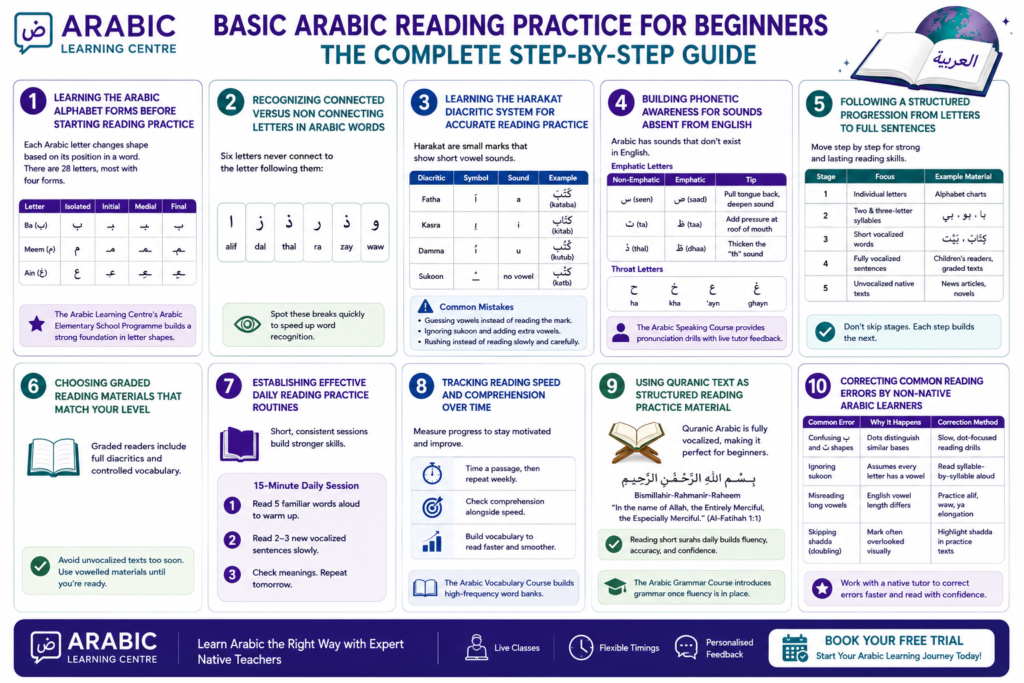
1. Learning The Arabic Alphabet Forms Before Starting Reading Practice
Arabic reading practice becomes possible once you recognize that each letter changes shape depending on its position in a word.
There are 28 letters, and most have four distinct forms: isolated, initial, medial, and final. This is the single biggest hurdle for new readers.
Unlike English, where letters keep one fixed shape, Arabic letters connect to their neighbors. A beginner attempting arabic reading practice without mastering these shapes will misread words constantly.
| Letter Name | Isolated | Initial | Medial | Final |
| Ba (ب) | ب | بـ | ـبـ | ـب |
| Meem (م) | م | مـ | ـمـ | ـم |
| Ain (ع) | ع | عـ | ـعـ | ـع |
The Arabic Learning Centre‘s Arabic Elementary School Programme dedicates its opening unit entirely to letter shapes, since this foundation determines every reading skill that follows.
Book Your Free Trial for Arabic Elementary School Programme Now!

2. Recognizing Connected Versus Non Connecting Letters In Arabic Words
Six letters never connect to the letter following them: alif (ا), dal (د), thal (ذ), ra (ر), zay (ز), and waw (و).
This creates visible “breaks” within otherwise joined words. Spotting these breaks quickly speeds up word recognition during any Arabic reading practice session.
3. Learning The Harakat Diacritic System For Accurate Basic Arabic Reading Practice
Harakat are the small marks above and below letters that represent short vowel sounds. Without them, a word’s pronunciation and meaning both stay ambiguous.
The three core diacritics are fatha (a short “a”), kasra (a short “i”), and damma (a short “u”). A fourth mark, sukoon, indicates the absence of a vowel.
| Diacritic | Symbol | Sound | Example |
| Fatha | ــَ | “a” | كَتَبَ (kataba) |
| Kasra | ــِ | “i” | كِتاب (kitab) |
| Damma | ــُ | “u” | كُتُب (kutub) |
| Sukoon | ــْ | no vowel | كَتْب (katb) |
Beginners often skip diacritics entirely once they feel confident, which is a mistake. Fully vocalized text remains essential for correct basic Arabic reading practice until word recognition becomes automatic.
Common Mistakes Learners Make Reading Harakat On Unfamiliar Words
New readers frequently guess a vowel based on similar-looking English words rather than reading the actual mark. This produces mispronunciations that compound over longer sentences.
Another frequent error is rushing past sukoon, causing learners to insert an extra vowel sound where none exists. Slow, deliberate reading corrects this habit quickly.
Inside Our Classrooms
See how we make learning interactive and engaging! Watch a quick snippet of our live, conversational classes in action:
4. Building Phonetic Awareness For Arabic Sounds Absent From English
Several Arabic letters have no equivalent sound in English, and non-native speakers need targeted phonetic training to produce them accurately.
Emphatic letters like ص, ض, ط, and ظ require a deeper, more forceful articulation than their non-emphatic counterparts س, د, ت, and ذ.
| Non-Emphatic | Emphatic | English Speaker Tip |
| س (seen) | ص (saad) | Pull tongue back, deepen sound |
| ت (ta) | ط (taa) | Add pressure at roof of mouth |
| ذ (thal) | ظ (dhaa) | Thicken the “th” sound |
Throat letters ح, خ, ع, and غ originate deeper in the vocal tract than any English consonant. Mastering them noticeably improves accuracy during Arabic reading practice.
The Arabic Speaking Course at The Arabic Learning Centre pairs pronunciation drills with live tutor feedback, correcting these sounds before they become fixed habits.
Book Your Free Trial for Arabic Speaking Course Now!

5. Following A Structured Progression From Letters To Full Sentences
Effective basic Arabic reading practice always moves through defined stages rather than jumping straight to full texts.
Learners should first master isolated letters, then two-letter combinations, then short vocalized words, and only then complete sentences.
| Stage | Focus | Example Material |
| 1 | Individual letters and shapes | Alphabet charts |
| 2 | Two and three-letter syllables | با، بو، بي |
| 3 | Short vocalized words | كِتاب، بَيْت |
| 4 | Fully vocalized sentences | Children’s readers, graded texts |
| 5 | Unvocalized native texts | News articles, novels |
Skipping stages creates fragile reading skills that collapse once diacritics disappear from advanced texts. Patience through each stage pays off substantially later.
6. Choosing Graded Reading Materials That Match Your Current Level
Graded readers designed for non-native speakers include full diacritics and controlled vocabulary. These texts let you practice Arabic reading without constant dictionary lookups interrupting comprehension.
Avoid jumping into unvocalized newspaper Arabic too early. It removes the vowel scaffolding beginners still depend on for accurate pronunciation.
7. Establishing Effective Daily Arabic Reading Practice Routines
Short, consistent sessions outperform occasional long study blocks for building durable reading skills in Arabic.
Fifteen to twenty minutes of focused daily reading strengthens letter recognition far more than a single two-hour session once a week.
Structuring A Fifteen Minute Daily Reading Session
Begin each session by reading five familiar words aloud to warm up recognition speed. This primes the brain before introducing new material.
Next, read two or three new vocalized sentences slowly, checking any unfamiliar word against its meaning. Repeat the same sentences the following day.
8. Tracking Reading Speed And Comprehension Over Time
Recording how long a passage takes to read, then repeating it weekly, reveals genuine fluency gains. Comprehension should always be checked alongside speed, not instead of it.
Vocabulary retention directly affects reading speed, since unfamiliar words force constant pausing. The Arabic Vocabulary Course builds high-frequency word banks that make reading practice noticeably smoother.
Book Your Free Trial for Arabic Vocabulary Course Now!

Read Also: How Hard Is It to Read Arabic?
9. Using Quranic Text As Structured Basic Arabic Reading Practice Material
Quranic Arabic offers fully vocalized, carefully preserved text, making it genuinely useful material for arabic reading practice, even for learners with no religious study goal.
Every word carries complete harakat, removing the ambiguity found in modern unvocalized writing. This makes pronunciation practice far more reliable for beginners.
بِسْمِ ٱللَّهِ ٱلرَّحْمَـٰنِ ٱلرَّحِيمِ
Bismillahir-Rahmanir-Raheem
“In the name of Allah, the Entirely Merciful, the Especially Merciful.” (Al-Fatihah 1:1)
Reading short, familiar surahs aloud daily reinforces letter shapes, diacritics, and rhythm simultaneously. Many students find this repetition genuinely accelerates their overall reading confidence.
The Arabic Grammar Course at The Arabic Learning Centre is structured with this sequencing in mind, introducing formal grammatical categories only once students have the vocabulary and reading fluency to contextualize the rules meaningfully.
Book Your Free Trial for Arabic Grammar Course Now!

Read Also: Does Arabic Read Right to Left?
10. Correcting Common Reading Errors Made By Non Native Arabic Learners
Certain reading mistakes appear consistently across beginner and intermediate learners, regardless of their native language background.
| Common Error | Why It Happens | Correction Method |
| Confusing ب and ت shapes | Dots distinguish similar bases | Slow, dot-focused reading drills |
| Ignoring sukoon | Assumes every letter carries a vowel | Read syllable-by-syllable aloud |
| Misreading long vowels | English vowel length differs | Practice alif, waw, ya elongation |
| Skipping shadda (doubling) | Mark often overlooked visually | Highlight shadda in practice texts |
Working through a written correction table like this one, alongside a native tutor, shortens the timeline for eliminating these habits considerably.
Read Also: Can I Learn Arabic in 3 Months?
Don’t Just Take Our Word For It
Take a look inside our vibrant classes and see our students and teachers in action. Click below to watch our classroom experience:
Begin Your Arabic Reading Journey With Expert Guidance At The Arabic Learning Centre!
Structured, guided instruction turns basic Arabic reading practice from a frustrating guessing game into steady, measurable progress.
The Arabic Learning Centre offers:
- Native Arabic tutors with structured, level-based curricula
- Live sessions plus recorded materials for flexible review
- Scheduling across global time zones
- Affordable pricing with a genuinely free trial
Courses We Offer:
- Quranic Arabic Course
- Arabic Course for Islamic Studies
- Learn Arabic for New Muslims
- Learn Arabic Letters for Tajweed
- Al Azhar Arabic Course
- Madinah Arabic Course
- Online Arabic Classes for Kids
- Arabic Words Course for Kids
- Arabic Lessons for Kindergarten
- Arabic Elementary School
- Arabic Intermediate School
- Arabic High School
Book your free trial lesson today!

Conclusion
Basic Arabic reading practice grows from mastering letter shapes, harakat, and unfamiliar phonetics before moving toward unvocalized, native-level texts confidently.
Short daily sessions paired with graded materials build measurable fluency far more reliably than occasional, unstructured long study attempts ever could.
Guided instruction from native tutors shortens this timeline considerably, turning uncertain beginners into confident, accurate readers of Arabic script.
Frequently Asked Questions
How Long Does It Take To Read Arabic Fluently As A Beginner?
Most learners recognize letter shapes within two to four weeks of daily practice. Fluent, comfortable reading of vocalized texts typically develops over six to twelve months.
Progress depends heavily on consistency rather than raw study hours. Fifteen minutes daily outperforms sporadic longer sessions for building lasting letter recognition and reading speed.
Should Beginners Practice Reading Without Diacritics Early On?
No, beginners should avoid unvocalized text until word recognition becomes automatic. Harakat provide essential pronunciation guidance that prevents guessing and reinforces correct vowel sounds.
Removing diacritics too early causes learners to memorize incorrect pronunciations. Most instructors recommend vocalized materials for the first six to nine months of study.
Is Quranic Arabic Good Practice Material For Non Religious Learners?
Yes, Quranic Arabic offers fully vocalized, precisely preserved text that benefits any learner regardless of study purpose. Complete harakat throughout makes pronunciation practice unusually reliable.
The rhythm and repetition found in short surahs also reinforce letter shapes and vowel sounds. Many secular learners use this text purely for reading structure.
What Causes Most Reading Mistakes Among English Speaking Arabic Learners?
Confusing similar letter shapes and skipping sukoon or shadda marks cause the majority of reading errors. Emphatic and throat letters also trip up English speakers regularly.
Slow, syllable-by-syllable reading paired with native tutor correction resolves these habits faster than self-study alone. Consistent feedback prevents mistakes from becoming fixed pronunciation patterns.
Can Adults Learn To Read Arabic As Effectively As Children?
Yes, adults often progress faster through structured reading stages due to stronger analytical skills and disciplined study habits. Children may absorb pronunciation slightly more naturally.
Adult learners benefit from explicit grammar and phonetic explanations that children rarely need. The Arabic Learning Centre‘s Arabic Classes for Adults structures lessons around this analytical strength.
Related Articles
Arabic Alphabet & Writing