 Arabic Alphabet & Writing
| Key Takeaways |
| The Arabic alphabet contains exactly 28 letters, all of which are consonants in their base form. |
| Arabic is written from right to left, and most letters change shape depending on their position in a word. |
| Each Arabic letter represents a unique sound, including several sounds that do not exist in English at all. |
| The 28 letters are supplemented by diacritical marks called Tashkeel that represent short vowels in the script. |
| Most adult beginners can recognize all 28 Arabic letters within three to four weeks of structured daily practice. |
The Arabic alphabet has 28 letters. Every letter is a consonant, and each one has up to four different written forms depending on where it appears in a word. This is the single most important structural fact to understand before you begin learning Arabic script — and knowing it early removes one of the biggest sources of confusion for new learners.
Those 28 letters carry an entire civilization’s worth of literature, law, theology, and poetry. For the learner sitting down with the script for the first time, though, what matters most is this: 28 letters is a genuinely manageable number, and with the right structured approach, recognizing them all is well within reach — usually within a few weeks of consistent daily practice.
How Many Letters Does the Arabic Alphabet Have?
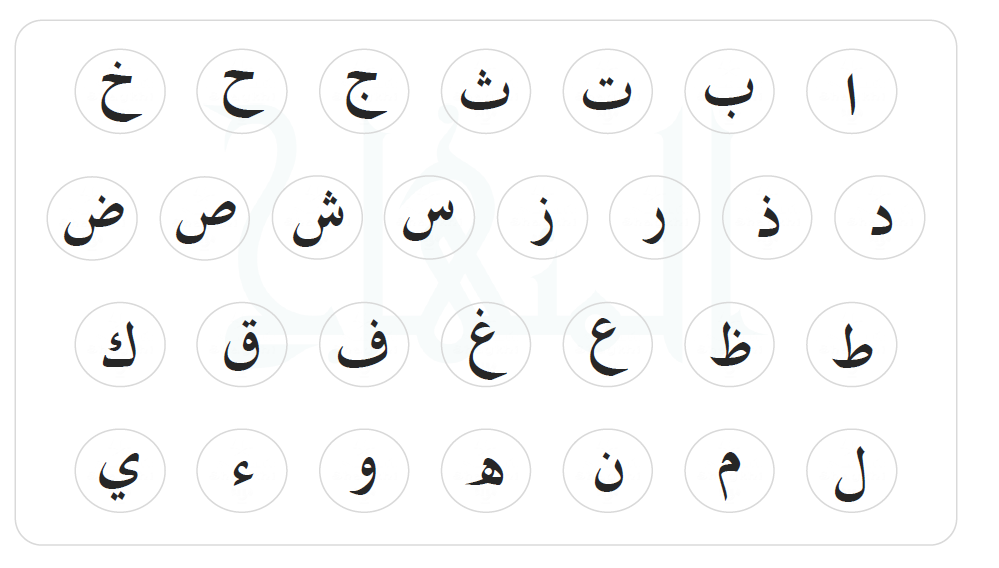
The Arabic alphabet consists of 28 letters, arranged in a fixed traditional sequence. All 28 letters are fundamentally consonants. Short vowel sounds — the Arabic equivalents of a, i, and u — are not represented by letters at all. They are written using small symbols placed above or below the letters, known collectively as Tashkeel (تشكيل) or diacritical marks.
This is one of the first genuine surprises for English-speaking learners. In English, vowels are full letters sitting on the same line as consonants.
In Arabic, short vowels are optional marks — often omitted entirely in everyday adult reading. Learners who understand this early avoid enormous confusion later.
Understanding the Arabic alphabet number of 28 is step one. Step two is accepting that each of those letters may look quite different depending on its position within a word — a rule we will cover in detail shortly.
At The Arabic Learning Centre, our Learn to Read Arabic Course begins precisely here: with the 28 letters and their positional forms, taught in a sequence that builds recognition before attempting full words. It is the most effective starting point our certified instructors have found after years of working with non-Arabic speaking adults.
Start Reading Arabic with a FREE Trial

What Are All 28 Arabic Letters?
The 28 letters of the Arabic alphabet, listed in their traditional order, are as follows. Each letter is shown with its name, its isolated form, and the English approximation of its sound.
| # | Letter Name | Arabic Script (Isolated) | Approximate Sound |
| 1 | Alif | ا | a / ā |
| 2 | Ba | ب | b |
| 3 | Ta | ت | t |
| 4 | Tha | ث | th (as in think) |
| 5 | Jim | ج | j |
| 6 | Ha | ح | strong h (pharyngeal) |
| 7 | Kha | خ | kh (as in Scottish loch) |
| 8 | Dal | د | d |
| 9 | Thal | ذ | dh (as in the) |
| 10 | Ra | ر | r (rolled) |
| 11 | Zay | ز | z |
| 12 | Sin | س | s |
| 13 | Shin | ش | sh |
| 14 | Sad | ص | emphatic s |
| 15 | Dad | ض | emphatic d |
| 16 | Ta (emphatic) | ط | emphatic t |
| 17 | Tha (emphatic) | ظ | emphatic dh |
| 18 | Ayn | ع | voiced pharyngeal (no English equivalent) |
| 19 | Ghayn | غ | gh (like a French r) |
| 20 | Fa | ف | f |
| 21 | Qaf | ق | deep k (from back of throat) |
| 22 | Kaf | ك | k |
| 23 | Lam | ل | l |
| 24 | Mim | م | m |
| 25 | Nun | ن | n |
| 26 | Ha (second) | ه | h |
| 27 | Waw | و | w / ū |
| 28 | Ya | ي | y / ī |
Several of these letters — particularly ح, ع, ص, ض, ط, and ظ — represent sounds with no direct English equivalent. These are the letters beginners struggle with most, and they deserve dedicated pronunciation work from the very beginning.
Shots Videos from Our Courses
Why Do Arabic Letters Change Shape Depending on Position?
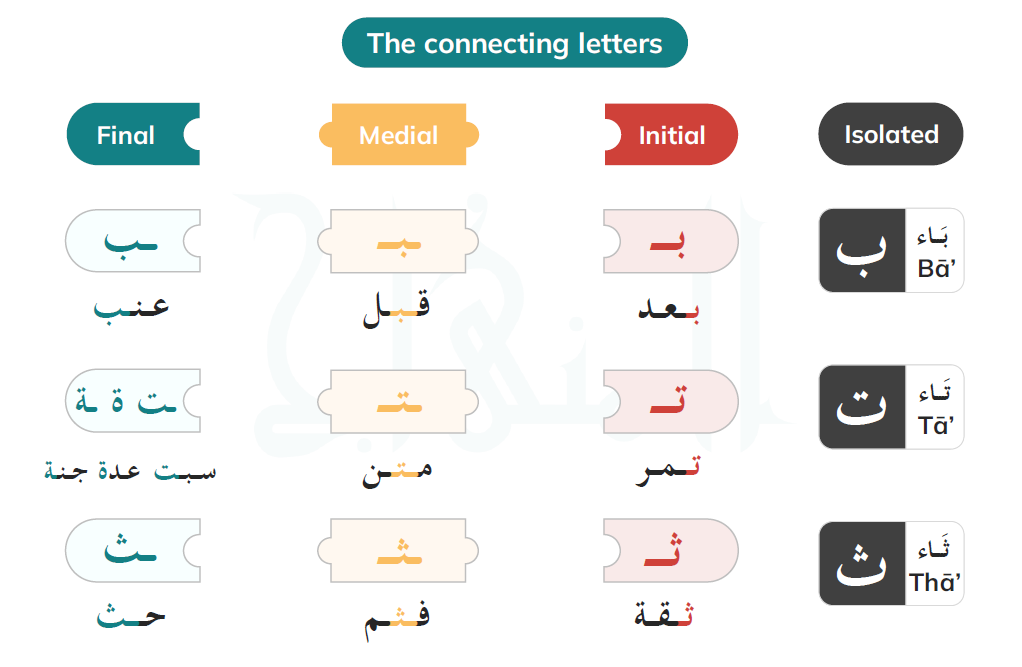
Each of the 28 Arabic letters has up to four distinct written forms: isolated, initial (start of a word), medial (middle of a word), and final (end of a word). The letter changes shape depending on which neighbors it connects to within a word.
This feature of the script causes early discouragement in many beginners. A student learns the isolated form of ب (Ba), then opens a textbook and cannot recognize it embedded inside a word.
Explore and Study Al-Menhaj Book for Free
This is the most common early stumbling block we observe at The Arabic Learning Centre — not the sounds themselves, but the realization that the same letter can look quite different in different positions.
The good news: the shape changes follow consistent, learnable patterns. Most letters have a core recognizable shape that persists across all four forms — you are learning variations on a theme, not entirely new symbols.
How the Letter Ba Changes Across Its Four Positions
| Position | Form | Example |
| Isolated | بـ | ب |
| Initial (start of word) | بـ | بَيْت (bayt — house) |
| Medial (middle of word) | ـبـ | كَبِير (kabīr — large) |
| Final (end of word) | ـب | كَتَبَ (kataba — he wrote) |
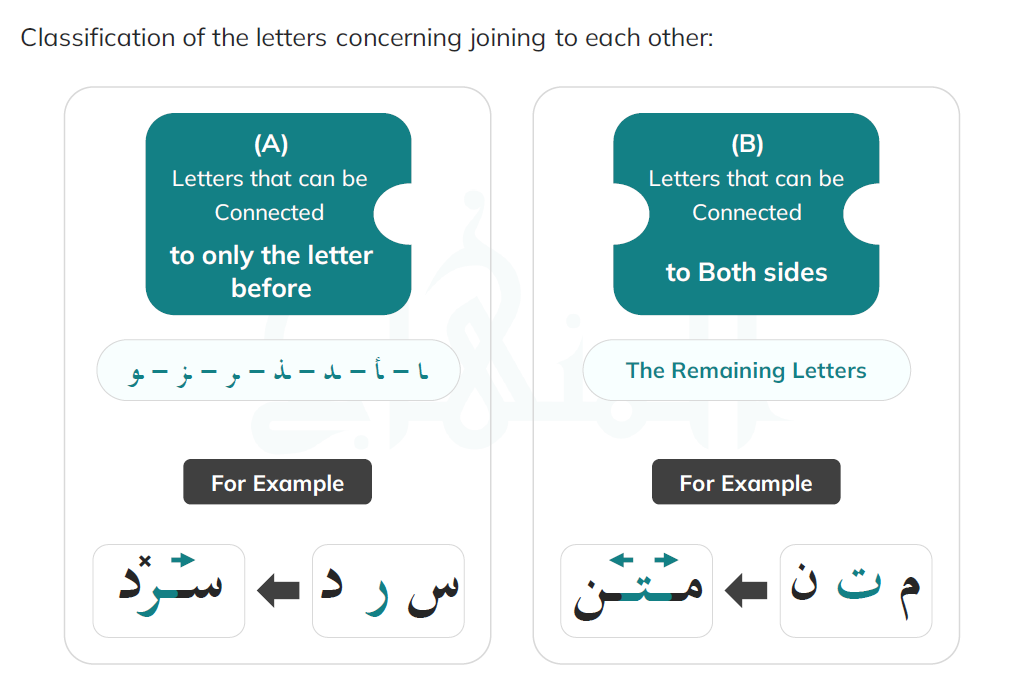
Six letters in Arabic — ا, د, ذ, ر, ز, و — are non-connecting letters. They connect only to the letter before them, never to the letter after. This reduces the positional complexity for those six significantly, which is worth noting when teaching letter sequencing to beginners.
What Is the Difference Between Arabic Letters and Arabic Vowels?
The 28 Arabic letters represent consonants and long vowels only. Short vowels — the three core vowel sounds of Arabic — are represented by diacritical marks placed above or below letters, not by letters themselves. These marks form the Tashkeel system.
The three primary Tashkeel marks are:
- Fatha (فَتْحَة) — a small diagonal line above a letter, producing the short a sound: بَ = ba
- Kasra (كَسْرَة) — a small diagonal line below a letter, producing the short i sound: بِ = bi
- Damma (ضَمَّة) — a small curl above a letter, producing the short u sound: بُ = bu
Additional marks include Sukun (indicating no vowel follows) and Shadda (indicating a doubled consonant). These are critical for accurate Quranic reading and formal written Arabic, though they are routinely omitted in everyday Arabic text.
In our instructors’ experience, the confusion between Fatha and Kasra is the single most consistent error pattern among adult beginners in their first two to three weeks. Both marks look similar to learners who are not yet reading Arabic intuitively. Targeted drilling of these two marks specifically — before moving to full words — saves significant frustration later.
For learners whose goal is reading the Quran, mastering Tashkeel is non-negotiable. The Quran is printed with full diacritical marks precisely to preserve exact pronunciation. Our Quranic Arabic Course addresses this systematically from the first lesson.
Join Our Quranic Arabic Course With a Free Trial

Are There Any Special Symbols or Letters Beyond the 28?
Beyond the 28 core letters and the Tashkeel marks, Arabic script includes a small number of additional symbols worth knowing from the outset.
What Is the Hamza in Arabic?
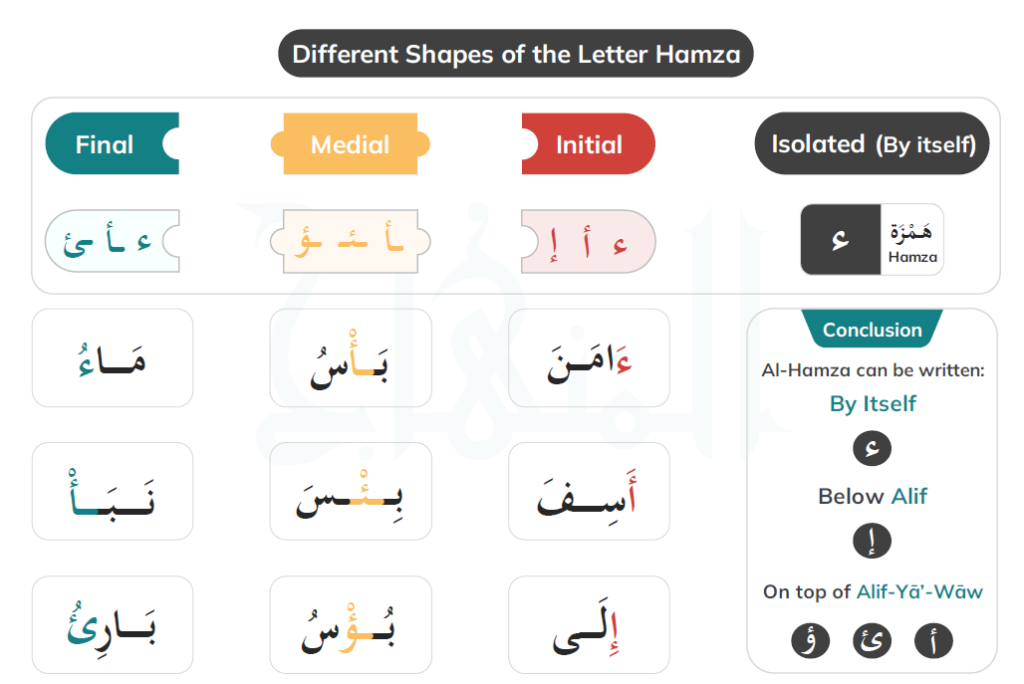
Hamza (ء) represents a glottal stop — the brief catch in the throat heard between the two syllables of the English expression “uh-oh.” It is technically not considered a separate letter in the traditional 28-letter count, though it functions as one in most contexts.
Hamza can appear independently, or it can be written above or below Alif, above Waw, or above Ya (without its dots). Its placement follows specific orthographic rules that trip up even intermediate learners.
Explore and Study Al-Menhaj Book for Free
What Is the Ta Marbuta?
Ta Marbuta (ة) is a modified form of Ta that appears only at the end of words. It typically marks the feminine gender of nouns and adjectives. It is pronounced either as a (in casual speech, when it ends a sentence) or as at (when followed by another word in a grammatical construction).
Ta Marbuta is not counted among the 28 letters — it is a contextual variant of Ta — but every beginner encounters it quickly and needs to understand what it is.
How Does the Arabic Alphabet Number Compare to Other Languages?
The Arabic alphabet, at 28 letters, sits in an interesting position compared to other major world scripts. Understanding this helps calibrate expectations for learners coming from different linguistic backgrounds.
| Script | Number of Core Letters | Direction |
| Arabic | 28 | Right to left |
| English (Latin) | 26 | Left to right |
| Hebrew | 22 | Right to left |
| Persian (Farsi) | 32 (Arabic-based + 4 extra) | Right to left |
| Urdu | 38 (Arabic-based + extras) | Right to left |
| Greek | 24 | Left to right |
At 28 letters, Arabic is not dramatically larger than the English alphabet at 26. The added challenge is not quantity — it is the combination of positional letter forms, right-to-left directionality, and the absence of short vowels in standard adult text.
Persian and Urdu both use Arabic script as their base, with additional letters added to represent sounds unique to those languages.
A learner who masters the 28 Arabic letters already has foundational literacy in three major world scripts. That is a significant return on a focused few weeks of study.
How Long Does It Take to Learn the Arabic Alphabet?
Most adult learners can recognize all 28 Arabic letters in their isolated forms within two to three weeks of structured daily practice of fifteen minutes. Reaching confident reading fluency — recognizing letters across all four positional forms within running text — typically takes six to eight weeks of consistent work.
These are not optimistic estimates. They reflect what we observe across learner cohorts at The Arabic Learning Centre when students follow a structured curriculum rather than learning letters in random order from apps or scattered online resources.
The sequencing of letter introduction matters significantly. Our certified instructors teach letters in groups that share similar base shapes — ب, ت, ث share one base form; ج, ح, خ share another. This grouping method accelerates recognition by allowing learners to build on visual patterns they have already internalized.
Students who try to memorize all 28 letters in isolation before encountering them in words typically plateau around week three. Those who begin seeing letters in short, vowelled words from week one consolidate recognition far more durably.
The Arabic Course for Beginners at The Arabic Learning Centre structures exactly this progression — letters in context, from day one, with a certified instructor providing real-time correction.
For parents looking to give younger learners this foundation early, our Online Arabic Classes for Kids builds the same letter recognition through age-appropriate methods.
Join Our Arabic Course for Beginners With a Free Trial

Read Also: How to Write in Arabic?
What Makes Several Arabic Letters Particularly Difficult for English Speakers?
Eight letters of the Arabic alphabet present consistent pronunciation difficulty for native English speakers, because they involve articulation points — known as Makharij (مَخَارِج), plural of Makhraj — that English does not use. Knowing which letters these are, and why, is the first step toward addressing them.
The Letters English Speakers Find Hardest
| Letter | Name | Why It Is Difficult |
| ع | Ayn | Voiced pharyngeal fricative — produced deep in the throat with no English equivalent |
| ح | Ha (pharyngeal) | Voiceless pharyngeal fricative — a strongly breathed h from the throat |
| خ | Kha | Velar fricative — similar to ch in Scottish loch |
| غ | Ghayn | Voiced velar fricative — similar to a French r |
| ص | Sad | Emphatic s — produced with the tongue pressed flat, creating a deeper resonance |
| ض | Dad | Emphatic d — the same tongue position as Sad, applied to a d sound |
| ط | Ta (emphatic) | Emphatic t — a t sound with the tongue pressed flat |
| ق | Qaf | Deep k produced at the very back of the throat |
Beginners consistently mispronounce ع (Ayn) as a plain vowel — essentially swallowing the letter entirely. This matters enormously because ع is among the most frequent letters in Arabic text.
A learner who cannot distinguish ع from a plain a sound will misread and mispronounce a large proportion of Arabic words.
Our Arabic Pronunciation Course works specifically on Makhraj — the precise physical placement of the tongue, lips, and throat for each letter — because correct articulation habits are far easier to build early than to correct later.
Our Students Reviews
Begin Pronouncing Arabic Fluently with a Free Trial

Read Also: How to Read and Write Arabic Numbers?
Begin Learning the Arabic Alphabet with Certified Instructors at The Arabic Learning Centre
The Arabic alphabet has 28 letters. That number is manageable. What makes the difference is how you learn them — the sequencing, the exposure to letters in context, and the real-time feedback that stops bad habits before they form.
The Arabic Learning Centre offers:
- 1-on-1 personalized sessions with certified native Arabic instructors
- Structured curriculum covering all 28 letters and their positional forms from day one
- Flexible scheduling available 24/7 to fit any time zone or lifestyle
- A free trial lesson — no commitment required
- Specialist courses for beginners, kids, Quran learners, and advanced students
Explore our Arabic Course for Beginners or start with our Learn to Read Arabic Course today. Your first lesson is free.
Check out our top courses in Arabic and choose the course you need to start learning Arabic today:
- Arabic Course for Beginners
- Arabic Script Writing Course
- Arabic Speaking Course
- Learn Arabic Letters for Tajweed
- Learning Arabic Grammar
- Arabic Vocabulary Course
- Fusha Arabic Course
- Classical Arabic Course
- Arabic Course for Islamic Studies
- Quranic Arabic Course
- Learn Arabic for New Muslims
Start with a FREE trial class and enhance your Arabic language skills

Conclusion
The Arabic alphabet’s 28 letters form a consistent, learnable system. Each letter is a consonant with up to four positional forms, supplemented by diacritical marks that represent short vowels. The right-to-left script and the absence of short vowels in everyday text are the two features that require the most early adjustment for English speakers.
Recognizing all 28 letters is achievable within weeks for adult learners who follow structured instruction. The deeper skill — reading fluently across positional forms, in vowelled and unvowelled text — develops steadily over six to eight weeks of daily practice with the right curriculum.
Mastering the Arabic alphabet is not the end of the road. It is the foundation on which grammar, vocabulary, conversation, and eventually classical texts are built. Every hour invested in getting the letters right from the start pays dividends at every stage that follows.
Read Also: How Many Letters Are in the Arabic Alphabet?
Frequently Asked Questions About the Arabic Alphabet
How many letters are in the Arabic alphabet?
The Arabic alphabet contains exactly 28 letters. All 28 are fundamentally consonants. Short vowels are represented separately through diacritical marks called Tashkeel, which are placed above or below letters rather than written as standalone letters. This gives Arabic a distinctly different structure from alphabets like English, where vowels are full letters.
Is the Arabic alphabet number the same for all Arabic-speaking countries?
Yes. The core Arabic alphabet of 28 letters is consistent across all Arabic-speaking countries and across Modern Standard Arabic (Fusha) and Quranic Arabic. Regional dialects may use slightly different pronunciations of some letters, but the written script remains standardized. Persian, Urdu, and Pashto use Arabic script with additional letters added.
Why do Arabic letters change shape in words?
Arabic is a connected cursive script. Most of the 28 letters join to their neighbors within a word, and the joining position — initial, medial, or final — determines the letter’s visual form. Six letters are non-connecting and attach only to the preceding letter. Learning these shape rules is essential for reading fluency and typically takes four to six weeks of structured practice.
Does Arabic have capital letters?
No. Arabic script does not use capital letters. There is no distinction between uppercase and lowercase forms — unlike English, which uses capitals for proper nouns, the start of sentences, and emphasis. In Arabic, sentence beginnings and proper nouns are identified through context and grammatical structure rather than capitalization.
What is the best way to start learning the Arabic alphabet?
The most effective starting point is learning letters in groups that share similar base shapes, then immediately seeing those letters inside short, vowelled words. Learning isolated letters by rote without contextual exposure leads to recognition gaps when reading text. Structured lessons with a certified instructor who provides real-time pronunciation feedback produce the fastest and most durable results — particularly for the eight letters that have no English sound equivalent.
Related Articles
Arabic Alphabet & Writing