 Quranic Arabic
Three months into a structured Arabic program, most adult learners are genuinely surprised by how much they can read, write, and understand. The question “can I learn Arabic in 3 months?” is asked by thousands of motivated beginners every year, and the honest answer depends less on time and more on method, consistency, and what “learning Arabic” actually means for you.
Three months is not enough to reach fluency, and any program that promises otherwise should be treated with skepticism. But three months of properly structured study is absolutely enough to achieve a defined, meaningful milestone: reading the Arabic script independently, building a working vocabulary of 300–500 words, and holding basic conversations or understanding foundational Quranic phrases.
Can I Learn Arabic in 3 Months?
Yes, you can make meaningful progress in Arabic in three months, but you should not expect full fluency. With structured study for around 5–7 hours per week, a complete beginner can build a functional foundation, including reading vowelled Arabic, recognizing common vocabulary, forming basic sentences, and handling simple conversations.
With consistent daily practice, learners may reach roughly an A1–A2 level and develop a working vocabulary of around 300–500 words within this period. The key is to focus first on the Arabic script and pronunciation, then gradually develop vocabulary, reading, and basic grammar rather than trying to master everything at once.
What You Can Realistically Achieve for Learning Arabic in 3 Months
Three months of structured Arabic learning, approximately 5–7 hours per week, will take a complete beginner to a functional foundation level. You will not be fluent, but you will be literate, recognizably communicative, and genuinely positioned to accelerate.
Most learners at this stage can read Arabic text aloud with diacritics (harakat), recognize high-frequency vocabulary, construct basic sentences using the present tense, and apply elementary grammar patterns such as the definite article (ال) and masculine/feminine agreement.
This corresponds roughly to an A1–A2 level on the Common European Framework of Reference (CEFR), the globally recognized language proficiency scale. It is a genuine linguistic foundation, not a superficial one.
Learners focused specifically on Islamic studies will find that The Arabic Learning Centre’s Arabic Course for Islamic Studies provides a structured linguistic foundation for engaging directly with classical Islamic texts.
Book Your Free Trial for Arabic Course for Islamic Studies Now!

Arabic Script Acquisition Is the First and Most Critical Phase
The Arabic alphabet contains 28 letters, each of which takes up to four different written forms depending on its position in a word: initial, medial, final, and isolated. For English speakers, this positional variation is the single steepest cognitive hurdle in the first month.
The most common mistake beginners make is attempting to learn letters in isolation without immediately connecting them to full words. A far more effective approach, one used in classical Arabic pedagogy, is to teach each letter alongside two or three high-frequency words in which that letter appears in its most common positional form.
Within four to six weeks of consistent daily practice (20–30 minutes per day), most adult learners can read vowelized Arabic text (text with full harakat markings) at a slow but accurate pace. This milestone unlocks the entire Arabic written world, including the Quran, classical literature, and modern Arabic news.
How the Root-and-Pattern System Speeds Up Arabic Vocabulary 3-Month Learning
Arabic vocabulary operates through a root and pattern (الجذر والوزن) system that has no close equivalent in English. Most Arabic words derive from a three-letter root — for example, the root ك-ت-ب (k-t-b) carries the core meaning of “writing” and generates: كَتَبَ (kataba — he wrote), كِتَاب (kitāb — book), كَاتِب (kātib — writer), مَكْتَب (maktab — desk/office), and مَكْتُوب (maktūb — letter/written).
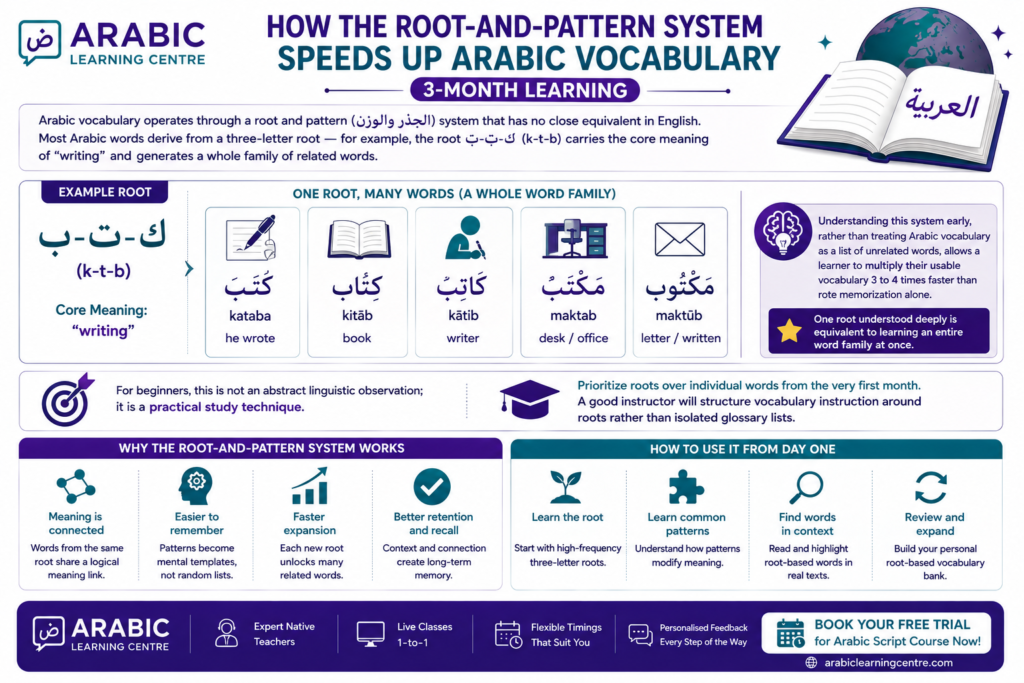
Understanding this system early, rather than treating Arabic vocabulary as a list of unrelated words, allows a learner to multiply their usable vocabulary three to four times faster than rote memorization alone. One root understood deeply is equivalent to learning an entire word family at once.
For beginners, this is not an abstract linguistic observation; it is a practical study technique. Prioritize roots over individual words from the very first month. A good instructor will structure vocabulary instruction around roots rather than isolated glossary lists.
Inside Our Classrooms
See how we make learning interactive and engaging! Watch a quick snippet of our live, conversational classes in action:
Modern Standard Arabic and Quranic Arabic Require Different Three-Month Learning Goals
One of the most important decisions a new Arabic learner must make is which variety of Arabic to study, because Modern Standard Arabic (MSA / Fusha) and Quranic Arabic have overlapping but distinct vocabularies, grammatical emphases, and practical applications.
| Feature | Modern Standard Arabic (MSA) | Quranic Arabic |
| Main purpose | Modern communication and formal writing | Understanding the Quran and classical texts |
| Vocabulary | Contemporary + formal vocabulary | Classical/Quranic vocabulary |
| Grammar | Modern formal grammar | Classical grammatical structures |
| Reading goal | News, books, official texts | Quranic and classical texts |
| Best for | General Arabic learners | Islamic/Quranic studies |
| 3-month priority | Literacy + functional communication | High-frequency Quranic vocabulary + grammar |
The Arabic Learning Centre offers both the Fusha Arabic Course and the Quranic Arabic Course, two distinct learning paths mapped to these specific goals, taught by native tutors who can adapt pacing to your three-month timeline.
Book Your Free Trial for Fusha Arabic Course Now!

Daily Practice Is the Key to Learning Arabic in 3 Months
Cognitive science research on language acquisition consistently shows that distributed practice, shorter sessions spread across multiple days, produces significantly stronger retention than massed practice (long sessions concentrated into fewer days). For Arabic in particular, where script recognition and root pattern internalization require repeated retrieval, this distinction is especially relevant.
A practical 30–50-minute daily Arabic study routine could look like this:
| Activity | Daily Time | Purpose |
| New vocabulary | 10–15 min | Build vocabulary |
| Spaced repetition | 10 min | Strengthen retention |
| Reading | 10–15 min | Improve script recognition |
| Speaking/pronunciation | 5–10 min | Build accurate pronunciation |
| Total | 30–50 min | Consistent daily progress |
The practical implication for a three-month Arabic plan: structure daily minimum commitments of 30-50 minutes, not weekly hour-blocks. Even on low-energy days, a brief review session activates retrieval pathways and prevents the decay that makes so many language learners feel they are “starting over.”
Why Studding Grammar Too Early Can Slow Your Arabic Learning Progress
Among adult English speakers who attempt Arabic and abandon it within the first three months, the most frequently reported cause is being introduced to formal Arabic grammar, cases (إعراب), verb conjugation tables, and dual forms before they have achieved basic reading fluency.
This is a sequencing error, not an inherent property of Arabic grammar. Arabic grammar is genuinely complex, but that complexity is navigable when introduced at the correct stage: after a learner can read fluently, recognize 200–300 words by sight, and construct simple phrases.
In the first three months, grammar instruction should be implicit and contextual, encountered through reading and pattern recognition, rather than explicitly rule-driven.
The Arabic Grammar Course at The Arabic Learning Centre is structured with this sequencing in mind, introducing formal grammatical categories only once students have the vocabulary and reading fluency to contextualize the rules meaningfully.
Book Your Free Trial for Arabic Grammar Course Now!

Read Also: How Hard Is It to Read Arabic?
Master Arabic Pronunciation Before Building Vocabulary in Your Arabic Learning Journey
Arabic contains several sounds that do not exist in English phonetics and cannot be approximated by simply reading transliteration. The most challenging for native English speakers are: the pharyngeal consonants ع (‘Ayn) and ح (Ha), the uvular ق (Qaf), the emphatic consonants ص (Sad), ض (Dad), ط (Ta), and ظ (Dha), and the glottal stop ء (Hamza).
Mispronouncing these sounds is not merely an accent issue. In Arabic, consonant quality distinguishes meaning entirely: قَلْب (qalb — heart) versus كَلْب (kalb — dog) differs by a single consonant. Establishing correct pronunciation in the first four to six weeks, through live instructor correction, not passive listening, prevents fossilized errors that become extremely difficult to correct later.
This is one area where an app or recorded course is genuinely insufficient. Real-time pronunciation correction from a qualified native Arabic tutor is the only reliable way to internalize sounds that have no English equivalent.
Read Also: Does Arabic Read Right to Left?
A Structured Three-Month Arabic Study Plan for Beginners
The following framework reflects standard Arabic pedagogy for motivated adult learners targeting the A1–A2 level within 90 days.
| Month | Focus Area | Weekly Target |
| Month 1 | Arabic script, letter forms (all 4 positions), short vowels (harakat), 100 core words | 5–6 hrs |
| Month 2 | Reading connected text, long vowels, tanwin, 200 additional words, basic sentence structure | 5–7 hrs |
| Month 3 | Fluent reading of vowelized text, present tense verbs, 200+ additional words, simple conversation | 6–8 hrs |
Daily practice should alternate between new material (15–20 minutes) and retrieval review of previously learned content (10–15 minutes). Flashcard systems using spaced repetition, such as Anki with a curated Arabic deck, are highly effective as supplementary tools alongside live instruction.
Read Also: Basic Arabic Reading Practice For Beginners
Why Structured Learning Can Accelerate Your Arabic Learning Progress
Independent Arabic learning resources, textbooks, apps, and YouTube channels can supplement structured instruction effectively, but they cannot replace it for the majority of adult beginners. The specific challenges of Arabic script recognition, root-pattern vocabulary, and pharyngeal pronunciation all require corrective feedback that self-study materials cannot provide.
Studies in second-language acquisition consistently show that learners who combine structured instruction with regular speaking practice reach functional benchmarks in roughly half the time as those who self-study alone. For a three-month goal, this difference is decisive.
Don’t Just Take Our Word For It
Take a look inside our vibrant classes and see our students and teachers in action. Click below to watch our classroom experience:
Start Learning Arabic in Three Months with Expert Guidance at The Arabic Learning Centre!
Three months is a meaningful, achievable timeline when the right structure backs it. At The Arabic Learning Centre, beginners receive a clear, pedagogically sequenced curriculum, from Arabic script through to functional literacy and basic communication, delivered by native Arabic tutors with 10+ years of experience teaching international learners.
- Native tutors who understand exactly where English speakers struggle
- Structured progression from the Arabic alphabet through A1–A2 level
- Live sessions with real-time pronunciation correction, plus recorded materials for review
- Flexible scheduling across global time zones, mornings, evenings, and weekends
- Affordable, transparent pricing with a free trial lesson to start
Courses We Offer:
- Business Arabic Course
- Learn Arabic from Zero
- Medical Arabic Course
- Learning Arabic for Non Arabic Speakers
- Learn Arabic in Saudi Arabia
- Learn to Read Arabic Course
- Arabic Grammar Course
- Arabic Speaking Course
- Arabic Script writing course
- Arabic Vocabulary Course
- Arabic Pronunciation Course
Whether your goal is Modern Standard Arabic, Quranic Arabic, or a combination of both, The Arabic Learning Centre has the course and the instructors to get you there.
Book your free trial lesson today and take the first concrete step toward Arabic in three months, with a structured plan, a qualified teacher, and a clear goal.
Book your free trial lesson today!

Conclusion
Three months of structured Arabic study will not produce fluency, but it will produce something genuinely valuable: a literate, recognizably functional foundation that most self-directed learners never reach in twice the time.
The difference between learners who hit that milestone and those who stall is rarely intelligence or aptitude. It is sequencing: learning script before grammar, roots before word lists, pronunciation before vocabulary, and the consistency of daily practice over weekly cramming.
The Arabic language rewards patience and method in equal measure. Begin with a clear, realistic goal, a structured curriculum, and a qualified instructor who corrects your pronunciation from day one, and three months becomes not just possible but genuinely transformative.
Frequently Asked Questions
Can a Complete Beginner Learn Arabic in 3 Months with No Prior Experience?
Yes, with an important clarification. A complete beginner with no prior Arabic exposure can achieve A1–A2 level proficiency in three months through structured study of 5–7 hours per week. That means independent reading of vowelized Arabic text, a working vocabulary of 300–500 words, and basic sentence construction. Full fluency requires significantly longer, but a functional, meaningful foundation is entirely achievable in this timeframe.
How Many Hours Per Day Do You Need to Study Arabic in 3 Months?
Approximately 45–60 minutes of daily study, split between new material and spaced-repetition review, is sufficient for most adult learners targeting A1–A2 in three months. Distributed daily practice consistently outperforms longer, less frequent sessions; 30 minutes every day produces stronger retention than 3 hours once a week.
Is Arabic Harder to Learn in 3 Months Than Other Languages?
Arabic is classified by the U.S. Foreign Service Institute as a Category IV language, its highest difficulty tier for native English speakers, requiring roughly 2,200 hours for professional proficiency. That figure, however, applies to full professional fluency, not functional beginner literacy. The Arabic script and root-pattern vocabulary system have steep initial learning curves, but motivated adult learners consistently master both within the first six to eight weeks of structured instruction.
What Is the Difference Between Learning MSA and Quranic Arabic in 3 Months?
Modern Standard Arabic in three months prioritizes reading literacy, grammatical sentence structure, and contemporary vocabulary for real-world use. Quranic Arabic in three months focuses on the classical root system, the highest-frequency Quranic vocabulary (approximately 300 words account for the majority of the Quran’s text), and basic case endings (إعراب). The two paths overlap significantly in script and foundational grammar but diverge in vocabulary emphasis and application.
Can You Learn to Read the Quran in 3 Months?
Most beginners can learn to read Quranic text aloud, with full diacritics (harakat) visible, within three months of structured instruction. Reading with proper Tajweed rules applied consistently requires additional time and dedicated Tajweed study.
Do Arabic Apps Work for Learning Arabic in 3 Months?
Arabic apps are useful supplementary tools, particularly for vocabulary revision through spaced repetition, but they cannot replace structured instruction for three core reasons: they cannot correct pharyngeal pronunciation errors in real time, they rarely teach the root-pattern system explicitly, and their grammar sequencing is often poorly ordered for adult learners. Use apps to reinforce daily vocabulary; rely on a qualified instructor for script, pronunciation, and grammar.
What Is the Best Way to Learn Arabic in 3 Months as an Adult?
The most effective approach combines three elements: live instruction with a qualified native Arabic tutor for pronunciation correction and grammar sequencing, daily spaced-repetition vocabulary practice using a root-organized word list, and consistent reading of vowelized Arabic texts from week three onward. Starting with the script and root system, rather than grammar rules, and maintaining daily minimum sessions of 30 minutes produces the strongest results within a three-month window.
Related Articles
Quranic Arabic