 Learn Arabic
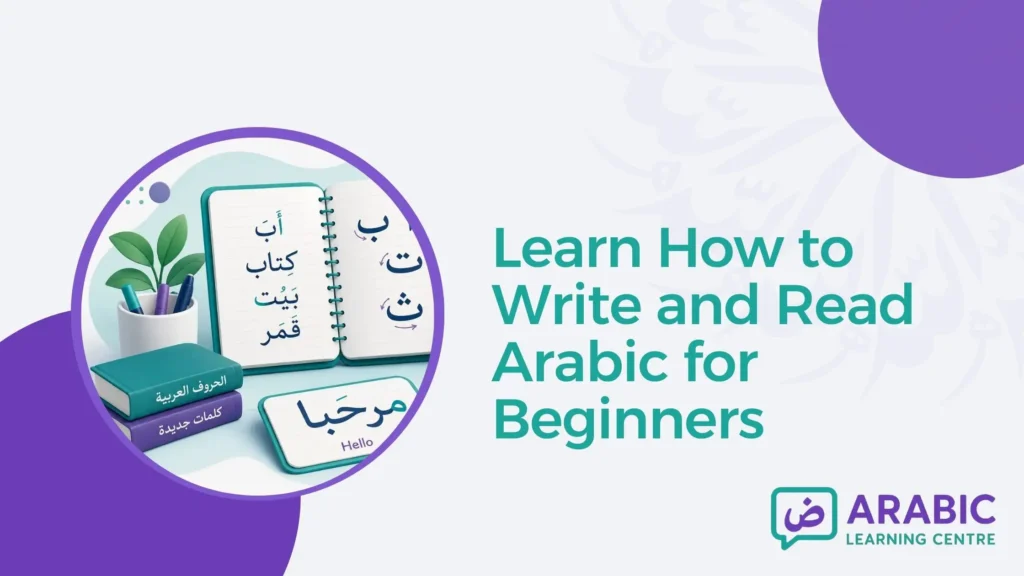
Most people who try to learn how to write and read Arabic for beginners give up in the first two weeks — not because Arabic is impossible, but because they started in the wrong place. They jumped into vocabulary before mastering the script, or tried memorizing all 28 letters in one sitting. Arabic has a clear, logical system. The problem is almost never the language — it is the sequence in which it is approached.
This guide fixes that. Each section covers one practical step in the exact order that works: what to do, how to practice it, and what you must be able to do before moving to the next stage.
1- Learn the Arabic Alphabet Before Attempting Any Word or Sentence
The Arabic alphabet has 28 letters — all representing consonants. Short vowel sounds are added through separate marks called harakat, which come in a later step. Before anything else, every beginner must know each letter’s name, shape, and sound as one complete unit.
The most effective approach is 5 letters per day. Research on working memory confirms that 5–7 new items per session is the optimal load for adult learners. Here is how to distribute the 28 letters across 6 days:
| Day | Letters | Names |
| Day 1 | أ ب ت ث ج | Alif, Ba, Ta, Tha, Jeem |
| Day 2 | ح خ د ذ ر | Ha, Kha, Dal, Dhal, Ra |
| Day 3 | ز س ش ص ض | Zay, Seen, Sheen, Sad, Dad |
| Day 4 | ط ظ ع غ ف | Ta, Dha, Ayn, Ghayn, Fa |
| Day 5 | ق ك ل م ن | Qaf, Kaf, Lam, Meem, Noon |
| Day 6 | هـ و ي | Ha, Waw, Ya |
For each letter in every session, practice these three actions in sequence:
- Write the letter name in large clear handwriting so you have a label attached to each shape.
- Write the isolated letter form 10 times while saying its sound aloud, connecting the visual shape to the spoken sound simultaneously.
- Find that letter inside one real Arabic word and circle it, so recognition begins in real context from Day 1.
Day 7 is a full review day — no new letters. Cover every letter shape and produce its sound without prompting. Any letter you hesitate on returns to your daily review list for Week 2. Never skip reviewing previous letters before adding new ones — those 5–10 minutes convert short-term recognition into long-term memory.
At The Arabic Learning Centre, the Arabic Classes for Non-Arabic Speakers guides complete beginners through exactly this structured alphabet sequence with a certified native tutor correcting every letter from Day 1.

Start your alphabet journey today.
2- Master Arabic Letter Connection to Read Real Words
Knowing 28 isolated letters does not mean you can read Arabic. Arabic is a cursive script — letters connect within words, and each letter’s shape changes depending on its position. This is where most self-taught beginners stall, and it is entirely solvable with the right approach.
Every Arabic letter has up to four positional forms:
| Form | Position | Description |
| Isolated | Stands alone | Full letter shape |
| Initial | Begins a word | Connected only to the right |
| Medial | Middle of a word | Connected on both sides |
| Final | Ends a word | Connected only to the left |
Six letters never connect to the letter that follows them. Memorizing these six as a group immediately unlocks connected reading:
| Letter | Name | Example Word | Reading |
| أ | Alif | أسد | asad (lion) |
| د | Dal | دَرَسَ | darasa (he studied) |
| ذ | Dhal | ذَهَبَ | dhahaba (he went) |
| ر | Ra | رَجُل | rajul (man) |
| ز | Zay | زَهْر | zahr (flower) |
| و | Waw | وَقْت | waqt (time) |
When you encounter any of these six letters inside a word, the connection breaks at that point. Every other letter connects to both the previous and the following letter.
To practice connection, follow this daily sequence:
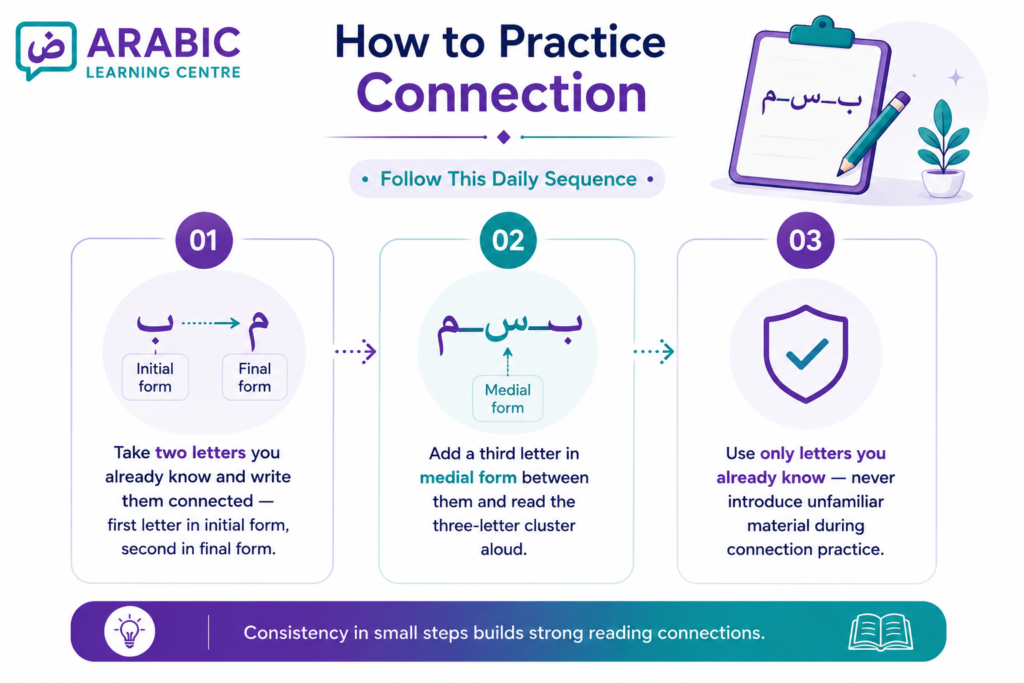
- Take two letters you already know and write them connected — first letter in initial form, second in final form.
- Add a third letter in medial form between them and read the three-letter cluster aloud.
- Use only letters you already know — never introduce unfamiliar material during connection practice.
Inside Our Classrooms
See how we make learning interactive and engaging! Watch a quick snippet of our live, conversational classes in action:
3- Practice Arabic Harakat to Pronounce Every Written Word Correctly
Harakat are the small marks placed above and below Arabic letters that indicate short vowel sounds. Without them, Arabic text is unreadable for beginners — like a word with all its vowels removed.
For anyone learning how to write and read Arabic, harakat are what transform a series of consonants into a fully pronounceable word. The five harakat every beginner must master are:
| Haraka | Name | Mark | Sound | Example |
| Fatha | فَتْحَة | ـَ | Short “a” | بَ = “ba” |
| Kasra | كَسْرَة | ـِ | Short “i” | بِ = “bi” |
| Damma | ضَمَّة | ـُ | Short “u” | بُ = “bu” |
| Sukoon | سُكُون | ـْ | No vowel | بْ = “b” |
| Shadda | شَدَّة | ـّ | Doubled consonant | بّ = “bb” |
The correct learning sequence for harakat is:
- Learn Fatha first and apply it to all 28 letters before introducing any other haraka.
- Add Kasra in Week 2, only after Fatha feels completely automatic across all letters.
- Add Damma in Week 3, then Sukoon and Shadda together in Week 4.
Never attempt all five harakat simultaneously — this is one of the most common mistakes in learning how to write and read Arabic alphabet. The brain needs each mark to become automatic before a new one is added. The daily harakat practice method that works:
- Take 5 letters from your alphabet list and write each one three times — once with Fatha, once with Kasra, once with Damma.
- Read each combination aloud immediately after writing it without pausing between writing and reading.
- Progress to two-letter syllable combinations only when single-letter harakat feel automatic.
At The Arabic Learning Centre, the Arabic Grammar Course teaches harakat and their grammatical function within a structured live curriculum — so beginners understand not just how to pronounce each mark, but why it appears where it does.

Understand Arabic pronunciation from its roots.
4- Write Arabic Letters by Hand to Build Permanent Script Memory
There is a reason every Arabic teacher emphasizes handwriting: it works faster than any screen-based alternative. Writing Arabic letters by hand builds motor memory — the automatic, physical knowledge of how each letter is formed — which directly accelerates reading recognition.
Research on language acquisition consistently shows that learners who write by hand reach reading fluency 30–40% faster than those who only practice visually.
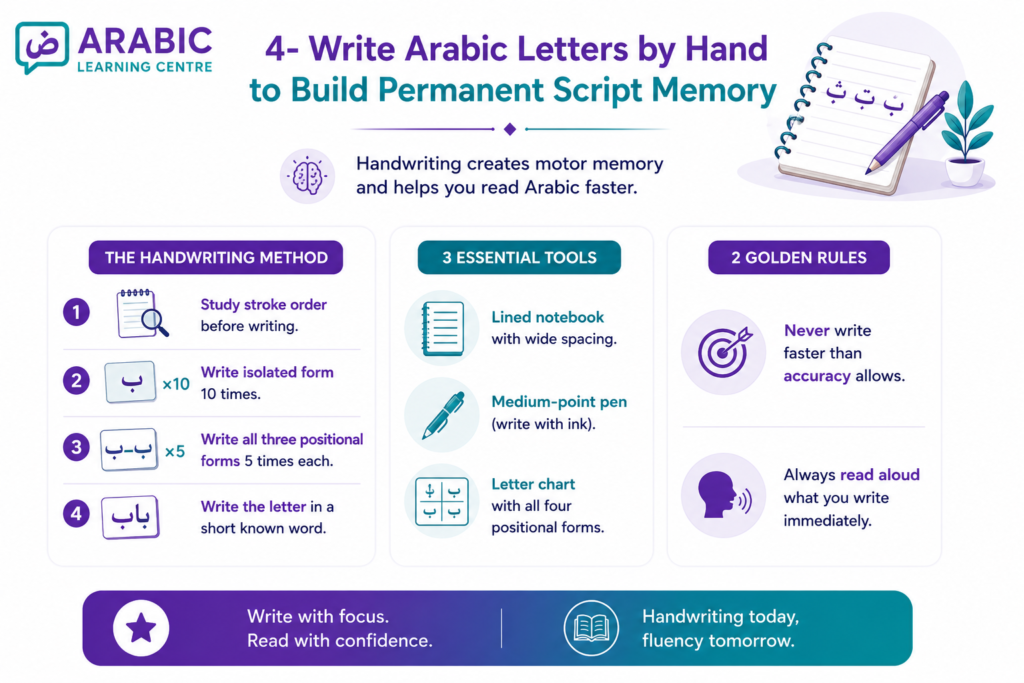
The correct handwriting method for Arabic script follows this sequence for every letter:
- Study the stroke order before touching the pen — Arabic letters have a specific sequence of strokes and dots that must be learned correctly from the start.
- Write the isolated form 10 times, focusing entirely on stroke accuracy rather than speed.
- Write the initial, medial, and final forms 5 times each, so all four positional forms develop muscle memory simultaneously.
- Write the letter inside a short known word, connecting it to at least one letter that precedes or follows it.
Three tools every beginner needs for Arabic handwriting practice:
- A lined notebook with wide spacing — Arabic letters have specific vertical proportions that lined paper helps maintain.
- A medium-point pen rather than a pencil — writing with ink forces commitment to each stroke and prevents the erasing habit that slows down muscle memory development.
- A letter chart showing all four positional forms of each letter posted near your writing area for immediate reference without breaking focus.
Two rules govern handwriting practice without exception:
- Never write faster than accuracy allows — speed comes automatically with repetition, and early speed habits produce sloppy letter forms that are very difficult to correct later.
- Always read aloud what you write immediately after writing it — the combination of motor action and spoken sound creates dual reinforcement that passive copying cannot produce.
Read Also: Is It Compulsory to Read the Quran in Arabic?
5- Read Short Vowelized Arabic Words Before Moving to Full Sentences
By the time you reach this step, you have the alphabet, the connection rules, and the harakat. The task now is converting those three skills into actual reading. The critical rule at this stage is one that most beginners ignore: start with fully vowelized text only, and build reading length progressively.
The three-level progression for early Arabic reading is:
- Level 1 — Days 1–7 of reading practice: Read individual vowelized syllables aloud. Example: بَ، كِ، تُ. Focus entirely on connecting the written mark to the spoken sound without hesitation.
- Level 2 — Days 8–14: Read fully vowelized two and three letter words. Start with words whose letters you know well.
- Level 3 — Days 15–21: Read fully vowelized short sentences of three to five words without stopping to decode individual letters.
Essential beginner words to practice reading and writing together — learn how to write and read Arabic alphabet through these high-frequency examples:
| Arabic Word | Transliteration | Meaning |
| بَيْت | bayt | house |
| كِتَاب | kitaab | book |
| مَاء | maa’ | water |
| بَاب | baab | door |
| قَلَم | qalam | pen |
| وَلَد | walad | boy |
| بِنْت | bint | girl |
| يَوْم | yawm | day |
| كَلْب | kalb | dog |
| شَمْس | shams | sun |
Two rules govern this reading phase without exception:
- Never read unvowelized text during the first 8 weeks — attempting to guess vowels before building vocabulary creates inaccurate reading habits that persist long-term.
- Always read aloud — silent reading practice does not train pronunciation, and incorrect pronunciation habits slow reading recognition significantly.
At The Arabic Learning Centre, the Arabic Speaking Course develops reading and pronunciation together through live sessions with native tutors — the fastest method for converting written Arabic knowledge into confident spoken reading.
Read Also: How to Read Arabic Without Vowels?

Read Arabic aloud with confidence from Week 3.
6- Use Proven Daily Practice Techniques to Accelerate Arabic Writing
Writing Arabic is a separate skill from reading it. Reading trains recognition — writing trains production. Both are essential for anyone who wants to learn how to write and read Arabic, and both require their own dedicated daily practice.
The most effective daily Arabic writing progression follows four stages:
- Stage 1 — Tracing: Begin by tracing letter outlines on paper before writing freehand. Tracing builds the correct directional habits for Arabic strokes without the cognitive load of recalling the form simultaneously.
- Stage 2 — Copying: Copy short Arabic words from vowelized text, letter by letter, while reading each word aloud after completing it.
- Stage 3 — Dictation: Have someone — or an audio recording — read a short Arabic word aloud and write what you hear from memory, then check it against the original.
- Stage 4 — Free writing: Write short sentences using vocabulary you already know, without copying from any source.
A practical daily session that covers both reading and writing skills:
| Time Block | Activity | Duration |
| Opening | Review previous day’s letters with harakat | 10 minutes |
| Core writing | Copy 5 new words in full vowelized form | 15 minutes |
| Reading practice | Read 10 short vowelized words aloud | 10 minutes |
| Closing | Write 3 words from memory without reference | 5 minutes |
| Total | 40 minutes |
Consistency across 40 minutes daily produces faster results than occasional two-hour sessions. The brain consolidates Arabic script during sleep — daily exposure is what triggers that consolidation.
Read Also: Learn to Read Arabic App – Top 9 Picks for Beginners
7- Avoid the Five Mistakes That Stall Arabic Reading and Writing Progress
Understanding what stalls progress is as valuable as knowing what accelerates it. These five mistakes appear repeatedly among beginners who plateau — and each one has a direct, practical fix.
The five most common mistakes when learning how to write and read Arabic for beginners are:
- Trying to memorize all 28 letters at once: The brain cannot consolidate 28 new items in a single session. Fix: use the 5-letter daily cycle and never add new letters without reviewing previous ones first.
- Skipping harakat and reading unvowelized text too early: This forces guessing, which builds inaccurate pronunciation patterns that become deeply ingrained. Fix: read only fully vowelized text for the first 8 weeks without exception.
- Practicing only visually without writing by hand: Screen-based recognition does not build the motor memory that makes reading automatic. Fix: write every letter you learn by hand on the same day you learn it, every session.
- Practicing silently throughout: Arabic is a phonetic language — silent practice does not train the sound-to-symbol connection that makes reading fluent. Fix: read every letter, word, and sentence aloud in every session.
- Moving to the next step before the current one is automatic: Connection practice before isolated forms are solid, or sentence reading before word reading is smooth, breaks the entire sequence. Fix: run a self-assessment at the end of each week — if you hesitate on any item, stay at that step for one more week before advancing.
At The Arabic Learning Centre, the Arabic Vocabulary Course builds reading vocabulary systematically through high-frequency word acquisition — eliminating the guesswork that forces most beginners into the mistake of reading unvowelized text too soon.
Read Also: Learn to Read Arabic in 21 Days

Build the vocabulary that makes reading automatic.
8- Follow a Realistic Timeline to Measure Your Reading and Writing Progress
One of the most damaging things a beginner can do is compare their progress to an unrealistic timeline. Arabic is classified by the US Foreign Service Institute as a Category IV language — the hardest category for English speakers. Basic reading and writing ability is genuinely achievable in weeks — full literacy takes months of consistent daily work.
Here is an honest, research-based timeline for beginners who practice 30–45 minutes daily:
| Milestone | Realistic Timeline | What It Means |
| Recognize all 28 isolated letters | 1–2 weeks | Can identify each letter shown alone |
| Recognize all 4 positional forms | 3–4 weeks | Can read letters inside connected words |
| Read simple vowelized syllables | 4–6 weeks | Can sound out any vowelized syllable |
| Read vowelized words fluently | 6–8 weeks | Basic reading ability with harakat |
| Write short words from memory | 3–4 months | Production without copying |
| Read vowelized sentences smoothly | 2–3 months | Basic reading fluency |
| Read unvowelized text | 6–12 months | Requires vocabulary knowledge |
Three factors that accelerate this timeline significantly:

- Handwriting practice from Day 1 — learners who write by hand consistently reach reading fluency 30–40% faster than those who only recognize letters digitally.
- Live correction from a native speaker — errors in pronunciation and script formation that go uncorrected for weeks become very difficult to fix later.
- Reading aloud in every session — the combination of visual recognition and spoken production is what converts passive knowledge into active reading ability.
Read Also: How to Read Arabic Time?
Don’t Just Take Our Word For It
Take a look inside our vibrant classes and see our students and teachers in action. Click below to watch our classroom experience:
Your Arabic Reading and Writing Journey Starts at The Arabic Learning Centre
Every step in this guide is achievable independently. The honest reality is that self-correction at the harakat and connection stages — where most beginners make the errors that stall progress for months — is nearly impossible without a native Arabic speaker identifying the mistake in real time.
The Arabic Learning Centre provides exactly what self-study cannot:
- Certified Arab tutors with native-level proficiency who correct script errors, harakat mistakes, and pronunciation during every session.
- One-on-one live sessions built around your specific weaknesses — not a generic curriculum that moves at the same pace for every learner.
- Real-time Makharij and pronunciation correction using audio-visual feedback during every session.
- Flexible scheduling across all global time zones — EST, PST, GMT, CET, IST, GST, and MYT.
- Female Arabic teacher options for learners who prefer culturally sensitive instruction.
- Monthly progress reports and written feedback after every session.
- Affordable pricing with transparent packages and family enrollment discounts.
Courses We Offer:
- Business Arabic Course
- Learn Arabic from Zero
- Medical Arabic Course
- Learning Arabic for Non Arabic Speakers
- Learn Arabic in Saudi Arabia
- Learn to Read Arabic Course
- Arabic Grammar Course
- Arabic Speaking Course
- Arabic Script writing course
- Arabic Vocabulary Course
- Arabic Pronunciation Course
Claim your free trial session now
Conclusion
The journey to learn how to write and read Arabic for beginners is not about talent — it is about sequence and consistency. Every step in this guide builds directly on the previous one: alphabet before connection, connection before harakat, harakat before words, words before sentences. Skipping any stage does not save time — it creates errors that cost more time to correct later.
Arabic reading and writing ability compounds with every week of daily practice. The alphabet that feels foreign in Week 1 becomes automatic by Week 3. The words that require letter-by-letter decoding in Week 4 become instantly recognizable by Week 8. The investment is real — and so is the return.
Register at The Arabic Learning Centre today and begin your Arabic reading and writing journey with certified native tutors guiding every step from the first letter to fluent reading.
FAQ
How long does it take to learn how to write and read Arabic for beginners?
With 30–45 minutes of daily practice, most beginners recognize all 28 letters in 1–2 weeks, read vowelized words in 6–8 weeks, and write short sentences independently within 3–4 months.
Is it necessary to learn the alphabet before reading Arabic words?
Yes, without exception. Attempting to read Arabic words before knowing all letter forms — including their four positional shapes — produces guessing habits that are very difficult to correct later.
What is the correct order to learn how to write and read Arabic alphabet?
Learn isolated letter forms first, then all four positional forms, then harakat, then connected words, then short vowelized sentences. Skipping any step in this sequence significantly slows progress.
Can I learn to write and read Arabic without a teacher?
The alphabet and harakat stages are achievable independently with structured resources. The connection and pronunciation stages produce errors that only a native speaker can identify and correct in real time.
How many minutes per day should I practice Arabic reading and writing?
A 40-minute daily session — split between reviewing previous material, practicing new writing, reading aloud, and self-testing from memory — produces faster results than longer occasional sessions.
Related Articles
Learn Arabic