 Arabic Grammar
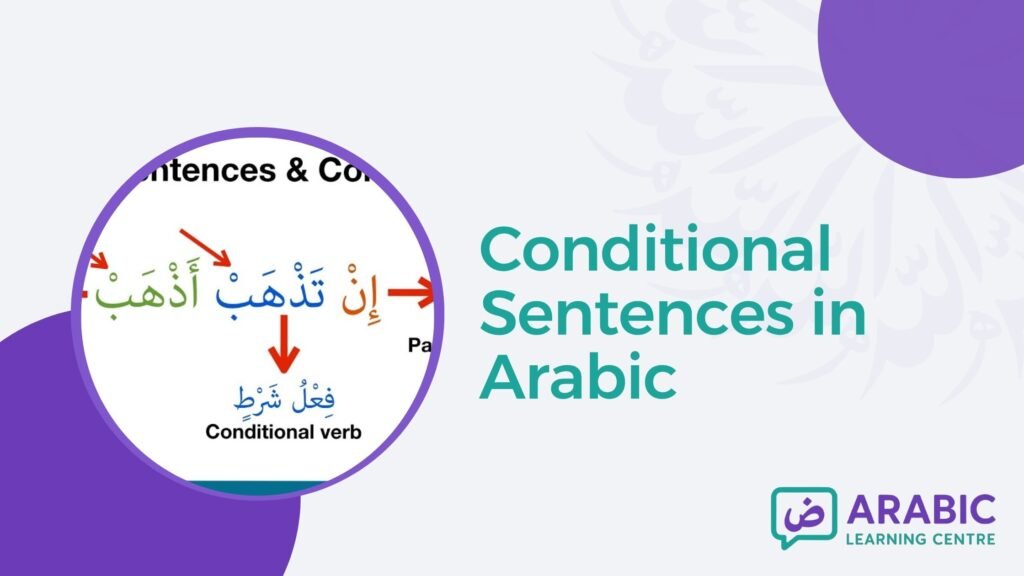
| Key Takeaways |
| Arabic conditional sentences use two core particles: إِنْ (in) for real conditions and لَوْ (law) for hypothetical ones. |
| Every Arabic conditional sentence has two parts: the condition clause (شَرْط shart) and the result clause (جَوَاب الشَّرْط jawab al-shart). |
| The فِعْل الشَّرْط (conditional verb) and its response verb must follow specific mood rules that differ from standard Arabic verb conjugation patterns. |
| Conditional particles in Arabic — including إِذَا, مَنْ, مَا, and مَهْمَا — each carry distinct meanings and govern different grammatical moods. |
Conditional sentences in Arabic — known as الجُمْلَة الشَّرْطِيَّة (al-jumlah al-shartiyyah) — allow you to express “if/then” relationships using specific particles that govern the grammatical mood of two linked clauses.
Every conditional sentence contains a condition (شَرْط shart) and a response (جَوَاب jawab), and choosing the right particle determines whether the condition is real, possible, or purely hypothetical.
What Is a Conditional Sentence in Arabic?
A conditional sentence in Arabic consists of two obligatory parts: the جُمْلَة الشَّرْط (jumlat al-shart) — the “if” clause — and the جُمْلَة الجَوَاب (jumlat al-jawab) — the “then” result clause. The conditional particle connects them and determines the grammatical mood of both verbs. Without both parts, the sentence is grammatically incomplete.
This two-part structure is consistent across all conditional types in Arabic. The particle comes first, the conditional verb follows in its appropriate form, and the result clause closes the sentence.
Think of it as a grammatical contract: the particle sets the terms, and both clauses must honour them.
If you are working through Arabic grammar systematically, you will find that understanding Arabic tenses gives important context before tackling conditional structures — because the mood of both the condition and response verbs depends heavily on how Arabic handles time and action.
What Are the Main Conditional Particles in Arabic?
The main conditional particles in Arabic are إِنْ (in), إِذَا (idha), لَوْ (law), مَنْ (man), مَا (ma), and مَهْمَا (mahma). Each carries a distinct meaning and triggers specific grammatical rules. Choosing the wrong particle changes both the meaning and the grammatical structure of the sentence.
Here is a reference table of the most important conditional particles used in Modern Standard Arabic and Classical Arabic (Fusha):
| Particle | Transliteration | Meaning / Use | Condition Type |
| إِنْ | in | If (general/real possible) | Real / possible |
| إِذَا | idha | If / When (expected events) | Real / probable |
| لَوْ | law | If (hypothetical/contrary to fact) | Hypothetical |
| لَوْلَا | lawla | If it were not for… | Negative hypothetical |
| مَنْ | man | Whoever | Refers to persons |
| مَا | ma | Whatever | Refers to things |
| مَهْمَا | mahma | Whatever / However much | Emphasis on any condition |
| أَيُّ | ayyu | Whichever | Refers to specific category |
| مَتَى | mata | Whenever | Refers to time |
| أَيْنَ | ayna | Wherever | Refers to place |
How Does the Real Conditional With إِنْ Work in Arabic?
إِنْ (in) is the foundational conditional particle in Arabic, used when the condition is genuinely possible or uncertain. When إِنْ introduces a sentence, the conditional verb (فِعْل الشَّرْط) and the response verb (جَوَاب الشَّرْط) are both placed in the مَجْزُوم (majzum — jussive) mood, making them grammatically distinct from their indicative forms.
How to Form the Jussive Mood in the Conditional?
For sound verbs (الفِعْل الصَّحِيح al-fi’l al-sahih), the jussive is formed by removing the final ُ (damma) from the present tense verb and applying سُكُون (sukoon) — a marker of vowellessness on the final consonant.
If you need a refresher on sukoon’s role in Arabic morphology, our guide on what sukoon is in Arabic explains this clearly.
Example:
إِنْ تَدْرُسْ تَنْجَحْ
In tadrus tanjaH
If you study, you will succeed.
Here, تَدْرُسْ (tadrus) and تَنْجَحْ (tanjaH) are both in the jussive — confirmed by the sukoon on the final consonant of each verb.
إِنْ تَعْمَلْ بِجِدٍّ تَحْصُلْ عَلَى نَتَائِجَ جَيِّدَةٍ
In ta’mal bi-jiddin tahsul ‘ala nata’ij jayyidah
If you work hard, you will get good results.
At The Arabic Learning Centre, students in our Arabic Grammar Course consistently report that the jussive mood is one of the first places where diacritical marks (حَرَكَات harakat) become truly indispensable for reading accurately — because the sukoon on the final consonant is the only visible marker distinguishing a jussive verb from its indicative form.
Start Learning Arabic Grammar with a Free Trial

Read also: Adjectives in Arabic
How Does the Hypothetical Conditional With لَوْ Work?
لَوْ (law) expresses hypothetical or contrary-to-fact conditions — situations the speaker knows did not happen or cannot happen. Both the condition and response verbs take the مَاضِي (past tense) form, and the response is often introduced by لَـ (la-) as a prefix.
This structure is the Arabic equivalent of the English “second conditional” (if I were… I would…).
Example:
لَوْ دَرَسْتَ لَنَجَحْتَ
Law darasta la-najaHta
If you had studied, you would have succeeded.
The past-tense verbs here do not describe a past event — they signal that the condition is unreal or contrary to current reality. This is a conceptual leap for many learners of Arabic, who initially try to match the English tense system onto Arabic.
Understanding this distinction requires solid grounding in how verbs are conjugated in Arabic across all patterns.
لَوْ كُنْتُ غَنِيًّا لَسَافَرْتُ إِلَى مَكَّةَ
Law kuntu ghaniyyan la-safartu ila Makkah
If I were rich, I would travel to Makkah.
Shots Videos from Our Courses
How Does لَوْلَا Work as a Negative Conditional Particle?
لَوْلَا (lawla) means “if it were not for” or “but for” and introduces a condition whose absence would cause the result in the response clause. It is a powerful and frequently-used structure in Classical Arabic and Quranic Arabic. لَوْلَا is always followed by a مُبْتَدَأ (subject noun or pronoun) — never by a verb — and its implied predicate is always omitted.
Example:
لَوْلَا اللهُ لَضِعْنَا
Lawla Allahu la-di’na
Were it not for Allah, we would have been lost.
لَوْلَا مُسَاعَدَتُكَ لَفَشِلْتُ
Lawla musa’adatuka la-fashiltu
Were it not for your help, I would have failed.
Read also: Types of Sentences in Arabic
How Do Nominal Conditional Particles Like مَنْ and مَا Work?
مَنْ (man) and مَا (ma) function as both conditional particles and relative pronouns. مَنْ refers to persons (“whoever”) and مَا refers to things (“whatever”). Both are أَسْمَاء الشَّرْط (asma’ al-shart — conditional nouns) and, like إِنْ, they put the conditional and response verbs into the jussive mood.
Example with مَنْ:
مَنْ يَزْرَعْ يَحْصُدْ
Man yazra’ yaHsud
Whoever sows (plants) shall reap.
This is a well-known Arabic proverb that also exemplifies the jussive perfectly.
Example with مَا:
مَا تَفْعَلْ مِنْ خَيْرٍ يَعْلَمْهُ اللهُ
Ma taf’al min khayrin ya’lamhu Allah
Whatever good you do, Allah knows it.
Students in our Arabic Course for Beginners who have already worked through Arabic verbal sentences will recognise these structures as extensions of the same subject-verb principles — the conditional particle simply adds a logical layer on top.
Join Our Arabic Course for Beginners With a Free Trial
Practice Exercises of Conditional Sentences in Arabic
Apply what you have learned. Complete the following exercises, then check your answers below.
Exercise 1 — Choose the correct particle: Fill in the blank with إِنْ, إِذَا, or لَوْ:
- _____ دَرَسْتَ بِجِدٍّ، لَنَجَحْتَ. (You didn’t study — imagining the alternative)
- _____ تَصْبِرْ تَنْجَحْ. (General possible condition)
- _____ وَصَلَ الضَّيْفُ فَأَخْبِرْنِي. (Expected arrival)
Exercise 2 — Translate into Arabic using the correct conditional:
- “Whoever tells the truth will be trusted.”
- “If it were not for patience, success would be difficult.”
- “Whatever you give, you will be rewarded.”
Answers:
- لَوْ — hypothetical (contrary to fact)
- إِنْ — real possible condition, jussive mood
- إِذَا — expected event, past-form verb
Our Students Reviews
Begin Mastering Arabic Grammar with Certified Instructors at The Arabic Learning Centre
Conditional sentences are one of the most intellectually satisfying structures in Arabic grammar — once the particle system clicks, the logic is elegant and consistent. Understanding إِنْ, لَوْ, إِذَا, and their grammatical requirements is a milestone in Arabic fluency.
At The Arabic Learning Centre, our Arabic Grammar Course is taught by certified native Arabic instructors with structured, step-by-step curriculum built specifically for non-Arabic speakers. Features include:
- Personalised 1-on-1 sessions tailored to your pace
- Flexible scheduling available 24/7
- Free trial lesson — no commitment required
- Grammar taught in context, not isolation
Check out our top courses in Arabic and choose the course you need to start learning Arabic today:
- Arabic Course for Beginners
- Arabic Script Writing Course
- Arabic Speaking Course
- Learn Arabic Letters for Tajweed
- Learning Arabic Grammar
- Arabic Vocabulary Course
- Fusha Arabic Course
- Classical Arabic Course
- Arabic Course for Islamic Studies
- Quranic Arabic Course
- Learn Arabic for New Muslims
Start with a FREE trial class and enhance your Arabic language skills

Read also: Arabic Sentence Structure
Conclusion
Conditional sentences in Arabic express real possibility, expectation, and hypothetical reasoning through a precise particle system. إِنْ governs real possible conditions with jussive verbs, إِذَا handles probable or expected events, and لَوْ marks hypothetical situations using past-tense forms.
Nominal conditional particles like مَنْ, مَا, مَهْمَا, مَتَى, and أَيْنَ extend this system elegantly — each targeting a different category of reference while following the same jussive mood rules as إِنْ. With consistent practice and structured guidance, conditional sentences become one of the most powerful tools in your Arabic grammar toolkit.
Frequently Asked Questions About Conditional Sentences in Arabic
What is the difference between إِنْ and إِذَا in Arabic conditionals?
إِنْ (in) is used when the condition is genuinely uncertain or merely possible, and it puts both verbs in the jussive mood. إِذَا (idha) is used when the condition is expected or probable, and it is followed by a past-tense verb even when the event is future. إِنْ signals doubt; إِذَا signals expectation.
Does لَوْ always use past-tense verbs in Arabic?
Yes — لَوْ (law) consistently takes past-tense verb forms in both the condition and response clauses in formal Modern Standard Arabic and Classical Arabic. This applies even when referring to present or future hypotheticals. The past form signals unreality, not past time. The response is typically introduced by the prefix لَـ (la-).
When must I add فَ before the response clause in an Arabic conditional?
The فَاء الرَّابِطَة is required before the response clause when it contains a nominal sentence, a future-marked verb (with سَ or سَوْفَ), an imperative, a negative particle such as لَنْ or لَا, or a past-tense verb that is semantically disconnected from the condition. Without it, the sentence is grammatically incomplete in formal Arabic.
Can conditional sentences appear in Quranic Arabic?
Yes — conditional structures are extremely common in the Quran, using إِنْ, مَنْ, إِذَا, and لَوْ extensively. The grammatical rules are the same as Classical Arabic (Fusha), making a solid grounding in Arabic grammar for beginners an essential foundation before approaching Quranic conditional passages with confidence.
Is the جَوَاب always a verb in Arabic conditional sentences?
No — the response clause (جَوَاب الشَّرْط) can be a verbal sentence or a nominal sentence (جُمْلَة اسْمِيَّة). When it is a nominal sentence, the فَاء الرَّابِطَة is mandatory as a connector. It can also contain an imperative verb. The key requirement is that the response clause logically follows from and is grammatically linked to the condition.
Related Articles
Arabic Grammar