 Arabic Grammar
| Key Takeaways |
| Arabic has ten common verb measures (أوزان), each built from a three-consonant root with predictable structural modifications. |
| The measure of a verb often signals its meaning — causative, reflexive, reciprocal, or passive — before you even look it up. |
| Measures II–IV typically add causative or intensive meanings to the base Form I verb from the same root. |
| Measures V–VIII are frequently passive or reflexive counterparts of the earlier causative and active measures. |
The ten measures of Arabic verbs are the structural backbone of the entire Arabic lexicon. Every common Arabic verb fits into one of ten numbered patterns — called أوزان (awzān, singular: وَزْن wazn) — each formed from a three-consonant root through specific prefixes, infixes, or consonant doubling.
Once you know these ten patterns, you hold the key to understanding and producing thousands of Arabic words you have never seen before.
What Are the Ten Measures of Arabic Verbs?
The ten measures of Arabic verbs are numbered patterns — Form I through Form X — each derived from a three-consonant root by adding specific structural changes: a doubled consonant, a long vowel, a prefix, or an infix. The root ك-ت-ب (k-t-b, meaning “write”) appears differently in each form, but its three core consonants remain unchanged throughout.
Before examining each measure, a foundational clarification is essential: the root (جَذْر, jathr) and the measure (وَزْن, wazn) are separate concepts. The root carries the core meaning; the measure shapes how that meaning is expressed — active, causative, reflexive, or passive.
At The Arabic Learning Centre, our Arabic Grammar Course builds this root-and-pattern framework explicitly from the first lesson, so students stop memorizing individual verbs and start reading Arabic systematically.
The classical template used in Arabic grammar scholarship to illustrate these patterns uses the root ف-ع-ل (f-ʿ-l), which itself means “to do.” Each measure below shows this template alongside a real example.
Start Learning Arabic Grammar with a Free Trial

1. Form I (فَعَلَ) Functions as the Base of All Arabic Verbs
Form I is the base Arabic verb pattern — the simplest expression of the root’s core meaning. It carries no additional structural marker; the three root consonants appear with basic short vowels. All other nine measures are derived in relation to this base form.
Form I verbs can take three vowel patterns on the middle root letter in the past tense — Fatha (كَسَرَ), Kasra, or Damma — and this affects their present-tense pattern.
This internal variation within Form I is why beginners must check the present-tense vowel when learning any new Form I verb.
| Arabic | Transliteration | Meaning |
| كَتَبَ | kataba | He wrote |
| دَخَلَ | dakhala | He entered |
| كَسَرَ | kasara | He broke |
| أَكَلَ | akala | He ate |
To understand how these verbs conjugate across tenses, the guide on conjugating verbs in Arabic provides a thorough practical foundation.
2. Form II (فَعَّلَ) Adds to the Basic Verb Meaning
Form II is formed by doubling the middle root consonant — marked in Arabic script by a شَدَّة (shadda). This doubling consistently signals either an intensive version of the Form I meaning, or a causative — making someone else perform the Form I action.
The shadda is the defining marker. You cannot mistake a Form II verb once you recognise this doubling.
A learner who sees دَرَّسَ immediately knows it is Form II of دَرَسَ — and therefore means “to teach” (cause someone to study) rather than simply “to study.”
| Form I | Meaning | Form II | Meaning |
| دَرَسَ | to study | دَرَّسَ | to teach (cause to study) |
| كَسَرَ | to break | كَسَّرَ | to smash repeatedly |
| دَخَلَ | to enter | دَخَّلَ | to cause to enter |
| خَرَجَ | to exit | خَرَّجَ | to graduate (cause to exit) |
Students at The Arabic Learning Centre regularly find that Form II is the first measure that produces that genuine “the system is working” feeling — the moment they realise Arabic vocabulary is not random memorisation but a structured, decodable system.
Shots Videos from Our Courses
3. Form III (فاعَلَ)
Form III is formed by inserting a long Alif vowel (ا) after the first root consonant. Its meaning consistently involves performing an action toward or with another person — creating a relational or reciprocal dimension that Forms I and II lack.
Form III verbs are frequently verbs of interaction: writing to someone, corresponding with someone, arguing with someone. The preposition “with” or “to” is often embedded in the Form III meaning itself.
| Arabic | Transliteration | Meaning |
| كَاتَبَ | kātaba | to correspond with |
| قَاتَلَ | qātala | to fight against |
| ضَايَقَ | ḍāyaqa | to harass / bother |
| سَاعَدَ | sāʿada | to help / assist |
4. Form IV (أَفْعَلَ)
Form IV is identified by a Hamza prefix (أَ) in the past tense. Like Form II, it frequently expresses a causative meaning — causing the Form I action to happen — but through prefixation rather than consonant doubling. Form IV is one of the two primary causative measures in Arabic grammar.
The difference between Form II and Form IV causatives is subtle and sometimes lexically determined — the same root may use one or the other, or both with distinct shades of meaning.
| Form I | Meaning | Form IV | Meaning |
| شَعَرَ | to feel | أَشْعَرَ | to make (someone) feel |
| صَلُحَ | to be good/right | أَصْلَحَ | to fix / reform |
| خْرَجَ | to exit | أَخْرَجَ | to extract / produce |
| سْلَمَ | to be safe | أَسْلَمَ | to submit / embrace Islam |
For learners building a structured vocabulary base, the Arabic Vocabulary Course at The Arabic Learning Centre systematically organises new words by root and measure — a method that is significantly more efficient than word-list memorisation.
Read also: How to Memorize Arabic Verb Forms?
Enroll in Our Arabic Vocabulary Course to Get Your Free Trial

5. Forms V and VI Express Reflexive and Reciprocal Meanings
Forms V and VI are the reflexive-passive counterparts of Forms II and III respectively. Both are formed by adding the prefix تَـ (ta-) to their base forms. Form V (تَفَعَّلَ) corresponds to Form II; Form VI (تَفاعَلَ) corresponds to Form III.
This pairing is one of the most elegant patterns in Arabic morphology: if a Form II verb means “to teach someone,” the Form V counterpart means “to learn” (receive the teaching upon oneself). If Form III means “to help another,” Form VI means “to help each other.”
| Form | Pattern | Example | Meaning |
| V | تَفَعَّلَ | تَعَلَّمَ | to learn (cf. Form II عَلَّمَ, to teach) |
| V | تَفَعَّلَ | تَزَوَّجَ | to get married |
| VI | تَفاعَلَ | تَكَاتَبَ | to correspond with each other |
| VI | تَفاعَلَ | تَسَارَعَ | to race / hurry together |
Understanding how these forms relate structurally to a verbal sentence in Arabic deepens comprehension significantly — especially when Forms V and VI appear as the main verb of a sentence with a subject performing a reflexive action.
6. The Passive and Reflexive Patterns in Forms VII and VIII
Forms VII and VIII are both commonly reflexive or passive in meaning, and both are formed through infixation — adding consonants inside or before the root. Form VII (اِنْفَعَلَ) adds اِنـ before the root; Form VIII (اِفْتَعَلَ) inserts تَـ after the first root consonant with اِ added at the start.
Form VII is essentially the passive counterpart of Form I: if Form I means “to break (something),” Form VII means “to be broken.” Form VIII is slightly broader — it can be reflexive, passive, or carry a meaning of acquisition and effort.
| Form | Pattern | Example | Base Root Meaning | Form Meaning |
| VII | اِنْفَعَلَ | اِنْكَسَرَ | break | to be broken |
| VII | اِنْفَعَلَ | اِنْفَجَرَ | explode | to explode (intrans.) |
| VIII | اِفْتَعَلَ | اِشْتَغَلَ | work/occupy | to work / be occupied |
| VIII | اِفْتَعَلَ | اِشْتَهَرَ | fame | to become famous |
One important orthographic note: when the first root consonant is د، ذ، ز، ط، ظ، the تَـ infix in Form VIII assimilates to or merges with that consonant — producing forms like اِدَّعَى or اِضْطَرَّ. This is a rule non-native learners must explicitly learn; it does not occur intuitively.
7. Form IX (اِفْعَلَّ)
Form IX is one of the rarest of the ten measures. It is almost exclusively restricted to verbs describing colours and physical defects or characteristics, and is identified by the doubled final root consonant (marked with a shadda).
This narrow semantic field is not arbitrary — it reflects an ancient Arabic grammatical category documented in classical Nahw scholarship. The pattern signals a state of being rather than an action performed.
| Arabic | Transliteration | Meaning |
| اِبْيَضَّ | ibyaḍḍa | to become white / to whiten |
| اِحْمَرَّ | iḥmarra | to become red / to redden |
| اِسْوَدَّ | iswadda | to become black / to darken |
Because Form IX is so restricted, most learners encounter it in reading classical or Quranic Arabic rather than in everyday Modern Standard Arabic conversation.
Correct pronunciation of the doubled final consonant — holding the sound for a full count — is essential and frequently mispronounced by beginners.
The role of harakat in Arabic becomes particularly important here: the short vowels on a Form IX verb are the only way to distinguish it from potential lookalikes without context.
8. Form X (اِسْتَفْعَلَ) Expresses Seeking and Requesting
Form X is formed by adding the prefix اِسْتَـ (ista-) to the root. Its dominant meaning involves seeking, requesting, or considering something to be a certain quality. It is one of the most productive and frequently used derived measures in Modern Standard Arabic.
Form X verbs appear constantly in formal Arabic — news media, academic texts, and Islamic writing — making them high-value forms for intermediate and advanced learners to prioritise.
| Arabic | Transliteration | Meaning |
| اِسْتَفْهَمَ | istafhama | to inquire / seek understanding |
| اِسْتَكْتَبَ | istaktaba | to ask (someone) to write |
| اِسْتَقْبَلَ | istaqbala | to receive / welcome |
| اِسْتَغْفَرَ | istaghfara | to seek forgiveness |
| اِسْتَطَاعَ | istaṭāʿa | to be able / to manage |
اِسْتَغْفَرَ is a particularly important Form X verb for Muslim learners — its root غ-ف-ر means forgiveness, and the Form X meaning (seeking forgiveness) is the precise meaning of Istighfar. This is a clear example of how measure knowledge deepens both linguistic and religious comprehension simultaneously.
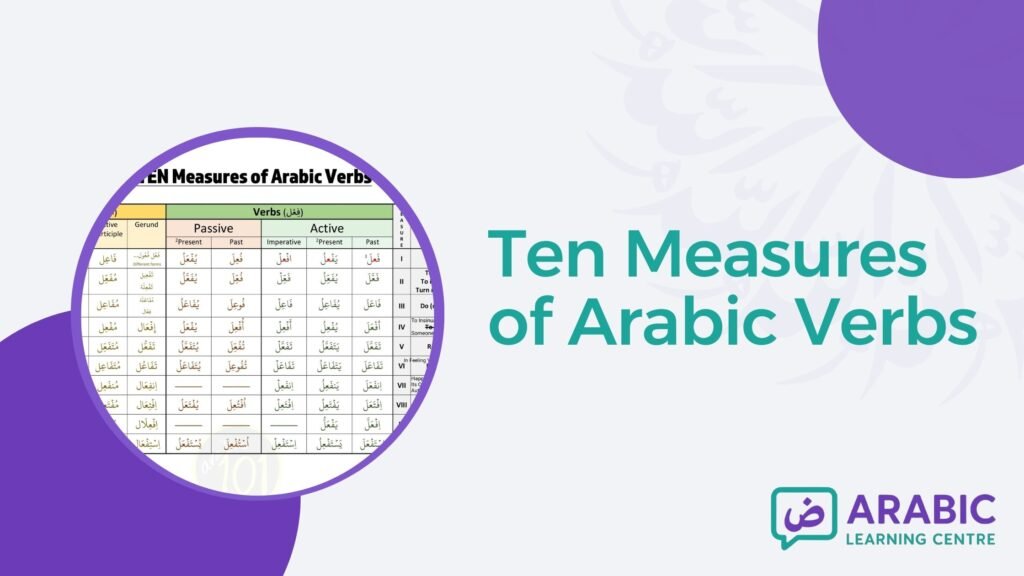
Ten Arabic Verb Measures Chart
| Form | Arabic Pattern | Key Feature | Primary Meaning |
| I | فَعَلَ | Base form | Core root meaning |
| II | فَعَّلَ | Doubled middle consonant | Causative / intensive |
| III | فاعَلَ | Long Alif after 1st consonant | Relational / directional |
| IV | أَفْعَلَ | Hamza prefix | Causative |
| V | تَفَعَّلَ | تَـ + Form II | Reflexive / passive of II |
| VI | تَفاعَلَ | تَـ + Form III | Reciprocal / reflexive of III |
| VII | اِنْفَعَلَ | اِنـ prefix | Passive / intransitive of I |
| VIII | اِفْتَعَلَ | تَـ infix after 1st consonant | Reflexive / acquisitive |
| IX | اِفْعَلَّ | Doubled final consonant | Colours and physical states |
| X | اِسْتَفْعَلَ | اِسْتَـ prefix | Seeking / requesting |
Read also: The Arabic Verb “To Be”
Practice Exercises to Apply Ten Measures of Arabic Verbs
The ten measures become functional knowledge only through active application. These exercises are designed to move pattern recognition from passive understanding to active production.
Exercise 1: Identify the Measure
Determine the form number for each verb below:
- تَكَلَّمَ — to speak
- أَرْسَلَ — to send
- اِنْقَطَعَ — to be cut off
- اِسْتَقَالَ — to resign
- كَاتَبَ — to correspond with
(Answers: V, IV, VII, X, III)
Exercise 2: Derive the Form
Using the root ع-ل-م (ʿ-l-m, knowledge/knowing), produce:
- Form I: عَلِمَ (to know)
- Form II: عَلَّمَ (to teach)
- Form IV: أَعْلَمَ (to inform)
- Form V: تَعَلَّمَ (to learn)
- Form X: اِسْتَعْلَمَ (to enquire)
This single root yields five distinct verbs across five measures — all decodable once you know the patterns.
Exercise 3: Translate Using Measure Logic
Without a dictionary, identify the likely meaning of اِسْتَكْبَرَ given that the root ك-ب-ر means “to be great/big.”
(Answer: Form X — to consider oneself great — i.e., to be arrogant. This precise word appears in the Quran.)
For learners who want structured practice with feedback from a qualified instructor, The Arabic Learning Centre’s Arabic Course for Beginners provides exactly this type of systematic measure-based training with personalised correction.
Our Students Reviews
Join Our Arabic Course for Beginners With a Free Trial
Start Mastering Arabic Verb Patterns with The Arabic Learning Centre
Arabic verb measures are the single most powerful structural tool in the Arabic learner’s toolkit. With ten patterns covering the vast majority of the lexicon, a learner who understands them gains access to thousands of words through root-and-pattern logic rather than rote memorisation.
The Arabic Learning Centre offers:
- Arabic Grammar Course — structured verb measure training with certified native Arabic instructors
- Arabic Course for Beginners — foundational Arabic from the ground up
- 1-on-1 personalised sessions with flexible 24/7 scheduling
- Free trial lesson — no commitment required
Book your free trial today and build the grammatical foundation that makes Arabic genuinely readable.
Check out our top courses in Arabic and choose the course you need to start learning Arabic today:
- Arabic Course for Beginners
- Arabic Script Writing Course
- Arabic Speaking Course
- Learn Arabic Letters for Tajweed
- Learning Arabic Grammar
- Arabic Vocabulary Course
- Fusha Arabic Course
- Classical Arabic Course
- Arabic Course for Islamic Studies
- Quranic Arabic Course
- Learn Arabic for New Muslims
Start with a FREE trial class and enhance your Arabic language skills

Conclusion
The ten Arabic verb measures — from the base Form I through to the seeking-and-requesting Form X — are not arbitrary categories. They are a living, productive system that generated and continues to generate the Arabic vocabulary used in the Quran, classical literature, and Modern Standard Arabic today.
Each measure’s structural marker — a doubled consonant, a prefix, an infix — carries consistent semantic weight. Form II’s shadda signals intensity or causation. Form VII’s in- prefix signals passivity. Form X’s ista- signals seeking. These patterns are reliable enough to make educated, often accurate inferences about words you encounter for the first time.
Frequently Asked Questions About the Ten Measures of Arabic Verbs
What are the ten measures of Arabic verbs in English?
The ten Arabic verb measures are: Form I (base meaning), Form II (causative/intensive), Form III (relational/directional), Form IV (causative with prefix), Form V (reflexive of II), Form VI (reciprocal of III), Form VII (passive/intransitive of I), Form VIII (reflexive/acquisitive), Form IX (colours and states), and Form X (seeking/requesting). Each is built from a three-consonant root with specific structural modifications.
Do all Arabic verbs follow the ten measures?
Most Arabic verbs from three-consonant roots follow these ten measures. There are also quadriliteral roots (four consonants) that follow four separate patterns labelled Iq–IVq, and a small number of genuinely irregular verbs. For practical learners, mastering the ten standard measures covers the overwhelming majority of verbs encountered in Modern Standard Arabic and classical texts.
Which Arabic verb measure is most common?
Forms I, II, IV, V, VIII, and X are the most frequently occurring in modern Arabic usage. Form I appears in virtually every Arabic text. Forms II and IV are essential for causative constructions. Form X appears constantly in formal Modern Standard Arabic, particularly in news, academic, and religious contexts.
How does knowing verb measures help with Arabic conjugation?
Once you identify a verb’s measure, its conjugation pattern becomes predictable. All Form II verbs conjugate identically; all Form X verbs follow the same pattern. This means learning ten conjugation templates — rather than individual verb paradigms — gives you the ability to conjugate verbs in Arabic across a massive range of vocabulary.
Related Articles
Arabic Grammar