 Arabic Grammar
Arabic learners often find possession confusing because Arabic does not usually use separate words like “my,” “your,” “his,” or “their.” Instead, Arabic adds small endings to nouns. These endings are called possessive pronouns, and they show who owns or is connected to something.
For example:
- كِتابي — kitābī — my book
- كِتابُكَ — kitābuka — your book
- كِتابُها — kitābuhā — her book
In this guide, you will learn possessive pronouns Arabic step by step, including their function, characteristics, usage, full chart, examples, comparison with similar pronouns, and practical exercises.
What Are Possessive Pronouns In Arabic?
Possessive pronouns in Arabic, or ضمائر الملكية, are attached suffixes used to show possession, ownership, or relationship. Unlike English, Arabic usually attaches the possessive meaning directly to the noun.
In English, we say:
- my book
- your house
- his pen
- their teacher
In Arabic, the possessive pronoun comes at the end of the noun:
| English | Arabic | Transliteration |
| My book | كِتابي | kitābī |
| Your book | كِتابُكَ | kitābuka |
| His book | كِتابُهُ | kitābuhu |
| Her book | كِتابُها | kitābuhā |
| Our book | كِتابُنا | kitābunā |
So, Arabic does not usually say “my” as a separate word before the noun. Instead, it attaches ـي to the noun to create the meaning of “my”.
Function Of Arabic Possessive Pronouns
The main function of Arabic possessive pronouns is to show who owns something or who something belongs to. They can also show relationship, connection, and association between people and things.
Arabic possessive pronouns answer questions such as:
- Whose book is this?
- Whose house is it?
- Who does this object belong to?
- Who is connected to this noun?
Examples:
- أَبي — abī — my father
- بَيْتُكَ — baytuka — your house
- صَديقُهُ — ṣadīquhu — his friend
- مُعَلِّمُنا — muʿallimunā — our teacher
This function makes possessive pronouns Arabic very important in daily speech, formal writing, Quranic Arabic, and Arabic grammar study.
Characteristics Of Arabic Possessive Pronouns
Arabic possessive pronouns have specific grammar features that make them different from English possessive words. Understanding these features helps learners use them correctly in sentences.
| Characteristic | Explanation | Example |
| They Are Attached Suffixes | They are added to the end of nouns | كِتابي — my book |
| They Show Gender | “Your” changes for masculine and feminine | كِتابُكَ / كِتابُكِ |
| They Show Number | Arabic has singular, dual, and plural forms | كِتابُكما / كِتابُكم |
| They Express Ownership | They show who owns something | بَيْتُهُ — his house |
| They Can Change Noun Spelling | Some nouns slightly change before suffixes | خالة → خالتي |
The most important idea is that Arabic possessive pronouns are not usually independent words. They are connected endings that become part of the noun.
Arabic Possessive Pronouns Chart
The chart below shows the main possessive pronouns in Arabic. These suffixes are attached to nouns to express meanings like my, your, his, her, our, and their.
| English Meaning | Arabic Suffix | Example With كِتاب | Translation |
| My | ـي | كِتابي | My book |
| Your — masculine singular | ـكَ | كِتابُكَ | Your book |
| Your — feminine singular | ـكِ | كِتابُكِ | Your book |
| His | ـهُ | كِتابُهُ | His book |
| Her | ـها | كِتابُها | Her book |
| Our | ـنا | كِتابُنا | Our book |
| Your — dual | ـكما | كِتابُكما | Your book |
| Their — dual | ـهما | كِتابُهما | Their book |
| Your — masculine plural | ـكم | كِتابُكم | Your book |
| Your — feminine plural | ـكنَّ | كِتابُكنَّ | Your book |
| Their — masculine plural | ـهم | كِتابُهم | Their book |
| Their — feminine plural | ـهنَّ | كِتابُهنَّ | Their book |
This chart is one of the easiest ways to memorise possessive pronouns Arabic because you can practise by attaching each suffix to the same noun.
Master Arabic Possessive Pronouns With An Advanced Arabic Course
Understanding possessive pronouns in Arabic is an important step toward reading, writing, and analysing Arabic with accuracy, but advanced fluency requires going beyond basic suffixes and sentence examples. The Arabic Learning Centre’s Advanced Arabic Course helps proficient learners develop deeper control of Arabic grammar, morphology, syntax, and textual analysis, including how structures like ضمائر الملكية function in classical, academic, and professional Arabic contexts. Through expert guidance, learners strengthen their ability to understand complex Arabic constructions, analyse authentic texts, and use Arabic with greater precision in research, translation, and advanced communication.
Join the Arabic Learning Centre’s Advanced Arabic Course today and move from understanding Arabic grammar rules to mastering them with confidence.
Shots Videos from Our Courses
How Do Possessive Pronouns Work In Arabic?
Arabic possessive pronouns work by adding the correct suffix to the end of a noun. The suffix changes depending on who owns the thing: I, you, he, she, we, or they.
The basic structure is:
Noun + Possessive Suffix = Possession
Examples:
| Noun | Suffix | Full Word | Meaning |
| كِتاب | ـي | كِتابي | My book |
| كِتاب | ـكَ | كِتابُكَ | Your book — masculine |
| كِتاب | ـكِ | كِتابُكِ | Your book — feminine |
| كِتاب | ـهُ | كِتابُهُ | His book |
| كِتاب | ـها | كِتابُها | Her book |
| كِتاب | ـنا | كِتابُنا | Our book |
For example, the noun كِتاب means “book.” When you add ـي, it becomes كِتابي, meaning “my book.”
Each Possessive Pronoun In Arabic With Examples
Each Arabic possessive pronoun has its own use depending on the speaker, listener, or person being discussed. The examples below show how each suffix works with common Arabic nouns.
My In Arabic — ـي
The suffix ـي means “my.” It is used when the speaker owns something or has a personal connection to something.
Examples:
- كِتابي — kitābī — my book
- قَلَمي — qalamī — my pen
- بَيْتي — baytī — my house
- أُمّي — ummī — my mother
- صَديقي — ṣadīqī — my friend
Sentence:
- بَيْتي قَريبٌ مِنَ المَدْرَسَةِ.
Baytī qarībun mina al-madrasah.
My house is near the school.
Your In Arabic Masculine Singular — ـكَ
The suffix ـكَ means “your” when speaking to one male person. It is used in Standard Arabic and formal grammar.
Examples:
- كِتابُكَ — kitābuka — your book
- قَلَمُكَ — qalamuka — your pen
- بَيْتُكَ — baytuka — your house
- صَديقُكَ — ṣadīquka — your friend
- عَمَلُكَ — ʿamaluka — your work
Sentence:
- هَلْ هذا كِتابُكَ؟
Hal hādhā kitābuka?
Is this your book?
Your In Arabic Feminine Singular — ـكِ
The suffix ـكِ means “your” when speaking to one female person. This is one of the clear gender differences in Arabic grammar.
Examples:
- كِتابُكِ — kitābuki — your book
- حَقيبَتُكِ — ḥaqībatuki — your bag
- سَيّارَتُكِ — sayyāratuki — your car
- أُخْتُكِ — ukhtuki — your sister
- عائِلَتُكِ — ʿāʾilatuki — your family
Sentence:
- حَقيبَتُكِ جَميلَةٌ.
Ḥaqībatuki jamīlah.
Your bag is beautiful.
His In Arabic — ـهُ
The suffix ـهُ means “his.” It is used when the owner is one male person.
Examples:
- كِتابُهُ — kitābuhu — his book
- بَيْتُهُ — baytuhu — his house
- عَمَلُهُ — ʿamaluhu — his work
- أَخوهُ — akhūhu — his brother
- رَأْيُهُ — raʾyuhu — his opinion
Sentence:
- عَمَلُهُ مُهِمٌّ.
ʿAmaluhu muhimm.
His work is important.
Her In Arabic — ـها
The suffix ـها means “her.” It is used when the owner is one female person.
Examples:
- كِتابُها — kitābuhā — her book
- بَيْتُها — baytuhā — her house
- غُرْفَتُها — ghurfatuhā — her room
- سَيّارَتُها — sayyāratuhā — her car
- رَأْيُها — raʾyuhā — her opinion
Sentence:
- غُرْفَتُها مَلِيئَةٌ بِالكُتُبِ.
Ghurfatuhā malīʾah bil-kutub.
Her room is full of books.
Our In Arabic — ـنا
The suffix ـنا means “our.” It is used when the owner is a group that includes the speaker.
Examples:
- كِتابُنا — kitābunā — our book
- بَيْتُنا — baytunā — our house
- مُعَلِّمُنا — muʿallimunā — our teacher
- بَلَدُنا — baladunā — our country
- دَرْسُنا — darsunā — our lesson
Sentence:
- مُعَلِّمُنا يَشْرَحُ الدَّرْسَ بِوُضوحٍ.
Muʿallimunā yashraḥu ad-darsa biwuḍūḥ.
Our teacher explains the lesson clearly.
Your Dual In Arabic — ـكما
The suffix ـكما means “your” when speaking to two people. This dual form is used in Standard Arabic and formal contexts.
Examples:
- كِتابُكما — kitābukumā — your book
- بَيْتُكما — baytukumā — your house
- صَديقُكما — ṣadīqukumā — your friend
Sentence:
- أَيْنَ بَيْتُكما؟
Ayna baytukumā?
Where is your house? — speaking to two people.
Their Dual In Arabic — ـهما
The suffix ـهما means “their” when referring to two people or two things. It can refer to two males, two females, or a mixed pair.
Examples:
- كِتابُهما — kitābuhumā — their book
- بَيْتُهما — baytuhumā — their house
- أَخوهُما — akhūhumā — their brother
Sentence:
- بَيْتُهما قَريبٌ مِنَ الجَامِعَةِ.
Baytuhumā qarībun mina al-jāmiʿah.
Their house is near the university.
Your Masculine Plural In Arabic — ـكم
The suffix ـكم means “your” when speaking to a group of males or a mixed group. It is commonly used in formal Arabic and many spoken varieties.
Examples:
- كِتابُكم — kitābukum — your book
- بَيْتُكم — baytukum — your house
- مُدَرِّسُكم — mudarrisukum — your teacher
- مَشْروعُكم — mashrūʿukum — your project
Sentence:
- مَشْروعُكم ناجِحٌ.
Mashrūʿukum nājiḥ.
Your project is successful.
Your Feminine Plural In Arabic — ـكنَّ
The suffix ـكنَّ means “your” when speaking to a group of females only. This form is common in formal Arabic, classical Arabic, and Quranic Arabic.
Examples:
- كِتابُكنَّ — kitābukunna — your book
- بَيْتُكنَّ — baytukunna — your house
- جُهودُكنَّ — juhūdukunna — your efforts
Sentence:
- جُهودُكنَّ واضِحَةٌ.
Juhūdukunna wāḍiḥah.
Your efforts are clear.
Their Masculine Plural In Arabic — ـهم
The suffix ـهم means “their” when referring to a group of males or a mixed group. It is one of the most useful plural possessive endings.
Examples:
- كِتابُهم — kitābuhum — their book
- بَيْتُهم — baytuhum — their house
- فَريقُهم — farīquhum — their team
- مَشْروعُهم — mashrūʿuhum — their project
Sentence:
- أَوْلادُهم يَلْعَبونَ في الحَديقَةِ.
Awlāduhum yalʿabūna fī al-ḥadīqah.
Their children are playing in the garden.
Their Feminine Plural In Arabic — ـهنَّ
The suffix ـهنَّ means “their” when referring to a group of females only. It appears more often in formal and classical Arabic than in daily speech.
Examples:
- كِتابُهنَّ — kitābuhunna — their book
- بَيْتُهنَّ — baytuhunna — their house
- قِصَّتُهنَّ — qiṣṣatuhunna — their story
- جُهودُهنَّ — juhūduhunna — their efforts
Sentence:
- قِصَّتُهنَّ مُلْهِمَةٌ.
Qiṣṣatuhunna mulhimah.
Their story is inspiring.
Build Arabic Grammar Confidence With Arabic Classes For Adults
Learning possessive pronouns in Arabic is much easier when grammar is explained clearly and practised through real sentences. The Arabic Learning Centre’s Arabic Classes For Adults support mature learners who want structured, practical Arabic instruction that fits their goals and learning pace. Through focused lessons in Arabic grammar, phonetics, sentence structure, reading, and speaking, adult learners can understand how forms like ضمائر الملكية work in everyday communication, formal writing, and Arabic texts.
Whether you are learning Arabic for study, work, travel, or personal growth, The Arabic Learning Centre helps you move from memorising grammar rules to using Arabic with confidence and accuracy.
Join the Arabic Learning Centre’s Arabic Classes For Adults today and start building practical Arabic skills step by step.
Arabic Possessive Pronouns Examples In Sentences
Seeing possessive pronouns inside full sentences helps learners understand how they work naturally. These examples cover family, home, school, work, and everyday speech.
Family Examples
Family words are very common with Arabic possessive pronouns because learners often talk about parents, siblings, relatives, and children.
- أُمّي تُحِبُّ قَهْوَتَها ساخِنَةً.
Ummī tuḥibbu qahwatahā sākhina.
My mother likes her coffee hot. - أَخوكَ مُهَنْدِسٌ ماهِرٌ.
Akhūka muhandisun māhir.
Your brother is a skilled engineer. - أُخْتُها تَدْرُسُ العَرَبِيَّةَ.
Ukhtuhā tadrusu al-ʿarabiyyah.
Her sister studies Arabic.
Home And Belongings Examples
Possessive pronouns are also used with objects, rooms, houses, cars, bags, and other personal belongings.
- بابُ بَيْتي أَزْرَقُ.
Bābu baytī azraq.
The door of my house is blue. - هَلْ هذِهِ سَيّارَتُكَ الجَديدَةُ؟
Hal hādhihi sayyāratuka al-jadīdah?
Is this your new car? - قَلَمُها أَحْمَرُ.
Qalamuhā aḥmar.
Her pen is red.
Study And Work Examples
In school and work contexts, possessive pronouns Arabic are useful with words like teacher, lesson, book, project, and job.
- دَرْسُنا سَهْلٌ.
Darsunā sahl.
Our lesson is easy. - مُدَرِّسُكم مُمتازٌ.
Mudarrisukum mumtāz.
Your teacher is excellent. - عَمَلُهُ مُهِمٌّ.
ʿAmaluhu muhimm.
His work is important.
Important Rules For Arabic Possessive Pronouns
Some Arabic nouns change slightly when possessive suffixes are added. These rules are important for writing correct Arabic, especially in formal and Standard Arabic.
Taa Marbuta Changes To ت
When a noun ends with ة, it usually changes to ت before adding a possessive suffix.
Examples:
| Original Noun | With Possessive Suffix | Meaning |
| خالة | خالتي | My aunt |
| سيارة | سيارتُكَ | Your car |
| مدرسة | مدرستُنا | Our school |
| عائلة | عائلتُها | Her family |
This is why learners should not simply attach the suffix without checking the noun ending.
Dual Nouns May Drop ن
In Standard Arabic, dual nouns ending in ـان or ـين usually drop the final ن before adding a possessive suffix.
Examples:
| Original Dual Noun | With Suffix | Meaning |
| والدان | والداهُما | Their two parents |
| يَدان | يَداهُ | His two hands |
| مُعَلِّمان | مُعَلِّماكُم | Your two teachers |
This rule is especially useful for advanced learners studying formal Arabic grammar.
Sound Masculine Plural May Drop ن
Sound masculine plural nouns ending in ـون or ـين can also drop the final ن before possessive suffixes.
Examples:
- مُدَرِّسون → مُدَرِّسوهم
their teachers - مُهَنْدِسون → مُهَنْدِسوهُ
his engineers
These forms are more common in formal Arabic writing than in casual speech.
Possessive Pronouns In Standard Arabic And Egyptian Arabic
Possessive pronouns exist in both Standard Arabic and Egyptian Arabic, but the pronunciation changes. Standard Arabic is used in formal writing, education, media, and Quranic study, while Egyptian Arabic is used in everyday speech in Egypt.
| English | Standard Arabic | Egyptian Arabic |
| My house | بَيْتي — baytī | بيتي — beiti |
| Your house — masculine | بَيْتُكَ — baytuka | بيتك — beitak |
| Your house — feminine | بَيْتُكِ — baytuki | بيتك — beitik |
| His book | كِتابُهُ — kitābuhu | كتابه — kitābu |
| Her book | كِتابُها — kitābuhā | كتابها — kitābha |
| Our house | بَيْتُنا — baytunā | بيتنا — beitna |
| Their house | بَيْتُهم — baytuhum | بيتهم — beithom |
In Egyptian Arabic, the endings are usually lighter and easier in pronunciation. For example, ـكَ becomes -ak, and ـكِ becomes -ik.
Examples:
- أبويا — abūya — my father
- أخوك — akhūk — your brother
- باباكي — bābāki — your dad — feminine
- بيتهم — beithom — their house
This light comparison helps learners understand how grammar changes between formal Arabic and spoken Arabic.
Possessive Pronouns Vs Object Pronouns In Arabic
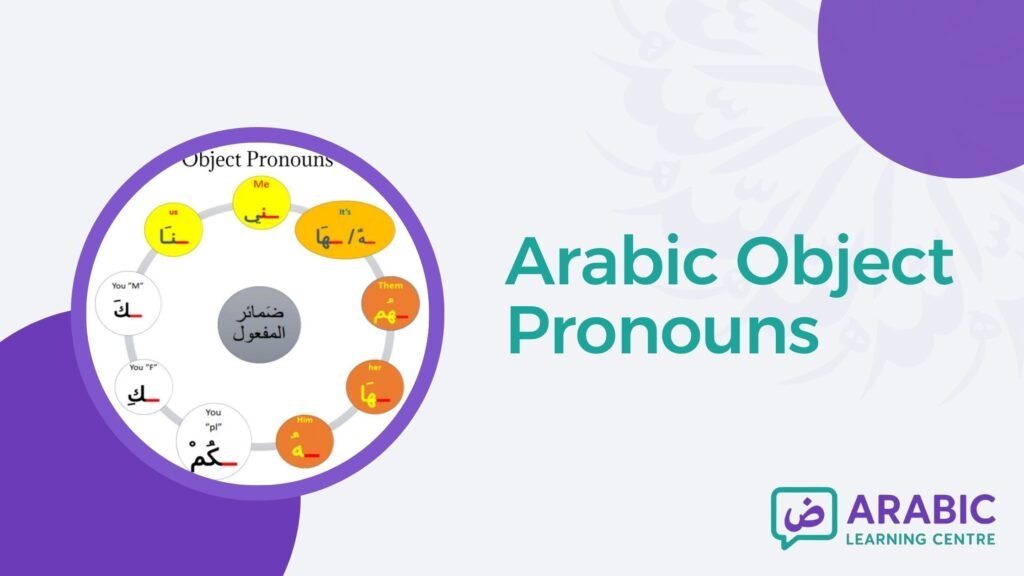
Possessive pronouns and object pronouns in Arabic can look very similar because both can appear as suffixes. The difference is not always in the suffix itself, but in the word it attaches to.
When the suffix attaches to a noun, it usually shows possession:
When the suffix attaches to a verb, it works as an object pronoun:
• كِتابُهُ — His book
• بَيْتُها — Her house
• مُعَلِّمُنا — Our teacher
So, the learner should always ask: is the suffix attached to a noun or a verb? This will help identify its function.
Read Also: Education Vocabulary In Arabic
Our Students Reviews
Read Also: Personal Pronouns In Arabic
Learn Possessive Pronouns Arabic With The Arabic Learning Centre
Understanding possessive pronouns Arabic becomes much easier when you study them through structured lessons, clear examples, and guided practice. The Arabic Learning Centre offers expert-led online Arabic instruction with native tutors, covering grammar, vocabulary, reading, writing, listening, and speaking through a progressive curriculum designed for different learner levels.
If you want to move beyond memorising ضمائر الملكية and start using Arabic possessive pronouns confidently in real sentences, The Arabic Learning Centre can help you build that foundation step by step through flexible online classes and guided support.
Start your Arabic learning journey today with a free trial lesson and practise Arabic grammar with confidence.
Courses We Offer:
- Online Arabic Course
- Classical arabic course
- Modern Standard Arabic Course
- Fusha Arabic Course
- Learn Saudi Arabic
Conclusion
Possessive pronouns Arabic are attached suffixes that show ownership, possession, and relationship. Instead of using separate words like “my,” “your,” or “their,” Arabic usually attaches the possessive pronoun directly to the noun.
For example:
- كِتابي — my book
- كِتابُكَ — your book
- كِتابُها — her book
- كِتابُنا — our book
- كِتابُهم — their book
To master possessive pronouns Arabic, focus on the suffixes, practise with common nouns, and pay attention to gender and number. With regular practice, these endings become easier to recognise and use correctly in real Arabic sentences.
Read Also: She Her Pronouns And Gender Pronouns In Arabic
Frequently Asked Questions
What Are Possessive Pronouns In Arabic?
Possessive pronouns in Arabic are suffixes attached to nouns to show ownership. For example, كِتابي means “my book,” and كِتابُهُ means “his book.”
How Do Possessive Pronouns Work In Arabic?
Possessive pronouns work by adding a suffix to the end of a noun. For example, the noun كِتاب means “book,” and when we add ـي, it becomes كِتابي, meaning “my book.”
Are Arabic Possessive Pronouns Separate Words?
No, Arabic possessive pronouns are not usually separate words like English “my,” “your,” or “their.” They are attached directly to the noun as endings, such as ـي, ـكَ, ـها, and ـنا.
What Is The Difference Between كَ And كِ In Arabic?
The suffix ـكَ is used when speaking to one male, while ـكِ is used when speaking to one female. For example, كِتابُكَ means “your book” for a male, and كِتابُكِ means “your book” for a female.
Do Possessive Pronouns Change In Egyptian Arabic?
Yes, the meaning stays the same, but the pronunciation often changes in Egyptian Arabic. For example, بَيْتُكَ in Standard Arabic becomes بيتك / beitak in Egyptian Arabic when speaking to a male.
Why Are Possessive Pronouns Important In Arabic?
Possessive pronouns are important because they are used in daily Arabic conversations, reading, writing, Quranic Arabic, and formal grammar. They help learners talk about family, belongings, places, work, and relationships clearly.
Related Articles
Arabic Grammar