 Arabic Grammar
| Key Takeaways |
| Sukoon (سُكُون) is a diacritical mark indicating a consonant carries no vowel sound in Arabic pronunciation. |
| Jazm (جَزْم) is a grammatical state that modifies Arabic verbs in the jussive mood, affecting their final inflection. |
| Both Sukoon and Jazm produce similar written forms but operate in entirely different grammatical domains — Sukoon is phonological, Jazm is syntactic. |
| Jazm is triggered by specific particles called حُرُوف الجَزْم (ḥurūf al-jazm), including لَمْ, لَا النَّاهِيَة, and إِنْ conditional. |
| Misunderstanding Sukoon as Jazm is one of the most consistent errors Arabic students make when studying verb conjugation. |
The difference between Sukoon and Jazm comes down to this: Sukoon is a phonological marker showing the absence of a vowel on a consonant, while Jazm is a syntactic grammatical state that places Arabic verbs in the jussive mood. They look visually similar — both can produce a vowelless ending — but they belong to completely different layers of the Arabic language system.
Understanding this distinction matters because confusing the two leads to genuine grammatical errors. A student who reads لَمْ يَكْتُبْ and identifies the final sukoon as merely “no vowel” has missed the entire grammatical function of Jazm — that the verb has been pulled into a specific mood by a governing particle.
Recognising why that vowel is absent changes how you read, analyse, and produce Arabic sentences entirely.
What Is Sukoon in Arabic and How Does It Function?
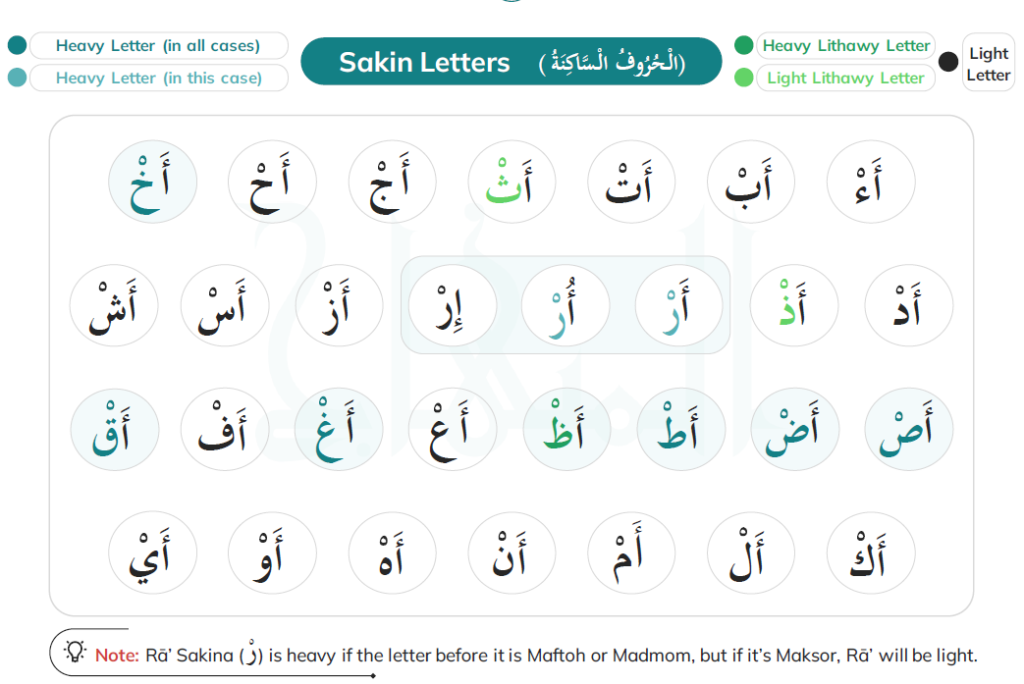
Sukoon (سُكُون) is a diacritical sign written as a small circle (°) above a letter, indicating that the consonant carries no vowel — the syllable closes on that letter. It is a feature of pronunciation and orthographic representation, not a statement about grammatical case or mood.
Every Arabic consonant must either carry a short vowel — Fatha (َ), Kasra (ِ), or Damma (ُ) — or be marked with Sukoon. There is no third option. When a syllable closes, the final consonant receives Sukoon.
Examples of Sukoon:
كَتَبْتُ
katabtu I wrote
Here, the بْ carries Sukoon because the syllable كَتَبْ closes on the ب before تُ begins the next syllable.
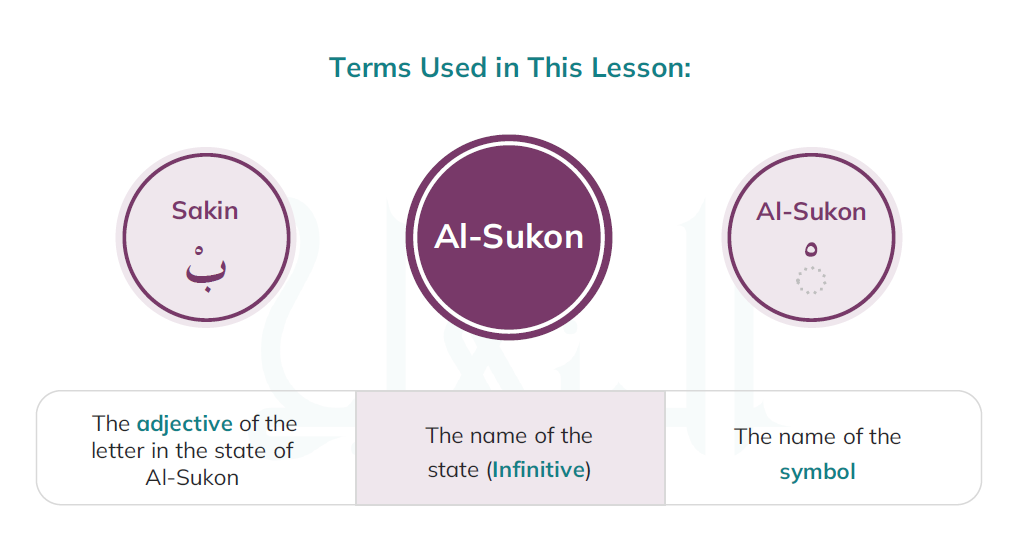
مِنْ
min
“From”
The نْ ends with Sukoon — a closed syllable with no following vowel on the ن.
Sukoon appears across all word types: nouns, verbs, particles, and pronouns. It has no grammatical meaning in itself. It simply tells you: this consonant has no vowel.
At The Arabic Learning Centre, our certified instructors regularly observe that beginners initially treat every vowelless letter as grammatically significant — but most Sukoons in Arabic text are purely phonological facts, not grammatical signals.
For a strong foundation in reading Arabic with correct vowelisation, our Arabic Course for Beginners provides structured, instructor-led training in precisely these fundamentals — including how to identify and produce Sukoon correctly from day one.
Join Our Arabic Course for Beginners With a Free Trial

What Is Jazm in Arabic Grammar?
Jazm (جَزْم) is one of the four grammatical states (iʿrāb) of the Arabic imperfect verb (الفِعْل المُضَارِع — al-fiʿl al-muḍāriʿ). It represents the jussive mood — a state the verb enters when governed by certain particles or grammatical structures that demand it.
In classical Nahw scholarship, Jazm is the verbal equivalent of the genitive case on nouns — it signals that the verb is syntactically subordinated to a governing element. The sign of Jazm varies by verb type:
| Verb Type | Sign of Jazm | Example |
| Strong verb (صَحِيح) | Final vowel dropped → Sukoon appears | يَكْتُبْ (yaktub) |
| Defective verb ending in ي or و (مُعْتَل الآخِر) | Final weak letter deleted entirely | يَدْعُ (yadʿu → يَدْعُ) |
| Five Verbs (الأَفْعَال الخَمْسَة) | Final ن (Nun) is deleted | لَمْ تَكْتُبُوا → لَمْ تَكْتُبُوا (nun deleted) |
This is where the similarity with Sukoon arises. For a strong verb, the sign of Jazm is a Sukoon on the final letter.
But that Sukoon is not a phonological accident — it is the grammatical marker of the jussive mood, placed there because a particle of Jazm has governed the verb.
Shots Videos from Our Courses
What Are the Particles That Cause Jazm?
Jazm is triggered exclusively by specific governing particles — called حُرُوف الجَزْم (ḥurūf al-jazm) — and by certain conditional and correlative structures. No verb enters Jazm spontaneously.
The major categories are:
Particles That Govern One Verb
These particles take a single verb into Jazm:
| Particle | Meaning | Example |
| لَمْ | Did not (negates past) | لَمْ يَذْهَبْ — “He did not go” |
| لَمَّا | Not yet | لَمَّا يَصِلْ — “He has not yet arrived” |
| لَا النَّاهِيَة | Prohibitive “do not” | لَا تَكْذِبْ — “Do not lie” |
| لَامُ الأَمْرِ | Commanding lam | لِيَكْتُبْ — “Let him write” |
Particles That Govern Two Verbs (Conditional)
These govern both the condition clause (فِعْل الشَّرْط) and the response clause (جَوَاب الشَّرْط):
| Particle | Meaning | Example |
| إِنْ | If | إِنْ تَدْرُسْ تَنْجَحْ — “If you study, you will succeed” |
| مَنْ | Whoever | مَنْ يَعْمَلْ يُكَافَأْ — “Whoever works will be rewarded” |
| مَا | Whatever | مَا تَفْعَلْ تُحَاسَبْ — “Whatever you do, you will be accountable” |
At The Arabic Learning Centre, students working through our Arabic Grammar Course encounter these structures in depth — with practical sentence building to ensure the conditional system becomes second nature rather than a memorised list.
Start Learning Arabic Grammar with a Free Trial

What Is the Core Difference Between Sukoon and Jazm?
Sukoon and Jazm differ fundamentally in domain: Sukoon is phonological, Jazm is syntactic. Sukoon marks the absence of a vowel on any consonant in any word.
Jazm is a grammatical state exclusive to the imperfect verb, caused by a governing particle, and its sign happens to be Sukoon — but only for strong verbs.
The table below clarifies the distinction directly:
| Feature | Sukoon (سُكُون) | Jazm (جَزْم) |
| Domain | Phonology / Orthography | Syntax / Grammar (Iʿrāb) |
| Applies to | All word types | Imperfect verbs only |
| Caused by | Syllable structure | Governing particles (ḥurūf al-jazm) or conditional structures |
| Written sign | Small circle (°) above letter | Sukoon (for strong verbs); deletion of final letter or Nun |
| Equivalent in noun grammar | No equivalent | Comparable to genitive (Jarr) or accusative (Naṣb) in nouns |
| Can appear in the same word? | Yes — as the marker of Jazm in strong verbs | Yes — the Sukoon you see IS the sign of Jazm |
The most concise way to state the distinction: every sign of Jazm on a strong verb is a Sukoon, but not every Sukoon is a sign of Jazm.
Why Do Learners Confuse Sukoon and Jazm?
Students at The Arabic Learning Centre consistently conflate these two concepts at the intermediate stage — typically after learning basic diacritics but before studying Arabic verb moods systematically.
The confusion has a very specific cause: in a strong imperfect verb, the written form of Jazm and an ordinary Sukoon look completely identical.
Compare these two sentences:
كَتَبْتُ الدَّرْسَ
katabtu al-darsa
I wrote the lesson — the بْ carries a phonological Sukoon only.
لَمْ يَكْتُبْ
lam yaktub
He did not write — the بْ carries the Sukoon of Jazm, triggered by لَمْ.
Visually, both بْ marks look identical. The grammatical difference is only visible when you identify the governing particle.
This is exactly why Arabic grammar analysis (iʿrāb) — the practice of parsing each word’s grammatical state — is taught rigorously in classical Arabic education. Iʿrāb trains you to ask not just what mark is on this letter but why is it there.
Our Arabic grammar for beginners resource explains this parsing system from the ground up, helping learners build the analytical habits that distinguish genuine Arabic literacy from surface-level reading.
Join Our Arabic Course for Beginners With a Free Trial

How Does Jazm Affect Defective Verbs Differently?
For students who have moved beyond strong verbs, the sign of Jazm becomes even more distinct from simple Sukoon — and this is where the concept truly clarifies itself.
Defective verbs (المُعْتَل الآخِر — verbs whose final root letter is و or ي) show Jazm through deletion of the final weak letter, not through Sukoon:
| Verb (Indicative) | Verb (After Jazm) | Sign of Jazm |
| يَدْعُو (yadʿū — he calls) | لَمْ يَدْعُ (lam yadʿu) | Final و deleted |
| يَمْشِي (yamshī — he walks) | لَمْ يَمْشِ (lam yamshi) | Final ي deleted |
| يَخْشَى (yakhshā — he fears) | لَمْ يَخْشَ (lam yakhsha) | Final ى deleted |
Here, there is no Sukoon on the final letter at all — the letter simply disappears. This form cannot be confused with ordinary Sukoon because there is no mark: the Jazm sign is absence itself.
Similarly, the Five Verbs (الأَفْعَال الخَمْسَة) — forms like تَكْتُبُونَ and يَكْتُبَانِ — show Jazm through deletion of the final ن (nun), producing forms like لَمْ تَكْتُبُوا and لَمْ يَكْتُبَا. Again, no Sukoon is present — the sign of Jazm is grammatical change, not a written diacritic.
This is one of the clearest demonstrations that Jazm and Sukoon are fundamentally different: Jazm is a grammatical state with multiple possible signs, only one of which resembles Sukoon.
Read Also: What Is Sukoon in Arabic?
How Do Sukoon and Jazm Relate to Quranic Arabic?
For learners approaching the Quran, this distinction carries particular weight. The Quran is fully vocalised with tashkeel (diacritical marks), which means every Sukoon and every sign of Jazm is explicitly written.
Readers who understand the difference can immediately identify not just how to pronounce a verb but what grammatical state it is in — which is essential for understanding Quranic meaning accurately.
Consider this Quranic example:
لَمْ يَلِدْ وَلَمْ يُولَدْ
lam yalid wa-lam yūlad
“He neither begets nor is He begotten.” (Surah Al-Ikhlas: 3)
Both يَلِدْ and يُولَدْ carry Sukoon on their final letters — but these are the signs of Jazm, triggered by لَمْ. A reader who recognises لَمْ as a particle of Jazm immediately understands that both verbs are in the jussive mood, expressing past negation. A reader who sees only “Sukoon” misses the grammatical structure entirely.
For structured study of this subject in its Quranic context, our Quranic Arabic Course and our Arabic course for Quranic understanding guide provide the grammatical depth needed to read the Quran with true comprehension.
Our Students Reviews
Read Also: How Many Harakat Are in Arabic?
Begin Mastering Arabic Grammar with The Arabic Learning Centre
The distinction between Sukoon and Jazm is one of dozens of precision points that separate functional Arabic literacy from guesswork. Understanding it properly requires structured instruction — not isolated memorisation.
The Arabic Learning Centre offers:
- Expert-led Arabic Grammar Course covering all verb moods including Jazm, Naṣb, and Rafʿ
- One-on-one sessions with certified native Arabic instructors
- Flexible scheduling available 24/7 to fit your life
- Structured curriculum progressing from foundational diacritics to advanced grammatical analysis
- Free trial lesson — no commitment required
Book your free trial lesson today and begin learning Arabic the way it was designed to be taught.
Check out our top courses in Arabic and choose the course you need to start learning Arabic today:
- Arabic Course for Beginners
- Arabic Script Writing Course
- Arabic Speaking Course
- Learn Arabic Letters for Tajweed
- Learning Arabic Grammar
- Arabic Vocabulary Course
- Fusha Arabic Course
- Classical Arabic Course
- Arabic Course for Islamic Studies
- Quranic Arabic Course
- Learn Arabic for New Muslims
Start with a FREE trial class and enhance your Arabic language skills

Conclusion
Sukoon and Jazm are not interchangeable — they operate on different levels of the Arabic language system. Sukoon is a phonological fact about a single consonant. Jazm is a grammatical state governing the imperfect verb, produced by specific syntactic relationships.
The Sukoon you see on a verb in the jussive mood is the written sign of Jazm — but understanding why it is there, what particle placed it there, and how it changes for different verb types transforms passive recognition into active grammatical command.
Learners who master this distinction consistently find that Arabic verb grammar — often described as one of the language’s most demanding features — begins to follow a clear and elegant internal logic. The grammar of Arabic rewards this kind of precise attention.
Read Also: Harakat in Arabic
Frequently Asked Questions About Sukoon and Jazm
Is Sukoon the Same as Jazm in Arabic?
Sukoon and Jazm are not the same thing. Sukoon is a diacritical mark indicating a vowelless consonant and can appear anywhere in any word type. Jazm is a grammatical state affecting imperfect verbs and is caused by governing particles. For strong verbs, the sign of Jazm happens to be a Sukoon — but the two concepts belong to different levels of the language.
Can a Verb Have Sukoon Without Being in the Jazm State?
Yes. A verb can carry Sukoon on non-final letters as a purely phonological feature without any Jazm being present. For example, in كَتَبْتُ (katabtu — “I wrote”), the بْ carries a phonological Sukoon as part of normal syllable structure, with no governing particle of Jazm involved whatsoever.
What Are the Signs of Jazm for Different Verb Types?
The sign of Jazm differs depending on the verb type. For strong verbs, it is a Sukoon on the final letter. For defective verbs ending in و or ي, it is deletion of the final weak letter. For the Five Verbs (الأفعال الخمسة), it is deletion of the final Nun. This variety is why Jazm cannot be reduced simply to “Sukoon.”
Why Is Understanding Jazm Important for Reading the Quran?
The Quran contains numerous instances of verbs in the jussive mood, particularly in negation with لَمْ and in conditional structures. Recognising Jazm allows the reader to understand the grammatical relationship between clauses, the tense and mood of verbs, and the precise meaning of Quranic statements — rather than reading individual words without understanding their syntactic function.
How Quickly Can a Learner Master Jazm in Arabic Grammar?
In our instructors’ experience at The Arabic Learning Centre, students with a solid grounding in the Arabic imperfect verb typically understand the concept of Jazm within one to two structured lessons. Applying it confidently across all verb types — including defective verbs and the Five Verbs — usually takes three to four additional weeks of practice with real Arabic text and Quranic examples.
Related Articles
Arabic Grammar