 Arabic Grammar

Learning particles in Arabic is an essential step toward understanding how Arabic sentences work. Small words such as مِنْ (min), فِي (fī), لَمْ (lam), and لَنْ (lan) may look simple, but each one has a specific meaning and grammatical function that can change the entire sentence.
In this guide, you will discover 12 main types of Arabic particles, their meanings, grammatical rules, and practical examples. You will also learn how to identify particles in sentences, avoid common grammar mistakes, and use them more confidently in reading, writing, and everyday conversations.
Arabic particles can be challenging because the same particle may have different meanings depending on its context, while other particles change the grammatical endings of the words that follow them. Understanding these differences helps you interpret sentences more accurately instead of relying on direct translation.
1. Prepositions (حروف الجر)
Prepositions link a noun to the rest of the sentence and always put that noun in the genitive case (مجرور, majrūr). The usual sign is a kasra: جئتُ مِنَ البيتِ (“I came from the house”).
The genitive does not always show as a kasra. Duals and sound masculine plurals take ـَيْنِ / ـِينَ (في البيتَيْنِ), and diptotes take a fatha (لِأحمدَ). Learners who look only for a kasra miss these cases.
| Particle | Core meaning | Example | Translation |
| مِنْ | from, of | جئتُ مِنَ البيتِ | I came from the house. |
| إلى | to | ذهبتُ إلى المدرسةِ | I went to the school. |
| في | in | الكتابُ في الحقيبةِ | The book is in the bag. |
| على | on | الكتابُ على الطاولةِ | The book is on the table. |
| عَنْ | about, away from | تحدّثَ عَنِ الدرسِ | He talked about the lesson. |
| بِـ | with, by | كتبتُ بالقلمِ | I wrote with the pen. |
| لِـ | for, belonging to | الكتابُ لِأحمدَ | The book is Ahmad’s. |
| كَـ | like | هو كالأسدِ في الشجاعةِ | He is like a lion in courage. |
Other prepositions include مُذْ and مُنْذُ (since), رُبَّ (many a), and حتّى (until).
2. Inna and its sisters (إنّ وأخواتها)
These six particles enter a nominal sentence. They put the subject in the accusative and leave the predicate in the nominative.
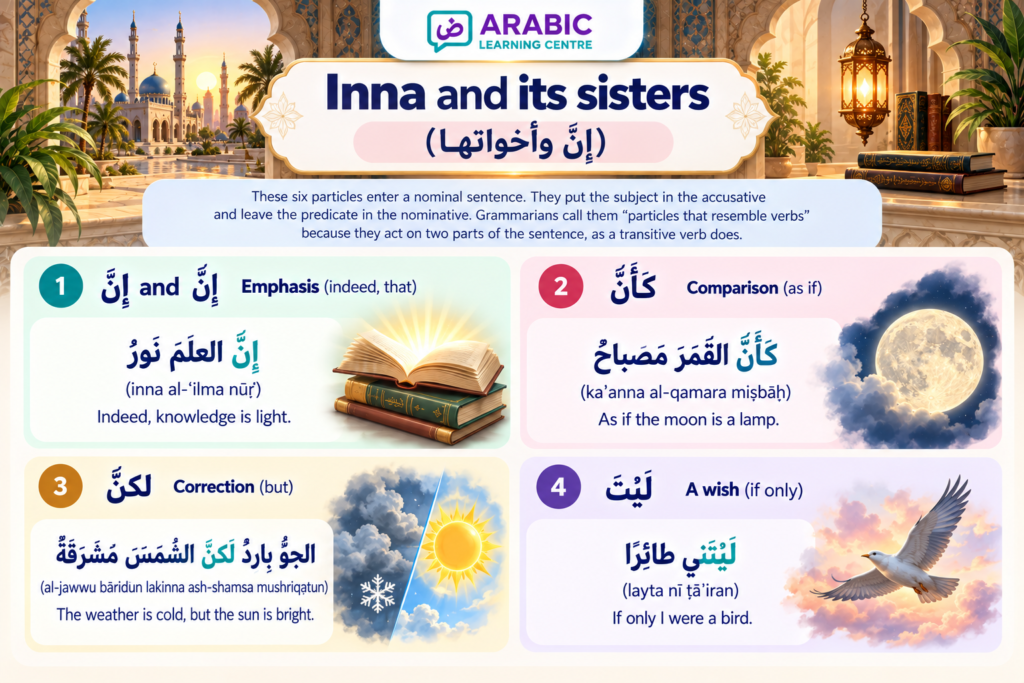
Grammarians call them “particles that resemble verbs” because they act on two parts of the sentence, as a transitive verb does.
- إنَّ (indeed) and أنَّ (that): emphasis.
إنَّ العلمَ نورٌ - كأنَّ (as if): comparison.
كأنَّ القمرَ مصباحٌ - لكنَّ (but): correction.
الجوُّ باردٌ لكنَّ الشمسَ مشرقةٌ - لَيْتَ (if only): a wish, often for something unlikely
- لَعَلَّ (perhaps): a hope for something possible
Read also: Kana Wa Akhawaatuha – The 13 Verbs Explained One By One
3. Conjunctions (حروف العطف)
Conjunctions join a word to an earlier one, and the joined word takes the same case.
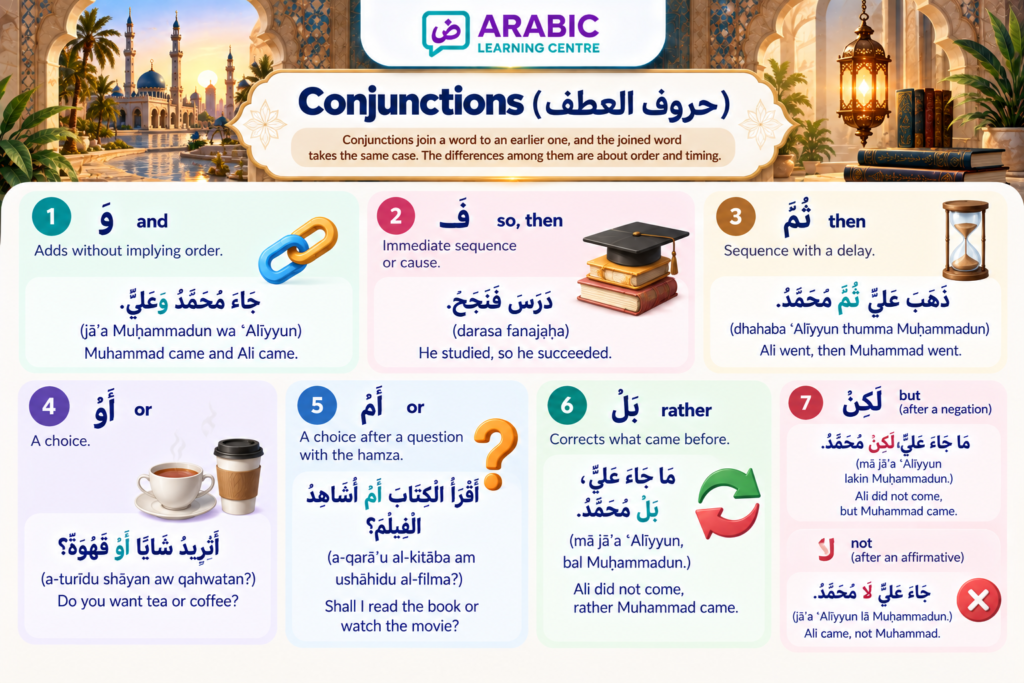
The differences among them are about order and timing:
- وَ (and): adds without implying order.
جاءَ محمدٌ وعليٌّ - فَـ (so, then): immediate sequence or cause.
درسَ فنجحَ - ثُمَّ (then): sequence with a delay.
ذهبَ عليٌّ ثُمَّ محمدٌ - أَوْ (or): choice.
أَمْ (or): a choice after a question with the hamza - بَلْ (rather), لكنْ (but, after a negation), لا (not, after an affirmative)
4. Subjunctive particles (حروف النصب)
These particles come before a present-tense verb and put it in the subjunctive (منصوب). They usually express purpose, intention, or future negation. The main ones are أَنْ, لَنْ, كَيْ, and إذَنْ.
The basic sign is a damma changing to a fatha: تسافرُ becomes أريدُ أن أسافرَ (“I want to travel”). Verbs of the five-verb pattern drop their final nūn instead: يذهبون becomes لن يذهبوا (“they will not go”).
With لام التعليل (لِأشتريَ) and with حتّى (حتّى أنجحَ), classical grammarians explain the subjunctive through an implied أنْ. This is why these two particles also appear on lists of prepositions.
5. Jussive particles (حروف الجزم)
Jussive particles put the present-tense verb in the jussive (مجزوم). Some govern one verb and some govern two.
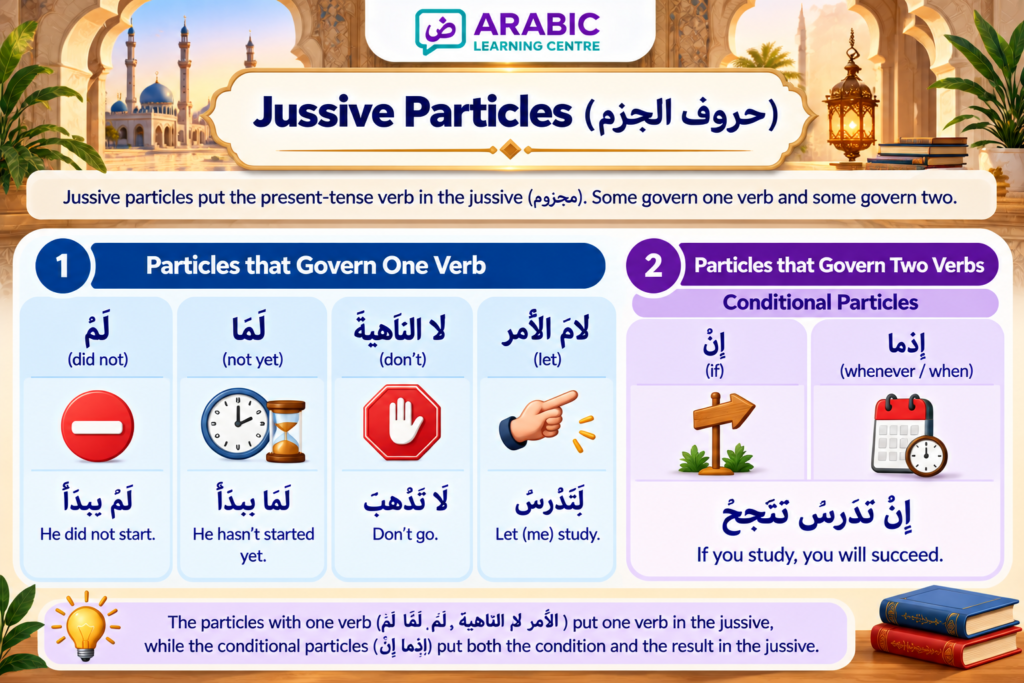
The particles that govern one verb are لَمْ (did not), لَمّا (not yet), لا الناهية (don’t), and لام الأمر (let).
لَمّا يبدأْ means “he hasn’t started yet” and suggests he still will, while لم يبدأْ only states that he didn’t.
The particles that govern two verbs are conditional, such as إنْ and إذما. Both the condition and the result take the jussive: إنْ تدرسْ تنجحْ (“If you study, you will succeed”).
The jussive has three signs: a sukūn (لم يذهبْ), a dropped weak final letter (لم يَدْعُ, not يدعو), or a dropped nūn (لم يذهبوا). These endings are where most written mistakes happen, and the Fusha Arabic course at Arabic Learning Centre practices them in real sentences until the correct form comes automatically.

6. Interrogative Particles (هل and أ)
Interrogative particles turn statements into questions. The two main particles are هَلْ (hal) and أَ (hamza). Both can introduce yes-or-no questions, but the hamza has additional uses that هل does not share.
| Particle | Use | Example | Meaning |
| هل | Yes-or-no questions | هل أنت سعيدٌ؟ | Are you happy? |
| أَ | Yes-or-no questions | أأنت سعيدٌ؟ | Are you happy? |
| أَ … أم | Choosing between alternatives | أَقهوةً تشربُ أم شايًا؟ | Would you like coffee or tea? |
| أليسَ | Negative questions | أليسَ هذا صحيحًا؟ | Is this not correct? |
Important grammar rule: The hamza can introduce a choice between two alternatives using أم and can precede a negation. Avoid using هل ليس to form a direct negative question; أليسَ…؟ is the appropriate construction.
7. Vocative Particles (حروف النداء)
Vocative particles are used to call or address someone or something directly. The most common is يا, which works in many everyday situations, as in يا أحمدُ (“O Ahmad!”).
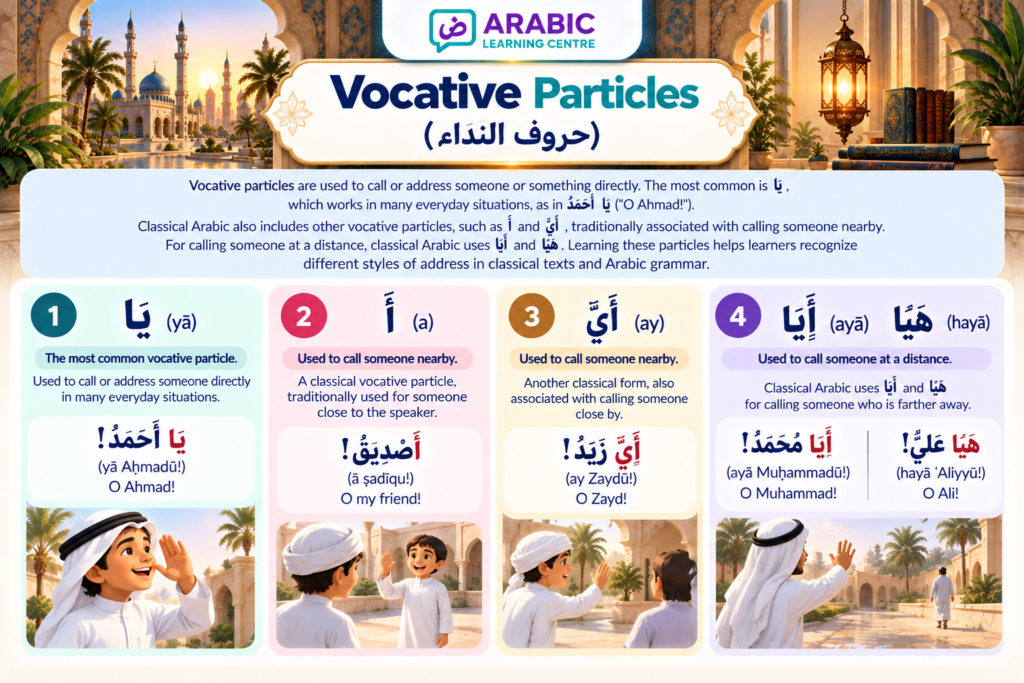
Classical Arabic also includes other vocative particles, such as أَ and أَيْ, traditionally associated with calling someone nearby. These forms are less common in modern everyday speech.
For calling someone at a distance, classical Arabic uses أَيا and هَيا. Learning these particles helps learners recognize different styles of address in classical texts and Arabic grammar.
Don’t Just Take Our Word For It
Take a look inside our vibrant classes and see our students and teachers in action. Click below to watch our classroom experience:
8. Answer Particles (حروف الجواب)
Answer particles respond to questions or statements by confirming, denying, or emphasizing a response. Their meanings differ according to the context, especially when the original question is negative.
| Particle | Meaning or function |
| نَعَمْ | Yes |
| أَجَلْ | Yes, indeed |
| إِيْ | Yes, especially in oaths |
| كَلَّا | No; certainly not |
| بَلَى | Contradicts a preceding negation |
The Special Use of بَلَى
The particle بَلَى reverses the negation in a negative question. A well-known Quranic example appears in Surah Al-A’raf, where Allah describes the covenant taken from the children of Adam.
أَلَسْتُ بِرَبِّكُمْ قَالُوا بَلَىٰ
“Am I not your Lord? They said, ‘Yes, indeed.’”
Surah Al-A’raf 7:172
In everyday Arabic, the same distinction applies:
- Question: ألم تكتب الواجب؟ — Didn’t you do the homework?
- بَلَى: Yes, I did.
- نَعَمْ: No, I didn’t.
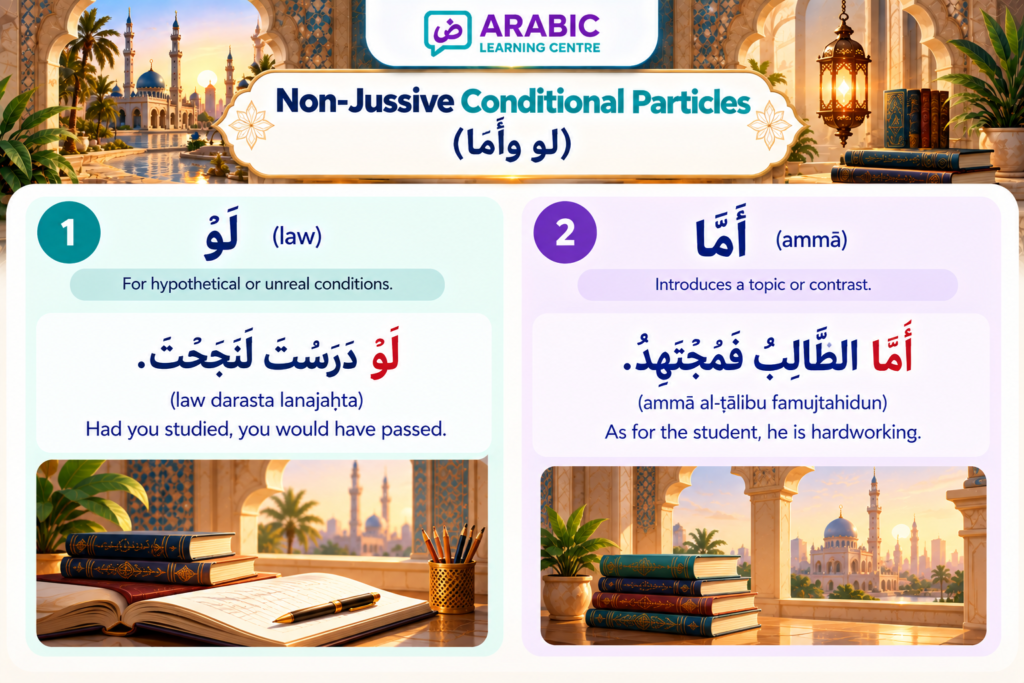
9. Non-Jussive Conditional Particles (لو and أمّا)
Some conditional particles do not make the following verb jussive.
لَوْ is commonly used for hypothetical or unreal conditions, often with past-tense verbs, as in لو درستَ لنجحتَ (“Had you studied, you would have passed”).
The particle لَوْ often describes a situation that did not happen or an imagined alternative. It connects a condition with its possible result and is frequently used in formal writing and everyday conversation.
أَمَّا introduces a topic, contrast, or division of information. The clause that follows its introductory phrase typically begins with فَـ, as in أمّا الطالبُ فمجتهدٌ (“As for the student, he is hardworking”). Omitting فَـ is a common grammatical mistake.
10. Verb-Marking Particles (قد، السين، سوف)
These particles occur with verbs and influence how the action is understood.
قَدْ can express realization or possibility, while سَـ and سَوْفَ indicate future time.
| Particle | Verb form or use | Example | Meaning |
| قَدْ | With a past-tense verb | قد قامت الصلاة | The prayer has begun |
| قَدْ | With a present-tense verb | قد ينجحُ | He may succeed |
| سَـ | Future | سيسافرُ | He will travel |
| سَوْفَ | Future | سوف يسافرُ | He will travel |
Key points to remember:
- قَدْ with a past-tense verb can emphasize that an action has occurred.
- قَدْ with a present-tense verb can indicate possibility.
- سَـ and سَوْفَ both express the future.
- Some grammar explanations associate سَـ with a nearer future and سَوْفَ with a more distant one, but this distinction is not absolute.
11. Particles of Urging and Reproach (حروف التحضيض)
Particles of urging encourage someone to perform an action, while the same forms can express reproach when referring to an action that was not performed. Common examples include هَلَّا, أَلَّا, لَوْلَا, and لَوْمَا.

When followed by a present-tense verb, these particles can encourage or urge someone to act. For example, هَلَّا تدرسُ؟ means “Why don’t you study?” and encourages the listener to begin studying.
When followed by a past-tense verb, they can express criticism or regret about a missed opportunity. For example, هَلَّا درستَ؟ means “Why didn’t you study?” The intended meaning depends on the verb form and the surrounding context.
12. Alerting Particles (حروف التنبيه)
Alerting particles draw the listener’s attention to what follows. They often appear before important statements or within demonstrative expressions.
| Particle | Function | Example | Meaning |
| أَلَا | Draws attention to a statement | أَلَا إِنَّهُمْ هُمُ الْمُفْسِدُونَ | Unquestionably, it is they who are the corrupters |
| هَا | Appears in demonstrative expressions | هَذَا | This |
| هَا | Appears in demonstrative expressions | هَؤُلَاءِ | These |
Quranic Example of أَلَا
In Surah Al-Baqarah, Allah describes the people who claim to believe while spreading corruption. The opening particle emphasizes the statement that follows.
أَلَا إِنَّهُمْ هُمُ الْمُفْسِدُونَ وَلَٰكِن لَّا يَشْعُرُونَ
“Unquestionably, it is they who are the corrupters, but they perceive [it] not.”
Knowing these rules on paper is one skill, and using them correctly while talking is another. The Arabic speaking course helps you practice particles like لم, لن, هل, and بلى in live conversation, so the correct form comes without stopping to think.

Three signs that a word is a particle
You can identify a particle by what it never accepts. Nouns and verbs both carry markers, while particles carry none of them.
| Feature | Nouns (الأسماء) | Verbs (الأفعال) | Particles (الحروف) |
| Definite article (الـ) | Accepts it: الكتاب | Does not accept it | Does not accept it: الـمِن ❌ |
| Tanween (ـٌ ـٍ ـً) | Accepts it: كتابٌ | Does not accept it | Does not accept it: مِنٌ ❌ |
| Ending changes (إعراب) | Changes with role in the sentence | Changes with tense and mood | Fixed (مبني, mabnī) |
Why Arabic Particles Require Special Attention?
Unlike most Arabic nouns and verbs, which often follow recognizable root-and-pattern systems (such as فَعَلَ، يَفْعَلُ، and مَفْعُول), particles generally have fixed forms that learners need to recognize and understand. Their meanings and grammatical functions depend on how they are used in a sentence.
The good news is that learners do not need to memorize every particle at once. Starting with frequently used particles, such as مِنْ، إِلَى، هَلْ، لَمْ، and إِنَّ, provides a practical foundation for reading and understanding Arabic. There is no single universally agreed number of Arabic particles, as classifications differ among grammarians.
The most effective approach is to learn each particle through examples, understand its grammatical function, and review it in context. This helps learners recognize particles naturally and apply them correctly when reading, writing, and speaking Arabic.
How to Identify Arabic Particles by Their Grammatical Function?
The next-word test helps you recognize Arabic particles by examining their position, grammatical effect, and meaning. Follow these three steps to identify how a particle functions in a sentence.

- Examine the Word That Follows the Particle: Determine whether the particle is followed by a noun, a verb, or a complete clause. For example, مِنْ is followed by a noun when it functions as a preposition.
- Recognize How Particles Affect Grammar: Identify the grammatical changes caused by the particle. A preposition makes the following noun genitive, while إِنَّ makes its noun accusative. Some particles also change the mood of a present-tense verb.
- Determine the Particle’s Meaning From Context: Read the complete sentence to understand the particle’s intended meaning. For example, in بابٌ مِنْ ذَهَبٍ (bābun min dhahabin), مِنْ means “of,” describing the material from which the door is made.
Common Mistakes When Using Arabic Particles
Arabic learners often confuse particles because their meanings and grammatical effects depend on context. Avoid these common mistakes to improve your Arabic grammar.
- Giving each particle one fixed translation (مِن = “from” every time) instead of reading the context
- Using لم with a past verb: لم ذهبَ ❌ → لم يذهبْ ✅
- Keeping the nūn after a jussive particle: لم يذهبون ❌ → لم يذهبوا ✅
- Mixing up إنْ / إنَّ and أنْ / أنَّ, where a single shadda changes the grammar
- Answering a negative question with نعم when بلى is meant
If your child is studying Arabic grammar at school and making these same mistakes, the intermediate school Arabic course covers particles step by step at a level suited to the curriculum, with practice that strengthens what is taught in class.

Inside Our Classrooms
See how we make learning interactive and engaging! Watch a quick snippet of our live, conversational classes in action:
Learn Arabic Grammar With Arabic Learning Centre
Understanding Arabic particles becomes easier when you learn grammar through structured lessons and practical examples. Instead of memorizing isolated rules, you can study how particles work in real sentences, understand their effects on nouns and verbs, and gradually develop greater confidence in using Modern Standard Arabic.
Arabic Learning Centre offers a structured approach to learning Arabic, helping students strengthen their grammar, expand their vocabulary, and improve their communication skills with guided instruction and practical exercises.
Whether you are a beginner or looking to refine your existing knowledge, the right learning path can help you progress step by step.
Learning with a clear curriculum also helps you connect individual grammar rules instead of studying each topic in isolation. Through consistent practice, you can improve your understanding of sentence structure, recognize common grammatical patterns, and apply what you learn in both written and spoken Arabic.
Start your Arabic learning journey today with a free trial at Arabic Learning Centre and discover a better way to master Arabic grammar and communication skills.
Courses We Offer:
- Quranic Arabic Course
- Arabic Course for Islamic Studies
- Learn Arabic for New Muslims
- Learn Arabic Letters for Tajweed
- Al Azhar Arabic Course
- Madinah Arabic Course
- Online Arabic Classes for Kids

Conclusion
Understanding particles in Arabic helps you move beyond memorizing vocabulary and start recognizing how words connect and influence one another. By learning the main particle types, understanding their grammatical effects, and practicing them in complete sentences, you can improve your Arabic comprehension and build a stronger foundation in grammar.
Start with frequently used particles such as مِنْ, فِي, هَلْ, لَمْ, and لَنْ, then gradually explore more advanced forms. Consistent practice and guided learning will help you recognize these particles naturally and use them accurately in different contexts.
Remember that mastering Arabic particles takes time and repeated exposure to authentic sentences. Review examples from reading materials, practice changing sentences using different particles, and pay attention to how each particle affects meaning and grammatical structure. With regular practice, these small words will become easier to recognize and use, making it simpler to understand more complex Arabic texts and express your ideas clearly.
Frequently Asked Questions
How many particles are there in Arabic?
Arabic has fewer than 80 particles in total. Because they do not follow root patterns, each one is memorized as it is. A core of about 25, including the main prepositions, conjunctions, and negation particles, covers most everyday texts.
What is the difference between لم and لن?
لم negates the past and puts the verb in the jussive: لم يذهبْ (“he did not go”).
لن negates the future and puts the verb in the subjunctive: لن يذهبَ (“he will not go”). Both are followed by a present-tense verb.
What is the difference between هل and the hamza in questions?
هل asks only yes/no questions. The hamza asks yes/no questions too, but it can also offer a choice between two options with أم and can come before a negation, as in أليس.
هل cannot do either.
Do particles change their endings?
No, particles never change their endings. They are fixed (مبني, mabnī) and do not take case endings, tanween, or the definite article. Instead, they change the endings of the nouns and verbs that follow them.
When should I answer with بلى instead of نعم?
Use بلى to answer a negative question with “yes, the opposite is true.” To ألستَ طالبًا؟ (“Aren’t you a student?”), بلى means “Yes, I am,” while نعم would mean “Right, I’m not.”
Which particles should a beginner learn first?
Start with the main prepositions (من، إلى، في، على، عن، بـ، لـ), the conjunctions و, فـ, and ثم, the negation particles لا, لم, and لن, and the question particle هل. These come up in almost every sentence, so they give you the most progress for the effort.
One response to “Particles In Arabic – 12 types With Meanings, Rules And Examples”
Related Articles
Arabic Grammar








[…] Read also: Particles in Arabic – 12 types with meanings, rules, and examples […]