 Arabic Grammar
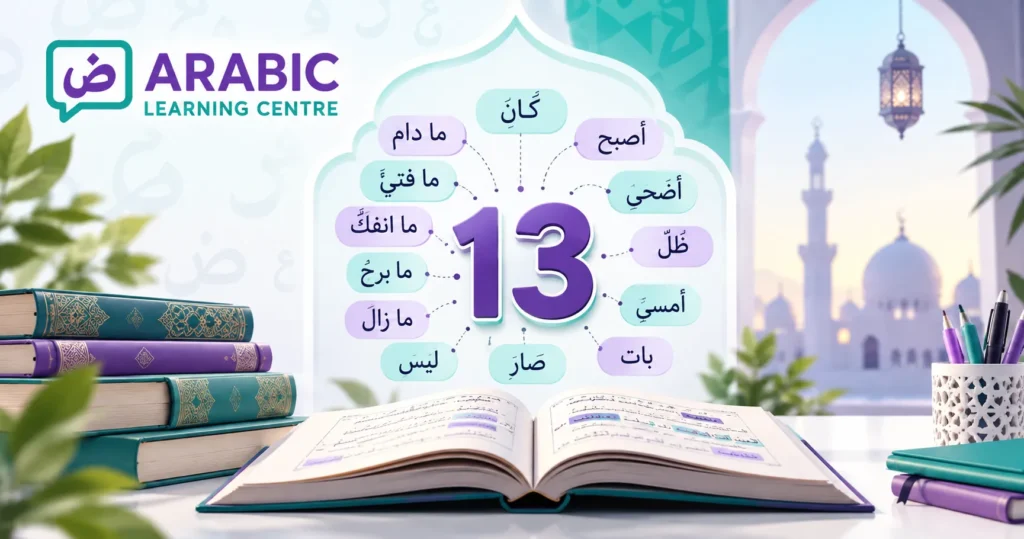
If you have ever read a simple Arabic sentence like كان الجوُّ جميلًا (“The weather was nice”) and wondered why جميل suddenly ends with a fathah instead of a dammah, you have already met Kana wa Akhawaatuha.
This small family of verbs, known in English as “Kana and her sisters”, is one of the first big topics every learner faces after the basic nominal sentence. It appears everywhere: in the Quran, in classical poetry, in news headlines and in everyday speech.
In Arabic grammar, Kana wa Akhawaatuha are 13 “abrogating” (nasikha) verbs. They enter a nominal sentence made of a subject (mubtada’) and a predicate (khabar) and change its grammar. The subject stays in the nominative case (marfu’) and is now called the ism of Kana. The predicate moves to the accusative case (mansub) and is now called the khabar of Kana.
They are also called “incomplete” (naqisa) verbs. An ordinary verb can complete a meaning with its subject alone, but these verbs cannot: saying كان زيدٌ (“Zayd was…”) leaves the listener waiting for the rest of the sentence.
1. كان (Kana) – was / to be
Kana is the head of the family and gives the whole group its name. It links the ism to the khabar in the past, or describes a permanent quality with no specific time. The clearest illustration comes at the end of a verse in Surat al-Furqan that reflects on Allah creating human beings from water and joining them through lineage and marriage:
﴿وَهُوَ الَّذِي خَلَقَ مِنَ الْمَاءِ بَشَرًا فَجَعَلَهُ نَسَبًا وَصِهْرًا ۗ وَكَانَ رَبُّكَ قَدِيرًا﴾
“It is He who created humans from water, then gave them ties of lineage and marriage. And your Lord is ever All-Powerful.” (al-Furqan 25:54)
Notice that كان here does not limit the meaning to the past. Allah’s power is not something that existed once and then ended; it is a permanent attribute, so the phrase means “your Lord is ever Powerful”. Grammatically, ربُّ is the ism of كان, marfu’ with dammah, the كَ is an attached pronoun in the position of jarr as mudaf ilayh, and قديرًا is the khabar, mansub with fathah.
Kana works with no condition and is fully conjugable, so it does the same job in every form:
| Form | Example | Translation |
| Past | كان الجوُّ جميلًا | The weather was nice. |
| Present | يكون الطقسُ معتدلًا في الربيع | The weather is mild in spring. |
| Imperative | كُنْ صبورًا | Be patient. |
Even its verbal noun keeps the same effect, as in أعجبني كونُك مجتهدًا (I liked your being hardworking). If you want to review how the nominal sentence works before Kana enters it, our Arabic grammar course covers the mubtada’ and khabar step by step.
Read also: Kana Wa Akhawaatuha – The 13 Verbs Explained One By One

2. أصبح (Asbaha) – became / was in the morning
Asbaha originally ties the khabar to the morning, but in modern Arabic it very often just means “became”. You will hear أصبح الطقسُ باردًا (The weather turned cold) in any weather forecast, with الطقسُ as the ism and باردًا as the khabar. It works with no condition and conjugates fully: أصبح، يُصبح، أَصْبِحْ.
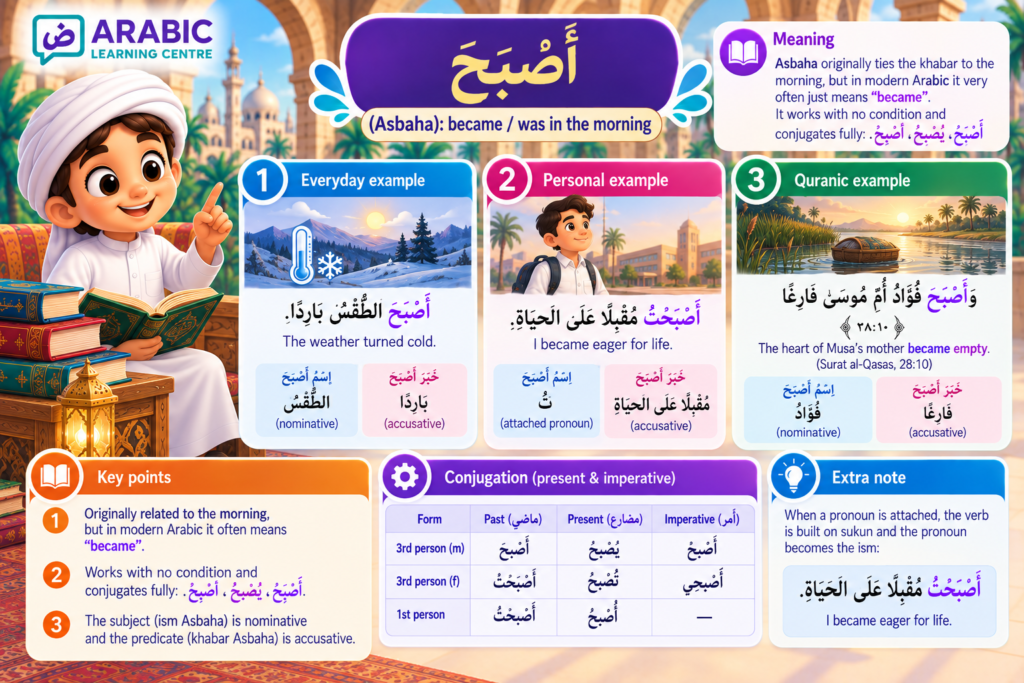
The Quran uses أصبح to capture a sudden change of state at a moment of intense emotion. After the mother of Musa placed her baby in the river, as Allah had inspired her to do, her heart was overwhelmed:
﴿وَأَصْبَحَ فُؤَادُ أُمِّ مُوسَىٰ فَارِغًا ۖ إِن كَادَتْ لَتُبْدِي بِهِ لَوْلَا أَن رَّبَطْنَا عَلَىٰ قَلْبِهَا لِتَكُونَ مِنَ الْمُؤْمِنِينَ﴾
“The heart of Musa’s mother became empty. She was about to reveal his secret, had We not strengthened her heart so that she would be one of the believers.” (al-Qasas 28:10)
Here أصبح carries both of its senses at once: it was the morning after she let him go, and her heart became empty of everything except the thought of her son.
فؤادُ is the ism of أصبح (marfu’), أمِّ is mudaf ilayh, and فارغًا is the khabar (mansub). When a pronoun is attached, as in أصبحتُ مقبلًا على الحياة (I became eager for life), the verb is built on sukun and the ت becomes the ism.
Read also: The Five Nouns In Arabic (Al-Asma Al-Khamsa) – The List of All 5 with Examples
3. أضحى (Adha) – became / was in the forenoon
Adha ties the khabar to the duha, the bright mid-morning hours. Because this time of day is mentioned less in daily speech, أضحى today appears mostly in literary writing, where it often simply means “became”. Like Kana, it works with no condition and conjugates fully (أضحى، يُضحي، أَضْحِ).
Here is a full parsing of أضحت السماءُ بهيجةً (The sky turned bright by mid-morning):
| Word | I’rab |
| أضحت | Past incomplete verb; the ت is the feminine ta’ with no grammatical position |
| السماءُ | Ism of أضحى, marfu’ with dammah |
| بهيجةً | Khabar of أضحى, mansub with fathah |
4. ظلّ (Zalla) – remained / kept on during the day
Zalla shows that the khabar stayed true throughout the daytime, so it usually translates as “kept” or “remained”. In ظلّ المريضُ نائمًا, the patient stayed asleep all day. It works with no condition and conjugates fully (ظلّ، يظلّ، ظَلْ). Do not confuse the verb ظَلَّ (zalla) with the noun ظِلّ (zill, shade).
Surat an-Nahl uses ظلّ in a verse that condemns a pre-Islamic attitude: some Arabs were displeased when told that a daughter had been born to them.
﴿وَإِذَا بُشِّرَ أَحَدُهُم بِالْأُنثَىٰ ظَلَّ وَجْهُهُ مُسْوَدًّا وَهُوَ كَظِيمٌ﴾
“When one of them is given news of a baby girl, his face stays darkened all day as he holds in his grief.” (an-Nahl 16:58)
The choice of ظلّ is telling. The darkened face is not a passing moment; it lasts through the day, showing how deep the man’s resentment runs.
وجهُه is the ism of ظلّ, the ه is mudaf ilayh, and مسودًّا is the khabar, mansub with fathah. The clause وهو كظيم that follows is a hal describing his suppressed anger.
5. أمسى (Amsa) – became / was in the evening
Amsa ties the khabar to the evening, and in modern texts it commonly means “became”. It works with no condition and conjugates fully (أمسى، يُمسي، أَمْسِ). The two uses are easy to tell apart from context:
| Sentence | Meaning of أمسى | Translation |
| أمست الطيورُ عائدةً إلى أعشاشها | In the evening | The birds were returning to their nests in the evening. |
| أمسى اختلافُ الرأي واضحًا | Became | The disagreement became clear. |
6. بات (Bata) – spent the night being
Bata shows that the khabar was true through the night. In بات الجنديُّ حارسًا لبلده (The soldier spent the night guarding his country), الجنديُّ is the ism and حارسًا is the khabar.
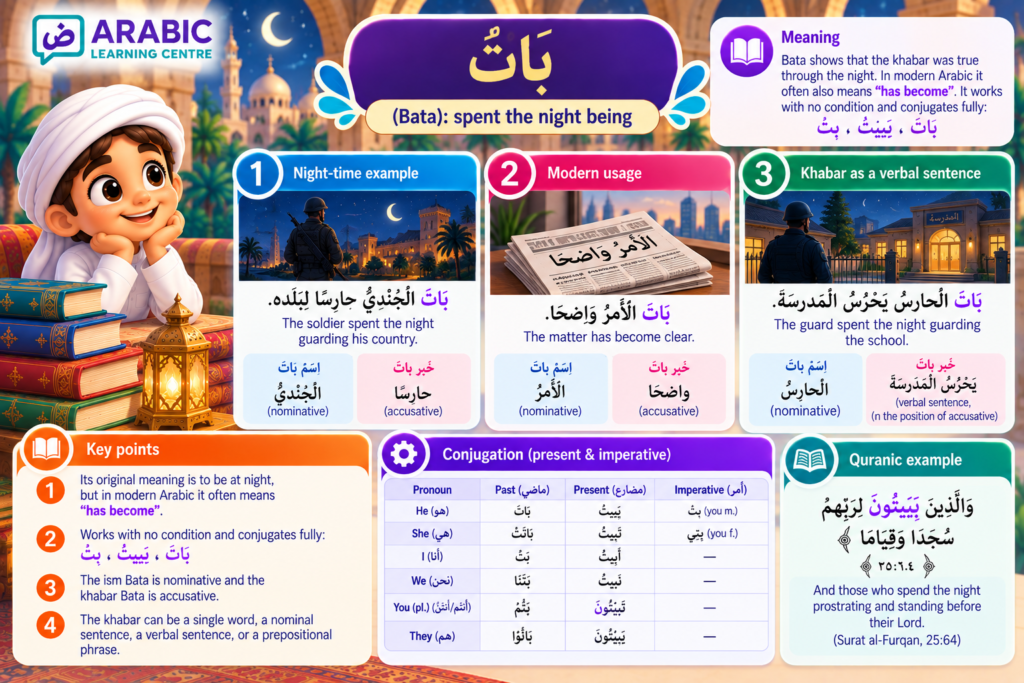
Bata works with no condition and conjugates fully: بات، يبيت، بِتْ. In modern news writing it also often means “has become”, as in بات الأمرُ واضحًا (The matter has become clear).
Its khabar does not have to be a single word. In بات الحارسُ يحرسُ المدرسةَ, the whole verbal sentence يحرسُ المدرسةَ is the khabar. It is therefore “in the position of nasb” rather than carrying a visible fathah.
The present form يبيت appears in a beautiful verse of Surat al-Furqan describing the servants of the Most Merciful, who spend their nights in worship while others sleep:
﴿وَالَّذِينَ يَبِيتُونَ لِرَبِّهِمْ سُجَّدًا وَقِيَامًا﴾
“And those who spend the night prostrating and standing before their Lord.” (al-Furqan 25:64)
The verb fits the meaning perfectly: their devotion fills the night itself, the very time بات refers to.
يبيتون is a present incomplete verb, marfu’ with the nun as one of the five verbs; the waw is its ism, سجّدًا is its khabar, mansub with fathah, and قيامًا is joined to it by the conjunction و.
Inside Our Classrooms
See how we make learning interactive and engaging! Watch a quick snippet of our live, conversational classes in action:
7. صار (Sara) – became (change of state)
Sara is the verb of transformation: the ism moves from one state into the state of the khabar.
- Forms: fully conjugable: صار، يصير، صِرْ.
- Condition: works with no condition.
- Example: صار القطنُ نسيجًا (The cotton became fabric).
- Dual example: صار التلميذان مجتهدَيْن (The two pupils became hardworking), with the khabar mansub by ya’.
- Khabar as a phrase: صارت الطائرةُ بين السحاب (The plane was among the clouds), where the adverbial phrase is the khabar.
Words like صار, يصير and صِرْ are everyday verbs worth memorising early. Our Arabic vocabulary course helps you build that core word bank.

8. ليس (Laysa) – is not
Laysa negates the khabar, usually in the present: ليس الماءُ باردًا means “The water is not cold.” It works with no condition, but it is jamid, so it has a past form only. Learners sometimes doubt it is a verb at all. The proof is that it takes subject endings like any past verb:
| Pronoun | Form | Example |
| أنا | لستُ | لستُ متعبًا |
| أنتَ | لستَ | لستَ وحدك |
| هي | ليست | ليست المسألةُ صعبةً |
| هم | ليسوا | ليسوا غائبين |
Two patterns are worth knowing. With restriction, ليس الظالمُ إلا هالكًا keeps هالكًا as the khabar after إلا. With a redundant ب, as in لستُ بغاضبٍ, the word غاضب is still the khabar, mansub with an implied fathah.
9. ما زال (Ma zala) – still
Ma zala shows that the khabar has continued without stopping. The ما is a negation particle, and “did not cease” gives the meaning “still”: ما زال الوقتُ باكرًا (It is still early).
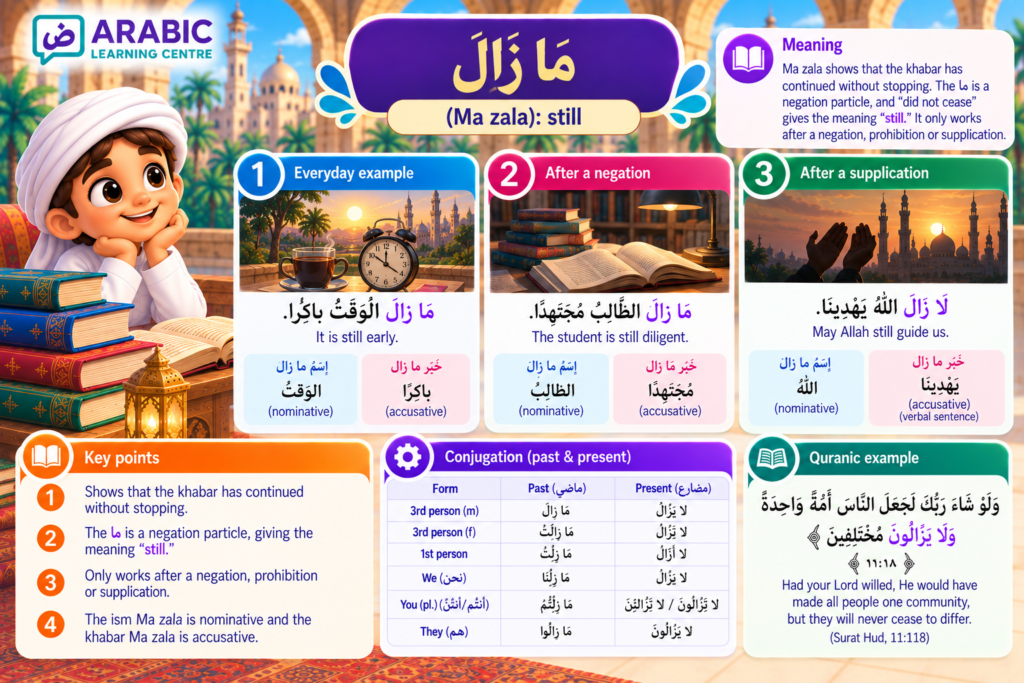
In the present it becomes لا يزال, which appears in a verse of Surat Hud about Allah’s will and human diversity:
﴿وَلَوْ شَاءَ رَبُّكَ لَجَعَلَ النَّاسَ أُمَّةً وَاحِدَةً ۖ وَلَا يَزَالُونَ مُخْتَلِفِينَ﴾
“Had your Lord willed, He would have made all people one community, but they will never cease to differ.” (Hud 11:118)
The verse presents disagreement among people as an ongoing reality, and لا يزالون expresses exactly that continuity.
يزالون is a present incomplete verb, marfu’ with the nun as one of the five verbs; the waw is its ism, and مختلفين is its khabar, mansub with ya’ because it is a sound masculine plural.
This verb only works after a negation, prohibition or supplication, and forgetting that is the most common mistake with it:
| Sentence | Correct? | Why |
| ما زال الوردُ متفتحًا | Yes | ما gives the meaning “still blooming” |
| زال الوردُ متفتحًا | No | Without ما, زال means “ceased” |
10. ما برح (Ma bariha) – still / did not stop being
Ma bariha carries the same “still” meaning as ma zala and is common in literary Arabic. On its own, برح means “left” (برح المكانَ, he left the place), so negating it gives the sense of “never left the state of”. It follows the same rules as ma zala: it needs a preceding negation and has only a past and a present form (ما برح، لا يبرح).
In ما برح العاملُ واقفًا (The worker is still standing), the khabar is the single word واقفًا. In ما برح العالمُ يسعى للسلام (The world has not stopped striving for peace), the khabar is the verbal sentence يسعى للسلام.
The Quran shows that برح can work after لن as well as ما. When Musa left his people to meet his Lord, some of the Children of Israel began worshipping the golden calf. Harun warned them, and they replied stubbornly:
﴿قَالُوا لَن نَّبْرَحَ عَلَيْهِ عَاكِفِينَ حَتَّىٰ يَرْجِعَ إِلَيْنَا مُوسَىٰ﴾
“They said, ‘We will not stop devoting ourselves to it until Musa returns to us.'” (Taha 20:91)
The negated verb لن نبرح expresses their determination to keep worshipping the calf without a break, which is exactly the continuity this verb carries.
نبرح is a present incomplete verb, mansub after لن; its ism is a hidden pronoun meaning “we”, and عاكفين is its khabar, mansub with ya’ as a sound masculine plural. The phrase عليه is linked to عاكفين.
11. ما انفكّ (Ma infakka) – never ceased to be
Ma infakka stresses that the ism has never separated from the khabar. Alone, انفكّ means “came loose”, which is why its negation means “stayed attached”. Like the other continuity verbs, it needs a negation before it and has only two forms, ما انفكّ and لا ينفكّ.
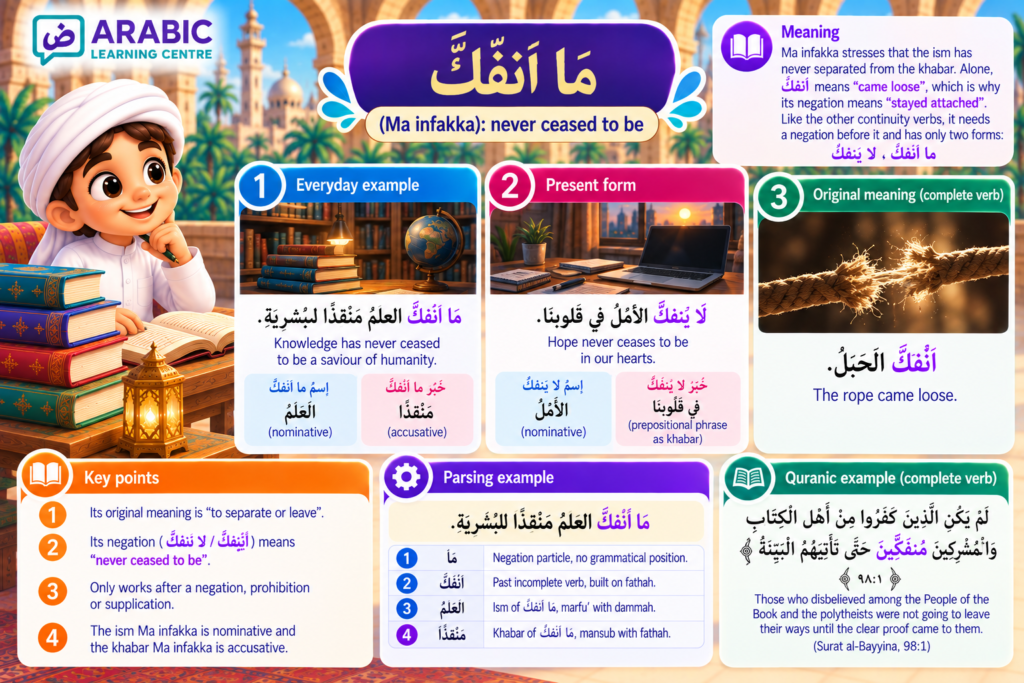
To parse ما انفكّ العلمُ منقذًا للبشرية (Knowledge has never ceased to be a saviour of humanity), work through it in four steps:
- ما: negation particle with no grammatical position.
- انفكّ: past incomplete verb, built on fathah.
- العلمُ: ism of ما انفكّ, marfu’ with dammah.
- منقذًا: khabar of ما انفكّ, mansub with fathah.
The original meaning of the root, “to separate or leave”, is clear in the opening verse of Surat al-Bayyina, which speaks of the disbelievers before the coming of the Prophet ﷺ:
﴿لَمْ يَكُنِ الَّذِينَ كَفَرُوا مِنْ أَهْلِ الْكِتَابِ وَالْمُشْرِكِينَ مُنفَكِّينَ حَتَّىٰ تَأْتِيَهُمُ الْبَيِّنَةُ﴾
“Those who disbelieved among the People of the Book and the polytheists were not going to leave their ways until the clear proof came to them.” (al-Bayyina 98:1)
Here مُنفكّين is the participle of the complete verb انفكّ, meaning “departing”, and it serves as the khabar of لم يكن, mansub with ya’. The verse is a useful contrast: when انفكّ means “left” it is complete, and only when it is negated and followed by an ism and khabar, as in ما انفكّ العلمُ منقذًا, does it join the sisters of Kana.
12. ما فتئ (Ma fati’a) – did not cease to be
Ma fati’a completes the four continuity verbs. It is the most formal of them and appears often in classical poetry and literary prose, usually in the present as لا يفتأ. It follows the same rules as ما زال: a preceding negation is required, and only the past and present forms exist.
Typical examples are ما فتئ الأملُ مرجوًّا (Hope has never stopped being hoped for) and ما فتئ الجهلُ مناهضًا للتقدّم (Ignorance has never ceased to oppose progress). In both, the noun after the verb is the ism and the mansub word is the khabar.
The most famous example of this verb comes from the story of Prophet Yusuf. Years after losing Yusuf, his father Ya’qub still mourned him, and his sons said to him in frustration:
﴿قَالُوا تَاللَّهِ تَفْتَأُ تَذْكُرُ يُوسُفَ حَتَّىٰ تَكُونَ حَرَضًا أَوْ تَكُونَ مِنَ الْهَالِكِينَ﴾
“They said, ‘By Allah, you will never stop remembering Yusuf until you waste away or perish.'” (Yusuf 12:85)
This verse teaches a special rule: the negation before فتئ can be dropped after an oath, so تفتأ here means لا تفتأ (you will not stop).
تفتأ is a present incomplete verb, marfu’ with dammah; its ism is a hidden pronoun meaning “you”, and the verbal sentence تذكرُ يوسفَ is its khabar, in the position of nasb.
When you feel ready for the next step, our intermediate Arabic course takes you on to Inna wa Akhawaatuha and the other abrogating particles.

13. ما دام (Ma dama) – as long as
Ma dama sets a duration: the main action lasts for as long as the ism keeps the quality of the khabar. It is jamid, with a past form only, and it must follow ما of duration (ما المصدرية الظرفية). Without that ما, دام is a complete verb meaning “lasted”. A simple example is لا أخرج من البيت ما دام المطرُ نازلًا (I won’t leave the house as long as it is raining).
The best-known example comes from the words of the infant Isa (Jesus) in Surat Maryam, spoken from the cradle in defence of his mother:
﴿وَجَعَلَنِي مُبَارَكًا أَيْنَ مَا كُنتُ وَأَوْصَانِي بِالصَّلَاةِ وَالزَّكَاةِ مَا دُمْتُ حَيًّا﴾
“He has made me blessed wherever I may be, and has charged me with prayer and zakah for as long as I live.” (Maryam 19:31)
The phrase ما دمتُ حيًّا sets the duration of the command: prayer and zakah remain due for as long as he lives, with no end before death. This is exactly the meaning ما دام adds to any sentence. Here is the parsing of the key phrase:
| Word | I’rab |
| ما | Particle of duration (masdariyya zarfiyya) |
| دمتُ | Past incomplete verb built on sukun; the ت is its ism, in the position of raf’ |
| حيًّا | Khabar of ما دام, mansub with fathah |
Kana wa Akhawaatuha at a glance
Now that you have met all 13 verbs one by one, it helps to see them side by side. The table below groups Kana wa Akhawaatuha by meaning, shows which forms each group can take, and highlights the conditions some of them need before they can work.
| Verb | Meaning | Forms | Condition |
| كان، أصبح، أضحى، ظلّ، أمسى، بات، صار | Time of day or change of state | Past, present, imperative | None |
| ليس | Negation | Past only | None |
| ما زال، ما برح، ما انفكّ، ما فتئ | Continuity (“still”) | Past and present | Preceded by negation |
| ما دام | Duration (“as long as”) | Past only | Preceded by ما of duration |
Don’t Just Take Our Word For It
Take a look inside our vibrant classes and see our students and teachers in action. Click below to watch our classroom experience:
Master Arabic grammar with Arabic Learning Centre
Reading about Kana wa Akhawaatuha is the first step, but using these verbs confidently in your own sentences takes guided practice and honest feedback. That is exactly what Arabic Learning Centre is built for. We believe Arabic grammar should feel like a key that opens the language, not a wall of rules to memorise, so every lesson connects the rule to real meaning.
At Arabic Learning Centre, you learn with teachers who explain each topic clearly and patiently, and who correct your mistakes as you go. You practise with real examples from the Quran, classical texts and modern Arabic, so you understand not only how a rule works but why it matters. Each learner moves at a comfortable pace, with a learning plan shaped around their level and goals.
Whether you want to understand the Quran more deeply, read Arabic books and news, or speak with confidence at work or while travelling, we are here to support you at every stage. Our goal is simple: to help you turn grammar rules into real understanding and real communication.
Start today with a free trial lesson and see how much easier Arabic can be.
Courses We Offer:
- Business Arabic Course
- Learn Arabic from Zero
- Medical Arabic Course
- Learning Arabic for Non Arabic Speakers
- Learn Arabic in Saudi Arabia
- Learn to Read Arabic Course
Conclusion
Kana wa Akhawaatuha may look like a long list at first, but the whole topic rests on one simple rule: the ism stays marfu’ and the khabar becomes mansub. Once that rule is clear, each of the 13 verbs simply adds its own colour to the sentence.
Kana places the meaning in time, and أصبح، أضحى، ظلّ، أمسى and بات tie it to a part of the day.
صار shows a change of state, ليس negates it, the four continuity verbs keep it going, and ما دام sets how long it lasts.
The Quranic verses in this guide show that these verbs are far more than dry grammar rules. The heart of Musa’s mother “became” empty, a face “remained” darkened all day, and the servants of the Most Merciful “spend the night” in prayer. In each case, the choice of verb paints a picture that no other verb could.
To make these verbs your own, practise a little every day. Take a simple sentence such as البيتُ كبيرٌ, add each sister in turn and read the result aloud: صار البيتُ كبيرًا، ما زال البيتُ كبيرًا، ليس البيتُ كبيرًا. Then look out for Kana and her sisters whenever you read the Quran or a news article. Within a few weeks, the fathah on the khabar will come naturally, and you will be ready for the next family of abrogators, Inna wa Akhawaatuha.
Frequently asked questions
1. What is Kana wa Akhawaatuha in Arabic grammar?
Kana wa Akhawaatuha is a group of abrogating verbs that enter a nominal sentence. They keep the subject marfu’, calling it their ism, and make the predicate mansub, calling it their khabar. For example, الطالبُ نشيطٌ becomes كان الطالبُ نشيطًا.
2. How many sisters does Kana have?
Kana has 12 sisters, which makes 13 verbs in total: كان، أصبح، أضحى، ظلّ، أمسى، بات، صار، ليس، ما زال، ما برح، ما انفكّ، ما فتئ and ما دام. Some grammarians also add verbs meaning “became”, such as عاد and غدا, which can work like صار.
3. What is the difference between Kana wa Akhawaatuha and Inna wa Akhawaatuha?
They do opposite jobs. Kana and her sisters are verbs that make the ism marfu’ and the khabar mansub. Inna and her sisters are particles that make the ism mansub and the khabar marfu’, as in إنّ الطالبَ نشيطٌ.
4. Why are they called incomplete (naqisa) verbs?
An ordinary verb is complete with its subject: جاء محمدٌ (Muhammad came) makes full sense. Kana and her sisters are not complete with their marfu’ noun alone.
كان محمدٌ needs a khabar, such as كان محمدٌ جالسًا, before the meaning is complete.
5. Which sisters of Kana need a condition to work?
Eight verbs work with no condition: كان، أصبح، أضحى، ظلّ، أمسى، بات، صار and ليس. The four continuity verbs, زال، برح، انفكّ and فتئ, only work after a negation, prohibition or supplication.
دام only works after ما of duration.
6. Can the khabar of Kana come before its ism?
Yes. The khabar can sit between any of these verbs and its ism, as in the classical line فليس سواءً عالمٌ وجهولُ (A knowing man and an ignorant one are not equal). It can also come before the verb itself, as in مطمئنًّا بات المؤمنُ, with every sister except ليس and ما دام.
One response to “Kana Wa Akhawaatuha – The 13 Verbs Explained One By One”
Related Articles
Arabic Grammar





[…] Read also: Kana Wa Akhawaatuha – The 13 Verbs Explained One By One […]