 Arabic Grammar
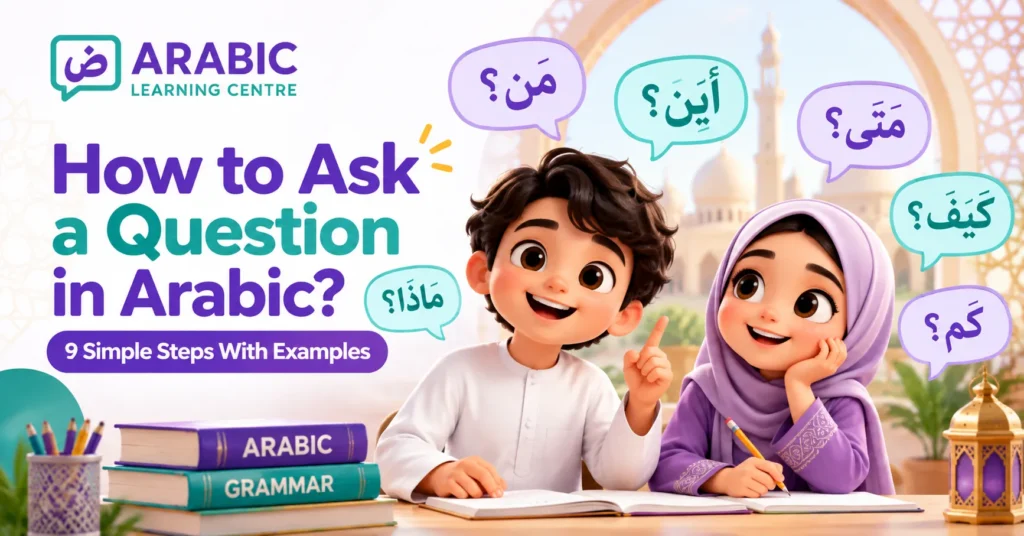
Learning how to ask questions in Arabic is an important step toward having real conversations. Whether you want to ask someone’s name, find a place, understand a price, or simply keep a conversation going, knowing a few basic question patterns can make Arabic much easier to use in everyday situations.
The good news is that Arabic questions follow clear patterns. You can turn a statement into a yes-or-no question with هَل (hal), use question words such as مَن (man), أين (ayna), and متى (mataa) to ask for specific information, or use forms such as كَم (kam) and أَيّ (ayy) when asking about numbers and choices. Once you understand these patterns, you can build many questions even with a limited vocabulary.
In this guide, you will learn the main ways to ask questions in Modern Standard Arabic, with Arabic script, transliteration, English meanings, and practical examples. You will also see common Egyptian Arabic forms and learn how they differ from standard Arabic.
Step 1: Turn Any Statement Into a Yes/No Question With هَل (hal)
The easiest way to ask a question in Arabic is to put هَل (hal) at the start of a normal sentence. You don’t change the word order or the verb, unlike English, which needs “do” or “did.”
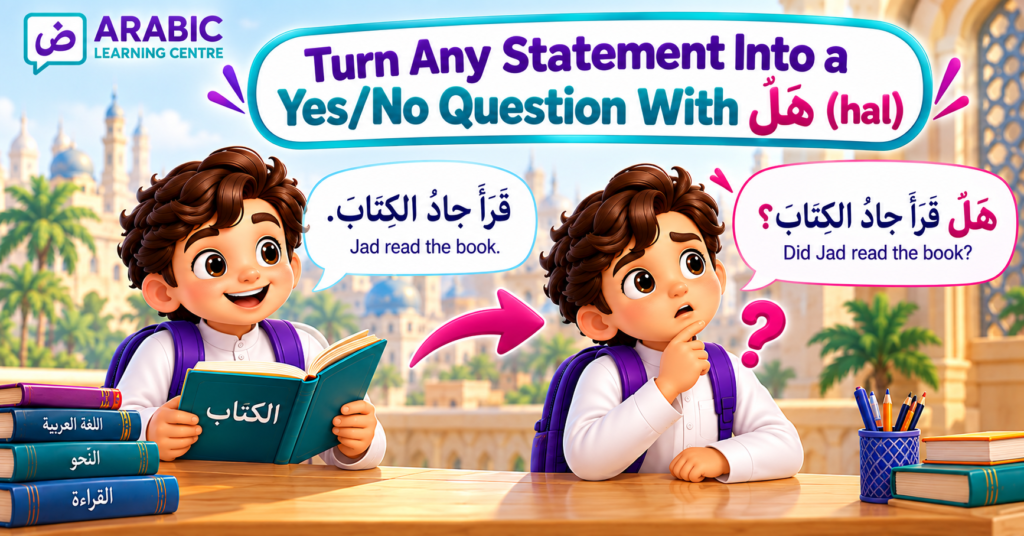
The formula is simple: هَل + statement + ؟
| Statement | Question |
| قَرَأَ جاد الكِتاب (qara’a Jaad al-kitaab) – Jad read the book. | هَل قَرَأَ جاد الكِتاب؟ (hal qara’a Jaad al-kitaab?) – Did Jad read the book? |
| أنتَ مِصري (anta miSri) – You are Egyptian. | هَل أنتَ مِصري؟ (hal anta miSri?) – Are you Egyptian? |
| تُحِبُّ القَهوة (tuHibbu al-qahwa) – You like coffee. | هَل تُحِبُّ القَهوة؟ (hal tuHibbu al-qahwa?) – Do you like coffee? |
Two useful set phrases start with hal:
- هَل هُناك…؟ (hal hunaaka…?) – Is there…? / Are there…? For example, هَل هُناك مَكتَب بَريد قَريب؟ (hal hunaaka maktab bariid qariib?) – Is there a post office nearby?
- هَل يُمكِنُك…؟ (hal yumkinuka…?) – Can you…? For example, هَل يُمكِنُك مُساعَدَتي؟ (hal yumkinuka musaa’adatii?) – Can you help me?
In speech, hal is optional. A rising tone at the end of the sentence is enough to turn it into a question, and you will hear this all the time in everyday Arabic.
If you’d like structured practice with a teacher who corrects your pronunciation and grammar as you speak, join our Arabic course for adults. Lessons are built around real conversations, so asking and answering questions becomes second nature fast.
Step 2: Recognise أ (a-), the Formal Yes/No Particle Used in Writing
Standard Arabic has a second yes/no particle: the letter أ (alif with hamza), attached directly to the first word. It works like hal but sounds more formal and literary, so you’ll meet it mostly in books, speeches, the Quran, and song titles.
- أَقَرَأَ جاد الكِتاب؟ (a-qara’a Jaad al-kitaab?) – Did Jad read the book?
- أَلَيسَ كَذلِك؟ (a-laysa kadhaalik?) – Isn’t that so?
- أَغَداً أَلقاك؟ (a-ghadan alqaak?) – Will I see you tomorrow? (the title of a famous Umm Kulthum song)
Keep two rules in mind.
أ is not placed before a word that starts with “al-” (the), or before a word that already begins with أ. As a beginner, recognise أ when you read it, but use hal when you speak.
Read also: Question Words In Arabic – 14 Essential Arabic Question Words with Examples
Step 3: Answer With نَعَم (Yes) or لا (No)
Once you can ask, you need to answer. Arabic has two common words for “yes” and two for “no.”
| Word | Meaning | Example |
| نَعَم (na’am) | Yes (neutral) | نَعَم، قَرَأَ جاد الكِتاب. (na’am, qara’a Jaad al-kitaab.) – Yes, Jad read the book. |
| أَجَل (ajal) | Yes, indeed (emphatic) | أَجَل، قَرَأَ جاد الكِتاب. (ajal, qara’a Jaad al-kitaab.) – Yes, indeed. |
| لا (laa) | No (neutral) | لا، لَم يَقرَأ جاد الكِتاب. (laa, lam yaqra’ Jaad al-kitaab.) – No, Jad didn’t read the book. |
| كَلّا (kallaa) | No, not at all (strong) | كَلّا، لَم يَقرَأ جاد الكِتاب. (kallaa, lam yaqra’ Jaad al-kitaab.) – Not at all. |
Notice the negative answer: the past tense قَرَأَ becomes لَم يَقرَأ (lam yaqra’), which uses لَم plus the present-tense verb. In spoken Egyptian Arabic, you’ll usually hear أيوه (aywa) for “yes” and لأ (la’) for “no.”
Try it yourself: turn أَكَلَ جاد التُّفّاحة (akala Jaad at-tuffaaHa – Jad ate the apple) into a question, then answer it both ways.
Answer: هَل أَكَلَ جاد التُّفّاحة؟ – نَعَم، أَكَلَ جاد التُّفّاحة. / لا، لَم يَأكُل جاد التُّفّاحة. (laa, lam ya’kul Jaad at-tuffaaHa.)
Don’t Just Take Our Word For It
Take a look inside our vibrant classes and see our students and teachers in action. Click below to watch our classroom experience:
Step 4: Learn the Core Arabic Question Words
For questions that need real information, not just yes or no, you need question words (أدوات الاستفهام). In Modern Standard Arabic they almost always come first in the sentence, followed by the rest of the statement.
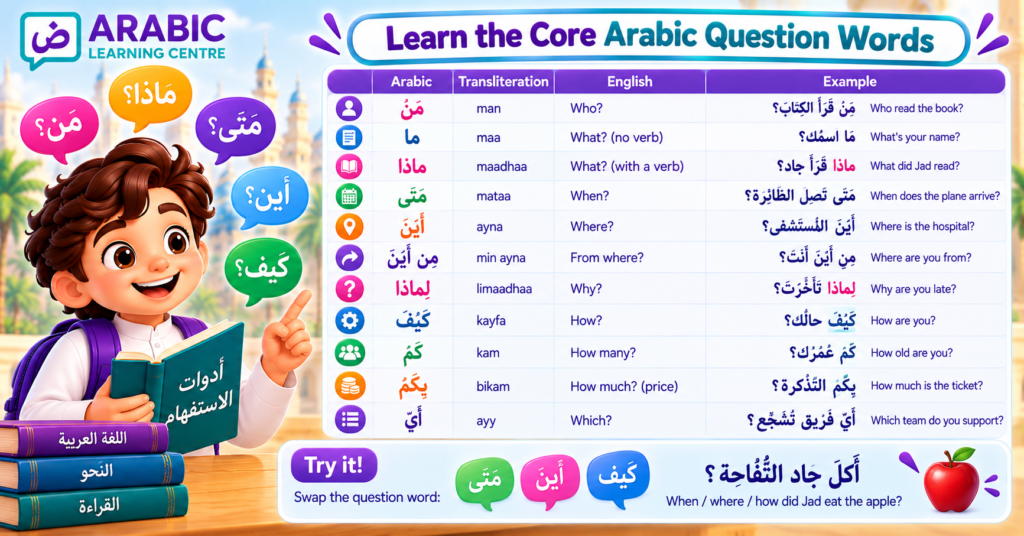
The pattern is always question word + statement. Take one sentence and swap the question word to practise: مَتى / أَينَ / كَيفَ أَكَلَ جاد التُّفّاحة؟ – When / where / how did Jad eat the apple?
A good tip: question words are powerful even on their own. In a market, pointing at a jacket and saying بِكَم؟ (bikam?) is enough for the seller to tell you the price. If you want to build the nouns that go after these words, our Arabic vocabulary course groups everyday words by topic so you can ask about food, travel, shopping, and more.
Read also: What Are the Arabic Names of Each of the Five Pillars of Islam?

Step 5: Say ما (maa) Without a Verb and ماذا (maadhaa) With a Verb
Both words mean “what,” and choosing the right one is a classic beginner hurdle. The rule is easy: use ما when there is no verb, and ماذا when there is one.
| ما (maa) – no verb | ماذا (maadhaa) – with a verb |
| ما اسمُك؟ (maa ismuk?) – What’s your name? | ماذا تُريد؟ (maadhaa turiid?) – What do you want? |
| ما عَمَلُك؟ (maa ‘amaluk?) – What’s your job? | ماذا أَقول لَك؟ (maadhaa aquul lak?) – What shall I tell you? |
| ما رَأيُك في الحَفلة؟ (maa ra’yuk fil-Hafla?) – What did you think of the party? | ماذا تَدرُس؟ (maadhaa tadrus?) – What do you study? |
You’ll often see ما followed by a pronoun such as هُوَ (huwa) or هِيَ (hiya), for example ما هُوَ الفَرق؟ (maa huwa al-farq?) – What is the difference? The same “verb or no verb” logic explains why لِماذا (why) also contains ماذا. To see how these fit into full sentence patterns, explore our Arabic grammar lessons.

Step 6: Ask “How Many” With كَم + a Singular Noun and Prices With بِكَم
كَم (kam) means “how many,” but it works differently from English. The noun after كَم is singular, not plural, and in formal Arabic it takes the accusative ending -an.
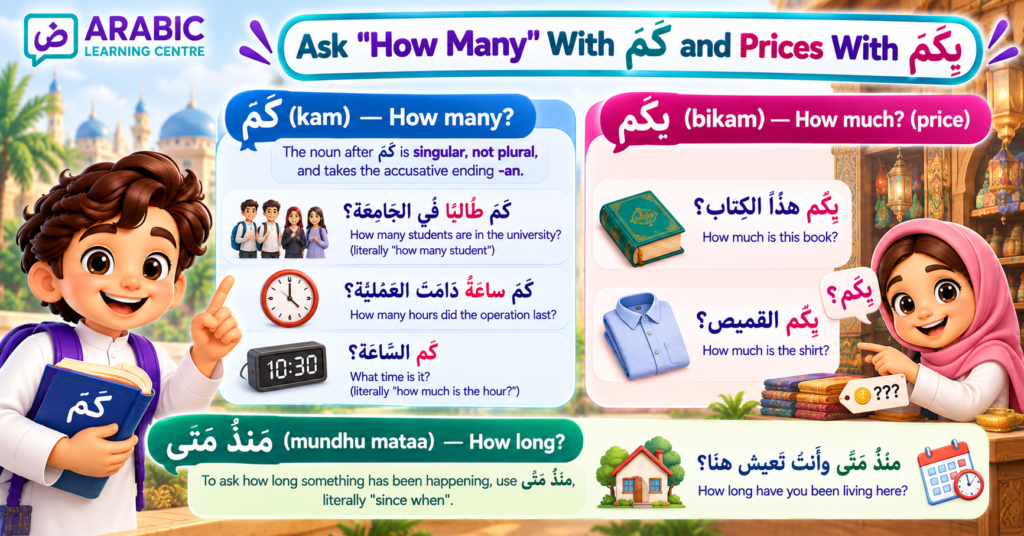
- كَم طالِباً في الجامِعة؟ (kam Taaliban fil-jaami’a?) – How many students are in the university? (literally “how many student”)
- كَم ساعةً دامَت العَمَلِيّة؟ (kam saa’atan daamat al-‘amaliyya?) – How many hours did the operation last?
- كَم السّاعة؟ (kam as-saa’a?) – What time is it? (literally “how much is the hour?”)
For prices, add بِ (bi-) to make بِكَم (bikam):
- بِكَم هذا الكِتاب؟ (bikam haadhaa al-kitaab?) – How much is this book?
- بِكَم القَميص؟ (bikam al-qamiiS?) – How much is the shirt?
To ask how long something has been happening, use مُنذُ مَتى (mundhu mataa), literally “since when”: مُنذُ مَتى وأَنتَ تَعيش هُنا؟ (mundhu mataa wa-anta ta’iish hunaa?) – How long have you been living here?
Read also: Names of Animals in Arabic – Words, Plurals and Everyday Sentences
Step 7: Ask “Which” With أَيّ (ayy)
أَيّ (ayy) comes directly before an indefinite singular noun, like “which” in English. You can also attach a pronoun to it to mean “which of them/you.”
- أَيّ لَون تُفَضِّل؟ (ayy lawn tufaDDil?) – Which colour do you prefer?
- في أَيّ فُندُق تَسكُن؟ (fii ayy funduq taskun?) – Which hotel are you staying in?
- أَيُّهُم تُفَضِّل؟ (ayyuhum tufaDDil?) – Which one of them do you prefer?
In Egyptian Arabic, you’ll also hear انهو / انهي / انهم (anhu / anhi / anhum), for masculine, feminine, and plural nouns: انهي شَقّة؟ (anhi sha”a?) – Which apartment?
Step 8: Offer Choices With أَم (am) and أَو (aw)
When you ask someone to pick between options, standard Arabic uses two different words for “or.”
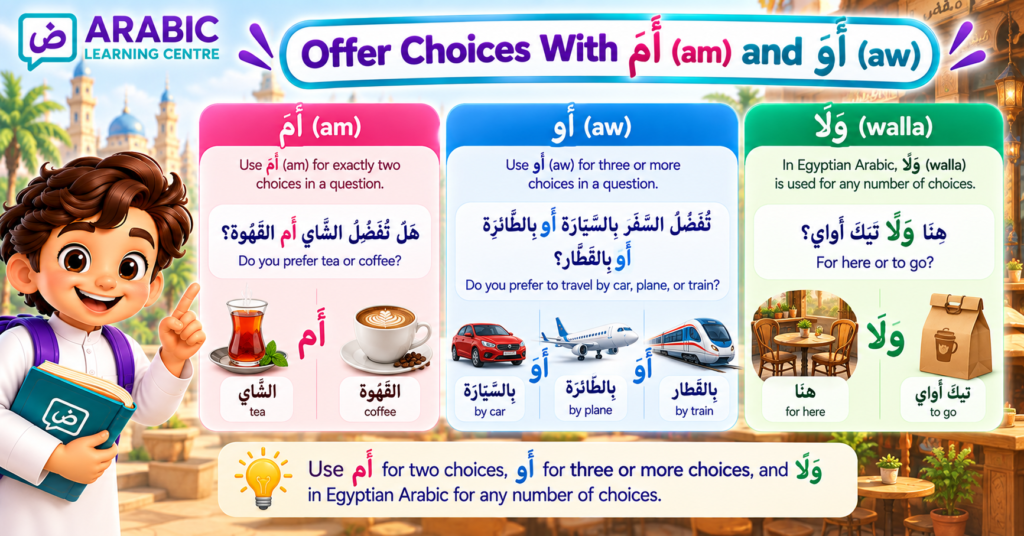
- أَم (am) separates exactly two choices in a question: هَل تُفَضِّل الشّاي أَم القَهوة؟ (hal tufaDDil ash-shaay am al-qahwa?) – Do you prefer tea or coffee?
- أَو (aw) links three or more choices: تُفَضِّل السَّفَر بِالسَّيّارة أَو بِالطّائِرة أَو بِالقِطار؟ (tufaDDil as-safar bis-sayyaara aw biT-Taa’ira aw bil-qiTaar?) – Do you prefer to travel by car, plane, or train?
Egyptian Arabic keeps it simple with one word, وَلّا (walla), for any number of choices: هِنا وَلّا تيك أواي؟ (hina walla take away?) – For here or to go?
Step 9: Practise With Everyday Arabic Question Examples
The best way to lock in these patterns is to memorise a set of ready-made questions you’ll actually use. Here are 15 how to ask a question in Arabic examples for travel, small talk, and shopping, all in Modern Standard Arabic.
| English | Arabic | Transliteration |
| How are you? | كَيفَ حالُك؟ | kayfa Haaluk? |
| What’s your name? | ما اسمُك؟ | maa ismuk? |
| Where are you from? | مِن أَينَ أَنتَ؟ | min ayna anta? |
| How old are you? | كَم عُمرُك؟ | kam ‘umruk? |
| What’s your job? | ما عَمَلُك؟ | maa ‘amaluk? |
| Do you speak English? | هَل تَتَكَلَّم الإنجليزِيّة؟ | hal tatakallam al-injliiziyya? |
| Can you help me? | هَل يُمكِنُك مُساعَدَتي؟ | hal yumkinuka musaa’adatii? |
| Where is the bathroom? | أَينَ الحَمّام؟ | ayna al-Hammaam? |
| Where is the store? | أَينَ المَتجَر؟ | ayna al-matjar? |
| What time is it? | كَم السّاعة؟ | kam as-saa’a? |
| How much does it cost? | كَم الثَّمَن؟ | kam ath-thaman? |
| Can I pay by credit card? | هَل يُمكِنُني الدَّفع بِبِطاقة الائتِمان؟ | hal yumkinunii ad-daf’ bi-biTaaqat al-i’timaan? |
| How is the weather? | كَيفَ الطَّقس؟ | kayfa aT-Taqs? |
| When is your birthday? | مَتى عيدُ ميلادِك؟ | mataa ‘iidu miilaadik? |
| What’s your favourite colour? | ما لَونُك المُفَضَّل؟ | maa lawnuk al-mufaDDal? |
Say each question out loud, then answer it about yourself. Asking and answering in pairs builds both speaking and listening at the same time.
Common Mistakes to Avoid When Asking Questions in Arabic
Arabic questions follow simple patterns, but beginners often make small mistakes with question words, sentence structure, and noun forms.
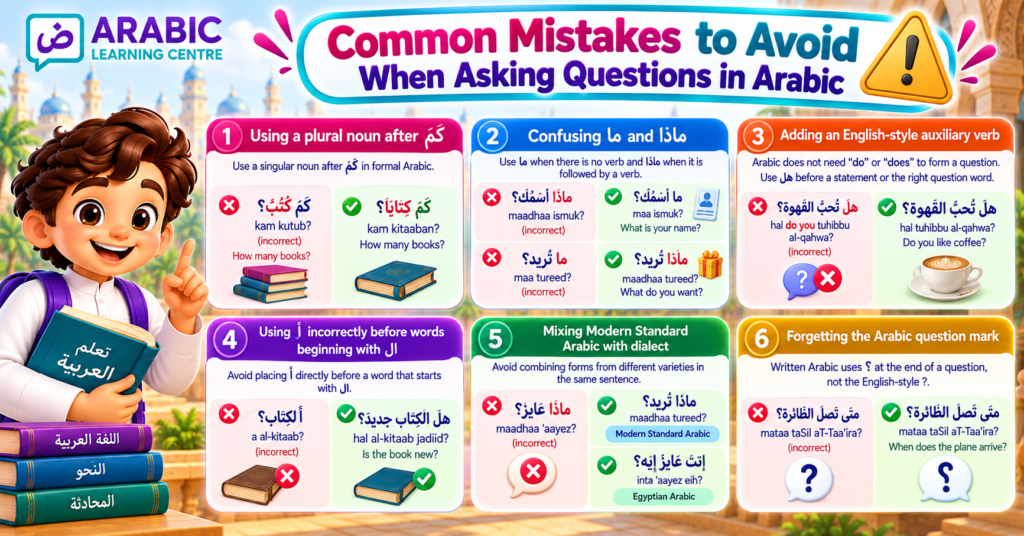
Learning these common errors will help you form clearer questions and sound more natural when speaking or writing Arabic.
- Using a plural noun after كَم: Use a singular noun after كَم in formal Arabic. Say كَم كِتاباً؟ (kam kitaaban?), not كَم كُتُب؟ for “How many books?”
- Confusing ما and ماذا: Use ما when there is no verb and ماذا when it is followed by a verb. For example, ما اسمُك؟ means “What is your name?” while ماذا تُريد؟ means “What do you want?”
- Adding an English-style auxiliary verb: Arabic does not need “do” or “does” to form a question. Use هَل before a statement or use the appropriate question word.
- Using أ incorrectly before words beginning with ال: Avoid placing أ directly before a word that starts with الـ. Instead of أَالكِتاب؟, use هَل الكِتاب جَديد؟ (hal al-kitaab jadiid?) – “Is the book new?”
- Mixing Modern Standard Arabic with dialect: Avoid combining forms from different varieties in the same sentence. For example, choose ماذا تُريد؟ in Modern Standard Arabic or إنت عايز إيه؟ in Egyptian Arabic rather than mixing the two.
- Forgetting the Arabic question mark: Written Arabic uses ؟ at the end of a question, not the English-style ?.
Inside Our Classrooms
See how we make learning interactive and engaging! Watch a quick snippet of our live, conversational classes in action:
Learn Arabic Conversation at Arabic Learning Centre
Knowing Arabic question words is only the first step. To use them naturally, you need regular practice asking and answering questions in real conversations.
At Arabic Learning Centre, you can develop your Arabic speaking skills through structured lessons that help you use grammar, vocabulary, and everyday expressions with greater confidence.
With regular guidance and speaking practice, you can learn how to form questions correctly, respond naturally, and understand the questions you hear in everyday Arabic.
This makes it easier to move from memorising words and grammar rules to using Arabic confidently in real situations, whether you are introducing yourself, asking for information, shopping, travelling, or having a simple conversation.
Start your free trial with Arabic Learning Centre and begin practising Arabic questions and everyday conversations with expert guidance.
Courses We Offer:
- Arabic Course for Beginners
- Arabic Classes for Adults
- Arabic Classes for Ladies
- Advanced Arabic Course
- Intensive Arabic Course
Conclusion
Knowing how to ask questions in Arabic gives you the tools to move beyond memorising isolated words and start building real conversations. By learning هَل for yes-or-no questions and mastering the most common question words, you can ask about people, places, time, prices, choices, and everyday situations with much greater confidence.
Start by practising a few useful questions every day. Say each one aloud, change the vocabulary, and answer the question yourself. With regular speaking practice, these patterns will become natural, making it easier to understand others and express what you want to know in Arabic.
Frequently Asked Questions
How do you ask a yes-or-no question in Arabic?
The easiest way is to place هَل (hal) at the beginning of a statement. For example, هَل أَنتَ طالِب؟ (hal anta taalib?) means “Are you a student?” In everyday spoken Arabic, you can also ask a question through your tone of voice without using هَل.
What are the main question words in Arabic?
Common Arabic question words include مَن (who), ما / ماذا (what), متى (when), أين (where), لماذا (why), كيف (how), كم (how many/how much), and أيّ (which). Learning these words gives you the foundation for asking most information questions.
What is the difference between ما and ماذا?
Both ما (maa) and ماذا (maadhaa) can mean “what.” A useful beginner rule is to use ما when there is no verb, as in ما اسمُك؟ (“What is your name?”), and ماذا with a verb, as in ماذا تُريد؟ (“What do you want?”).
Does Arabic have a word like “do” or “does” for questions?
No. Arabic does not normally need an auxiliary verb such as “do” or “does.” In Modern Standard Arabic, you can use هَل before a statement to form a yes-or-no question, while information questions begin with the appropriate question word.
Where does the question word come in an Arabic sentence?
In Modern Standard Arabic, the question word usually comes at the beginning of the sentence. For example, أَينَ المَتحَف؟ means “Where is the museum?” Spoken dialects can use different word orders, so Egyptian Arabic may place the question word differently.
How do you say “how much” in Arabic?
For asking about a price, use بِكَم (bikam). For example, بِكَم هذا الكِتاب؟ means “How much is this book?” You can also use كَم in questions about quantity and numbers.
Related Articles
Arabic Grammar