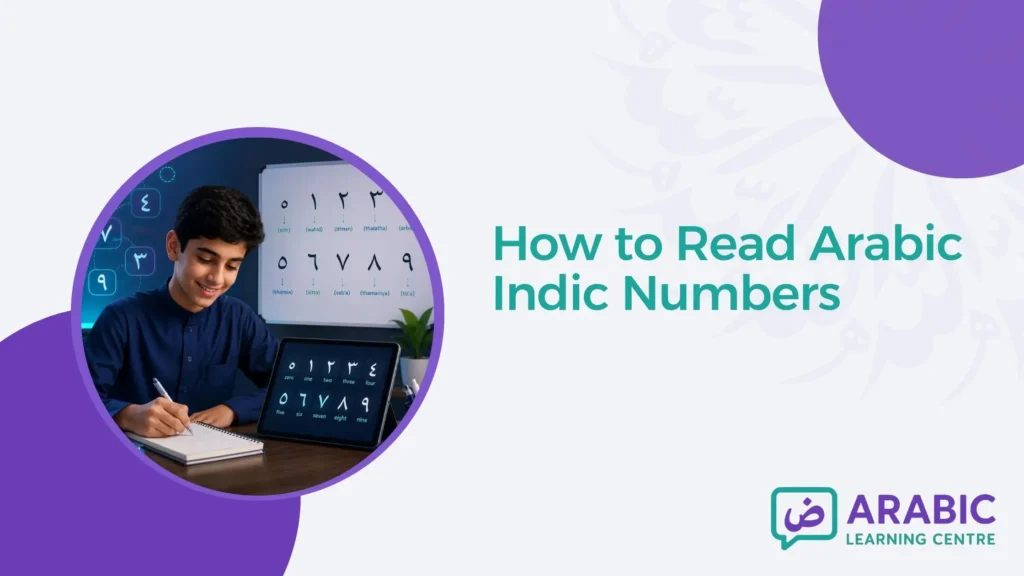
 Learn Arabic
| Key Takeaways |
| The Eastern Arabic numeral system (٠١٢٣٤٥٦٧٨٩) is the original and most authentic system for writing numbers in Arabic. |
| Arabic numbers are written and read from left to right, even though Arabic script itself runs right to left. |
| In Arabic compound numbers, units are stated before tens — so ١٢٣ is read as “one hundred, three and twenty,” not “one hundred and twenty-three.” |
| Mastering numbers 1–10 in Arabic gives learners the building blocks to construct any larger number through consistent, predictable patterns. |
Learning how to read and write Arabic numbers is more approachable than most beginners expect. The original and most authentic system for writing Arabic numbers is the Eastern Arabic numeral system (٠١٢٣٤٥٦٧٨٩). These are the native numerals of the Arabic script tradition and represent the foundational literacy every serious Arabic learner should master first.
What surprises many learners is that Arabic numbers behave differently from Arabic script in one key respect. While Arabic text reads right to left, numbers are read left to right.
Once this single fact is clear — alongside the Arabic-specific rule that units come before tens in compound numbers — the rest of the system becomes logical and learnable with structured practice.
1. Understand That Eastern Arabic Numerals
To read and write Arabic numbers correctly, you must first know that the Eastern Arabic numeral system (٠١٢٣٤٥٦٧٨٩) is the historically authentic and primary system in Arabic writing.
The Western Arabic numerals (0–9) that the modern world uses are themselves derived from this same Eastern tradition, transmitted to Europe through Arabic mathematical scholarship.
Modern contexts — certain digital platforms or international publications — may use Western numerals, but Eastern numerals remain the dominant and original form in authentic Arabic literacy.
The Arabic Learning Centre’s Arabic Course for Beginners introduces Eastern Arabic numerals from the very first session, ensuring students build on the authentic tradition from day one.
Join Our Arabic Course for Beginners With a Free Trial

2. Learn the Direction Arabic Numbers Are Read and Written
Arabic numbers are read and written left to right, regardless of the right-to-left direction of Arabic script. This applies universally to Eastern Arabic numerals within Arabic texts.
The numeral ١٢٣ is read beginning from the leftmost digit — the hundreds — proceeding right. Positional value follows the same left-to-right logic as in mathematics globally.
This is one of the most consistent points of confusion for new learners. In our instructors’ experience at The Arabic Learning Centre, students who first encounter Arabic numbers inside a right-to-left text expect the numerals to follow the same direction.
They do not. Numbers occupy their own directional logic within the Arabic writing system — a consistent exception, not an inconsistency.
A practical example:
١٩٨٤
Alf wa-tisʿumiʾa wa-arbaʿa wa-thamānūn
One thousand, nine hundred and four and eighty
Read that numeral left to right: ١ (one thousand), ٩ (nine hundred), ٨ (eighty position), ٤ (four).
Shots Videos from Our Courses
3. Master the Eastern Arabic Numerals One Through Ten
How to read Arabic numbers fluently begins with internalising the ten base digits of the Eastern Arabic numeral system.
These ten symbols are the foundation of every larger number. Unlike Arabic letters, they do not change form based on position in a word — they are fixed, standalone symbols that carry consistent visual identity.
Train your eye to recognise each symbol directly, alongside its spoken Arabic name. Do not rely on transliteration alone — the goal is immediate visual recognition of the Eastern numeral itself.
| Western Numeral | Eastern Arabic Numeral | Arabic Name | Transliteration |
| 0 | ٠ | صِفْر | Sifr |
| 1 | ١ | وَاحِد | Wāḥid |
| 2 | ٢ | اثْنَان | Ithnan |
| 3 | ٣ | ثَلَاثَة | Thalātha |
| 4 | ٤ | أَرْبَعَة | Arbaʿa |
| 5 | ٥ | خَمْسَة | Khamsa |
| 6 | ٦ | سِتَّة | Sitta |
| 7 | ٧ | سَبْعَة | Sabʿa |
| 8 | ٨ | ثَمَانِيَة | Thamāniya |
| 9 | ٩ | تِسْعَة | Tisʿa |
Students at The Arabic Learning Centre who spend fifteen minutes daily on recognition of these ten symbols consistently achieve reliable reading fluency within ten to fourteen days.
4. Learn to Read Arabic Numbers from 11 to 19
Arabic numbers from eleven to nineteen follow a consistent compound structure built on the base digits already learned.
In Modern Standard Arabic (MSA), numbers 11–19 combine the unit number with the word عَشَر (ʿashar — ten), forming what classical Nahw scholarship calls the al-aʿdād al-murakkaba (الأعداد المركَّبة) — the compound numbers.
A critical grammatical point applies here: Arabic numbers carry gender agreement requirements that differ from English. Numbers 3–10, when modifying a counted noun, take the opposite gender of that noun — a rule known as ʿaks al-qāʿida (عَكْس القَاعِدَة), the reversal rule.
Numbers 11 and 12 agree in gender with the noun; 13–19 revert to the reversal pattern. This is a named rule in classical Nahw and must be studied systematically, not guessed.
| Number | Eastern Numeral | Arabic (MSA) | Transliteration |
| 11 | ١١ | أَحَدَ عَشَرَ | Aḥada ʿashara |
| 12 | ١٢ | اثْنَا عَشَرَ | Ithnā ʿashara |
| 13 | ١٣ | ثَلَاثَةَ عَشَرَ | Thalāthata ʿashara |
| 14 | ١٤ | أَرْبَعَةَ عَشَرَ | Arbaʿata ʿashara |
| 15 | ١٥ | خَمْسَةَ عَشَرَ | Khamsata ʿashara |
| 19 | ١٩ | تِسْعَةَ عَشَرَ | Tisʿata ʿashara |
Understanding this gender agreement system deeply is something our Arabic Grammar Course addresses in dedicated structured lessons — because rote memorisation alone does not produce accurate usage.
Start Learning Arabic Grammar with a Free Trial

5. Learn Read Arabic Numbers in the Tens — 20 to 90
Arabic numbers for the tens — 20, 30, 40 through 90 — are formed by adding the suffix ـُون (-ūn) in the nominative case, or ـِين (-īn) in the accusative and genitive, to a modified root of the unit number. Classical Nahw calls these the ʿuqūd (عُقُود) — the decade numbers. The structure is phonologically regular: once you know the base roots from 1–9, the tens follow a consistent formation pattern.
| Tens | Eastern Numeral | Arabic (MSA) | Transliteration |
| 20 | ٢٠ | عِشْرُون | ʿIshrūn |
| 30 | ٣٠ | ثَلَاثُون | Thalāthūn |
| 40 | ٤٠ | أَرْبَعُون | Arbaʿūn |
| 50 | ٥٠ | خَمْسُون | Khamsūn |
| 60 | ٦٠ | سِتُّون | Sittūn |
| 70 | ٧٠ | سَبْعُون | Sabʿūn |
| 80 | ٨٠ | ثَمَانُون | Thamānūn |
| 90 | ٩٠ | تِسْعُون | Tisʿūn |
For compound numbers between the tens, Arabic uses the connective وَ (wa — and), with a crucial word order rule addressed fully in the next step.
6. Learn to Read Arabic Compound Numbers — Units Come Before Tens
Reading Arabic compound numbers correctly requires understanding that Arabic places the unit before the ten — the opposite of English order. The number ٢٥, for example, is read as خَمْسَةٌ وَعِشْرُون (Khamsatun wa-ʿishrūn) — literally “five and twenty,” not “twenty-five.” This rule applies consistently across all compound numbers from 21 to 99.
This is one of the most important structural rules for learners. Consider the numeral ١٢٣:
١٢٣
Miʾa wa-thalātha wa-ʿishrūn
One hundred, three and twenty
The hundred comes first. Then the unit — three — comes before the ten — twenty. The connective وَ (wa) links each element. English speakers consistently default to “one hundred and twenty-three” — placing the ten before the unit — which produces incorrect Arabic. This reversal must be consciously practised until it becomes automatic.
A further example reinforces the pattern:
٤٧ Sabʿa wa-arbaʿūn “Seven and forty”
Never “forty-seven” in Arabic word order. At The Arabic Learning Centre, our instructors observe this as the single most common spoken error among intermediate learners reading Arabic numerals aloud — and it is fully correctable with targeted practice.
For learners building Arabic grammar foundations, mastering this number structure early prevents deeply entrenched habits later.
7. Learn to Write Arabic Numbers for Hundreds and Thousands
Writing Arabic numbers in the hundreds and thousands follows the same positional logic, with Arabic-specific vocabulary for each magnitude. The word for one hundred is مِئَة (Miʾa).
Two hundred uses the dual form مِئَتَان (Miʾatān). Hundreds from 300–900 combine the unit with مِئَة as a compound. Thousands use أَلْف (Alf) for one thousand, أَلْفَان (Alfān) for two thousand, and آلَاف (Ālāf) for three thousand onward.
| Number | Eastern Numeral | Arabic Expression | Transliteration |
| 100 | ١٠٠ | مِئَة | Miʾa |
| 200 | ٢٠٠ | مِئَتَان | Miʾatān |
| 300 | ٣٠٠ | ثَلَاثُمِئَة | Thalāthumiʾa |
| 1,000 | ١٠٠٠ | أَلْف | Alf |
| 2,000 | ٢٠٠٠ | أَلْفَان | Alfān |
| 5,000 | ٥٠٠٠ | خَمْسَةُ آلَاف | Khamsat ālāf |
A full number demonstrating the unit-before-ten rule at scale:
١٩٩٤ Alf wa-tisʿumiʾa wa-arbaʿa wa-tisʿūn “One thousand, nine hundred, four and ninety”
Notice: arbaʿa (four) precedes tisʿūn (ninety) — units before tens, consistently. The connective وَ (wa) is grammatically required between each element in MSA and cannot be omitted.
For learners pursuing how to learn Arabic systematically, numbers in context — reading prices, years, and quantities — are among the most high-frequency practical skills to develop early.
8. Practice Reading Eastern Arabic Numerals in Real Contexts
Reading Eastern Arabic numerals fluently requires encountering them in real, functional contexts — not in isolation. Prices, dates, and phone numbers are the highest-frequency environments where Eastern Arabic numerals appear.
Training the eye to read them in authentic texts builds automatic recognition far faster than abstract drill alone.
At The Arabic Learning Centre, we consistently observe that learners who practise numerals within authentic Arabic materials — product labels, Arabic newspapers — develop automatic recognition within two to three weeks.
Those who study them only in isolation take significantly longer to transfer that recognition to real reading contexts.
Practical contexts to build Eastern Arabic numeral fluency:
- Prices in Arabic texts: ١٥٠ جُنَيْهاً — Miʾa wa-khamsūn junayhan — “One hundred and fifty pounds”
- Dates: ١٤٤٦ هـ — Alf wa-arbaʿumiʾa wa-sitta wa-arbaʿūn — Hijri year, read unit before ten
- Quran pagination: Page ٣٢ = Ithnan wa-thalāthūn — “Two and thirty”
For learners interested in reading the classical texts, the Learn to Read Arabic Course at The Arabic Learning Centre provides structured training in Eastern numeral recognition within authentic Islamic text environments.
Start Reading Arabic with a FREE Trial

9. Avoid the Most Common Mistakes When Reading and Writing Arabic Numbers
The most frequent errors learners make with Arabic numbers fall into three predictable categories: misreading Eastern numeral symbols, misapplying gender agreement rules, and placing tens before units in compound numbers. Identifying these patterns early prevents them from becoming entrenched habits.
Error Pattern 1 — Eastern numeral symbol confusion
Learners trained on Western numerals consistently misread ٥ as 0 and ٦ as 7.
These two Eastern digits are the most visually misleading for Western-trained eyes. Deliberate side-by-side comparison practice for these specific symbols resolves the confusion within days.
Error Pattern 2 — Gender agreement reversal
Using ثَلَاثَة (Thalātha — with tāʾ marbūṭa, feminine-marked) with a feminine noun feels natural — but Arabic grammar requires it with masculine nouns for numbers 3–10. The ʿaks al-qāʿida reversal rule is consistent and learnable, but it must be studied as a named grammatical rule, not intuited.
Our Students Reviews
Error Pattern 3 — English word order in compound numbers
This is the most persistent error at intermediate level. Saying “twenty and three” instead of “three and twenty” for ٢٣ produces unnatural Arabic. The correct form is always ثَلَاثَةٌ وَعِشْرُون — unit first, then ten. Every compound number from 21–99 follows this pattern without exception.
Accurate pronunciation of number words also prevents spoken errors — The Arabic Learning Centre’s Arabic Pronunciation Course addresses the phonological distinctions between number words that sound deceptively similar to untrained ears.
Begin Pronouncing Arabic Fluently with a Free Trial

Read Also: How to Write in Arabic?
Begin Learning Arabic Numbers with Certified Instructors at The Arabic Learning Centre
Mastering Eastern Arabic numerals — the original and authentic numeral system of the Arabic tradition — alongside their spoken forms and grammatical rules opens direct access to classical texts, and real Arabic communication.
The Arabic Learning Centre offers:
- 1-on-1 personalised lessons with certified native Arabic instructors
- Flexible scheduling available 24/7 to fit any time zone
- Structured curricula covering Eastern Arabic numerals, grammar, script, and conversation
- A free trial lesson — no commitment required
Explore our Arabic Course for Beginners or our Learn to Read Arabic Course and build your Arabic number literacy on the authentic foundation, Insha’Allah.
Check out our top courses in Arabic and choose the course you need to start learning Arabic today:
- Arabic Course for Beginners
- Arabic Script Writing Course
- Arabic Speaking Course
- Learn Arabic Letters for Tajweed
- Learning Arabic Grammar
- Arabic Vocabulary Course
- Fusha Arabic Course
- Classical Arabic Course
- Arabic Course for Islamic Studies
- Quranic Arabic Course
- Learn Arabic for New Muslims
Start with a FREE trial class and enhance your Arabic language skills

Conclusion
The Eastern Arabic numeral system (٠١٢٣٤٥٦٧٨٩) is the original script of the Arabic numerical tradition — found across centuries of classical scholarship and traditional Arabic books. Every learner of Arabic who encounters these texts must be fluent in these numerals, not only in the Western forms.
The two rules that define Arabic number reading — left-to-right direction, and units before tens in compound numbers — are consistent and logical once practised in context. ١٢٣ is one hundred, three and twenty: the unit comes before the ten, every time, without exception.
Read Also: How Many Letters Are in the Arabic Alphabet?
Frequently Asked Questions About How to Read and Write Arabic Numbers
Which numeral system is the original Arabic system — Eastern or Western?
The Eastern Arabic numeral system (٠١٢٣٤٥٦٧٨٩) is the original and most authentic system in Arabic writing. These numerals appear throughout classical Arabic manuscripts spanning centuries. Western Arabic numerals (0–9) are themselves derived from this Eastern tradition, transmitted to Europe through Arabic mathematical scholarship during the medieval period.
Are Arabic numbers written left to right or right to left?
Arabic numbers — including Eastern Arabic numerals — are written and read left to right, even within right-to-left Arabic text. This directional exception applies universally. The leftmost digit carries the highest positional value, exactly as in Western mathematics. A learner reading Arabic text switches direction for numerals automatically once this rule is internalised through practice.
How do you read a compound Arabic number like ٢٣?
The number ٢٣ is read as ثَلَاثَةٌ وَعِشْرُون (Thalāthatun wa-ʿishrūn) — “three and twenty.” Arabic always places the unit before the ten in compound numbers from 21–99. English order (“twenty-three”) does not apply. The connective وَ (wa — and) links the unit and the ten and is grammatically required in Modern Standard Arabic.
What is the gender agreement rule for Arabic numbers?
Arabic numbers 3–10 take the opposite grammatical gender of the noun they modify — a rule called ʿaks al-qāʿida (عَكْس القَاعِدَة) in classical Nahw. Numbers 11 and 12 agree in gender with the noun. Numbers 13–19 revert to the reversal pattern. This rule has no equivalent in English and requires dedicated study — it cannot be reliably guessed or intuited without structured grammatical instruction.
How long does it take to learn to read Eastern Arabic numerals confidently?
Most adult learners achieve reliable recognition of Eastern Arabic numerals 0–9 within one to two weeks of fifteen-minute daily practice. Confidence with compound numbers and their correct spoken order — units before tens — typically develops within three to four weeks.