 Arabic Grammar

The five nouns in Arabic (al-asma al-khamsa, الأَسْمَاءُ الخَمْسَةُ) are أَبٌ (father), أَخٌ (brother), حَمٌ (in-law), فَمٌ (mouth) and ذُو (possessor of). They mark their case with a letter instead of a short vowel: و in the nominative, ا in the accusative and ي in the genitive.
Most Arabic nouns show their case with a ḍamma, fatḥa or kasra on the last letter. The five nouns (al-asma al-khamsa) stretch those vowels into full letters. That is why the same word appears as أَبُو, أَبَا or أَبِي depending on its role in the sentence.
The long letter is not invented.
أَبٌ and أَخٌ were originally three-letter words ending in a weak letter (أبو, أخو), and that letter returns when the noun is annexed. You will meet these forms in Modern Standard Arabic, in classical poetry, in the Quran and in everyday names like Abu Bakr.
Below, each of the five nouns gets its own section, with its three forms, real examples and one detail that makes it different from the others.

1. أَبٌ (Ab): Father
أَبٌ is the noun most textbooks use to teach the rule, and the one you will hear most. Its three forms are أَبُو, أَبَا and أَبِي.
| Case | Form | Example | Why this case |
| Nominative | أَبُو | ذهبَ أَبُو زَيْدٍ إلى المسجدِ, “Abu Zaid went to the mosque.” | Subject of the verb |
| Nominative | أَبُو | كانَ أَبُوكَ مسلمًا قويًّا, “Your father was a strong Muslim.” | Subject (ism) of كان |
| Accusative | أَبَا | رأينا أَبَاكَ في المسجدِ, “We saw your father in the mosque.” | Direct object |
| Accusative | أَبَا | إنَّ أَبَا حبيبٍ رجلٌ كريمٌ, “Habib’s father is a generous man.” | Subject (ism) of إنّ |
| Genitive | أَبِي | هذا الكتابُ لِأَبِيكَ, “This book is for your father.” | After a preposition |
| Genitive | أَبِي | سيارةُ أَبِيكَ جميلةٌ, “Your father’s car is beautiful.” | Second term of an idafa |
The Quran uses all three forms:
The Quran uses all three forms. The nominative appears in the story of Musa at the well of Madyan, where two women explain why they are waiting to water their flock:
وَأَبُونَا شَيْخٌ كَبِيرٌ
“And our father is a very old man.”
Here أَبُونَا is the subject (mubtada’).
The accusative appears in the story of Yusuf, after his brothers threw him into the well and returned home pretending to grieve:
وَجَاءُوا أَبَاهُمْ عِشَاءً يَبْكُونَ
“They came to their father at night, weeping.”
Here أَبَاهُمْ is the object of جاءوا.
The genitive appears at the opening of Surat Al-Masad, which was revealed about the Prophet’s uncle and fierce opponent:
تَبَّتْ يَدَا أَبِي لَهَبٍ وَتَبَّ
“May the hands of Abu Lahab perish, and he has perished.”
Here أَبِي is the second term of an idafa with يَدَا.
Read also: Genitive Case In Arabic – A Complete Guide To Idafa
2. أَخٌ (Akh): Brother
أَخٌ follows exactly the same pattern as أَبٌ: أَخُو, أَخَا, أَخِي. The Quran gives a clear example of each case.
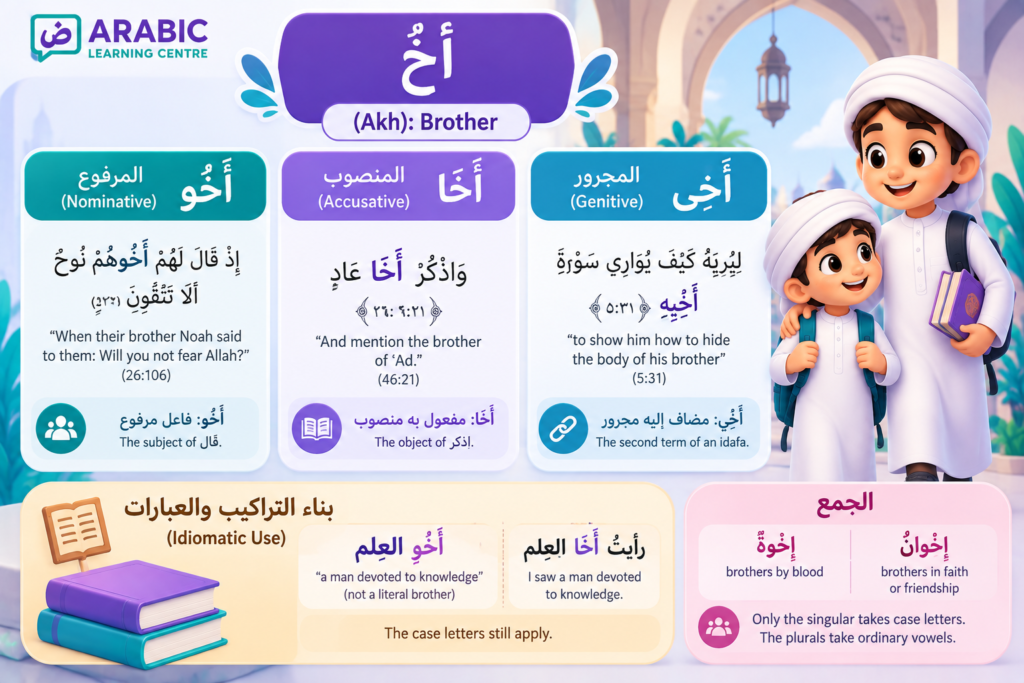
The Quran gives a clear example of each case. The nominative comes from Surat Ash-Shu’ara, which describes Nuh calling his people to faith:
إِذْ قَالَ لَهُمْ أَخُوهُمْ نُوحٌ أَلَا تَتَّقُونَ
“When their brother Noah said to them: Will you not fear Allah?”
Here أَخُو is the subject of قال.
The accusative comes from Surat Al-Ahqaf, which tells the Prophet ﷺ to recall the story of Hud and his people:
وَاذْكُرْ أَخَا عَادٍ إِذْ أَنذَرَ قَوْمَهُ بِالْأَحْقَافِ
“And mention the brother of ʿAd, when he warned his people in the sand dunes.”
Here أَخَا is the object of اذكر.
The genitive comes from the story of Adam’s two sons, when Allah sent a crow to teach the killer what to do with his brother’s body:
لِيُرِيَهُ كَيْفَ يُوَارِي سَوْءَةَ أَخِيهِ
“To show him how to hide the body of his brother.”
Here أَخِي is the second term of an idafa with سَوْءَةَ.
Good to know: only the singular takes case letters. The plurals إِخْوَةٌ (brothers by blood) and إِخْوَانٌ (brothers in faith or friendship) take ordinary vowels.
Read also: Nominative Case In Arabic – Signs, Positions, And Examples
3. حَمٌ (Ḥam): In-law
حَمٌ is the least familiar of the five nouns. It refers to a woman’s relatives by marriage, especially her husband’s father, and sometimes his brother or other male relatives. Its forms are حَمُو, حَمَا and حَمِي.
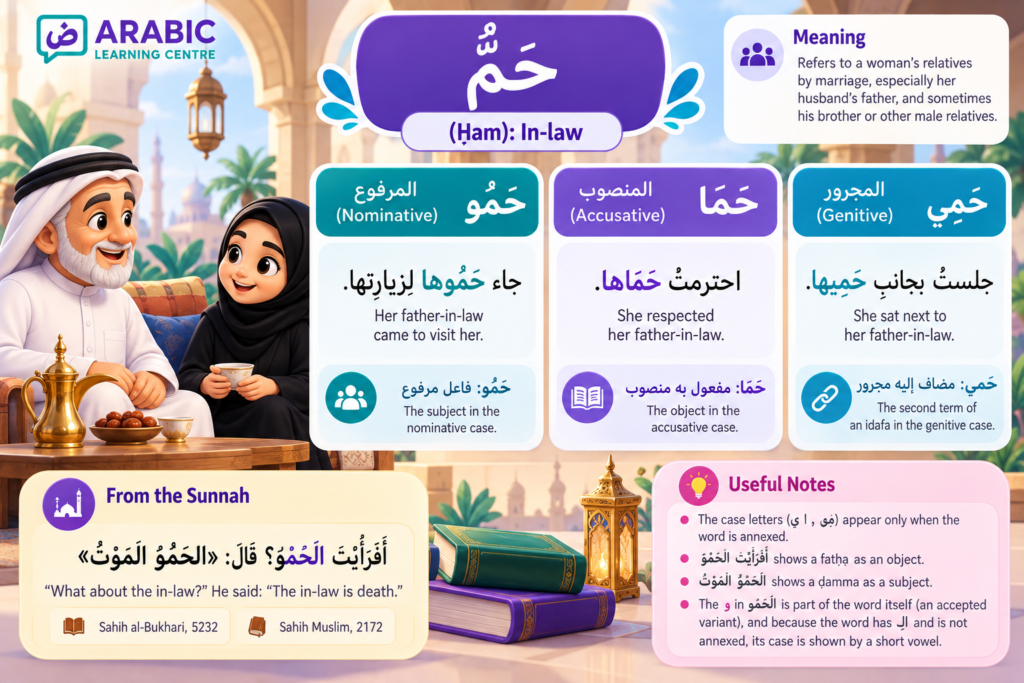
Because حَمٌ describes the wife’s in-laws, it almost always carries a feminine pronoun (ـها) in examples:
- Nominative: جاءَ حَمُوها لزيارتِها, “Her father-in-law came to visit her.”
- Accusative: احترمتْ حَمَاها, “She respected her father-in-law.”
- Genitive: جلستْ بجانبِ حَمِيها, “She sat next to her father-in-law.”
The word is best known from a hadith about a man being alone with a woman who is not his mahram. The Prophet ﷺ warned against entering upon women, and a man from the Ansar asked about the husband’s relatives specifically:
أَفَرَأَيْتَ الحَمْوَ؟ قَالَ: «الحَمْوُ المَوْتُ»
“What about the in-law?” He said: “The in-law is death.” (Sahih al-Bukhari, 5232; Sahih Muslim, 2172)
Imam al-Nawawi explains that الحَمْو here means the husband’s relatives other than his father and sons, such as his brother, nephew or cousin, since the father-in-law is already a mahram. Calling him “death” is a strong comparison: people are relaxed when a brother-in-law comes and goes, so the danger is greater than with a stranger.
Notice the grammar too. The word takes a fatḥa in أَفَرَأَيْتَ الحَمْوَ as an object, and a ḍamma in الحَمْوُ المَوْتُ as a subject. The و here belongs to the word itself (حَمْو is an accepted variant), and because the word has ال and is not annexed, its case is shown by a short vowel. It is a neat reminder that the case letters only appear when the noun is annexed.
Don’t Just Take Our Word For It
Take a look inside our vibrant classes and see our students and teachers in action. Click below to watch our classroom experience:
4. فَمٌ (Fam): Mouth
فَمٌ is the only one of the five nouns with two possible shapes. It joins the group only when it drops its م and becomes فُو, فَا, فِي. If it keeps the م, it behaves like any ordinary noun.
| Case | Without م (one of the five nouns) | With م (ordinary noun) |
| Nominative | فُوكَ نظيفٌ | فَمُكَ نظيفٌ |
| Accusative | فتحَ فَاهُ | فتحَ فَمَهُ |
| Genitive | في فِيكَ طعامٌ | في فَمِكَ طعامٌ |
Both columns mean the same thing: “Your mouth is clean,” “He opened his mouth,” “There is food in your mouth.” The difference is only in how the case is marked.
The Quran uses the short form in the accusative, in a verse comparing those who call on others besides Allah to a thirsty man reaching for water he can never drink:
كَبَاسِطِ كَفَّيْهِ إِلَى الْمَاءِ لِيَبْلُغَ فَاهُ وَمَا هُوَ بِبَالِغِهِ
“Like one who stretches his hands toward water so it may reach his mouth, but it will never reach it.” (Surat Ar-Ra’d, 13:14)
Here فَاهُ is the object of يبلغ, without the م.
Good to know: in modern writing, فَمٌ with its م is far more common. Learn to recognize فُو, فَا and فِي when reading, especially in classical Arabic texts.

5. ذُو (Dhu): Possessor of
ذُو means “the one who has” or “endowed with.” Unlike the other four, it has no meaning on its own and is always followed by a noun. Its forms are ذُو, ذَا and ذِي.
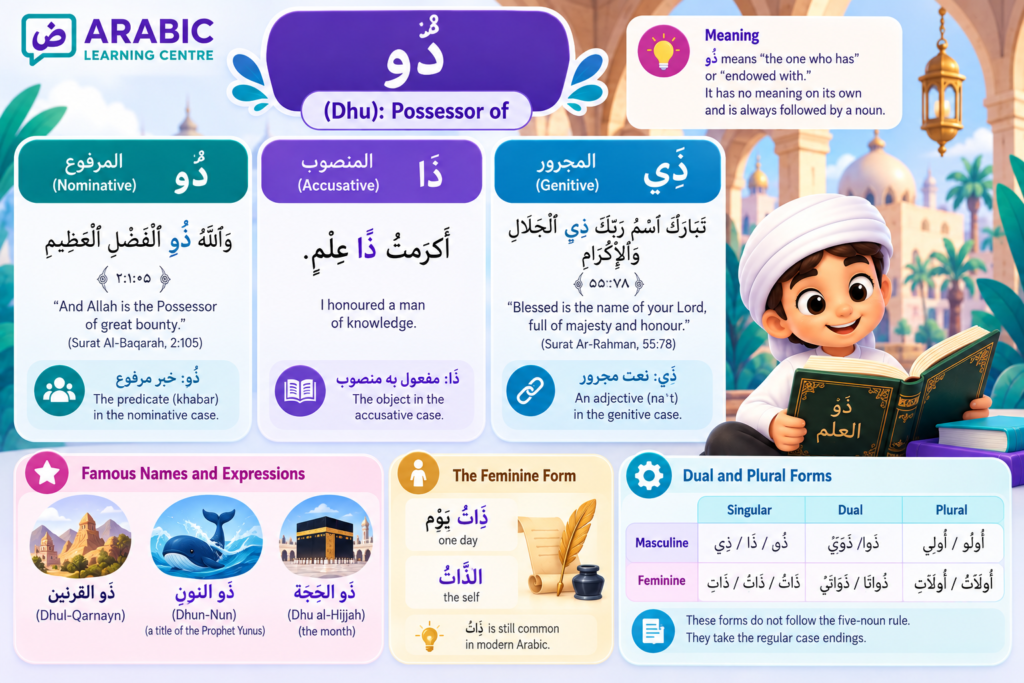
The nominative comes from Surat Al-Baqarah, which reminds the believers that Allah grants His mercy to whom He wills:
وَاللَّهُ ذُو الْفَضْلِ الْعَظِيمِ
“And Allah is the Possessor of great bounty.” (Surat Al-Baqarah, 2:105)
Here ذُو is the predicate (khabar) of اللهُ.
The accusative is easy to see in an everyday sentence: أكرمتُ ذَا عِلْمٍ, “I honoured a man of knowledge.”
The genitive comes from the closing verse of Surat Ar-Rahman, which ends a long list of Allah’s blessings with praise of His name:
تَبَارَكَ اسْمُ رَبِّكَ ذِي الْجَلَالِ وَالْإِكْرَامِ
“Blessed is the name of your Lord, full of majesty and honour.” (Surat Ar-Rahman, 55:78)
Here ذِي is an adjective (naʿt) of رَبِّكَ, so it follows it in the genitive.
ذُو is also the root of many famous names: ذو القرنين (Dhul-Qarnayn), ذو النون (Dhun-Nun, a title of the Prophet Yunus) and the month ذو الحجة. They change with the case too: في شهرِ ذي الحجةِ.
ذُو has its own dual, plural and feminine forms, which do not follow the five-noun rule:
| Singular | Dual | Plural | |
| Masculine | ذُو / ذَا / ذِي | ذَوَا / ذَوَيْ | أُولُو / أُولِي |
| Feminine | ذَاتُ / ذَاتَ / ذَاتِ | ذَوَاتَا / ذَوَاتَيْ | أُولَاتُ / أُولَاتِ |
The feminine ذَاتُ is still common in modern Arabic: ذَاتَ يَوْمٍ means “one day,” and الذَّاتُ means “the self.”
The Five Nouns at a Glance
The table below shows how each of the five nouns changes across the three grammatical cases when the required conditions are met.
| Noun | Meaning | Nominative (و) | Accusative (ا) | Genitive (ي) |
| أَبٌ | father | أَبُو | أَبَا | أَبِي |
| أَخٌ | brother | أَخُو | أَخَا | أَخِي |
| حَمٌ | in-law | حَمُو | حَمَا | حَمِي |
| فَمٌ | mouth | فُو | فَا | فِي |
| ذُو | possessor of | ذُو | ذَا | ذِي |
When Do the Five Nouns Take و, ا, and ي?
The five nouns take و in the nominative, ا in the accusative, and ي in the genitive only when certain conditions are met.
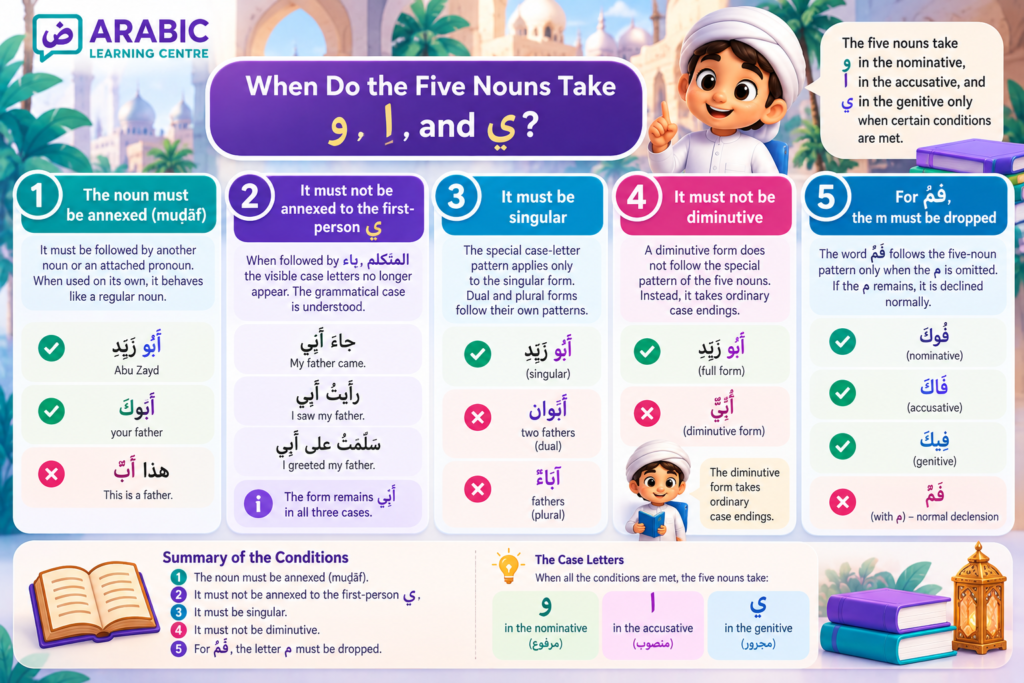
If any of these conditions is missing, they are declined with ordinary short vowels instead.
1. The noun must be annexed (muḍāf)
It must be followed by another noun or an attached pronoun, as in أَبُو زَيْدٍ and أَبُوكَ. When used on its own, it behaves like a regular noun:
هذا أَبٌ — “This is a father.”
2. It must not be annexed to the first-person ي
When one of the five nouns is followed by ياء المتكلم, the visible case letters no longer appear. For example:
جاءَ أَبِي
رأيتُ أَبِي
سلّمتُ على أَبِي
In all three cases, the form remains أَبِي, while the grammatical case is understood rather than shown by و، ا، or ي.
3. It must be singular
The special case-letter pattern applies only to the singular form. Dual and plural forms follow their own declension patterns, such as:
أَبَوَانِ — two fathers
آبَاءٌ — fathers
4. It must not be diminutive
A diminutive form such as أُبَيٌّ does not follow the special pattern of the five nouns. Instead, it takes ordinary case endings.
5. For فَمٌ, the letter م must be dropped
The word فَمٌ follows the five-noun pattern only when the م is omitted, as in فُوكَ، فَاكَ، فِيكَ. If the م remains, it is declined normally.
Common Mistakes with the Five Nouns
The five nouns follow a clear pattern, but learners often make mistakes when choosing the correct case form. The key is to identify the noun’s grammatical role before deciding whether it should take و، ا، or ي.
| Common Mistake | Wrong | Correct |
| Using أبو in every grammatical case | سلّمتُ على أبو بكرٍ | سلّمتُ على أبي بكرٍ |
| Forgetting the accusative ا | رأيتُ أخوكَ | رأيتُ أخاكَ |
| Using a colloquial form in MSA | هذا أبوي | هذا أبي |
| Using the special case letters without idafa | جاءَ أبو | جاءَ أبٌ |
| Treating ذات like ذو | جاءتْ ذاتو علمٍ | جاءتْ ذاتُ علمٍ |
The first mistake is the most common, because names like Abu Bakr are learned in the nominative. Always check the word’s role in the sentence before writing it. If you are just starting out, an Arabic course for beginners builds these habits from day one.

However, أبو does not stay unchanged. Its form depends on its grammatical position:
- جاءَ أبو بكرٍ — nominative
- رأيتُ أبا بكرٍ — accusative
- سلّمتُ على أبي بكرٍ — genitive
Also remember that ذو follows the special pattern of the five nouns, but its feminine counterpart ذات does not. It is declined with ordinary case endings: ذاتُ، ذاتَ، ذاتِ.
A simple rule to remember is: do not choose the form by memory alone; first determine the noun’s case in the sentence.
Inside Our Classrooms
See how we make learning interactive and engaging! Watch a quick snippet of our live, conversational classes in action:
Learn Arabic Grammar the Right Way with Arabic Learning Centre
Reading a rule is one thing; using it correctly in every sentence is another. At Arabic Learning Centre, we turn grammar topics like the five nouns into skills you actually use, through live one-to-one lessons with experienced Arabic tutors.
Your tutor builds a plan around your level and goals, whether you want to read the Quran with understanding, master Modern Standard Arabic, or speak with confidence. Every lesson combines clear explanations, real examples and instant correction, so mistakes like أبو instead of أبي disappear for good. And because classes are online, you learn from anywhere, at times that suit you.
Ready to take your Arabic further? Book your first lesson with Arabic Learning Centre today and start learning Arabic grammar the way it should be taught.
Courses We Offer:
- Online Arabic Course
- Classical arabic course
- Modern Standard Arabic Course
- Fusha Arabic Course
- Learn Saudi Arabic
- Arabic Course for Beginners

Conclusion
The five nouns in Arabic (al-asma al-khamsa) look tricky at first, but they all follow one pattern: و in the nominative, ا in the accusative and ي in the genitive. That pattern applies whenever the noun is singular, annexed and not followed by “my.”
Start with أَبٌ and أَخٌ, since you will meet them every day. Then learn to recognize فُو and ذُو in your reading, and keep حَمٌ in mind for classical texts. Once you can switch between أَبُو, أَبَا and أَبِي without thinking, the other four nouns follow naturally.
The best way to make the rule stick is to see it in context. Read a short passage every day, underline each of the five nouns, and name its case before you check the ending. Keep building your vocabulary at the same time, and these forms will soon feel as natural as any other word.
Frequently Asked Questions
What are the five nouns in Arabic?
They are أَبٌ (father), أَخٌ (brother), حَمٌ (in-law), فَمٌ (mouth) and ذُو (possessor of). Together they are called al-asma al-khamsa, الأَسْمَاءُ الخَمْسَةُ.
Why do the five nouns take letters instead of vowels?
أَبٌ, أَخٌ and حَمٌ originally ended in a weak letter, which returns when the noun is annexed. The result is a long vowel: و for ḍamma, ا for fatḥa and ي for kasra.
Is أَبِي (“my father”) one of the five nouns?
No. When the first-person ي is attached, the noun keeps the same form in all three cases, and its case is only implied.
Do the five nouns follow the rule in spoken Arabic?
Not usually. Most dialects use one fixed form, such as أبو in Egyptian and Levantine Arabic. The full system belongs to Modern Standard Arabic and classical Arabic.
Are there six nouns instead of five?
Some grammarians add هَنٌ (a vague word for “thing”) and call the group al-asma al-sitta, the six nouns. Most modern textbooks teach the five covered here.
How long does it take to master the five nouns?
Recognizing the forms takes a few days of practice. Using them correctly while speaking or writing comes faster with regular exercises and feedback from a teacher.
One response to “The Five Nouns In Arabic (Al-Asma Al-Khamsa) – The List of All 5 with Examples”
Related Articles
Arabic Grammar








[…] Read also: The Five Nouns In Arabic (Al-Asma Al-Khamsa) – The List of All 5 with Examples […]