 Arabic Grammar
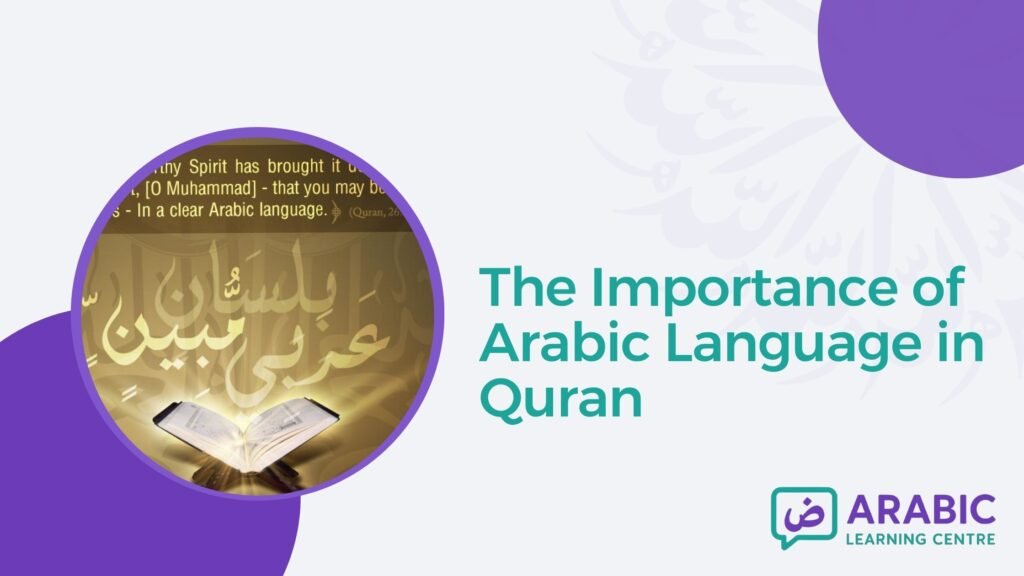
The importance of Arabic language in Quran becomes clear when we consider the direct relationship between the language and revelation.
Muslims around the world speak many different languages, yet the Quran they recite remains in the Arabic language in which it was revealed.
For non-Arabic-speaking Muslims, translations provide an essential way to access the general meanings of the Quran. However, learning Arabic adds another dimension. It allows learners to recognize Quranic vocabulary, understand sentence structures, notice connections between words, and gradually engage with verses without depending entirely on translation.
The Quran itself draws attention to the language of revelation. Allah says:
إِنَّآ أَنزَلْنَـٰهُ قُرْءَٰنًا عَرَبِيًّۭا لَّعَلَّكُمْ تَعْقِلُونَ
“Indeed, We have sent it down as an Arabic Quran so that you may understand.”
The verse establishes a clear connection between the Arabic Quran and understanding. Learning Arabic, therefore, can help a Muslim move gradually from simply reciting Quranic words toward recognizing and reflecting on their meanings.
You do not have to become fluent before seeing the benefits. Understanding common words, basic grammar, and frequently occurring roots can already make familiar Surahs feel more accessible.
Here are 10 reasons that explain the importance of Arabic language in Quran and why Muslims may benefit from learning it.
1. Arabic Is the Original Language of the Quran
The most fundamental reason for studying Arabic is straightforward: the Quran was revealed in Arabic.
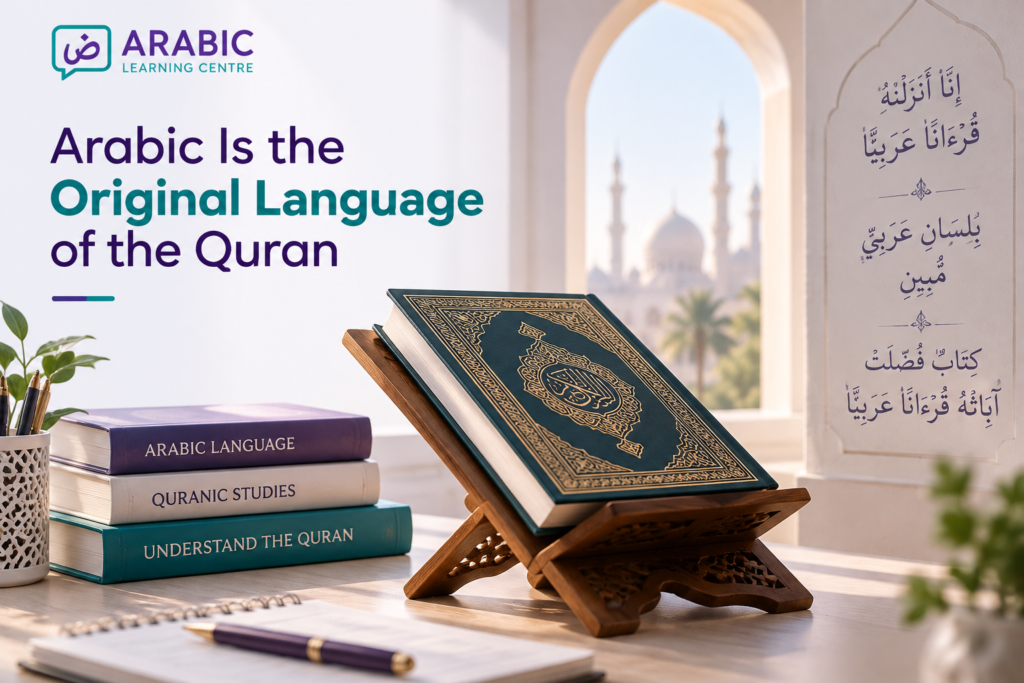
This point is not mentioned only once in the Quran. Several verses explicitly describe the revelation as Arabic.
Allah says:
إِنَّآ أَنزَلْنَـٰهُ قُرْءَٰنًا عَرَبِيًّۭا لَّعَلَّكُمْ تَعْقِلُونَ
“Indeed, We have sent it down as an Arabic Quran so that you may understand.”
In another passage describing the revelation, Allah says:
بِلِسَانٍ عَرَبِيٍّ مُّبِينٍ
“In a clear Arabic tongue.”
The Quran also states:
كِتَـٰبٌۭ فُصِّلَتْ ءَايَـٰتُهُۥ قُرْءَانًا عَرَبِيًّۭا لِّقَوْمٍۢ يَعْلَمُونَ
“A Book whose verses are perfectly explained—a Quran in Arabic for people who know.”
These verses demonstrate why Arabic occupies such a central position in Quran study. Translation can communicate meaning, but the actual words, grammatical structures, sounds, and rhetorical features of the revelation remain Arabic.
For learners whose primary goal is understanding revelation and traditional Islamic texts, studying Classical Arabic provides a focused route into the vocabulary and grammatical structures used in classical sources.

2. Arabic Helps You Understand the Quran Without Depending Entirely on Translation
Translations are extremely valuable, particularly for beginners. However, translation inevitably involves interpretation and linguistic choices.
A single Arabic word can carry several related meanings, while an English translator may need to select one word or phrase that communicates the most appropriate meaning in that particular context.
Consider تقوى (Taqwa). Depending on the context and translation, you may encounter expressions such as “piety,” “God-consciousness,” “righteousness,” or “fear of Allah.”
These translations help English-speaking readers understand the concept, but learning the Arabic word allows students to recognize it whenever it occurs and gradually understand its meaning according to context.
The same applies to hundreds of recurring Quranic words.
As your Arabic improves, you begin recognizing:
- common nouns and verbs;
- frequently repeated Quranic expressions;
- pronouns and particles;
- relationships between words from the same root;
- basic sentence structures;
- changes in verb forms;
- emphasis and repetition.
This does not make translations unnecessary. Rather, it allows you to use translations as learning aids while developing a more direct relationship with the original Arabic text.
That transition is one of the clearest demonstrations of the importance of Arabic language in Quran study.
3. Arabic Reveals Layers of Quranic Meaning
Arabic is built around an intricate system of roots, patterns, grammatical endings, and sentence structures.
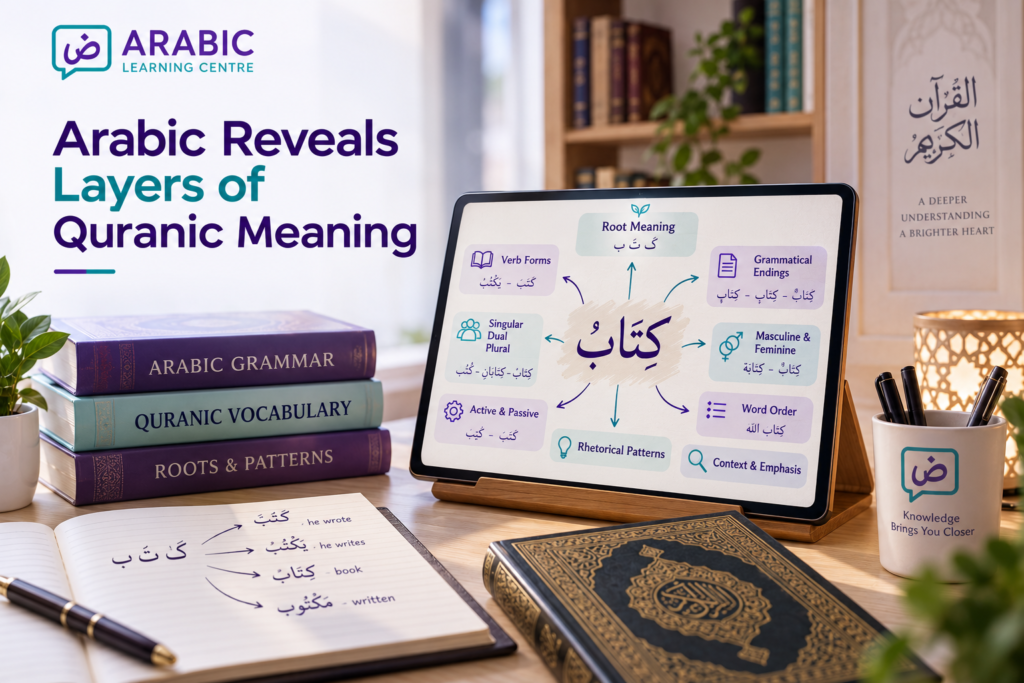
As learners become familiar with these features, they can begin noticing details that may be difficult to reproduce fully in another language.
For example, Arabic study can help you recognize:
- why a particular verb form appears in a verse;
- connections between words sharing the same root;
- singular, dual, and plural forms;
- masculine and feminine forms;
- active and passive structures;
- emphasis within sentences;
- relationships between pronouns and nouns;
- changes in word order;
- repeated rhetorical patterns.
This becomes particularly important when studying the Quran at a deeper level.
Allah describes the Quran as being revealed in Arabic in another verse:
وَكَذَٰلِكَ أَنزَلْنَـٰهُ قُرْءَانًا عَرَبِيًّۭا وَصَرَّفْنَا فِيهِ مِنَ ٱلْوَعِيدِ لَعَلَّهُمْ يَتَّقُونَ أَوْ يُحْدِثُ لَهُمْ ذِكْرًۭا
“And so We have sent it down as an Arabic Quran and varied the warnings in it, so perhaps they will shun evil or it may cause them to be mindful.”
Learning Arabic allows students to explore such passages not only through an English rendering but through the vocabulary and structures of the verse itself.
You do not need advanced linguistic training before experiencing this benefit. Even elementary grammar and vocabulary can reveal patterns that were previously invisible.
4. Arabic Makes Quran Recitation More Meaningful
There is an important difference between knowing how to pronounce a verse and knowing what the verse means.
A learner may recite a Surah accurately from memory while understanding only its general translation. Once Arabic vocabulary becomes familiar, however, recitation begins to communicate meaning immediately.
Words that previously existed mainly as sounds begin to represent recognizable ideas.
You start noticing commands, questions, descriptions, warnings, promises, expressions of gratitude, references to Allah’s attributes, and accounts of earlier peoples while you are actually reciting.
This can make Quran recitation more reflective.
The Prophet Muhammad ﷺ emphasized the special status of learning and teaching the Quran.
Before considering the Hadith, it is important to notice that Quran learning encompasses a lifelong relationship with revelation: reading it, reciting it correctly, studying its meanings, and passing beneficial knowledge to others.
The Prophet ﷺ said:
خَيْرُكُمْ مَنْ تَعَلَّمَ الْقُرْآنَ وَعَلَّمَهُ
“The best among you are those who learn the Qur’an and teach it.”
This Hadith highlights the virtue attached to learning the Quran and teaching it to others. Arabic study can support that broader learning journey by helping non-Arabic speakers progress from pronunciation and memorization toward vocabulary recognition and deeper comprehension.
In this sense, learning Arabic does not replace Tajweed, memorization, or Tafsir. It complements them.
5. Arabic Helps You Understand the Words You Recite in Salah
One of the most practical benefits of learning Arabic is that Muslims already use the language every day.
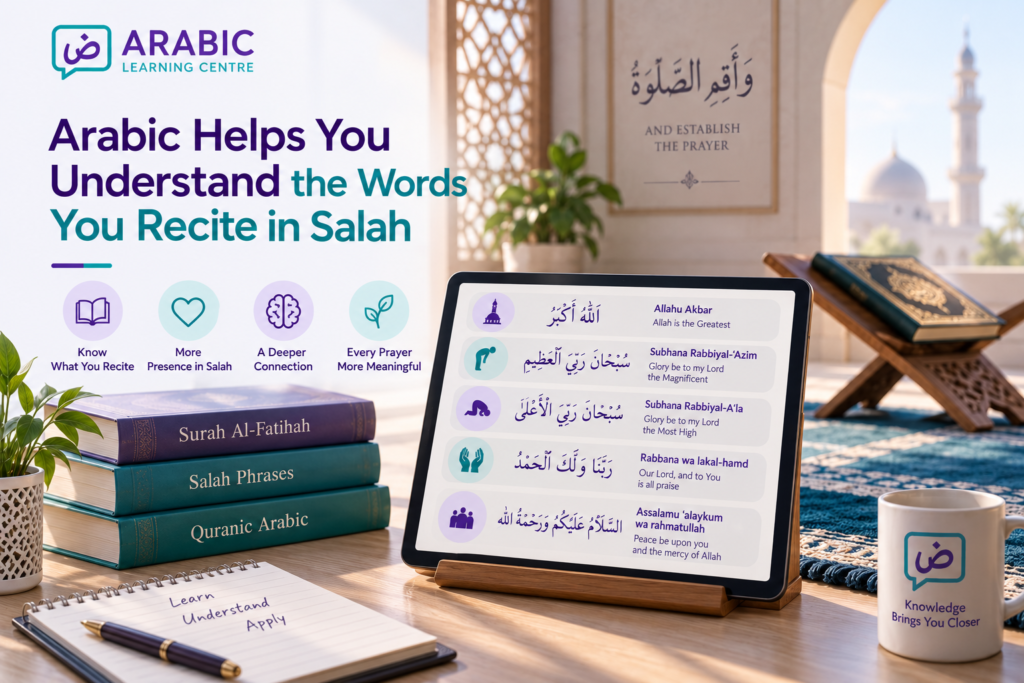
Surah Al-Fatihah is recited repeatedly throughout the five daily prayers, while Salah also includes Arabic phrases of praise, glorification, supplication, and remembrance.
Some of the expressions Muslims regularly use include:
- الله أكبر — Allahu Akbar
- سُبْحَانَ رَبِّيَ الْعَظِيمِ — Subhana Rabbiyal-‘Azim
- سُبْحَانَ رَبِّيَ الْأَعْلَى — Subhana Rabbiyal-A’la
- رَبَّنَا وَلَكَ الْحَمْدُ — Rabbana wa lakal-hamd
- السَّلَامُ عَلَيْكُمْ وَرَحْمَةُ اللهِ — Assalamu ‘alaykum wa rahmatullah
A Muslim can memorize these phrases without speaking Arabic fluently. But understanding them allows the mind to follow the words being spoken.
The difference becomes particularly noticeable with Surah Al-Fatihah.
When you understand words such as:
- الْحَمْدُ — praise
- رَبِّ — Lord
- الرَّحْمَٰنِ — the Most Compassionate
- الرَّحِيمِ — the Most Merciful
- نَعْبُدُ — we worship
- نَسْتَعِينُ — we ask for help
- اهْدِنَا — guide us
you can begin following the progression of meaning as you recite.
The goal is no longer simply to remember an English translation outside prayer. You gradually become capable of connecting the Arabic words you are actually reciting with their meanings.
This is one of the most immediate practical benefits of learning Quranic Arabic.
Read also: Arabic Alphabet with Fatha Kasra and Damma
6. Arabic Helps You Study Tafsir More Deeply
Tafsir involves much more than translating Arabic sentences into another language.
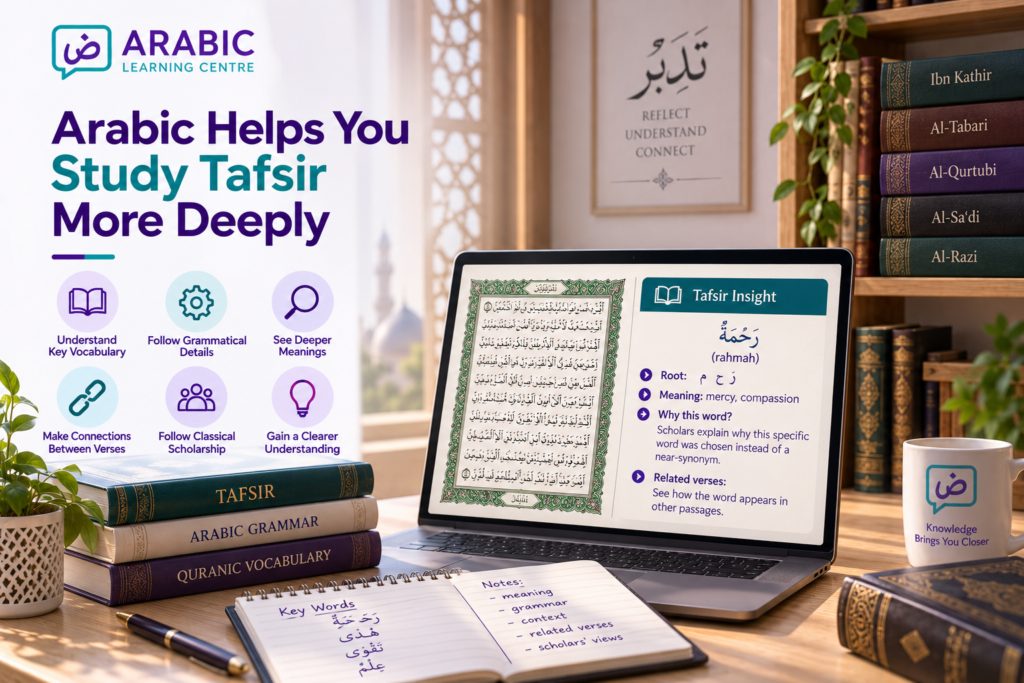
Scholars of Tafsir examine vocabulary, grammar, morphology, rhetorical devices, context, related Quranic passages, Prophetic traditions, and classical Arabic usage when explaining verses Learning Arabic gives students a foundation for understanding these discussions.
For example, a Tafsir may explain:
- why one word was selected instead of a near-synonym;
- why a particular verb form was used;
- what a pronoun refers to;
- how the position of a word creates emphasis;
- how two verses use slightly different expressions;
- how an Arabic root contributes to meaning.
Without some knowledge of Arabic, these explanations can remain abstract With Arabic knowledge, students can look at the verse and begin seeing what the scholar is discussing.
This does not mean that knowing basic Arabic qualifies someone to interpret the Quran independently. Tafsir is a scholarly discipline that requires knowledge of numerous Islamic sciences.
Arabic should instead be viewed as one of the essential tools that helps students follow qualified scholarship more closely.
7. Arabic Opens the Door to Hadith and Classical Islamic Scholarship
The importance of Arabic language in Quran learning extends beyond the Quran itself.

The Prophet Muhammad ﷺ taught his Companions in Arabic, and the Hadith literature was transmitted and preserved in Arabic.
Likewise, much of the classical scholarship in Tafsir, Hadith, Fiqh, Aqidah, Seerah, Usul, and Arabic linguistics was written in Arabic.
Translations have made many important works accessible to English-speaking Muslims, but they represent only part of a much larger scholarly library Learning Arabic gradually gives students greater access to original sources.
At an introductory level, this might simply mean recognizing a familiar Quranic or Hadith expression At an intermediate level, a student may begin reading simplified Arabic explanations.
More advanced learners may eventually study classical texts with qualified teachers Arabic therefore becomes more than another academic subject. It becomes a tool through which other areas of Islamic knowledge can be approached.
Inside Our Classrooms
See how we make learning interactive and engaging! Watch a quick snippet of our live, conversational classes in action:
8. Arabic Helps You Recognize Quranic Roots and Word Families
One of the most useful features of Arabic for Quran learners is its root-based structure.
Many Arabic words are formed from roots, commonly consisting of three consonants. Different patterns built around a root can produce related words.
Consider the root:
ك – ت – ب (K-T-B)
It is associated with writing and produces words such as:
- كَتَبَ (kataba) — he wrote
- كِتَاب (kitab) — book
- كَاتِب (katib) — writer
- مَكْتُوب (maktub) — written
- مَكْتَب (maktab) — office/desk
- مَكْتَبَة (maktabah) — library/bookshop
This system can make vocabulary learning much more organized Instead of memorizing six completely unrelated words, you recognize them as members of one lexical family.
The same principle becomes particularly useful when reading the Quran because important roots recur across different Surahs and contexts.
A learner who develops root recognition can begin asking useful questions while reading:
- Have I seen this root before?
- What other Quranic words come from it?
- Has the word changed form here?
- Does that change affect the meaning?
- Where else does this root occur in the Quran?
This transforms vocabulary learning from memorizing isolated words into building interconnected networks of meaning.
Read also: Preposition in Arabic – A Complete Guide
9. Learning Arabic Can Support Quran Memorization
Memorization becomes easier for many learners when words form meaningful sequences rather than unfamiliar sounds Understanding an ayah gives the learner another memory pathway.
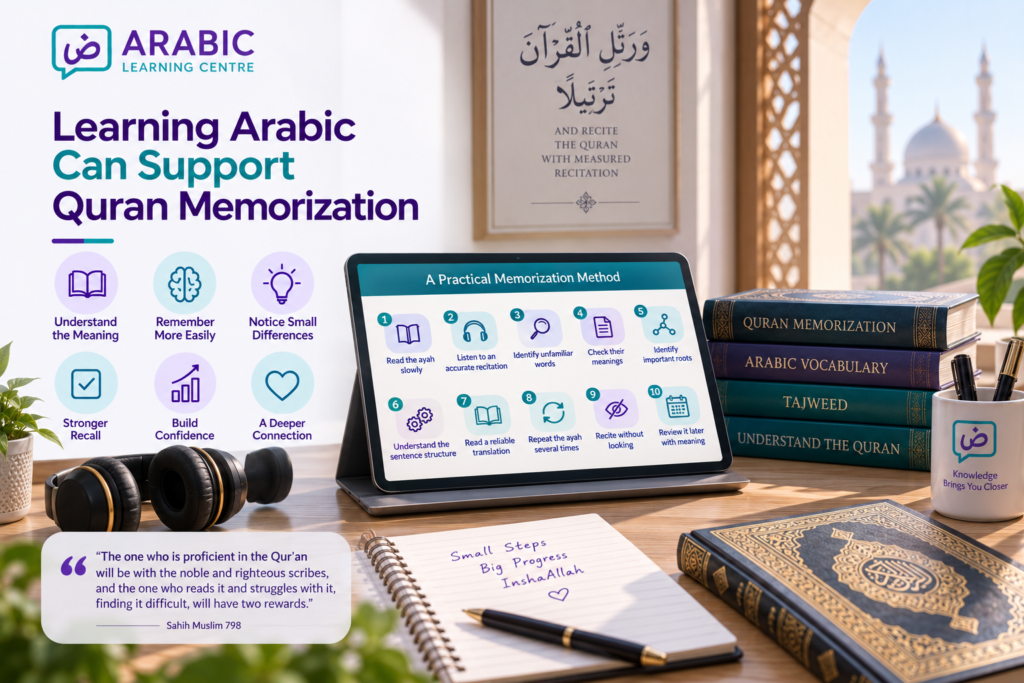
Instead of remembering only pronunciation, the student can remember the progression of meaning and how one phrase connects with the next Arabic knowledge can also help distinguish between similar verses.
Two verses may sound very similar while differing in a pronoun, verb, noun, or grammatical structure. If the learner understands what each verse is communicating, these differences become easier to notice.
A practical memorization method is:
- Read the ayah slowly.
- Listen to an accurate recitation.
- Identify unfamiliar Arabic words.
- Check their meanings.
- Identify important roots.
- Understand the general sentence structure.
- Read a reliable translation.
- Repeat the ayah several times while recalling its meaning.
- Recite without looking.
- Review it later while mentally following the meaning.
The Prophet ﷺ gave special encouragement to those who remain committed to Quran recitation even when it is difficult for them. His teaching provides important reassurance for beginners who find Arabic pronunciation or reading challenging at first.
‘Aishah (may Allah be pleased with her) reported that the Messenger of Allah ﷺ said:
الْمَاهِرُ بِالْقُرْآنِ مَعَ السَّفَرَةِ الْكِرَامِ الْبَرَرَةِ، وَالَّذِي يَقْرَأُ الْقُرْآنَ وَيَتَتَعْتَعُ فِيهِ وَهُوَ عَلَيْهِ شَاقٌّ لَهُ أَجْرَانِ
“The one who is proficient in the Qur’an will be with the noble and righteous scribes, and the one who reads it and struggles with it, finding it difficult, will have two rewards.”
This Hadith is particularly encouraging for non-Arabic speakers. Difficulty at the beginning should not be interpreted as failure. Quran reading and Arabic comprehension develop gradually through consistent practice, correction, and repetition.
10. Arabic Connects Quran Study With Everyday Communication
Not everyone learns Arabic for exactly the same reason One student may primarily want to understand the Quran. Another may want to read Tafsir and Hadith.
Someone else may also want to communicate confidently with Arabic speakers, travel, study in an Arabic-speaking country, or use the language professionally.
These goals can complement one another Quranic and Classical Arabic develop textual understanding, while conversational Arabic develops listening, speaking, and spontaneous communication.
For learners who want Arabic to become an active language rather than something they encounter only during study, an Arabic Speaking Course can complement Quran-focused learning by building practical vocabulary, listening ability, and conversational confidence.

The important point is to distinguish your goals If Quran comprehension is the priority, Classical Arabic deserves particular attention. If communication is also important, speaking and listening can be developed alongside it.
How to Start Learning Arabic for Quran Understanding?
Recognizing the importance of Arabic language in Quran is the first step. The next is turning that motivation into a practical learning plan.
You do not need to begin with advanced grammar or large vocabulary lists. A gradual progression is more manageable and gives you opportunities to apply what you learn directly to Quranic passages.
1. Learn the Arabic Alphabet and How Letters Connect in Words
Start by recognizing all Arabic letters and their different forms. Arabic letters may appear differently depending on whether they occur independently or at the beginning, middle, or end of a word.
Focus first on accurate recognition and pronunciation rather than reading speed. Your goal at this stage is to identify letters confidently and understand how they connect to form complete Arabic words.
2. Learn Harakat to Read Arabic Words With the Correct Vowels
Once you recognize the letters, learn the main signs that determine how Arabic words are pronounced:
- Fatha (َ)
- Kasra (ِ)
- Damma (ُ)
- Sukoon (ْ)
- Shaddah (ّ)
- Tanween (ً ٍ ٌ)
Understanding these signs allows you to move from identifying individual letters to reading complete Arabic words accurately. They are especially important for beginners reading Quranic Arabic, where changes in vowels can affect pronunciation and meaning.
3. Build a Core Vocabulary of Words That Frequently Appear in the Quran
Once basic reading becomes comfortable, begin learning frequently occurring Quranic words rather than memorizing random vocabulary.
Prioritize useful categories such as:
- common verbs;
- pronouns;
- prepositions;
- conjunctions;
- names and attributes;
- recurring nouns;
- common Quranic expressions.
Because many words appear repeatedly throughout the Quran, building a core Quranic vocabulary can quickly increase the number of words you recognize while reading.
4. Learn Basic Nahw to Understand How Quranic Sentences Are Structured
Nahw, or Arabic syntax, helps you understand how words relate to one another within a sentence.
Begin with foundational concepts rather than attempting advanced grammatical analysis immediately. Learn how to recognize subjects, predicates, verbs, objects, pronouns, prepositions, and basic sentence structures.
The purpose is not simply to memorize grammar terminology. It is to look at a Quranic sentence and gradually understand who is performing an action, what the action is, and how the different words relate to one another.
5. Study Basic Sarf to Recognize How Arabic Words Change Their Form and Meaning
Sarf, or Arabic morphology, explains how words change form while remaining connected to the same underlying root.
It becomes particularly valuable when studying Quranic verbs and vocabulary. By recognizing common morphological patterns, you may be able to identify the root of a word you have never studied before and understand how its particular form contributes to its meaning.
Over time, Sarf makes unfamiliar Quranic vocabulary feel less unfamiliar because you begin recognizing the structures behind the words.
6. Study Common Arabic Roots to Connect Related Quranic Words
Instead of treating every new Quranic word as an isolated piece of vocabulary, begin identifying the roots behind the words you encounter.
Keep a simple list containing:
- the Arabic root;
- its general meaning;
- Quranic words derived from it;
- example verses where those words appear.
As your list grows, you will begin seeing connections between words throughout different Surahs. This creates a vocabulary network rather than a long collection of disconnected definitions.
7. Apply Your Arabic Vocabulary and Grammar to Short Surahs You Already Know
Do not wait until you have completed Arabic grammar before applying what you learn to the Quran. Start with Surahs you already recite regularly.
Surah Al-Fatihah and short Surahs from Juz ‘Amma provide manageable starting points.
For each passage:
- Identify familiar vocabulary.
- Mark new words.
- Find important roots.
- Identify pronouns.
- Examine simple grammar.
- Read a reliable translation.
- Study a concise Tafsir.
- Recite again while following the meaning.
This turns Arabic from a theoretical subject into a practical tool for understanding the Quran.
Read also: Can You Learn Arabic on Babbel? – Best Alternatives for Arabic Learners
8. Progress From Short Surahs to Longer Quranic Passages as Your Understanding Improves
Once short Surahs become easier to understand and analyze, gradually begin working with longer Quranic passages.
Do not expect yourself to understand every word immediately. First identify the vocabulary, roots, and grammatical structures you already recognize before checking unfamiliar words.
This encourages your mind to process as much of the Arabic as possible instead of automatically switching to an English translation whenever you encounter a new verse.
9. Review Quranic Vocabulary and Grammar Regularly to Retain What You Learn
Arabic learning requires repetition. Vocabulary and grammar that are not regularly reviewed can quickly become difficult to recall.
A short period of focused study every day can be more manageable than studying for several hours and then leaving Arabic untouched for days.
Review previously learned vocabulary, revisit Arabic roots, reread familiar passages, and look for grammar rules you have studied in actual Quranic verses. Regular application helps move knowledge from short-term recognition to long-term understanding.
10. Study With a Qualified Teacher to Follow a Structured Quranic Arabic Learning Path
Independent resources can support your Arabic learning, but beginners often struggle to determine what they should learn first and how different areas of the language fit together.
Common questions include:
- What should I study first?
- Which vocabulary is most useful?
- Am I pronouncing this correctly?
- Which grammar rules matter at my level?
- How do I apply grammar to the Quran?
- When should I begin reading classical texts?
Structured instruction removes much of this uncertainty. A teacher can organize vocabulary, reading, Nahw, Sarf, and Quranic application according to your current ability rather than expecting you to build the learning sequence yourself.
For complete beginners, an Arabic Course for Non-Arabic Speakers can provide a structured starting point and help learners progress gradually from basic Arabic reading toward stronger comprehension.

Don’t Just Take Our Word For It
Take a look inside our vibrant classes and see our students and teachers in action. Click below to watch our classroom experience:
Start Your Arabic Learning Journey With Arabic Learning Centre
Understanding the importance of Arabic language in Quran is only the beginning.
With Arabic Learning Centre, you can follow a structured learning path that helps you build vocabulary, strengthen grammar, and develop the Arabic skills needed to understand the Quran and classical Islamic texts with greater confidence.
Whether you are starting from the basics or want to take your Arabic to a deeper level, the academy offers courses suited to different learning goals, including Classical Arabic, Arabic for non-native speakers, and practical speaking skills.
With guided learning and regular practice, you can gradually turn what you learn into real understanding.
Start with a free trial and take your first step toward understanding Arabic with confidence.
Courses We Offer:
- Quranic Arabic Course
- Arabic Course for Islamic Studies
- Learn Arabic for New Muslims
- Learn Arabic Letters for Tajweed
- Al Azhar Arabic Course
- Madinah Arabic Course
- Online Arabic Classes for Kids
- Arabic Words Course for Kids
- Arabic Lessons for Kindergarten
- Arabic Elementary School
- Arabic Intermediate School
- Arabic High School

Conclusion
The importance of Arabic language in Quran lies in the direct relationship between Arabic and revelation. The Quran was revealed in Arabic, and its vocabulary, grammatical structures, rhetorical features, and patterns of expression are inseparable from that language.
Translations remain valuable and necessary resources for millions of Muslims, but Arabic study gives learners an opportunity to move progressively closer to the original wording.
You do not have to wait until you are fluent to experience that benefit.
Learning the meaning of Al-Fatihah is progress. Recognizing a recurring Quranic root is progress. Understanding a sentence without checking the translation is progress. Following the meaning while reciting a familiar Surah is progress.
The Prophet ﷺ gave Muslims a powerful reason to continue this learning journey when he said:
خَيْرُكُمْ مَنْ تَعَلَّمَ الْقُرْآنَ وَعَلَّمَهُ
“The best among you are those who learn the Qur’an and teach it.”
This Hadith places Quran learning in a position of great virtue. For non-Arabic speakers, studying Arabic can become part of that lifelong process—not as an end in itself, but as a practical tool for reading with greater understanding, studying with greater depth, and developing a closer relationship with the words of the Quran.
Frequently Asked Questions
What Is the Importance of Arabic Language in Quran?
The importance of Arabic language in Quran begins with the fact that Arabic is the original language of revelation. Allah describes the Quran explicitly as Arabic:
إِنَّآ أَنزَلْنَـٰهُ قُرْءَٰنًا عَرَبِيًّۭا لَّعَلَّكُمْ تَعْقِلُونَ
“Indeed, We have sent it down as an Arabic Quran so that you may understand.”
Surah Yusuf, 12:2
Learning Arabic allows students to recognize the Quran’s vocabulary, roots, grammar, and linguistic patterns directly instead of encountering all of these features exclusively through translation.
Do I Need to Learn Arabic to Understand the Quran?
Translations allow non-Arabic speakers to understand the general meanings of Quranic verses and remain extremely useful resources.
Arabic becomes important when you want to explore the original vocabulary, grammatical relationships, rhetorical features, and multiple shades of meaning contained in the Arabic text.
The two can therefore work together: translations support understanding while Arabic study gradually provides greater access to the original.
What Type of Arabic Should I Learn to Understand the Quran?
Classical or Quranic Arabic should be prioritized if Quran comprehension is your main goal.
Focus on common Quranic vocabulary, roots, basic Nahw, Sarf, pronouns, particles, and sentence structures before progressing toward advanced classical texts.
Is Quranic Arabic Different From Spoken Arabic?
Yes, although both belong to Arabic.
Quranic Arabic refers to the classical language of the Quran, while everyday spoken Arabic includes numerous regional dialects.
Someone primarily interested in understanding the Quran should prioritize Classical Arabic. Someone who also wants to communicate comfortably with Arabic speakers can study conversational Arabic alongside it.
Can a Complete Beginner Learn Quranic Arabic?
Yes. Beginners can progress through a structured sequence:
Alphabet → Harakat → reading → Quranic vocabulary → roots → basic grammar → short Surahs → longer passages.
There is no requirement to master advanced grammar before beginning to understand simple Quranic expressions.
Does Learning Arabic Help With Quran Memorization?
Arabic comprehension can support memorization because verses become meaningful sequences rather than unfamiliar sounds.
Understanding vocabulary and sentence structure can also help learners distinguish between similar passages and remember what comes next through meaning as well as sound.
Related Articles
Arabic Grammar