 Learn Arabic
Learning how to use a preposition in Arabic is essential if you want to build accurate sentences and understand how Arabic grammar works.
Arabic prepositions, known as حروف الجر (Huruf al-Jarr), connect nouns and pronouns with other parts of a sentence and express relationships such as place, direction, time, possession, cause, and comparison.
However, Arabic prepositions do more than simply connect words. A preposition affects the grammatical case of the noun that follows it, making that noun Majroor (مجرور), or genitive.
This is one of the major differences learners need to understand when moving beyond basic Arabic vocabulary and beginning to form complete sentences.
In this guide, you will learn the most important prepositions in Arabic, their meanings, how they affect nouns, the answer to what are the 17 prepositions in Arabic, and how to use them naturally through clear examples.
What Is a Preposition in Arabic?
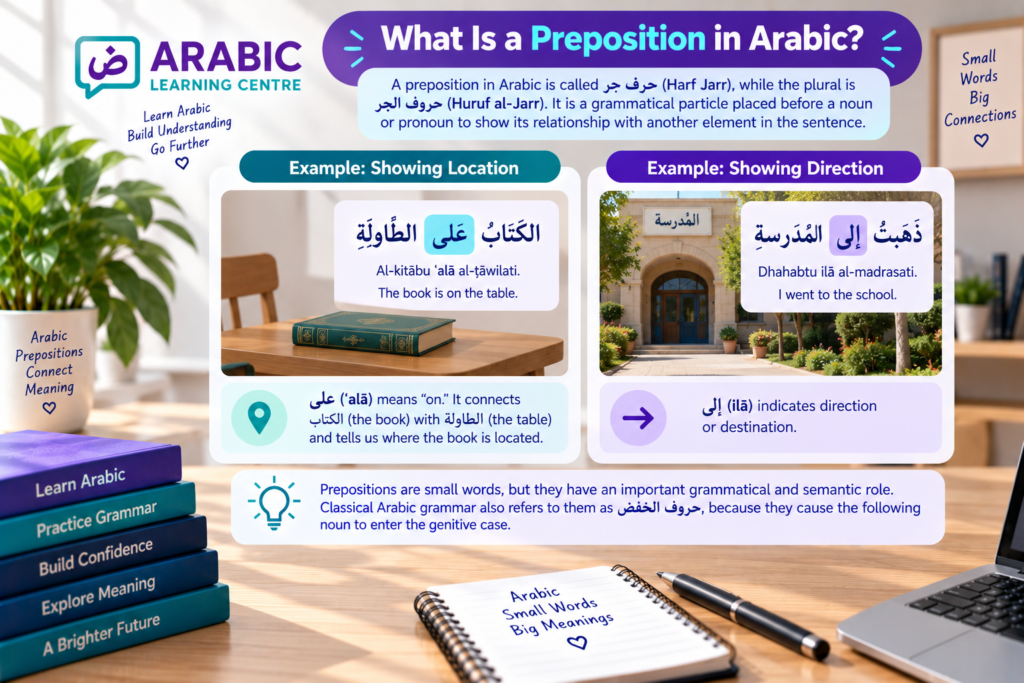
A preposition in Arabic is called حرف جر (Harf Jarr), while the plural is حروف الجر (Huruf al-Jarr). It is a grammatical particle placed before a noun or pronoun to show its relationship with another element in the sentence.
For example:
الكتابُ على الطاولةِ
Al-kitābu ʿalā al-ṭāwilati.
The book is on the table.
Here, على (ʿalā) means “on.” It connects الكتاب (the book) with الطاولة (the table) and tells us where the book is located.
Another example is:
ذهبتُ إلى المدرسةِ
Dhahabtu ilā al-madrasati.
I went to the school.
The preposition إلى (ilā) indicates direction or destination.
Prepositions are therefore small words, but they have an important grammatical and semantic role. Classical Arabic grammar also refers to them as حروف الخفض, because they cause the following noun to enter the genitive case.
Why Are Arabic Prepositions Called Huruf al-Jarr?
The Arabic term جرّ (jarr) refers to the genitive grammatical state caused by these particles. When a preposition comes before a noun, the noun becomes اسمًا مجرورًا (isman majrooran).
Consider:
في البيتِ
Fi al-bayti
In the house
The word البيت follows the preposition في, so it becomes Majroor and normally takes a Kasra (ـِ) at the end: البيتِ.
This grammatical effect is fundamental to Arabic sentence structure. It means that learning prepositions is not only about memorizing translations such as “in,” “from,” or “to.” You also need to understand how the words following those prepositions change.
How Many Prepositions Are There in Arabic?
You may find different answers to this question depending on the grammar book and the way Arabic prepositions are classified.
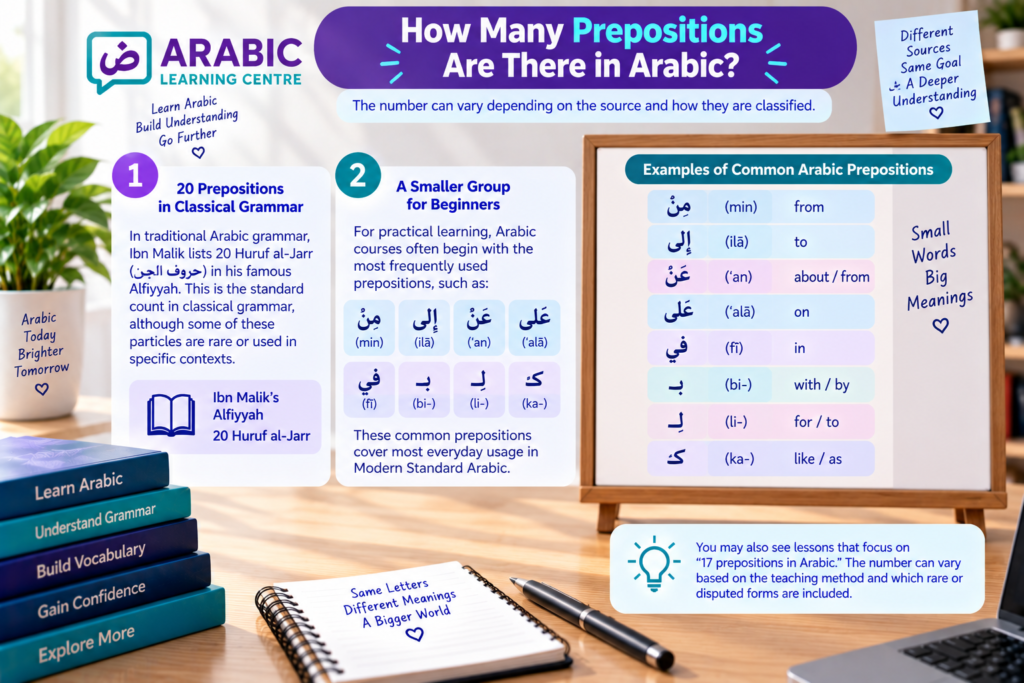
In traditional Arabic grammar, Ibn Malik lists 20 Huruf al-Jarr (حروف الجر) in his famous Alfiyyah. This broader classical list includes some particles that are rare, restricted to particular usages, or not commonly encountered by beginners in Modern Standard Arabic.
For practical learning, Arabic courses often begin with a smaller group of frequently used prepositions such as مِنْ (min), إِلَى (ilā), عَنْ (‘an), عَلَى (‘alā), فِي (fī), بِـ (bi-), لِـ (li-), and كَـ (ka-) before introducing less common classical forms.
This is why you may come across lessons or searches asking “what are the 17 prepositions in Arabic?”
The number can vary according to the teaching method and which rare or disputed forms are included. If you are studying traditional Arabic grammar, however, 20 is the standard count given in Ibn Malik’s Alfiyyah.
Students who want to strengthen their formal Arabic can explore the Fusha Arabic Course at Arabic Learning Centre.
Studying Fusha in a structured setting can help learners connect grammar rules such as Huruf al-Jarr with vocabulary, reading, sentence formation, and practical communication.

What Are the 17 Prepositions in Arabic?
For learners looking specifically for what are the 17 prepositions in Arabic, the following 17 provide a useful study list covering the major and several classical Huruf al-Jarr:
| Arabic | Transliteration | Common Meaning | |
| 1 | مِن | min | from, of |
| 2 | إلى | ilā | to, toward |
| 3 | عن | ʿan | about, away from |
| 4 | على | ʿalā | on, upon |
| 5 | في | fī | in, at |
| 6 | الباء / بِـ | bi | with, by, through |
| 7 | اللام / لِـ | li | for, to |
| 8 | الكاف / كَـ | ka | like, as |
| 9 | حتى | ḥattā | until, up to |
| 10 | مُذ | mudh | since |
| 11 | مُنذ | mundhu | since |
| 12 | رُبَّ | rubba | perhaps/many a |
| 13 | واو القسم / وَ | wa | by, for an oath |
| 14 | تاء القسم / تَ | ta | by, for an oath |
| 15 | خلا | khalā | except |
| 16 | عدا | ʿadā | except |
| 17 | حاشا | ḥāshā | except |
Learners should remember that this is a practical 17-item study set rather than the only possible classical enumeration. More extensive grammar lists may additionally include كي، متى، لعلّ, and some treatments discuss other rare constructions.
If your main goal is everyday Arabic, you do not need to memorize every rare form immediately. Start with من، إلى، عن، على، في، ب، ل، ك, then expand your knowledge as your grammar becomes stronger.
The Most Common Prepositions in Arabic
Although classical grammar contains a relatively long list, a handful of prepositions in Arabic appear constantly in ordinary speech and writing.
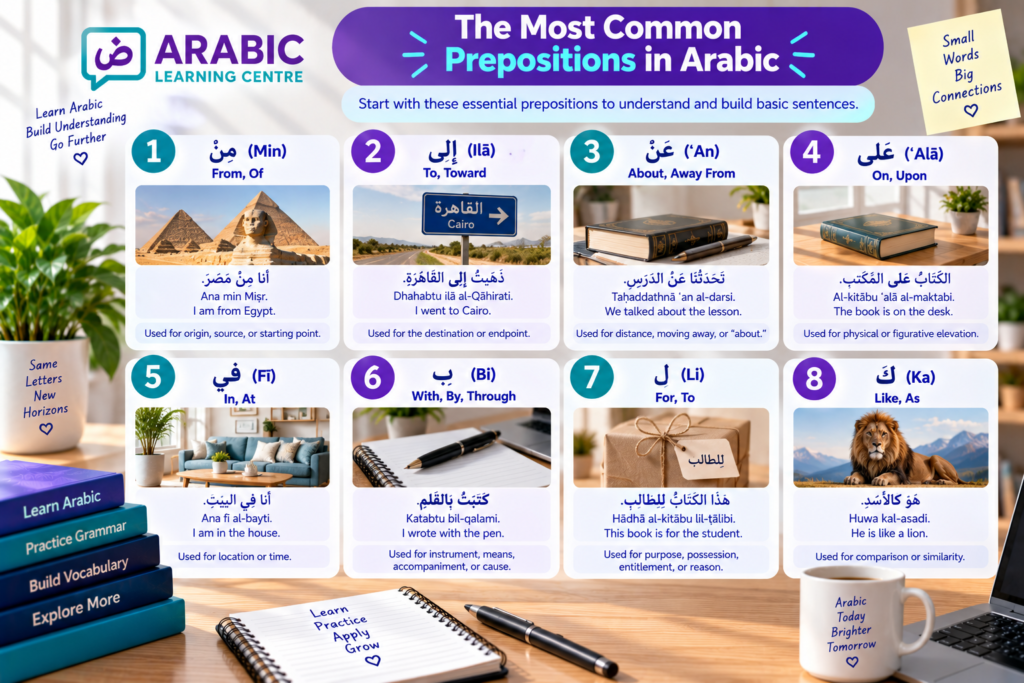
Mastering these first makes it much easier to understand basic sentences.
1. مِن (Min) — From, Of
مِن is one of the most frequently used Arabic prepositions. Its basic meaning is “from,” particularly when describing the starting point, origin, or source of something.
أنا من مصرَ.
Ana min Miṣr.
I am from Egypt.
خرجتُ من البيتِ.
Kharajtu min al-bayti.
I left the house.
It can also indicate part of a whole:
شربتُ من الماءِ.
Sharibtu min al-māʾi.
I drank some of the water.
In more advanced Arabic, من can express several other meanings, including cause, explanation, substitution, and emphasis. Its exact translation therefore depends on context.
2. إلى (Ilā) — To, Toward
إلى generally indicates the endpoint of movement, direction, or time.
ذهبتُ إلى السوقِ.
Dhahabtu ilā al-sūqi.
I went to the market.
سافرتُ إلى القاهرةِ.
Safartu ilā al-Qāhirati.
I traveled to Cairo.
It can also mark the endpoint of a period:
عملتُ إلى المساءِ.
ʿAmiltu ilā al-masāʾi.
I worked until the evening.
For beginners, remembering من = from and إلى = to provides a useful pair for expressing movement.
3. عن (ʿAn) — About, Away From
The core meaning of عن involves distance or moving away, but in everyday Arabic it frequently corresponds to the English word “about.”
تحدثنا عن الدرسِ.
Taḥaddathnā ʿan al-darsi.
We talked about the lesson.
المدرسة بعيدة عن البيتِ.
Al-madrasatu baʿīdatun ʿan al-bayti.
The school is far from the house.
It can also occur with verbs whose natural English translation may use a different structure, which is why learners should study Arabic verb-preposition combinations together.
4. على (ʿAlā) — On, Upon
The most familiar meaning of على is physical or figurative elevation.
الكتاب على المكتبِ.
Al-kitābu ʿalā al-maktabi.
The book is on the desk.
جلستُ على الكرسيِّ.
Jalastu ʿalā al-kursiyyi.
I sat on the chair.
Its meaning is not limited to physical location. Depending on context, على can also indicate obligation, cause, accompaniment, or other abstract relationships.
5. في (Fī) — In, At
في is extremely common and primarily expresses location or time.
أنا في البيتِ.
Ana fī al-bayti.
I am in the house.
الطلاب في الفصلِ.
Al-ṭullābu fī al-faṣli.
The students are in the classroom.
It is also commonly used with time expressions:
في الصباحِ
Fī al-ṣabāḥi
In the morning
في الليلِ
Fī al-layli
At night
This is especially important for English speakers because Arabic does not always divide “in,” “on,” and “at” in the same way English does.
6. بِـ (Bi) — With, By, Through
Unlike في or إلى, the preposition بِـ attaches directly to the following word.
كتبتُ بالقلمِ.
Katabtu bil-qalami.
I wrote with the pen.
Here, بِـ expresses the instrument used to perform the action.
It can also express cause, accompaniment, means, oath, and several other relationships. Because of its wide range of meanings, translating بِـ with the same English word every time can lead to mistakes.
7. لِـ (Li) — For, To
The preposition لِـ also attaches to the following noun.
هذا الكتابُ للطالبِ.
Hādhā al-kitābu lil-ṭālibi.
This book is for the student.
It frequently expresses possession, purpose, entitlement, or reason.
سافرتُ للدراسةِ.
Safartu lil-dirāsati.
I traveled to study / for study.
This preposition becomes especially useful as learners begin creating longer sentences involving purpose and relationships between people and objects.
8. كَـ (Ka) — Like, As
كَـ is commonly used for comparison or similarity and is attached directly to the following noun.
هو كالأسدِ.
Huwa kal-asadi.
He is like a lion.
أبيض كالثلجِ.
Abyaḍu kal-thalji.
White like snow.
The basic idea behind كَـ is resemblance, although Classical Arabic grammar records additional uses in particular contexts.
Read also: Arabic Alphabet with Fatha Kasra and Damma
Inside Our Classrooms
See how we make learning interactive and engaging! Watch a quick snippet of our live, conversational classes in action:
Other Important Arabic Prepositions
Once you are comfortable with the common prepositions above, you can begin learning forms that occur less frequently or have more specialized functions.
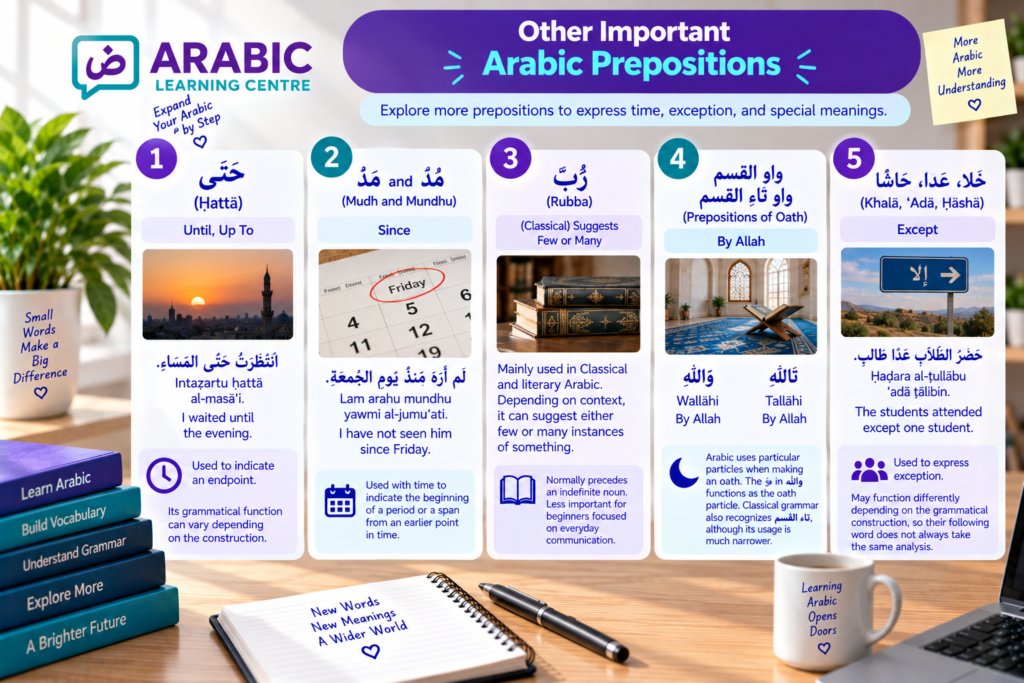
حتى (Ḥattā) — Until, Up To
حتى commonly indicates an endpoint.
انتظرتُ حتى المساءِ.
Intaẓartu ḥattā al-masāʾi.
I waited until the evening.
Its grammatical function can vary depending on the construction, so advanced learners should not assume that every occurrence of حتى functions identically.
مُذ and مُنذ (Mudh and Mundhu) — Since
These forms are associated particularly with time.
لم أرَه منذ يومِ الجمعةِ.
Lam arahu mundhu yawmi al-jumuʿati.
I have not seen him since Friday.
They can indicate the beginning of a period or a span extending from an earlier point in time.
رُبَّ (Rubba)
رُبَّ is mainly associated with Classical and literary Arabic. Depending on context, it can suggest either few or many instances of something.
It normally precedes an indefinite noun and is much less important for a beginner interested primarily in everyday communication than common prepositions such as في، من، إلى، على.
واو القسم and تاء القسم — Prepositions of Oath
Arabic uses particular particles when making an oath.
For example:
واللهِ
Wallāhi
By Allah
تاللهِ
Tallāhi
By Allah
The و in والله functions as the oath particle. Classical grammar also recognizes تاء القسم, although its usage is much narrower.
خلا، عدا، حاشا — Except
These three forms can be used to express exception.
حضر الطلاب عدا طالبٍ.
Ḥaḍara al-ṭullābu ʿadā ṭālibin.
The students attended except one student.
An important advanced point is that خلا، عدا، حاشا may function differently depending on the grammatical construction, so their following word does not always take the same analysis.
For female learners looking for a dedicated learning option, Arabic Learning Centre also offers an Arabic Course for Ladies, providing another pathway to develop Arabic skills systematically.

What Happens to a Noun After a Preposition in Arabic?
One of the most important rules to remember is that a noun governed by a preposition becomes Majroor (مجرور). However, the grammatical sign of Jarr (الجر) is not always the same; it depends on the type of noun.
1. A Singular Noun Usually Takes a Kasra
A singular noun normally takes a Kasra (ـِ) when it comes after a preposition.
فِي الْبَيْتِ (fī al-bayti) — in the house
Here, الْبَيْتِ is Majroor because it follows the preposition فِي, and its sign of Jarr is the visible Kasra.
2. A Sound Feminine Plural Takes a Kasra
A sound feminine plural (جمع المؤنث السالم) also takes a Kasra when it is Majroor.
إِلَى الْمُعَلِّمَاتِ (ilā al-muʿallimāti) — to the female teachers
Here, الْمُعَلِّمَاتِ is Majroor because it follows إِلَى, and its sign of Jarr is the Kasra.
3. A Dual Noun Takes Yaa
A dual noun (المثنى) is marked with Yaa (ياء) when it is Majroor.
عَلَى الْكُرْسِيَّيْنِ (ʿalā al-kursiyyayni) — on the two chairs
Here, الْكُرْسِيَّيْنِ is Majroor because it follows عَلَى, and its sign of Jarr is the Yaa.
4. A Sound Masculine Plural Takes Yaa
A sound masculine plural (جمع المذكر السالم) is also marked with Yaa when it is Majroor.
مَرَرْتُ بِالْمُعَلِّمِينَ (marartu bil-muʿallimīna) — I passed by the teachers
Here, الْمُعَلِّمِينَ is Majroor because it follows بِـ, and its sign of Jarr is the Yaa.
5. Certain Diptotes Take Fatha
Some Arabic nouns known as الممنوع من الصرف (al-mamnūʿ min al-ṣarf) take a Fatha (ـَ) instead of a Kasra when they are Majroor, provided that the conditions requiring Fatha are present.
This is a more advanced rule, so beginners should first become comfortable recognizing the basic relationship:
Preposition + Majroor noun
Once this becomes familiar, it is easier to study the different signs of Jarr and the special rules that apply to particular types of Arabic nouns.
Read also: Can You Learn Arabic on Babbel? – Best Alternatives for Arabic Learners
Attached and Detached Prepositions in Arabic
Another useful way to understand prepositions in Arabic is to divide them according to how they are written.
Detached Prepositions
These are written separately from the following noun.
Examples include:
- من — from
- إلى — to
- عن — about/from
- على — on
- في — in
- حتى — until
- منذ — since
For example:
من البيتِ — from the house
إلى المدرسةِ — to the school
في الغرفةِ — in the room
Attached Prepositions
Some Arabic prepositions consist of a single letter and attach directly to the following word.
The most important examples are:
- بِـ — with/by
- لِـ — for/to
- كَـ — like/as
For example:
بالقلمِ — with the pen
للطالبِ — for the student
كالأسدِ — like a lion
Recognizing these attached forms is particularly important when reading Arabic because beginners may mistakenly think the preposition is part of the noun itself.
The Three Types of Prepositions in Arabic Grammar
In classical Arabic grammar, Huruf al-Jarr (حروف الجر) can be divided into three types according to their grammatical role: original, additional, and quasi-additional prepositions.
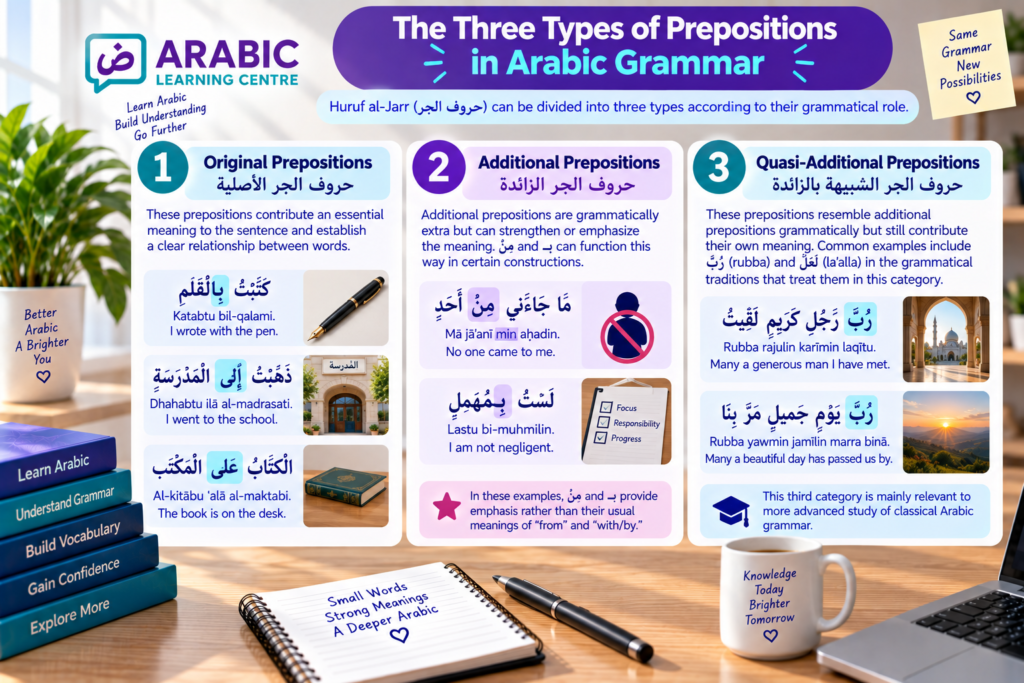
1. Original Prepositions — حروف الجر الأصلية
These prepositions contribute an essential meaning to the sentence and establish a clear relationship between words.
كَتَبْتُ بِالْقَلَمِ (katabtu bil-qalami) — I wrote with the pen.
ذَهَبْتُ إِلَى الْمَدْرَسَةِ (dhahabtu ilā al-madrasati) — I went to the school.
الْكِتَابُ عَلَى الْمَكْتَبِ (al-kitābu ‘alā al-maktabi) — The book is on the desk.
2. Additional Prepositions — حروف الجر الزائدة
Additional prepositions are grammatically extra but can strengthen or emphasize the meaning. مِنْ and بِـ can function this way in certain constructions.
مَا جَاءَنِي مِنْ أَحَدٍ (mā jā’anī min aḥadin) — No one came to me.
لَسْتُ بِمُهْمِلٍ (lastu bi-muhmilin) — I am not negligent.
In these examples, مِنْ and بِـ provide emphasis rather than their usual meanings of “from” and “with/by.”
3. Quasi-Additional Prepositions — حروف الجر الشبيهة بالزائدة
These prepositions resemble additional prepositions grammatically but still contribute their own meaning. Common examples include رُبَّ (rubba) and لَعَلَّ (la‘alla) in the grammatical traditions that treat them in this category.
رُبَّ رَجُلٍ كَرِيمٍ لَقِيتُ (rubba rajulin karīmin laqītu) — Many a generous man I have met.
رُبَّ يَوْمٍ جَمِيلٍ مَرَّ بِنَا (rubba yawmin jamīlin marra binā) — Many a beautiful day has passed us by.
This third category is mainly relevant to more advanced study of classical Arabic grammar.
Prepositions of Place in Arabic
Arabic uses several prepositions to describe where something is located.
في — In
الهاتف في الحقيبةِ.
Al-hātifu fī al-ḥaqībati.
The phone is in the bag.
على — On
الكوب على الطاولةِ.
Al-kūbu ʿalā al-ṭāwilati.
The cup is on the table.
من — From
خرج من المدرسةِ.
Kharaja min al-madrasati.
He left the school.
إلى — To
ذهب إلى المسجدِ.
Dhahaba ilā al-masjidi.
He went to the mosque.
Learning these four together gives beginners a practical foundation for describing location and movement.
Prepositions of Time in Arabic
Some of the same prepositions used for location can also express time.
في — In/At
في الصباحِ
In the morning
في المساءِ
In the evening
منذ — Since
منذ أسبوعٍ
Since a week ago / for a week, depending on context
حتى — Until
حتى المساءِ
Until the evening
This demonstrates why memorizing a single English translation for each preposition in Arabic is not enough. Context determines the intended meaning.
Read also: The Importance of Arabic Language in Quran – 10 Reasons
Common Mistakes When Using Prepositions in Arabic
Arabic learners may know the meanings of individual prepositions but still make mistakes when using them in complete sentences. Here are some of the most common ones.
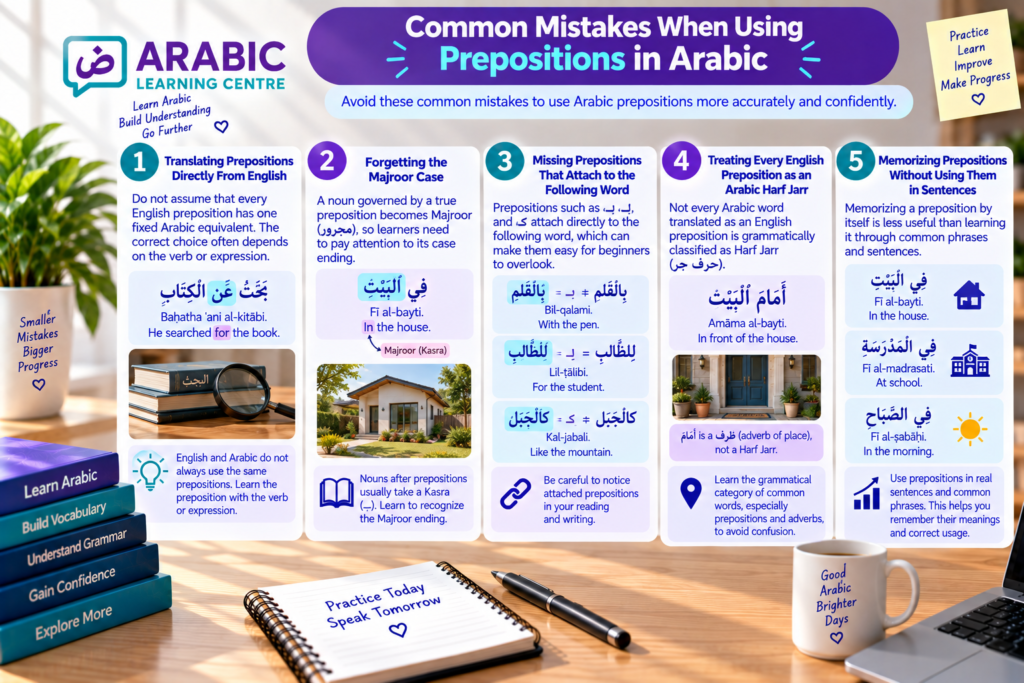
1. Translating Prepositions Directly From English
Do not assume that every English preposition has one fixed Arabic equivalent. The correct choice often depends on the verb or expression.
For example:
بَحَثَ عَنِ الْكِتَابِ (baḥatha ‘ani al-kitābi) — He searched for the book.
Here, English uses “for,” while Arabic uses عَنْ (‘an).
2. Forgetting the Majroor Case After a Preposition
A noun governed by a true preposition becomes Majroor (مجرور), so learners need to pay attention to its case ending.
فِي الْبَيْتِ (fī al-bayti) — in the house
Here, الْبَيْتِ takes a Kasra because it follows فِي.
3. Missing Prepositions That Attach to the Following Word
Prepositions such as بِـ، لِـ، and كَـ attach directly to the following word, which can make them easy for beginners to overlook.
بِالْقَلَمِ = بِـ + الْقَلَمِ — with the pen
لِلطَّالِبِ = لِـ + الطَّالِبِ — for the student
4. Treating Every English Preposition as an Arabic Harf Jarr
Not every Arabic word translated as an English preposition is grammatically classified as Harf Jarr (حرف جر).
For example, أَمَامَ الْبَيْتِ (amāma al-bayti) — in front of the house uses أَمَامَ, which functions as a ظرف rather than a Harf Jarr.
5. Memorizing Prepositions Without Using Them in Sentences
Memorizing فِي (fī) — in by itself is less useful than learning it through common phrases and sentences.
For example: فِي الْبَيْتِ — in the house, فِي الْمَدْرَسَةِ — at school, and فِي الصَّبَاحِ — in the morning.
Learning prepositions in context makes it easier to remember both their meanings and their correct grammatical use.
How to Learn Arabic Prepositions More Easily?
Start with the most common Arabic prepositions you are likely to encounter, such as فِي، مِنْ، إِلَى، عَلَى، عَنْ، بِـ، لِـ، and كَـ. Practice each one in one or two simple sentences while paying attention to the noun that follows it and how its ending changes.
Once these become familiar, you can gradually introduce less frequent particles and classical forms such as حَتَّى، مُنْذُ، مُذْ، and رُبَّ.
It is also helpful to learn prepositions together with the verbs and expressions that commonly use them. Instead of memorizing each word separately, learn combinations such as:
- فَكَّرَ فِي (fakkara fī) — to think about
- بَحَثَ عَنْ (baḥatha ‘an) — to search for
- ذَهَبَ إِلَى (dhahaba ilā) — to go to
- خَرَجَ مِنْ (kharaja min) — to go out of / leave
Learning these combinations as complete units helps you recognize natural Arabic usage and reduces the need to translate each preposition directly from English.
For very young learners who are beginning with Arabic vocabulary and simple sentence structures, the Arabic Course for Kindergarten at Arabic Learning Centre provides an age-appropriate way to build familiarity with the language from an early stage.

Don’t Just Take Our Word For It
Take a look inside our vibrant classes and see our students and teachers in action. Click below to watch our classroom experience:
Learn Arabic Prepositions in Context With Arabic Learning Centre
Knowing the rules of Arabic prepositions is useful, but using them correctly in real sentences requires regular practice with grammar, vocabulary, reading, and conversation.
At Arabic Learning Centre, you can develop these skills through structured Arabic lessons that help you understand grammar in context rather than simply memorizing rules.
You can practice common Huruf al-Jarr, recognize the Majroor forms that follow them, and become more confident using natural Arabic sentence patterns.
With guided practice, you can also learn how prepositions work with different verbs and expressions, avoid common translation mistakes, and apply grammatical rules naturally when speaking, reading, and writing. This helps turn concepts such as Harf Jarr and Majroor from rules you memorize into patterns you can recognize and use confidently.
Book your free trial lesson with Arabic Learning Centre and start learning Arabic with structured guidance.
Courses We Offer:
- Business Arabic Course
- Learn Arabic from Zero
- Medical Arabic Course
- Learning Arabic for Non Arabic Speakers
- Learn Arabic in Saudi Arabia
- Learn to Read Arabic Course
- Arabic Grammar Course
- Arabic Speaking Course
- Arabic Script writing course
- Arabic Vocabulary Course
- Arabic Pronunciation Course

Conclusion
Understanding a preposition in Arabic means learning much more than a list of translations. Huruf al-Jarr connect different parts of a sentence, express relationships such as place, direction, time, cause, and comparison, and directly affect the grammatical case of the noun that follows them.
Beginners should focus first on high-frequency prepositions in Arabic such as في، من، إلى، على، عن، ب، ل، ك and practice them in complete phrases. Once those patterns become natural, you can move on to less common and more classical forms.
And if you are wondering what are the 17 prepositions in Arabic, remember that 17 is a useful learning set rather than the only possible total. Classical grammatical traditions may count 20 or 21 depending on which rare and dialect-specific particles are included.
The most effective way to master them is therefore not to memorize numbers alone, but to see each preposition repeatedly in meaningful Arabic sentences, understand how it affects the noun after it, and practice using it in real communication.
FAQs About Prepositions in Arabic
What Is a Preposition in Arabic?
A preposition in Arabic is called حرف جر (Harf Jarr). It is a particle that comes before a noun or pronoun and expresses a relationship such as location, direction, time, cause, possession, or comparison. It also causes the noun it governs to become Majroor.
What Are the Most Common Prepositions in Arabic?
Some of the most common Arabic prepositions are:
مِن (min) — from
إلى (ilā) — to
عن (ʿan) — about/from
على (ʿalā) — on
في (fī) — in
بِـ (bi) — with/by
لِـ (li) — for/to
كَـ (ka) — like/as
These are excellent prepositions for beginners to learn first.
What Are the 17 Prepositions in Arabic?
A practical list of 17 prepositions in Arabic is:
من، إلى، عن، على، في، الباء، اللام، الكاف، حتى، مذ، منذ، رُبّ، واو القسم، تاء القسم، خلا، عدا، حاشا.
However, classical grammar books may provide a broader list and include rare or dialect-specific forms such as كي، متى، ولعلّ. This is why different resources may give different totals.
What Happens After a Preposition in Arabic?
The noun governed by an Arabic preposition becomes Majroor (مجرور). A singular noun commonly shows this with a Kasra, while dual nouns and sound masculine plurals have different genitive endings.
For example:
في المدرسةِFī al-madrasatiIn the school
The word المدرسةِ is Majroor because it follows في.
Can an Arabic Preposition Have More Than One Meaning?
Yes. Many Arabic prepositions have several meanings depending on context. بِـ, for example, can express instrument, cause, accompaniment, and other relationships. من can express origin, beginning, part of a whole, cause, and other meanings.
This is why learning prepositions through complete sentences is more effective than memorizing a single English translation.
Do Arabic Prepositions Come Before or After the Noun?
Arabic Huruf al-Jarr come before the nouns or pronouns they govern. Some are written separately, such as في البيت, while single-letter prepositions such as بِـ، لِـ، كَـ attach directly to the following word.