 Learn Arabic
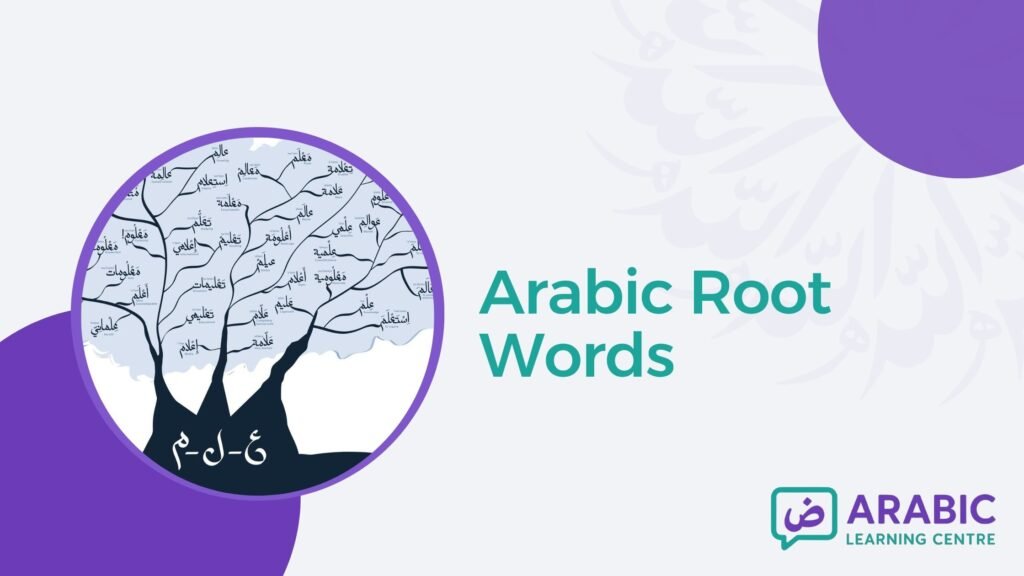
Arabic may seem like a language with an enormous number of separate words to memorize, but many of those words are actually connected through a highly organized system. At the center of that system are Arabic root words.
A root contains the original letters that carry the basic meaning from which a family of related words can be formed.
Once you learn to recognize these roots, unfamiliar Arabic vocabulary becomes much easier to analyze. Instead of treating every new word as an isolated item, you can begin connecting it to words you already know.
For example, the words عِلْم (‘ilm – knowledge), عَالِم (‘ālim – scholar), مَعْلُوم (ma‘lūm – known), and اِسْتِعْلَام (isti‘lām – inquiry) are different in form and use, but they share the root:
ع ل م — ‘Ayn – Lām – Mīm
This root is associated broadly with knowledge and knowing. Understanding this system is one of the most useful steps for learners who want to expand their vocabulary, improve reading comprehension, use dictionaries more effectively, and develop a deeper understanding of Arabic morphology.
What Are Arabic Root Words?
Arabic root words are the basic lexical foundations from which groups of related words are derived. The root consists of the original consonants of a word before additional letters, prefixes, suffixes, or morphological changes are taken into account.
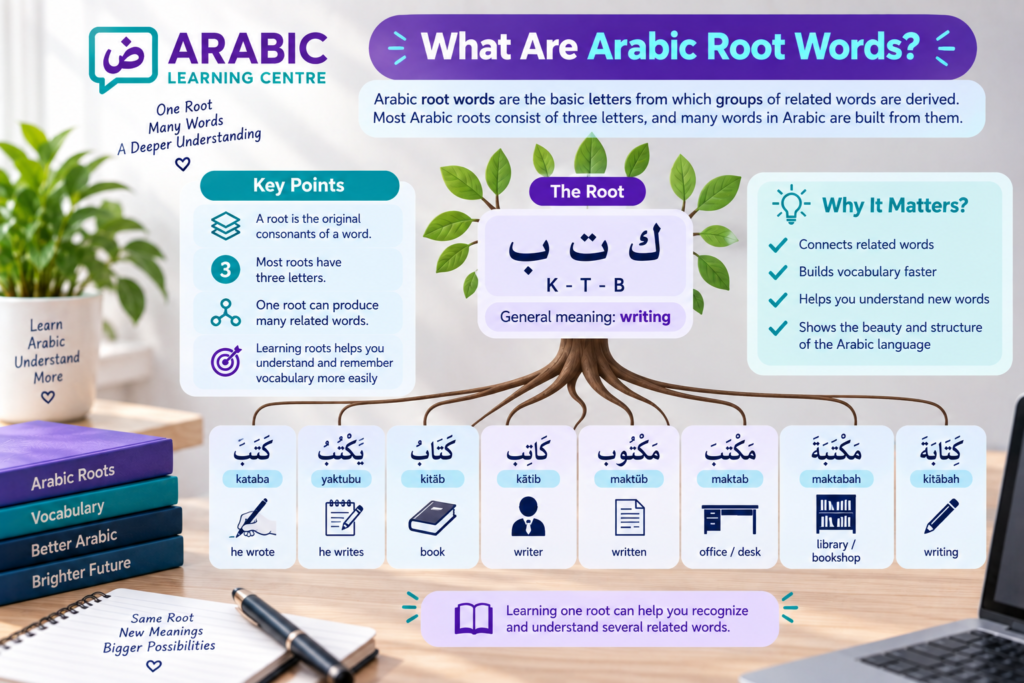
Most Arabic roots consist of three root letters, although Arabic also contains four-letter roots and some less common longer roots.
The three-letter root is particularly important because a very large part of Arabic vocabulary is organized around triliteral roots.
Consider the root: ك ت ب — K-T-B
Its general semantic field is connected with writing.
From these Arabic root letters, Arabic can produce several related words:
- كَتَبَ (kataba) — he wrote
- يَكْتُبُ (yaktubu) — he writes
- كِتَاب (kitāb) — book
- كَاتِب (kātib) — writer
- مَكْتُوب (maktūb) — written
- مَكْتَب (maktab) — office/desk
- مَكْتَبَة (maktabah) — library/bookshop
- كِتَابَة (kitābah) — writing
These words do not all mean the same thing. However, they belong to a related semantic family because they share the same underlying root.
This is what makes Arabic roots so valuable for learners: learning one root can help you recognize and understand several related words.
What Are Arabic Root Letters?
Arabic root letters are the original letters that remain at the core of a word and carry its fundamental lexical meaning.
In a regular triliteral root, there are three original consonants. Arabic morphology traditionally represents these positions with:
ف — ع — ل
Together, they form the model:
فَعَلَ (fa‘ala)
These letters do not mean that every Arabic word contains ف, ع, and ل. They are placeholders representing the first, second, and third letters of a root.
For example: كَتَبَ — kataba
Take the Arabic verb: كَتَبَ — kataba — “he wrote”
Its root letters are: ك — ت — ب
When we compare كَتَبَ with the model فَعَلَ:
| Pattern Letter | Root Letter |
| ف | ك |
| ع | ت |
| ل | ب |
So: فَعَلَ → كَتَبَ
This means that كَتَبَ follows the basic pattern فَعَلَ.
This relationship between the root and the pattern is essential for understanding Arabic morphology, or الصرف (‘ilm al-ṣarf).
Are All Arabic Roots Three Letters?
No. Although three-letter roots are the most common and the most important for beginners, Arabic roots are not limited to three letters.
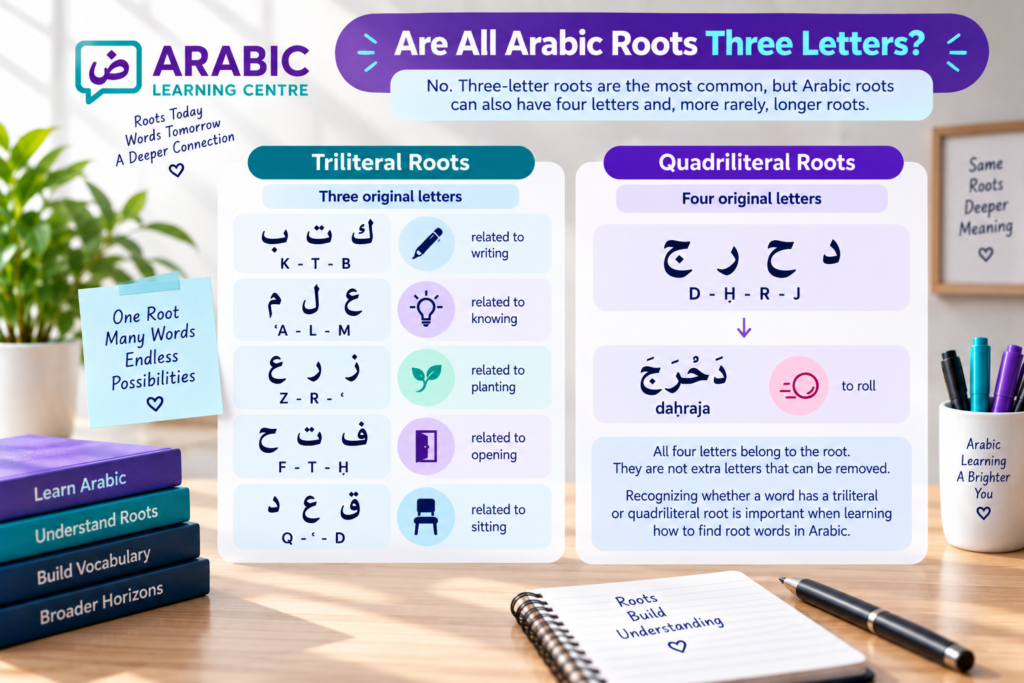
Triliteral Arabic Roots
A triliteral root contains three original letters.
Examples include:
ك ت ب — related to writing
ع ل م — related to knowing or knowledge
ز ر ع — related to planting
ف ت ح — related to opening
ق ع د — related to sitting
These roots can produce numerous nouns, verbs, adjectives, verbal nouns, and other derived forms.
Quadriliteral Arabic Roots
A quadriliteral root contains four original letters.
A common example is:
د ح ر ج
From it comes:
دَحْرَجَ (daḥraja) — to roll
Because all four letters belong to the lexical foundation, they cannot simply be removed as additional letters.
Recognizing whether a word has a triliteral or quadriliteral root is important when you are learning how to find root words in Arabic, because not every long-looking word is simply a three-letter root surrounded by extra letters.
How Arabic Root Words Create Word Families?
One of the most powerful characteristics of Arabic is its system of derivation, or الاشتقاق (al-ishtiqāq).
A root provides a core semantic idea, while different morphological patterns modify that idea to create different but related meanings.
Consider:
ز ر ع — Z-R-‘
The root is associated with planting or cultivation.
From it we can find words such as:
زَرَعَ (zara‘a) — he planted
زَارِع (zāri‘) — planter/farmer
زِرَاعَة (zirā‘ah) — agriculture/cultivation
مَزْرَعَة (mazra‘ah) — farm
مَزْرُوع (mazrū‘) — planted
Rather than memorizing each word without context, a learner who recognizes ز ر ع can see the relationship between them. The same principle applies to thousands of Arabic word families.
How Arabic Roots and Patterns Work Together?
Arabic morphology is largely built on the relationship between a root and a pattern, known in Arabic as وَزْن (wazn).
The root usually carries the central lexical idea, while the pattern helps shape that idea into a particular word with a specific grammatical or semantic function.
For example, consider the root:
ع — ل — م
This root is connected with the general idea of knowledge. When it appears in different patterns, it produces related but distinct words:
| Arabic Word | Transliteration | Meaning |
| عَلِمَ | ‘alima | he knew |
| عَالِم | ‘ālim | one who knows; scholar |
| مَعْلُوم | ma‘lūm | known |
| تَعْلِيم | ta‘līm | teaching / education |
| اِسْتِعْلَام | isti‘lām | inquiry |
Although the form of each word changes, the root letters ع ل م remain recognizable and continue to connect the words to the broader concept of knowledge.
This is why Arabic words are not usually formed by simply adding endings to an existing word. Instead, the root is placed into different morphological patterns, and each pattern contributes to the word’s structure and meaning.
Learning common Arabic roots and patterns together can therefore make it much easier to recognize related vocabulary and understand how new words are formed.
If you are developing your Arabic literacy more broadly, structured Arabic writing lessons can also help you become more comfortable recognizing letters and word structures in different written forms.

How to Find Root Words in Arabic Step by Step?
Learning how to find root words in Arabic requires more than simply removing the first or last letter of a word. Arabic morphology includes prefixes, suffixes, infixes, weak letters, doubled consonants, plurals, and other transformations.
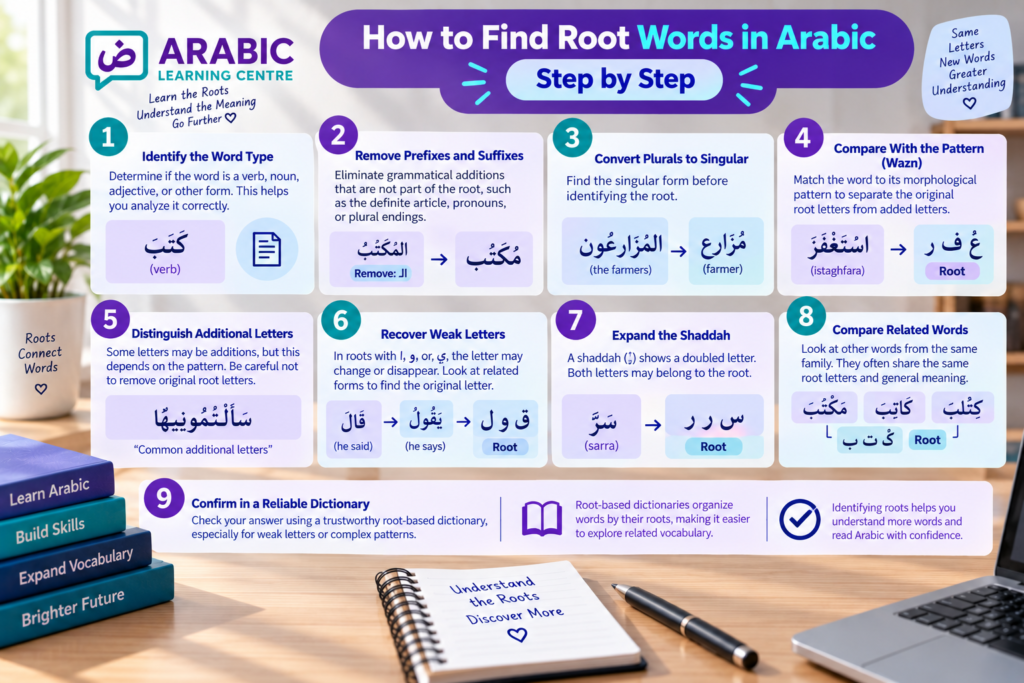
However, following a systematic process can make identifying Arabic roots much easier and more accurate.
1. Identify Whether the Arabic Word Is a Verb, Noun, Adjective, or Other Form
First, determine whether you are dealing with a verb, noun, adjective, plural, verbal noun, or another form. This matters because different word types follow different morphological patterns.
For verbs, it is often helpful to identify or return to the basic past-tense form. For nouns, you may need to remove definite articles, identify the singular form, or connect the noun to its related verb.
Do not begin by deleting every letter that looks unfamiliar; first understand the grammatical shape of the word.
2. Remove Prefixes and Suffixes That Are Not Part of the Arabic Root
An Arabic word may contain grammatical elements that do not belong to its lexical root. For example, the definite article الـ (al-) does not normally belong to the root.
Words may also contain attached pronouns, plural endings, feminine endings, conjunctions, or prepositions.
Removing these grammatical additions can make the underlying word easier to analyze. However, this should be done carefully because a letter that is an addition in one word may be an original root letter in another.
3. Convert Arabic Plural Nouns to the Singular Before Finding the Root
If you are analyzing a plural noun, finding its singular form can make the root much easier to identify.
For example, المزارعون (al-muzāri‘ūn) — the farmers can first be reduced to its singular form, مُزَارِع (muzāri‘) — farmer.
The singular word follows a derived pattern. Once the additional letters associated with that pattern are identified, the root becomes ز ر ع, which carries the central idea of planting or cultivation.
4. Compare the Arabic Word With Its Morphological Pattern (Wazn)
The Arabic morphological scale helps distinguish original root letters from letters introduced by a particular pattern.
For example, اِسْتَغْفَرَ (istaghfara) — he sought forgiveness follows the pattern اِسْتَفْعَلَ (istaf‘ala).
By comparing the word with its pattern, we can recognize ا س ت as letters introduced by the morphological pattern and isolate غ ف ر as the root. This method is much more reliable than removing letters at random.
Read also: Ikhfa Letters in Arabic – 15 Letters, Rules, Examples, and How to Remember Them
5. Distinguish Additional Letters From Original Arabic Root Letters
Traditional Arabic morphology identifies a group of letters that can frequently appear as additions. They are commonly remembered through the mnemonic سَأَلْتُمُونِيهَا.
However, being one of these possible additional letters does not automatically mean that a letter should be removed.
For instance, م can be an added letter in some morphological patterns, but it can also be an original root letter in other words. The word’s pattern and its related forms help determine whether a particular letter is original or additional.
6. Recover the Original Root Letter When ا، و، or ي Changes in a Weak Root
Some Arabic roots contain weak letters (حروف العلة), particularly ا، و، ي. These letters can change or disappear during conjugation and derivation, which means the visible form of a word may not show its root clearly.
For example, consider قَالَ (qāla) — he said. Looking only at the visible word might suggest the letters ق ا ل, but its present-tense form, يَقُولُ (yaqūlu) — he says, reveals the original و. The root is therefore ق و ل, not ق ا ل.
Looking at the present tense, verbal noun, or another related form can often help you recover an original weak letter that has changed in the form you are analyzing.
7. Expand the Shaddah to Identify Doubled Arabic Root Letters
A shaddah (ـّ) represents the doubling of a consonant, and in some words both occurrences of that consonant belong to the root.
For example, in سَرَّ (sarra), the doubled رّ represents two instances of ر. The root is therefore س ر ر. Treating the doubled consonant as only one root letter would result in an incorrect analysis.
Inside Our Classrooms
See how we make learning interactive and engaging! Watch a quick snippet of our live, conversational classes in action:
8. Compare Related Arabic Words to Identify Their Shared Root Letters
When the root is not immediately clear, compare the word with other words from the same family. Related Arabic words often preserve the same core letters even when their patterns, prefixes, suffixes, or internal vowels change.
Looking for letters that repeatedly appear across related words, while also considering their shared general meaning, can help reveal the underlying root.
This approach is particularly useful with weak roots, doubled roots, and highly derived words where the original root is less obvious from a single word.
9. Confirm the Arabic Root in a Reliable Root-Based Dictionary
After analyzing the word yourself, confirm your conclusion using a reliable Arabic dictionary. This is especially useful when dealing with weak letters, unusual morphological changes, or patterns that are difficult to recognize.
Many traditional Arabic dictionaries organize vocabulary according to roots rather than the exact surface form of a word. Learning how to identify Arabic roots therefore does more than improve your understanding of morphology; it also makes it easier to look up unfamiliar words and explore related vocabulary.
Developing this skill becomes increasingly important for students studying Classical Arabic, where recognizing morphological relationships can help with reading classical texts and understanding vocabulary in context.

Examples of How to Find Arabic Root Words
The easiest way to understand how to find Arabic root words is to apply the process to real examples. Each example below shows how to separate the root from the morphological pattern and recognize letters that have been added or changed.
Example 1: Finding the Root of اِسْتَغْفَرَ (Istaghfara)
اِسْتَغْفَرَ (istaghfara) means “he sought forgiveness.” It follows the morphological pattern اِسْتَفْعَلَ (istaf‘ala).
When we compare the word with the pattern, the structure becomes clearer:
اِسْتَفْعَلَ → اِسْتَغْفَرَ
The letters ا س ت belong to the derived pattern, while غ ف ر occupy the root positions. Therefore, the root is غ ف ر.
We can also see this root in غَفَرَ (ghafara) — he forgave. The root غ ف ر is generally associated with forgiveness and covering.
Example 2: Finding the Root of مُزَارِع (Muzāri‘)
مُزَارِع (muzāri‘) means “farmer.” The word follows the pattern مُفَاعِل (mufā‘il).
Compare the two forms:
مُفَاعِل → مُزَارِع
Here, م and ا are part of the morphological pattern, while the letters ز ر ع correspond to the root positions. The root is therefore ز ر ع.
The same root appears clearly in several related words: زَرَعَ (zara‘a) — planted, زِرَاعَة (zirā‘ah) — agriculture, مَزْرَعَة (mazra‘ah) — farm, and مَزْرُوع (mazrū‘) — planted.
Example 3: Finding the Weak Root of بَائِع (Bā’i‘)
بَائِع (bā’i‘) means “seller.” This example is slightly different because the word comes from a root containing a weak letter.
The related past-tense verb is بَاعَ (bā‘a) — he sold. Looking only at بَاعَ does not immediately reveal all three original root letters.
However, compare it with يَبِيعُ (yabī‘u) — he sells and بَيْع (bay‘) — sale/selling. These related forms reveal the original ي.
Therefore, the root is ب ي ع, not ب ا ع.
This is why checking related forms is important when a word contains ا، و، or ي.
Example 4: Finding the Doubled Root of سَرَّ (Sarra)
The word سَرَّ (sarra) demonstrates why you need to pay attention to the shaddah (ـّ) when finding Arabic roots.
The رّ does not represent only one consonant. The shaddah tells us that ر is doubled:
رّ = ر + ر
So when the word is analyzed at the root level, we get س ر ر.
Therefore, the root of سَرَّ is س ر ر. Ignoring the shaddah would cause you to miss one of the original root consonants.
Example 5: Finding the Root of اِنْدَمَجَ (Indamaja)
اِنْدَمَجَ (indamaja) means “merged” or “integrated.” It is a derived verb, so not every visible letter belongs to its lexical root.
After recognizing the derived structure and separating the additional elements, we arrive at the root د م ج.
A related word makes the connection easier to see: دَمْج (damj) — merging/integration.
Comparing اِنْدَمَجَ with دَمْج helps reveal the recurring letters د م ج and confirms the underlying root.
Example 6: Finding the Root of اِنْتَفَعَ (Intafa‘a)
اِنْتَفَعَ (intafa‘a) means “benefited.” Once we recognize it as a derived form, we can separate the additional letters from the lexical root.
The root is ن ف ع.
This becomes especially clear when we compare related words such as نَفْع (naf‘) — benefit, نَافِع (nāfi‘) — beneficial, and مَنْفَعَة (manfa‘ah) — benefit or advantage.
Across these different forms, the letters ن ف ع continue to appear and connect the words to the general idea of benefit or usefulness.
Example 7: Finding the Root of اِسْتَسْلَمَ (Istaslama)
اِسْتَسْلَمَ (istaslama) means “surrendered.” Like اِسْتَغْفَرَ, it contains the recognizable استـ structure of a derived Arabic verb.
Once the additional pattern letters are identified, the underlying root becomes س ل م.
The root س ل م appears across a wider family of Arabic words. Recognizing these recurring root letters makes it easier to see how apparently different words can belong to the same lexical family.
Read also: Iqlab Letters In Arabic – Rule, Pronunciation
Common Arabic Root Words and Their Families
Seeing several families together can help you become accustomed to the root system.
| Arabic Root | General Meaning | Example Words |
| ك ت ب | writing | كَتَبَ، كِتَاب، كَاتِب، مَكْتُوب، مَكْتَبَة |
| ع ل م | knowledge | عَلِمَ، عِلْم، عَالِم، مَعْلُوم، تَعْلِيم |
| ز ر ع | planting | زَرَعَ، زِرَاعَة، زَارِع، مَزْرَعَة، مَزْرُوع |
| ف ت ح | opening | فَتَحَ، فَتْح، فَاتِح، مَفْتُوح، مِفْتَاح |
| ن ف ع | benefit | نَفَعَ، نَفْع، نَافِع، مَنْفَعَة |
| غ ف ر | forgiveness | غَفَرَ، مَغْفِرَة، غَفُور، اِسْتَغْفَرَ |
| س ل م | safety/peace | سَلِمَ، سَلَام، سَلَامَة، اِسْتَسْلَمَ |
| ع م ل | work/action | عَمِلَ، عَمَل، عَامِل، مَعْمَل، اِسْتَعْمَلَ |
The English descriptions in the second column should be understood as broad semantic associations rather than exact definitions that every derived word must share.
Why Learning Arabic Root Words Makes Vocabulary Easier?
One of the biggest difficulties for Arabic learners is the apparent size of the vocabulary. Root recognition changes how you approach that vocabulary.
Imagine learning:
كَتَبَ
كِتَاب
كَاتِب
مَكْتُوب
مَكْتَب
مَكْتَبَة
as six completely unrelated vocabulary items That requires six separate memory associations.
Now imagine recognizing all of them as members of the ك ت ب family. Each new word has its own meaning, but it can be connected to a familiar lexical framework.
Over time, this creates a network of vocabulary rather than a long list of disconnected words.
How the Arabic Morphological Scale Helps Identify Root Letters?
The Arabic morphological scale (الميزان الصرفي) is one of the most useful tools for identifying root letters and distinguishing them from letters added through a morphological pattern.
For basic triliteral words, Arabic morphology uses ف ع ل as the standard reference letters. Here, ف represents the first root letter, ع represents the second, and ل represents the third.
For example, consider كَتَبَ (kataba) — he wrote, which follows the pattern فَعَلَ (fa‘ala):
كَتَبَ → فَعَلَ
The correspondence is ك = ف, ت = ع, and ب = ل. Therefore, the root is ك ت ب.
Now consider كَاتِب (kātib) — writer, which follows the pattern فَاعِل (fā‘il):
كَاتِب → فَاعِل
The letters ك ت ب still correspond to the three root positions ف ع ل, while the ا is an additional letter introduced by the pattern. The root therefore remains ك ت ب.
The same principle applies to مَكْتُوب (maktūb) — written, which follows the pattern مَفْعُول (maf‘ūl):
مَكْتُوب → مَفْعُول
Once again, ك ت ب occupy the three root positions, while م and و are part of the morphological pattern. The root remains ك ت ب.
By comparing Arabic words with their morphological patterns (أوزان), you can identify which letters belong to the original root and which have been added as part of the word’s structure.
This makes finding Arabic roots much more systematic and reliable than simply removing letters that appear to be additional.
How Arabic Root Words Make Dictionary Use Easier?
Understanding Arabic root words becomes especially valuable when you begin using traditional Arabic dictionaries. Instead of searching for every inflected or derived word exactly as it appears in a sentence, you may first need to identify its underlying root.
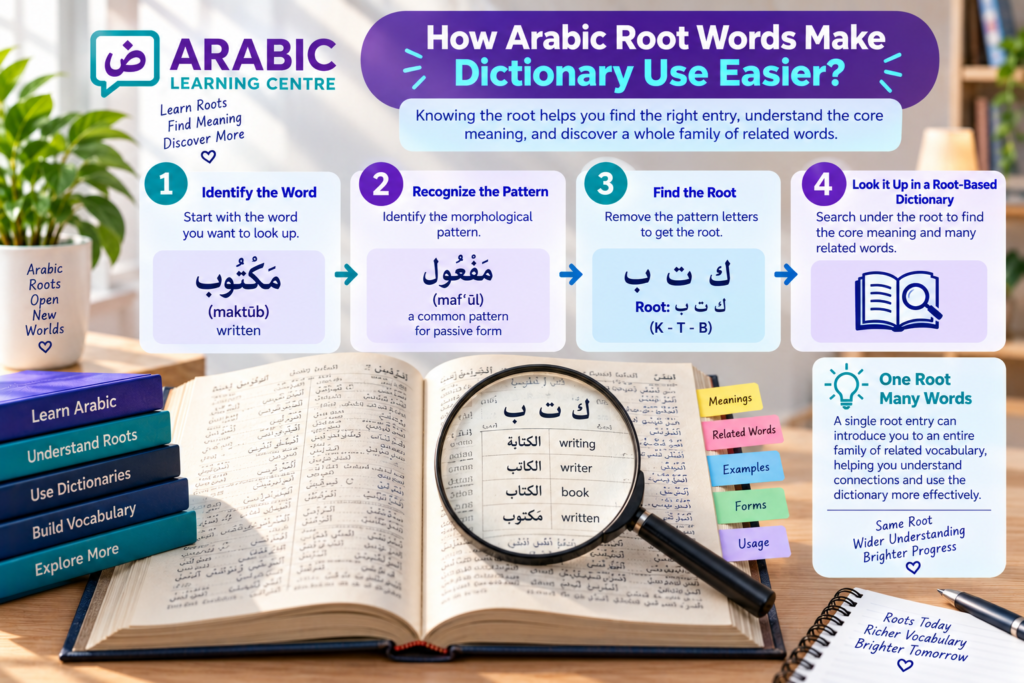
For example, suppose you encounter مَكْتُوب (maktūb) — written. By recognizing that it follows the pattern مَفْعُول (maf‘ūl), you can separate the letters introduced by the pattern and identify the root ك ت ب.
مَكْتُوب → مَفْعُول → Root: ك ت ب
You can then search under the appropriate root entry ك ت ب in a root-based Arabic dictionary to find the word’s core meanings and related derivations.
This makes dictionary use much more valuable than simply looking up a single word. One root entry can introduce you to an entire family of connected vocabulary, helping you see how different Arabic words share both root letters and related meanings.
Read also: Arabic Compound Letters – How Joined Arabic Letters Change Their Shape?
How Root Knowledge Improves Arabic Reading?
When beginners read Arabic, they often process a word letter by letter and then search their memory for an exact vocabulary match. Recognizing Arabic roots gives them another way to approach unfamiliar words.
For example, if you see مَعْلُومَات (ma‘lūmāt) — information, you may recognize the root ع ل م, which gives you a clue that the word is connected with knowledge or information.
Similarly, when you encounter مَكْتُوب (maktūb) — written, recognizing the root ك ت ب can immediately connect the word with the general idea of writing.
Root knowledge does not replace vocabulary learning, but it gives you an additional tool for recognizing connections and understanding unfamiliar words while reading Arabic.
If you are starting from the foundations, an Arabic course for non-Arabic speakers can help you build the reading, vocabulary, grammar, and morphological skills needed to recognize these relationships more confidently.

Common Mistakes When Finding Arabic Roots
Finding roots becomes easier with practice, but beginners often make several predictable mistakes.
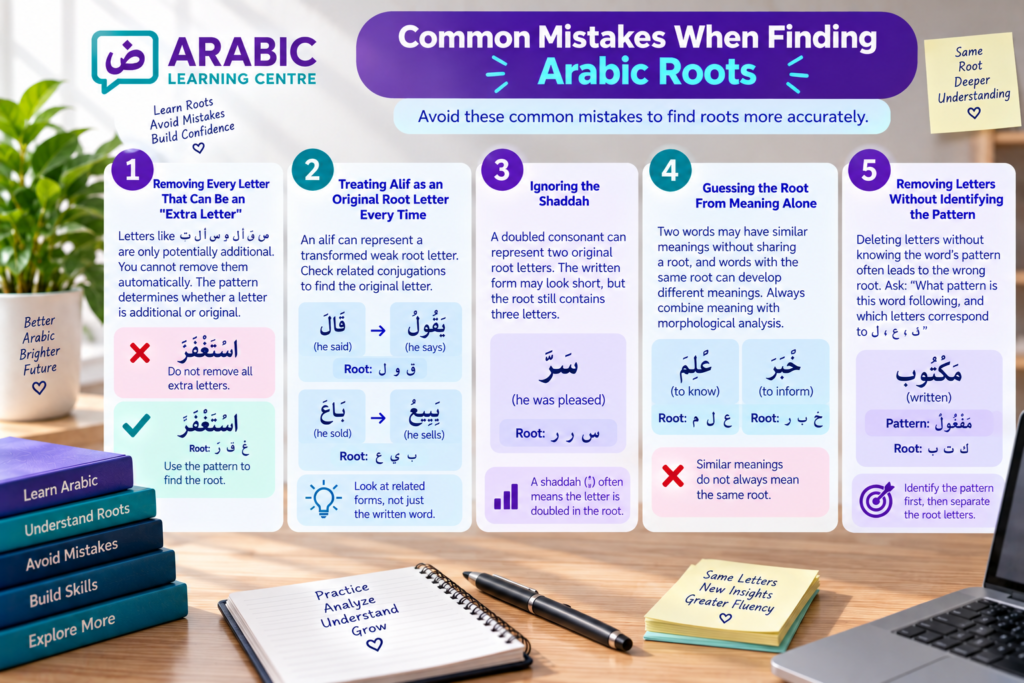
Removing Every Letter That Can Be an “Extra Letter”
Knowing سألتمونيها is useful, but those letters are only potentially additional. You cannot automatically remove every س, أ, ل, ت, م, و, ن, ي, or ه from a word. The pattern determines whether a particular letter is additional or original.
Treating Alif as an Original Root Letter Every Time
An alif can represent a transformed weak root letter. For example: قَالَ → يَقُولُ → ق و ل and: بَاعَ → يَبِيعُ → ب ي ع
Checking related conjugations is essential.
Ignoring the Shaddah
A doubled consonant can represent two original root letters.
For example: سَرَّ → س ر ر
The written form looks short, but the root still contains three consonants.
Guessing the Root From Meaning Alone
Two words may have similar meanings without sharing a root, while two words sharing a root may develop meanings that are less obviously connected.
Always combine meaning with morphological analysis.
Removing Letters Without Identifying the Pattern
This is one of the easiest ways to reach the wrong answer.
Rather than asking, “Which letters can I delete?” ask:
“What pattern is this word following, and which letters correspond to ف، ع، ل?”
That approach is much more reliable.
Read also: How Do U Say No in Arabic? – 15 Ways to Say No Naturally
Don’t Just Take Our Word For It
Take a look inside our vibrant classes and see our students and teachers in action. Click below to watch our classroom experience:
Learn Arabic Roots in Context With Arabic Learning Centre
Understanding Arabic root words becomes much easier when you learn them as part of real vocabulary, grammar, reading, and word formation rather than memorizing roots in isolation.
At Arabic Learning Centre, you can develop these skills through structured Arabic learning that helps you recognize word patterns, understand related vocabulary, and become more confident when reading and analyzing unfamiliar Arabic words.
Whether you are building your foundations or developing a deeper understanding of the language, learning Arabic in context can help turn concepts such as roots and patterns into practical skills you can actually use.
Book your free trial lesson with Arabic Learning Centre and start learning with expert guidance.
Courses We Offer:
- Online Arabic Course
- Classical arabic course
- Modern Standard Arabic Course
- Fusha Arabic Course
- Learn Saudi Arabic
- Arabic Course for Beginners
- Arabic Classes for Adults
- Arabic Classes for Ladies
- Advanced Arabic Course
- Intensive Arabic Course

Conclusion
Arabic root words provide a practical way to understand how much of Arabic vocabulary is connected.
By learning to identify root letters, recognize morphological patterns, account for weak and doubled letters, and compare related words, you can approach unfamiliar vocabulary more systematically.
Root knowledge does not replace vocabulary, grammar, or context, but it can make all three easier to navigate. With regular practice, you can begin seeing Arabic words not as isolated forms to memorize, but as members of larger, connected word families.
As your familiarity with common roots and patterns grows, this process can become increasingly natural.
You may start recognizing connections between words while reading, identifying possible meanings before checking a dictionary, and remembering new vocabulary through words you already know. Th
Frequently Asked Questions About Arabic Root Words
What Are Arabic Root Words?
Arabic root words are the lexical foundations from which related Arabic words are derived. A root consists of original letters that carry a central semantic association shared, to varying degrees, across a family of words.
How Many Letters Are in an Arabic Root?
Most commonly studied Arabic roots contain three letters. These are called triliteral roots. Arabic also has quadriliteral roots containing four original letters, along with less common longer roots.
What Are Arabic Root Letters?
Arabic root letters are the original consonants that form the lexical foundation of a word. For example, the root letters of كِتَاب (kitāb) are ك ت ب.
How Do You Find Root Words in Arabic?
To learn how to find root words in Arabic, identify the word’s grammatical form and morphological pattern, remove genuine affixes and pattern additions, return plurals to singular forms when necessary, restore changed weak letters, account for doubled consonants, and compare the result with related words. Finally, confirm uncertain roots in a reliable dictionary.
Why Are Arabic Roots Important?
Arabic roots help learners recognize relationships between words, expand vocabulary more efficiently, understand morphology, use Arabic dictionaries, and analyze unfamiliar vocabulary.
Does Every Word With the Same Root Have the Same Meaning?
No. Words derived from one root may share a broad semantic relationship, but each word can have a distinct lexical meaning. Context and morphological pattern are necessary for understanding the precise meaning.