 Learn Arabic

The Iqlab letters in Arabic are easier to memorize than the letters of most other Noon Sakinah and Tanween rules because Iqlab has only one letter: Baa (ب).
Whenever Noon Sakinah نْ or Tanween ـً، ـٍ، ـٌ is followed by Baa, the Noon sound is converted into a concealed Meem (م) with Ghunnah. This nasal sound is maintained for approximately two counts before moving smoothly into Baa.
Although the basic rule is simple, correct Iqlab depends on more than recognizing the letter. You also need to understand how the converted Meem is pronounced, how Iqlab appears in the Mushaf, and how to distinguish it from Ikhfa and other Tajweed rules.
What Is Iqlab in Tajweed?
Iqlab (الإقلاب) literally means conversion or changing something from one state into another. In Tajweed, it refers specifically to converting Noon Sakinah or Tanween into a concealed Meem when Baa (ب) comes immediately after it.
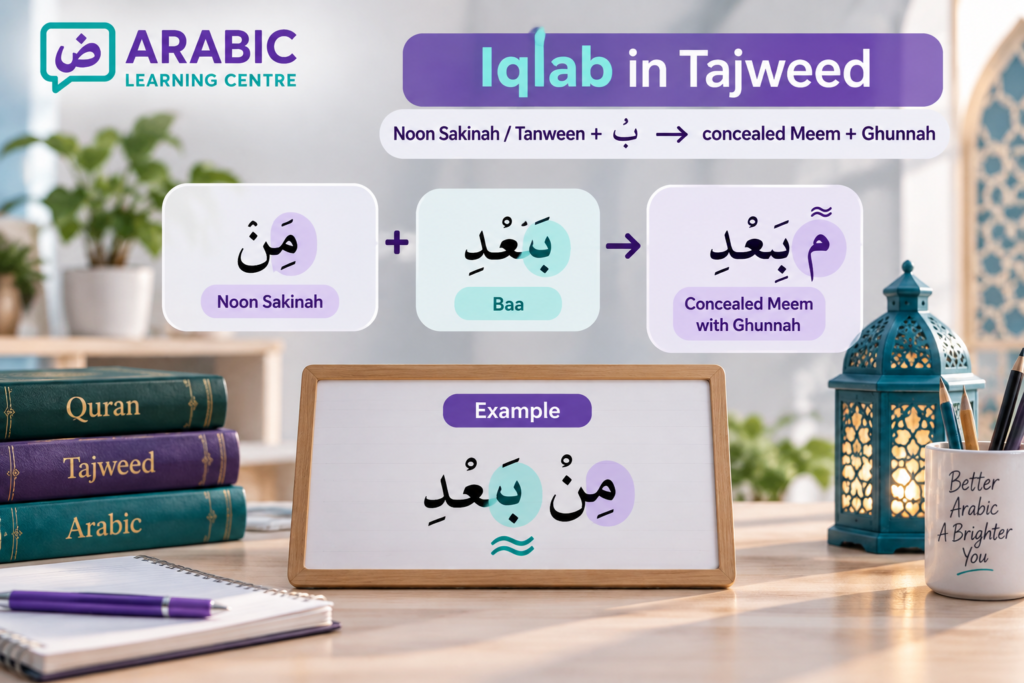
The basic rule can be summarized as:
Noon Sakinah / Tanween + ب → concealed Meem + Ghunnah
The Noon is therefore not pronounced as a clear ن, nor is it simply merged into Baa. Its sound changes into a concealed Meem while the Ghunnah remains for approximately two counts.
For example: مِنْ بَعْدِ
Although Noon is written in مِنْ, it is not pronounced as a clear Noon when connected to بَعْدِ. Iqlab changes it in pronunciation into a concealed Meem with Ghunnah before the Baa.
What Are the Iqlab Letters in Arabic?
Unlike Izhar, Idgham, and Ikhfa, there is only one Iqlab letter in Arabic: ب — Baa
Whenever Baa immediately follows Noon Sakinah or Tanween during connected recitation, Iqlab applies.
This makes Iqlab particularly easy to recognize:
| Tajweed Rule | Trigger Letters |
| Izhar | ء، هـ، ع، ح، غ، خ |
| Idgham | ي، ر، م، ل، و، ن |
| Iqlab | ب |
| Ikhfa | ت، ث، ج، د، ذ، ز، س، ش، ص، ض، ط، ظ، ف، ق، ك |
Building familiarity with Arabic letters and their sound relationships makes patterns like this much easier to recognize. Learners who are still developing that foundation can strengthen it through Arabic vocabulary learning, where recognizing words and letter patterns becomes part of broader language development.

Why Does Baa Cause Iqlab?
The reason Baa triggers Iqlab becomes clearer when you look at how Noon, Meem, and Baa are articulated.
- Noon (ن): Pronounced primarily with the tongue and carries a nasal quality.
- Meem (م): Pronounced with the lips and also carries Ghunnah.
- Baa (ب): Pronounced with the lips.
Moving directly from a clear Noon to Baa requires a noticeable shift from the tongue to the lips. Meem acts as a natural phonetic bridge because it shares the Ghunnah of Noon while sharing the lip articulation of Baa.
Noon (ن) → Meem (م) → Baa (ب)
For this reason, when Noon Sakinah or Tanween comes before Baa, the Noon is converted into a concealed Meem with Ghunnah, creating a smoother transition into the Baa.
When Does Iqlab Occur?
Iqlab occurs whenever Noon Sakinah or Tanween is immediately followed by Baa (ب) in connected recitation.
Depending on the form involved, the rule may appear within one word or across two words.
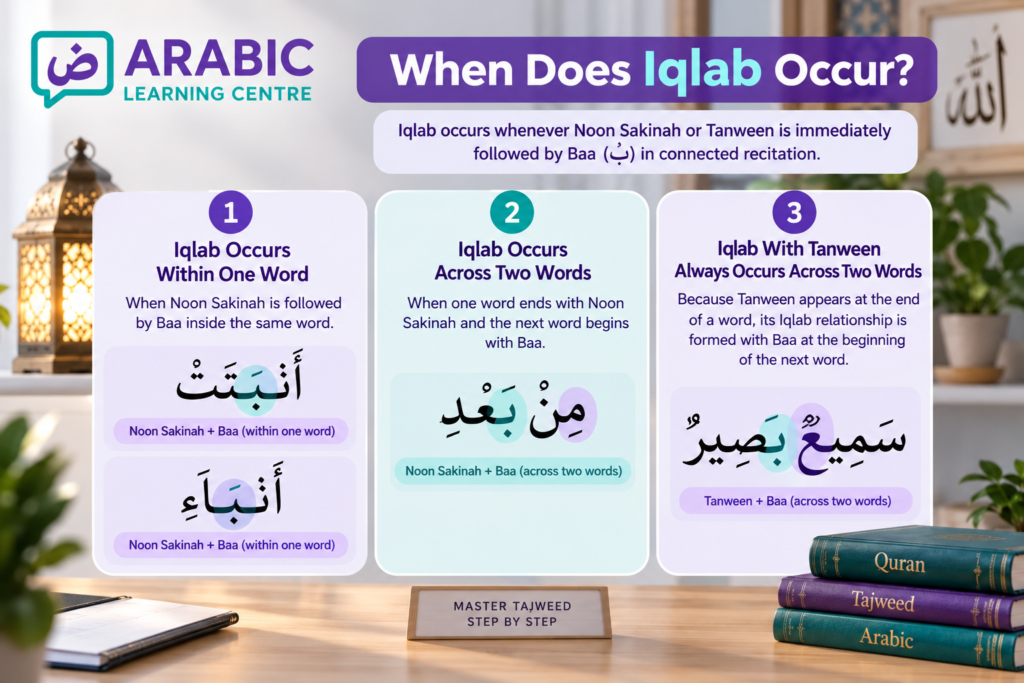
1. Iqlab Occurs Within One Word When Noon Sakinah Is Followed by Baa
Noon Sakinah may be followed directly by Baa inside the same Quranic word.
For example: أَنبَتَتْ
In أَنبَتَتْ, Noon Sakinah is followed by ب, so the Noon is converted into a concealed Meem with Ghunnah.
Another example is: أَنبَاءِ
The same pattern appears here: نْ + ب, so Iqlab is applied within the word.
2. Iqlab Occurs Across Two Words When Noon Sakinah Is Followed by Baa
Iqlab can also occur when one word ends with Noon Sakinah and the following word begins with Baa.
For example: مِنْ بَعْدِ
The Noon Sakinah at the end of مِنْ is followed by Baa in بَعْدِ, so the Noon changes into a concealed Meem with Ghunnah.
3. Iqlab With Tanween Always Occurs Across Two Words Before Baa
Because Tanween appears at the end of a word, its Iqlab relationship is formed with Baa at the beginning of the next word.
For example: سَمِيعٌ بَصِيرٌ
The Tanween at the end of سَمِيعٌ is followed by Baa in بَصِيرٌ, so the Tanween’s Noon sound is converted into a concealed Meem with Ghunnah.
How Should Iqlab Be Pronounced?
Correct Iqlab combines three elements: converting the Noon into Meem, concealing the converted Meem, and maintaining Ghunnah for approximately two counts before Baa.
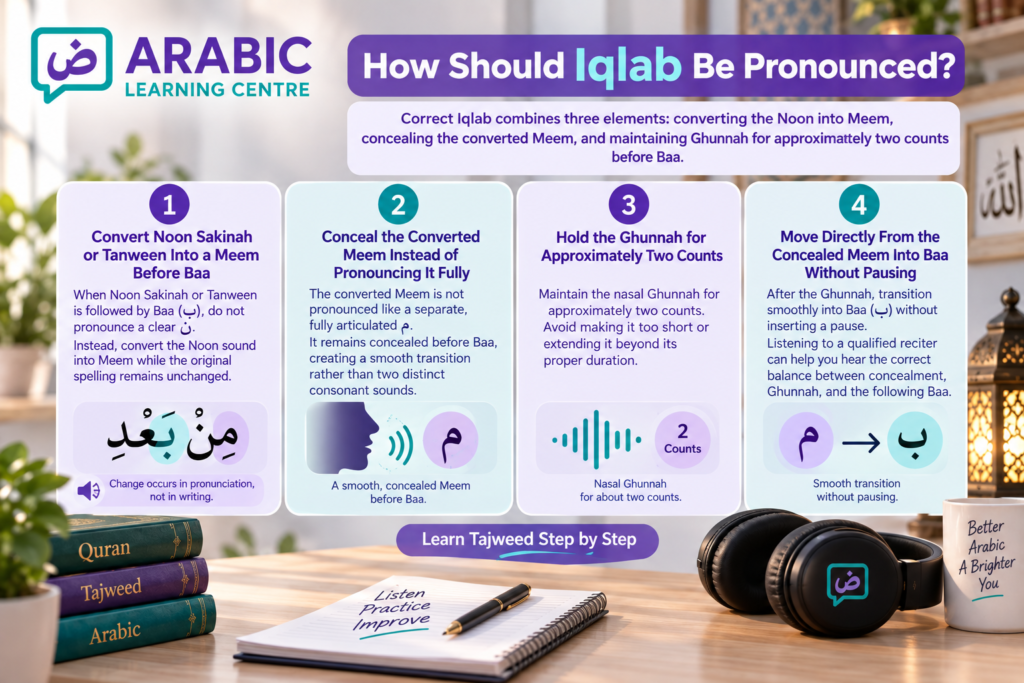
1. Convert Noon Sakinah or Tanween Into a Meem Before Baa
When Noon Sakinah or Tanween is followed by Baa (ب), do not pronounce a clear ن. Instead, convert the Noon sound into Meem while the original spelling remains unchanged.
The change occurs in pronunciation, not in writing.
2. Conceal the Converted Meem Instead of Pronouncing It Fully
The converted Meem is not pronounced like a separate, fully articulated م. It remains concealed before Baa, creating a smooth transition rather than two distinct consonant sounds.
3. Hold the Ghunnah of the Converted Meem for Approximately Two Counts
Maintain the nasal Ghunnah for approximately two counts. Avoid making it too short or extending it beyond its proper duration.
4. Move Directly From the Concealed Meem Into Baa Without Pausing
After the Ghunnah, transition smoothly into Baa (ب) without inserting a pause. Listening to a qualified reciter can help you hear the correct balance between concealment, Ghunnah, and the following Baa.
10 Examples of Iqlab in the Quran
Studying 10 examples of Iqlab in the Quran makes the rule easier to recognize during actual recitation.
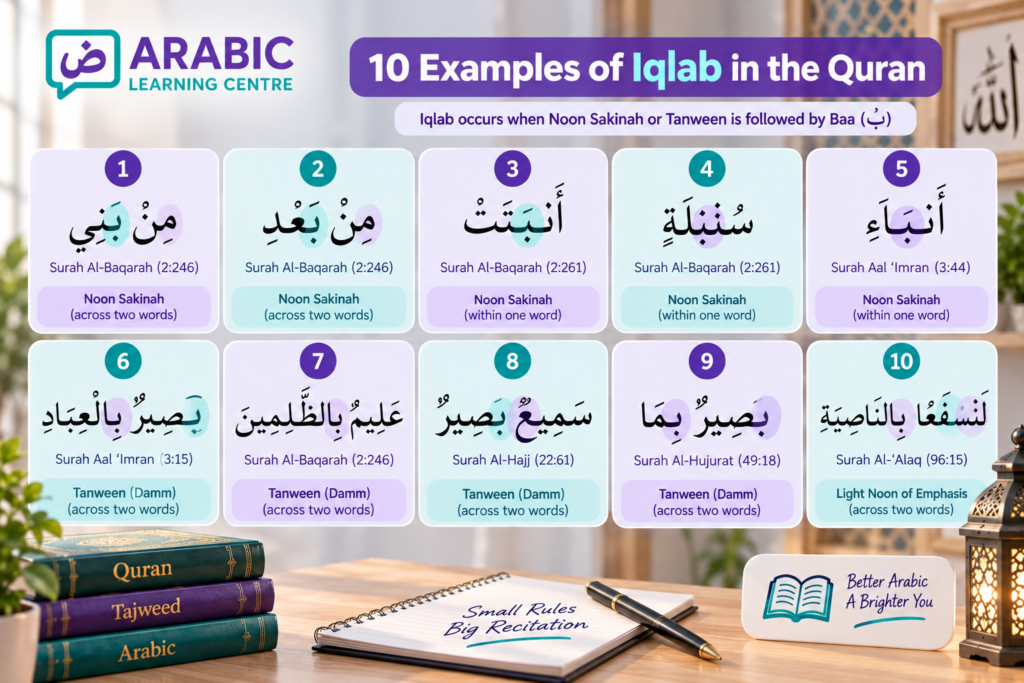
The examples below cover its main forms: Noon Sakinah before Baa within one word, Noon Sakinah before Baa across two words, and Tanween before Baa.
1. مِن بَنِي Shows Iqlab Between Two Words
This example shows how Iqlab connects the ending of one word with the beginning of the next.
Allah says:
أَلَمْ تَرَ إِلَى الْمَلَإِ مِن بَنِي إِسْرَائِيلَ مِن بَعْدِ مُوسَىٰ
“Have you not seen the chiefs of the Children of Israel after Moses?”
In مِن بَنِي, Noon Sakinah at the end of مِن is followed by Baa at the beginning of بَنِي, so the Noon changes into a concealed Meem with Ghunnah.
2. مِن بَعْدِ Is Another Two-Word Iqlab Example
This phrase gives another simple example of Noon Sakinah meeting Baa across a word boundary.
Allah says:
مِن بَعْدِ مُوسَىٰ
Here, نْ in مِن meets ب in بَعْدِ, causing Iqlab during connected recitation.
3. أَنبَتَتْ Shows Iqlab Within a Single Word
Iqlab is not limited to separate words, as this example shows the rule occurring inside one word.
Allah says:
كَمَثَلِ حَبَّةٍ أَنبَتَتْ سَبْعَ سَنَابِلَ
“Like a grain that sprouts seven ears.”
In أَنبَتَتْ, Noon Sakinah is immediately followed by Baa within the same word, so the Noon is converted into a concealed Meem.
4. سُنبُلَةٍ Contains Noon Sakinah Before Baa Within One Word
This is another useful example for practicing Iqlab without a word boundary between Noon and Baa.
Allah says:
فِي كُلِّ سُنبُلَةٍ مِّائَةُ حَبَّةٍ
“In every ear there are a hundred grains.”
The sequence نْ + ب occurs inside سُنبُلَةٍ, so Iqlab is applied with Ghunnah.
5. أَنبَاءِ Is Another Within-Word Example of Iqlab
Here, the Iqlab pattern is easy to identify because Noon Sakinah and Baa appear next to each other within the same word.
Allah says:
ذَٰلِكَ مِنْ أَنبَاءِ الْغَيْبِ نُوحِيهِ إِلَيْكَ
“This is from the news of the unseen which We reveal to you.”
In أَنبَاءِ, Noon Sakinah comes directly before Baa within the word, triggering Iqlab.
Read also: Ikhfa Letters in Arabic – 15 Letters, Rules, Examples, and How to Remember Them
Inside Our Classrooms
See how we make learning interactive and engaging! Watch a quick snippet of our live, conversational classes in action:
6. بَصِيرٌ بِالْعِبَادِ Shows Iqlab With Damm Tanween
This example moves from Noon Sakinah to Tanween and shows how the same Iqlab rule applies.
Allah says:
وَاللَّهُ بَصِيرٌ بِالْعِبَادِ
“And Allah is All-Seeing of His servants.”
The Damm Tanween in بَصِيرٌ is followed by Baa in بِالْعِبَادِ. Its Noon sound therefore changes into a concealed Meem with Ghunnah.
7. عَلِيمٌ بِالظَّالِمِينَ Shows Tanween Followed by Baa
The same pattern appears whenever Tanween at the end of a word meets Baa at the beginning of the next.
Allah says:
وَاللَّهُ عَلِيمٌ بِالظَّالِمِينَ
“And Allah is All-Knowing of the wrongdoers.”
The Tanween at the end of عَلِيمٌ meets Baa at the beginning of بِالظَّالِمِينَ, so Iqlab occurs between the two words.
8. سَمِيعٌ بَصِيرٌ Is a Clear Tanween Iqlab Example
This short Quranic phrase is particularly useful for hearing how Tanween changes before Baa.
Allah says:
وَأَنَّ اللَّهَ سَمِيعٌ بَصِيرٌ
“And Allah is All-Hearing, All-Seeing.”
In سَمِيعٌ بَصِيرٌ, the Damm Tanween is immediately followed by Baa (ب). During connected recitation, the Tanween’s Noon sound changes into a concealed Meem with Ghunnah.
9. بَصِيرٌ بِمَا تَعْمَلُونَ Shows Tanween Before Baa
This example reinforces the same Tanween pattern in a longer Quranic phrase.
Allah says:
وَاللَّهُ بَصِيرٌ بِمَا تَعْمَلُونَ
“And Allah is All-Seeing of what you do.”
In بَصِيرٌ بِمَا, the Tanween on بَصِيرٌ is followed by Baa in بِمَا, so Iqlab applies between the two words.
10. لَنَسْفَعًا بِالنَّاصِيَةِ Is a Special Iqlab Case
The final example is different from the previous patterns because it involves the light Noon of emphasis rather than ordinary Tanween.
Allah says:
كَلَّا لَئِن لَّمْ يَنتَهِ لَنَسْفَعًا بِالنَّاصِيَةِ
“But no! If he does not desist, We will certainly drag him by the forelock.”
The ending of لَنَسْفَعًا represents the light Noon of emphasis rather than ordinary grammatical Tanween. When connected to the following Baa in بِالنَّاصِيَةِ, it takes the Iqlab ruling.
Together, these Iqlab examples show the different forms learners need to recognize: Noon Sakinah + Baa within one word, Noon Sakinah + Baa across two words, and Tanween + Baa across two words.
How Is Iqlab Marked in the Mushaf?
The Uthmani Mushaf provides a useful visual sign for Iqlab, allowing readers to recognize the rule before they pronounce the word.
A Small Meem Above Noon Sakinah Indicates Iqlab Before Baa
When you see a small Meem (م) associated with Noon Sakinah before Baa, it signals that the written Noon changes in pronunciation.
The Noon is not pronounced clearly. Instead, it is converted into a concealed Meem with Ghunnah before moving into Baa (ب). The original Noon remains part of the written word; only its pronunciation changes.
A Small Meem With Tanween Signals Iqlab Before Baa
The Mushaf also provides a visual indication when Tanween is followed by Baa, helping readers recognize the same sound conversion across two words.
In this case, the Tanween’s Noon sound changes into a concealed Meem with Ghunnah before the following Baa.
While these Mushaf signs are helpful, learners should not depend on visual notation alone. The underlying rule is always:
Noon Sakinah or Tanween + ب = Iqlab
Becoming more comfortable with Arabic script also makes Quranic notation easier to recognize. Structured Arabic writing practice can help learners become more familiar with letter shapes, diacritics, and written Arabic patterns.

Read also: Arabic Compound Letters – How Joined Arabic Letters Change Their Shape?
What Is the Difference Between Iqlab With Noon Sakinah and Tanween?
The pronunciation rule is the same in both cases, but their positions differ.
| Form | Where Iqlab Can Occur | Example |
| Noon Sakinah | Within one word | أَنبَتَتْ |
| Noon Sakinah | Between two words | مِن بَعْدِ |
| Tanween | Between two words | بَصِيرٌ بِالْعِبَادِ |
Noon Sakinah can occur in the middle or at the end of a word, so its Iqlab may happen within one word or across two words.
Tanween, however, is a word-ending feature. Therefore, its Iqlab relationship with Baa occurs between two words during connected recitation.
Why Does Iqlab Not Apply When You Stop on Tanween?
Iqlab with Tanween only applies when the recitation is connected to a following Baa (ب). This is because the Tanween carries an /n/ sound during wasl (connected recitation), allowing that sound to be converted into a concealed Meem before Baa.
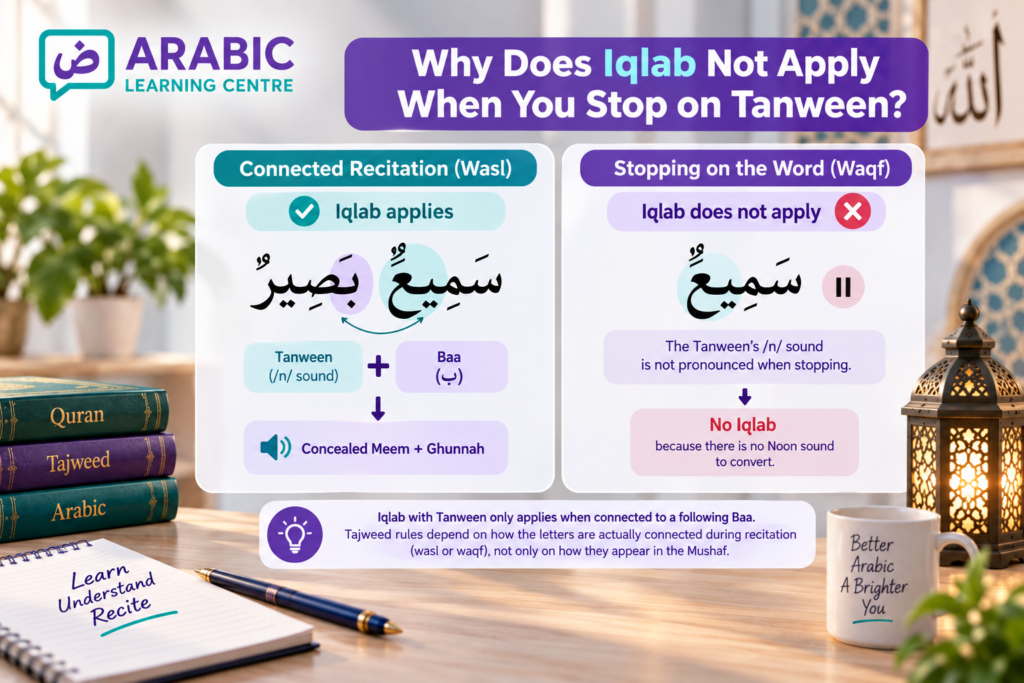
When you make waqf (stop) on the word, the Tanween’s /n/ sound is no longer pronounced. Since there is no Noon sound continuing into the following Baa, there is nothing to convert into Meem, and Iqlab does not occur.
For example, in سَمِيعٌ بَصِيرٌ, Iqlab applies when the two words are recited continuously because the Tanween in سَمِيعٌ meets the Baa in بَصِيرٌ. If the reciter stops on سَمِيعٌ, however, the connection with Baa is broken, so the Iqlab rule is not applied at that point.
This distinction shows why Tajweed rules are based not only on the letters visible in the Mushaf but also on how those letters are actually connected during recitation.
When identifying Iqlab with Tanween, learners should therefore check whether they are reading in wasl or making waqf before the following Baa.
What Is the Difference Between Iqlab and Ikhfa Shafawi?
Iqlab and Ikhfa Shafawi may sound similar because both involve a concealed Meem before Baa (ب). The key difference is the letter that comes before Baa and whether a sound conversion is required.
Iqlab Converts Noon Sakinah or Tanween Into Meem Before Baa
Iqlab begins with Noon Sakinah or Tanween, not an original Meem.
Noon Sakinah or Tanween + ب → Iqlab
When Baa follows, the Noon sound is converted into a concealed Meem and accompanied by Ghunnah. In other words, conversion is an essential part of Iqlab.
Ikhfa Shafawi Conceals an Existing Meem Sakinah Before Baa
Ikhfa Shafawi begins with a Meem that is already present in the original word.
Meem Sakinah (مْ) + ب → Ikhfa Shafawi
Because the Meem already exists, there is no conversion from Noon. The Meem Sakinah is simply concealed before Baa with Ghunnah.
The easiest way to distinguish the two is to look at the original sound: Iqlab starts with Noon Sakinah or Tanween and changes it into Meem, while Ikhfa Shafawi starts with an actual Meem Sakinah and only conceals it.
Three Errors That Make Iqlab Sound Wrong
Because Iqlab has only one trigger letter, most mistakes happen during pronunciation rather than recognition. These three errors can prevent the correct conversion and Ghunnah from being heard.
1. Pronouncing a Clear Noon Instead of Converting It Into Meem
Reading مِن بَعْدِ with a clear Noon means the essential sound conversion of Iqlab has not occurred.
The Noon should not remain audible as a complete ن. It should change into a concealed Meem before Baa.
2. Pronouncing the Converted Meem Too Clearly Instead of Concealing It
Another common mistake is turning the converted Meem into a separate, strongly articulated sound before Baa.
The Meem should remain concealed and flow naturally into Baa (ب) rather than sounding like an additional distinct letter.
3. Making the Iqlab Ghunnah Too Short or Longer Than Two Counts
The Ghunnah is an essential part of Iqlab and should be maintained for approximately two counts.
Making it too short can weaken the nasal quality of the rule, while overstretching it makes the pronunciation unnatural and disrupts the flow into Baa.
How to Practice Iqlab Until It Becomes Natural?
Iqlab is easy to memorize because it has only one trigger letter, but applying it naturally requires repeated recognition, listening, and pronunciation practice.
1. Memorize Baa as the Only Iqlab Letter and Recognize It Instantly
The first goal is to identify Iqlab without having to stop and think about the rule each time.
نْ / Tanween + ب = Iqlab
Train your eyes to notice Baa (ب) immediately after Noon Sakinah or Tanween so you can prepare for the sound change before pronouncing it.
2. Practice Converting Noon Into a Concealed Meem Within One Word
Start with words where Noon Sakinah and Baa appear together, as this makes the Iqlab pattern easy to recognize.
Practice:
أَنبَتَتْ
أَنبَاءِ
سُنبُلَةٍ
Focus on avoiding a clear Noon while maintaining the concealed Meem and Ghunnah before Baa.
3. Practice Iqlab Across Two Words Without Pausing Between Them
Once within-word examples feel comfortable, practice maintaining the same pronunciation when Noon Sakinah or Tanween and Baa appear in separate words.
Use examples such as:
مِن بَعْدِ
مِن بَنِي
سَمِيعٌ بَصِيرٌ
Recite each pair continuously so the word boundary does not interrupt the Iqlab sound.
4. Apply Iqlab Naturally While Reciting Complete Quranic Verses
Move beyond isolated words once you can pronounce the basic combinations correctly.
Read complete verses containing Iqlab and try to identify the rule without interrupting your recitation. This trains you to recognize the small Meem and apply the correct Ghunnah while maintaining the natural flow of the verse.
5. Compare Your Iqlab Pronunciation With a Qualified Reciter or Teacher
Listening helps you notice details of Iqlab that are difficult to understand from written explanations alone.
Compare your recitation with a skilled Qari, and when possible, receive direct correction from a qualified teacher. Feedback can reveal whether you are keeping the Noon too clear, making the converted Meem too strong, or holding the Ghunnah for the wrong duration.
Read also: Arabic Root Words – A Complete Guide
Don’t Just Take Our Word For It
Take a look inside our vibrant classes and see our students and teachers in action. Click below to watch our classroom experience:
Build Stronger Arabic Skills With Arabic Learning Centre
Understanding the Iqlab letters in Arabic becomes easier when Arabic letters, vowels, Tanween, and pronunciation patterns already feel familiar.
A strong language foundation allows learners to recognize Tajweed patterns more naturally rather than memorizing every rule in isolation.
Arabic Learning Centre supports learners from different ages and language backgrounds as they develop their Arabic through reading, listening, pronunciation, vocabulary, writing, and comprehension.
Structured practice can help learners become more confident when encountering Arabic both inside and outside Quranic study.
Start your free trial with Arabic Learning Centre today and build greater confidence in reading, pronunciation, and understanding Arabic.
Courses We Offer:
- Online Arabic Course
- Classical arabic course
- Modern Standard Arabic Course
- Fusha Arabic Course
- Learn Saudi Arabic
- Arabic Course for Beginners
- Arabic Classes for Adults
- Arabic Classes for Ladies
- Advanced Arabic Course
- Intensive Arabic Course

Conclusion
Learning the Iqlab letters in Arabic begins with one simple fact: Baa (ب) is the only letter that triggers Iqlab.
When it follows Noon Sakinah or Tanween, the Noon sound changes into a concealed Meem accompanied by Ghunnah for approximately two counts.
Correct Iqlab is not only about recognizing Baa. Learners also need to control the conversion, maintain the Ghunnah, recognize the small Meem in the Mushaf, and distinguish Iqlab from related rules such as Ikhfa Shafawi.
Practicing authentic Iqlab examples from the Quran is the most effective way to make the rule familiar. With regular listening, repetition, and correction, the conversion can gradually become automatic during Quran recitation.
Frequently Asked Questions About Iqlab Letters in Arabic
How Many Iqlab Letters Are There in Arabic?
There is only one Iqlab letter: Baa (ب). When Baa follows Noon Sakinah or Tanween, the Noon sound is converted into a concealed Meem with Ghunnah.
What Is Iqlab in Tajweed?
Iqlab is the conversion of Noon Sakinah or Tanween into a concealed Meem when followed by Baa (ب). The converted sound is accompanied by Ghunnah for approximately two counts.
What Is the Letter of Iqlab?
The only letter of Iqlab is ب (Baa). No other Arabic letter triggers this particular Noon Sakinah and Tanween rule.
How Long Is the Ghunnah in Iqlab?
The Ghunnah in Iqlab is maintained for approximately two counts. Its duration should remain balanced with the tempo of the recitation.
Can Iqlab Occur Within One Word?
Yes. When Noon Sakinah is followed by Baa within the same word, Iqlab applies. Examples include أَنبَتَتْ and أَنبَاءِ.
Can Iqlab Occur Between Two Words?
Yes. For example, in مِن بَعْدِ, Noon Sakinah appears at the end of the first word and Baa begins the next word, so Iqlab applies during connected recitation.
Related Articles
Learn Arabic